Feeds:
Posts
Comments

Posts Tagged ‘safety’

I have received the letter from Chairmen Waxman and Stupak of the of the House Committee on Energy and Commerce, requesting that the CSB investigate the BP Deepwater Horizon blowout.  It is my desire that the CSB do everything it can to facilitate the request and to undertake the investigation and determine what factors led to the explosion and failure of the blowout prevention system. ~John Bresland, CSB Chairman

In addition to the House and Senate Hearings, this would bring the number of official investigations to four:

  1. MMS-Coast Guard investigation required by the OCS Lands Act
  2. National Academy review requested by the Department of the Interior
  3. National Commission established by the President
  4. Chemical Safety Board review requested by the House Committee on Energy and Commerce

I have long advocated an independent investigation capability for major OCS incidents and recommended a special commission in my testimony before the Senate Committee on Energy and Natural Resources Committee on May 11.  However, is four official reviews too many?  The MMS-CG investigation is well underway and is required by statute, but the 3 independent reviews have yet to begin.  Perhaps these efforts can be consolidated.  If not, their respective missions must be very clearly defined.  Otherwise, there is a significant risk of gaps, confusion, and unnecessary overlap.  We need to make sure that each group knows their role and is staffed to obtain the information needed to prevent the recurrence of other offshore tragedies, in the US and elsewhere.
Read Full Post »

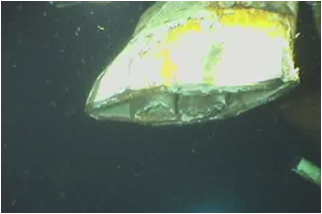
When they sheared the riser prior to installing the LMRP cap, the video clearly shows two segments of sheared drill pipe inside the riser.  How that happened is a mystery.  Did the explosion break the work string into multiple segments which fell back toward the BOP?

Read Full Post »


Vancouver, BC, Canada


The program for the International Regulators’ Offshore Safety Conference has been updated to include keynote presentations on the Montara and Macondo blowouts, and roundtable sessions that will address the lessons learned and how they should be applied by operators, contractors, and regulators.  The presentations, discussions, and debates are sure to be thought provoking and informative.  If you would like to participate, visit the conference website for more information.

Read Full Post »

Dette kan skje igjen (This could happen again)~ Magne Ognedal, Director General, Petroleum Safety Authority Norway

Magne’s quote in the Stavanger Aftenblad acknowledges that tragic accidents like the Macondo/Horizon blowout or Alexander Kielland sinking could happen again (see English translation of full article by BOE Europe Chief Odd Finnestad).  Magne goes on to say:

We must appreciate there are risks associated with our petroleum activities, and in our yearly risk assessments we attempt to put in concrete terms what those inherent risks are.  It is up to our national political system to determine whether this risk picture should be accepted or not.

and

We must endeavor to learn from whatever happens around the world, and if there is something that is also relevant to Norway we must apply those lessons, both regulators and industry

Industry and government officials would be wise to follow Magne’s lead and avoid “can’t happen here” statements.  A few of these statements were made in the US after the Montara (Timor Sea) blowout, and we know how that worked out.

Some very experienced and capable offshore managers have had “there but for the grace of God go I” moments in the wake of this disaster.  They know that this is not the time for boasting, piling-on, or schadenfreude.  Like Magne, real leaders are focused on monitoring the investigations, studying the findings and recommendations, and applying the lessons as necessary to further reduce their operating risks and the risks of others who conduct offshore oil and gas operations.

Read Full Post »

Jason Mathews

Kudos to Jason Mathews, David Dykes, John McCarroll, and their Coast Guard colleagues for their excellent work on the MMS-USCG investigation of the Macondo blowout.  Catch some of the testimony on C-Span.

Read Full Post »

Good news; production has ramped up nicely via the LMRP cap.

Getting a better picture of the well’s flow rate potential.

Read Full Post »

We won’t get a good read on the cap’s effectiveness until its placement is adjusted and oil production is stabilized.  Flow to the surface may also be initiated through the choke and kill lines, which could supplement and improve the effectiveness of the cap system.

Update from Deepwater Horizon Response Facebook page:

The LMRP Cap is in place and nitrogen pressure head is slowly being reduced in the riser. Throughout the day, the vents in the cap will be closed as production begins on the surface. The goal is to ensure methane hydrates do not form in the cap.

Read Full Post »

  • “Worst environmental disaster in US history” –  Reporters may want to wait until all of the data are in before making those kind of statements.  Largest oil spill doesn’t necessarily equate to the worst environmental disaster.  Some very large spills have had minimal long-term environmental damage, while the effects of some smaller spills have been quite serious.  The extensive long-term monitoring program will give us the answers.
  • Loss of wetlands – Louisiana has experienced serious wetland losses for years with little attention from the national media.  The barrier islands, which were approved by Admiral Allen, have been on the drawing board for some time and are primarily for wetlands restoration purposes.  Ironically, these islands may not have been approved and funded were it not for the oil spill.
  • BP employees – I’d like to see some reporting from the standpoint of typical BP employees.  Their lives have also been shattered.  The very existence of their company, which has lost 1/4 of its market value, is threatened.  While few BP employees had anything to do with the Macondo disaster, they are all working hard to set things right and continue their domestic and international operations.  It must be frustrating to realize that no matter how hard they work, it won’t be good enough to satisfy the critics.
  • Will the national reaction do more damage than the spill?  US production is threatened in the Gulf and elsewhere, and jobs are already being lost.  Preventing offshore drilling and production doesn’t prevent oil consumption.  As long as we consume oil, there will be a risk of spilling it during the production and transportation process.  We need to better manage those risks.  We didn’t eliminate tanker transport after Valdez, and we shouldn’t eliminate offshore exploration and production in the wake of Macondo.  Let’s not boycott ourselves and make OPEC the primary beneficiary of this disaster.
  • “Nationalize BP”- Just when you thought the commentary couldn’t get any sillier, you hear this kind of nonsense.  Hugo Chavez must be smiling.

Read Full Post »

  1. Kudos: To Admiral Landry for a job well done.  Since April 20, she has had the most challenging and thankless job in America, and performed it very well.  I’m sure she is happy to return to her “day job.”
  2. Remarkable: The work done by the ROVs and the people who deploy and control them.  If you haven’t watched the feed, check it out.
  3. Impressive: Admiral Allen’s briefings.  His summaries are concise and informative.  His responses to questions are direct.  Not much repetitive boilerplate.
  4. Improved: More complete and detailed information is being provided on the the well intervention work.
  5. Prediction: The LMRP cap will be successfully installed and will soon be recovering most of the oil.  We should be able to observe the key operations on the ROV cameras.  This will be very interesting, particularly when the final cut is made and the cap is installed.

Read Full Post »

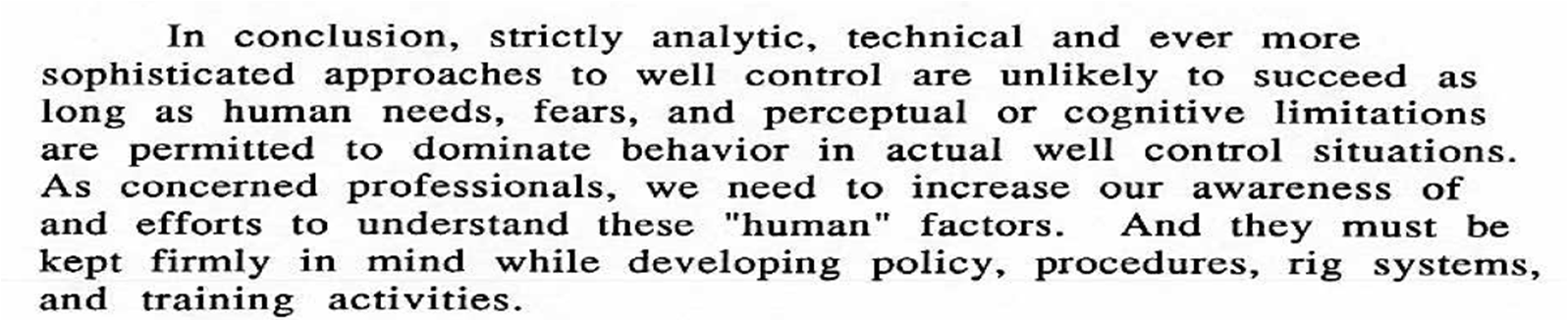
I was in the audience almost 18 years ago when Paul Sonnemann made an outstanding presentation on the thought processes and human response tendencies that contribute to well control incidents and other accidents.  These tendencies may have been significant contributing factors at both Montara and Macondo.  With Paul’s permission I have attached a copy of his 1992  paper.  I strongly suggest that you read it.

While considering new regulations, standards, and procedures, the industry and government need to look closely at the issues identified in Paul’s paper.

Read Full Post »

« Newer Posts - Older Posts »