Feeds:
Posts
Comments

Posts Tagged ‘safety’

One of the better paragraphs I have read since Macondo:

The Deepwater story shows the fight against complacency is a continuous struggle, not a single battle. An executive at another oil major told me the default setting for safety managers should be “chronic unease”. That’s easy to see if you’re a prison governor or lighthouse-keeper. But it should be part of any executive’s attitude. Constant vigilance against, say, new competition, supply chain disruption, or unforeseen technological change is a must for modern managers.

Read Full Post »

No government regulatory structure alone can guarantee safety in an industry that must constantly adapt new technology to natural variations in drilling sites and unexpected natural phenomena. Oversight must improve, as the Obama administration has made clear, but also every company involved in oil drilling – not just BP – must individually and in concert with others evaluate industry standards and safety research programs. And none should assume that BP’s mistakes could not occur elsewhere. Washington Post

Well said!

Read Full Post »

In the Wall Street Journal, Rex Tillerson says that the Macondo blowout was not caused by systemic problems within the industry:

The explosion aboard the Deepwater Horizon rig, resulting in the massive oil spill in the Gulf of Mexico, was caused by its operators’ decisions and not by general problems in the oil industry, Exxon Mobil Corp. Chief Executive Rex Tillerson said Thursday.

But then seems to contradict that statement:

“It’s really up to the industry” to make sure regulation is strong and disasters like these don’t happen again, he said.

So, isn’t the second quote acknowledging a systemic problem?

Read Full Post »

Wall Street Journal

The conclusions of the presidential commission’s inquiry into the causes of the Deepwater Horizon accident published Thursday make it increasingly likely that BP will not be found grossly negligent and will avoid the harshest financial penalties for the Gulf of Mexico oil spill.

Pre-trial orders

Siding with arguments by the Plaintiffs, Judge Barbier concluded that the depositions should go forward in New Orleans, rather than in Houston as preferred by BP.

BP vs. TO vs. Halliburton (quotes from New York Times article)

In a statement on Wednesday, BP noted that the commission had found fault with a number of companies, not only BP, the main owner of the well.

Halliburton said in a statement that it had acted at BP’s direction in preparing and injecting cement into the well. It said tests the panel identified as indicating problems with its cement formula were preliminary and did not contribute to the disaster. Halliburton also criticized the commission for what it called selective omissions of exculpatory material it gave to the panel’s staff.

A spokesman for Transocean said that BP, not Transocean, made the major decisions in the hours before the blowout. “Based on the limited information made available to them, the Transocean crew took appropriate actions to gain control of the well,” the spokesman said. “They were well trained and considered to be among the best in the business.”

Read Full Post »

Link to the full report

What?

The blowout in the Gulf of Mexico could have been prevented if the last-line of defence—the blind shear ram on the blowout preventer, located at the well head on the ocean floor—had activated and crushed the drill pipe. Given the importance of this equipment, and the evident dangers of relying on a single device, we urge the HSE to consider prescribing specifically that blowout preventers on the UK Continental Shelf should have two blind shear rams.

Comments:

  1. The UK government should NOT be commenting on the BOP failure until the US government has completed its forensic testing and investigation.
  2. The Committee has apparently not paid any attention to the testimony on the BOP issues or the other BOP information that has surfaced.  Have they not seen the comments from BP and Transocean or the videos shot on the Q4000?
  3. Would it have been appropriate for the US government to publish a report on Piper Alpha before Lord Cullen had completed his review?

Read Full Post »

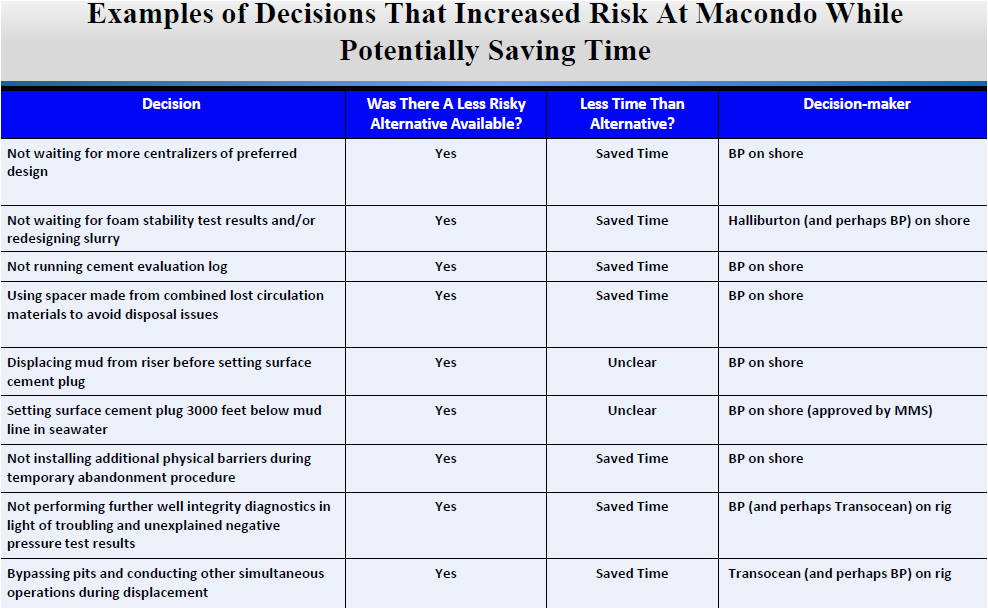
click on table to enlarge

Click for the chapter on the causes of the blowout

Read Full Post »

The UK Energy and Climate Change Committee has released its report entitled “UK Deepwater Drilling – Implications of the Gulf of Mexico oil spill.” We’ll post the report as we get a link.

Here’s the gist:

A moratorium on oil drilling in deep waters off Britain would undermine the country’s energy security, according to a report by lawmakers published on Thursday in response to the BP spill disaster last year.

Read Full Post »

The updated Norwegian health, safety, and environmental regulations, effective 1 January 2011, are now available online. This includes applicable regulations that other Norwegian authorities (in addition to PSA) oversee.

Read Full Post »

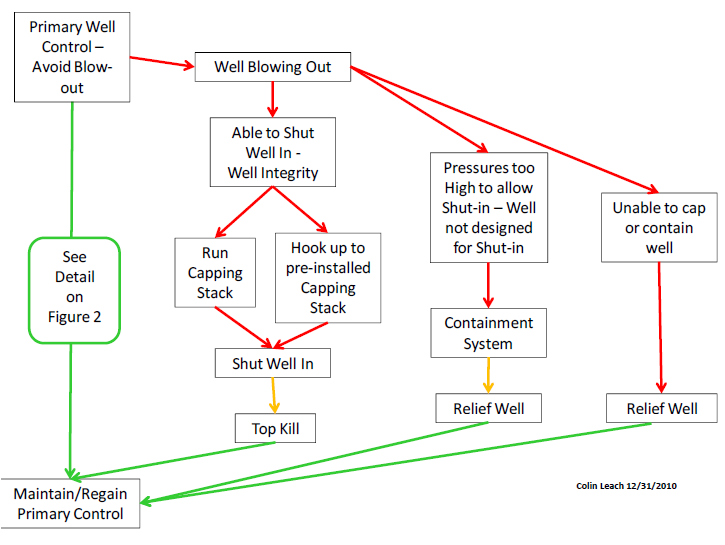
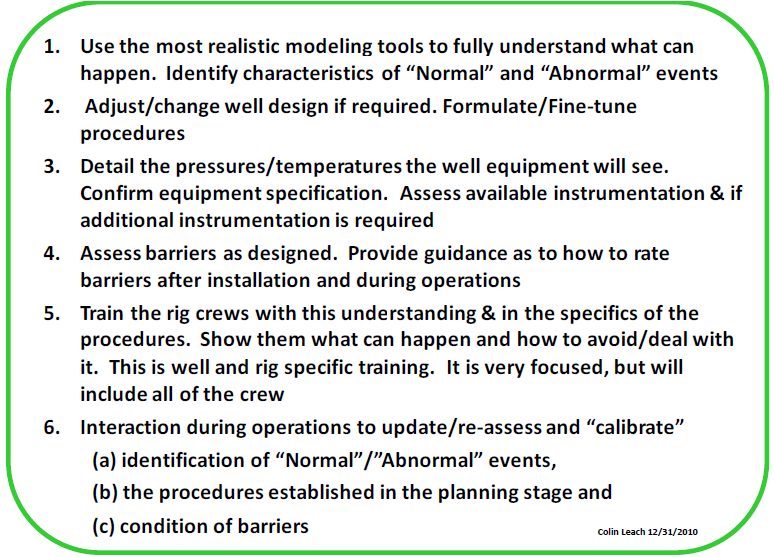
Colin Leach has provided a nice overview of the loss of well control scenarios for a deepwater well (Figure 1), and a concise, but comprehensive, summary of the critical elements of a well control program (Figure 2).   Click on either figure to enlarge.

We appreciate Colin’s continued leadership and initiative on well control issues.

Figure 1: Well Control Activities in Deep Water

Figure 2: Activities Focused on Maintaining Primary Well Control

Read Full Post »

A colleague sent a link to a Marathon Oil Company Macondo presentation that was posted by the Houston Chronicle. The presentation was intended for internal training and discussion purposes.

Firstly, I applaud Marathon for ensuring that the blowout is studied and debated within the company. Hopefully, they did the same thing for Montara, have a good internal system for studying accidents throughout the industry, and thoroughly investigate all of Marathon’s incidents and near misses.

I thought Marathon’s comments about safety culture were particularly interesting, including these on slide 58:

Although harder to define and measure, and even more difficult to regulate, we pointed to our culture as the single most important differentiating attribute when comparing us to BP.

In a recent meeting with an individual who has numerous dealings with BP, he observed that regardless of the purpose of the gathering (planning session to morning rig call), it is almost impossible to determine who is ultimately responsible and accountable for the operation being discussed. Evidence of this exists in the very report this presentation was derived from.
I wonder what convinces Marathon that their safety culture is superior. The above anecdote, while interesting, doesn’t tell us much. Prior to Macondo (and perhaps even after the blowout), I’ll bet most BP employees thought that they had a strong safety culture. Ditto for Transocean. Does Marathon have any better evidence demonstrating the strength of their safety culture? If not, what makes them so confident? Does Marathon have a process for assessing and monitoring the attitude and commitment of their employees? Have they conducted regular internal surveys to gauge safety culture? My sense is that they have not. If they had, they could make their case without the very subjective comparison with BP.

Read Full Post »
« Newer Posts - Older Posts »