John Smith has highlighted the attached bill that could, if passed, further derail Sable’s plans to restart Santa Ynez Unit (SYU) production.
This provision appears to target Sable:
Section 3(b)(2): Repair, reactivation, and maintenance of an oil and gas facility facility, including an oil pipeline, that has been idled, inactive, or out of service for five years or more shall be considered a new or expanded development requiring a new coastal development permit consistent with this section.
The legislation would be effective on 1/1/2026 so perhaps Sable will already be producing. Sable may also explore the jurisdictional and interstate commerce issues touched on in this post.
This LA Times update adds to the confusion as to the implications for Sable.
In addition to the Johnson filing, at least 7 other law firms (links below) have announced class action litigation alleging that Sable Offshore made false or misleading statements regarding the restart of Santa Ynez Unit production.
“This is a significant achievement for the Interior Department and aligns with the Administration’s Energy Dominance initiative, as it successfully resumed production in just five months.“
Will the Dept. of Justice intervene on behalf of Sable?
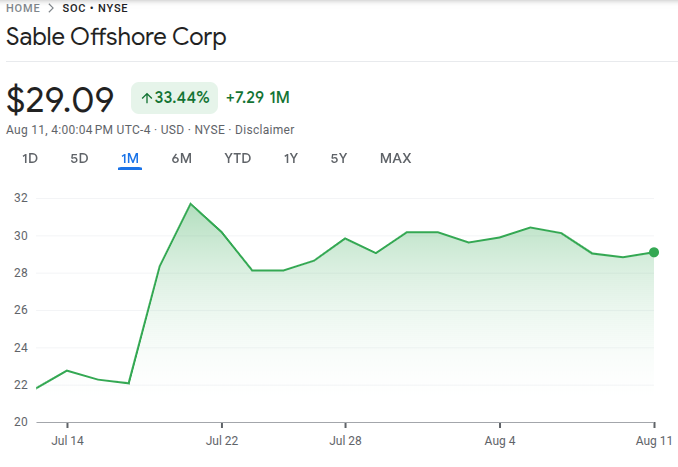
Meanwhile, Sable’s share price rebounded in mid-July and is holding up surprisingly well (see below). Perhaps investors don’t see the class action suits as a significant incremental threat given the risks associated with decisions by 8 California agencies, Santa Barbara County, and various judges, and the persistent challenges by well-organized opponents of offshore production.
On July 25, 2025, more than 2 months after Sable’s brief production restart and 7 weeks after a court decision halted further production, BSEE surprisingly announced the resumption of Santa Ynez Unit (SYU) production boasting:
“This is a significant achievement for the Interior Department and aligns with the Administration’s Energy Dominance initiative, as it successfully resumed production in just five months.“
Were the authors of the press release unaware that the SYU production, which was largely from well tests, was halted by court order shortly after it began? More philosophically, is such cheerleading appropriate for the principal safety regulator, particularly given that BSEE is engaged in litigation over its practices in facilitating SYU production?
Ironically, just 3 days after BSEE hailed the resumption of production, the attached lawsuit was filed on behalf of investors who purchased Sable Offshore securities between May 19, 2025 and June 3, 2025. BOE contributor John Smith shared the filing.
The plaintiffs allege misleading statements regarding the resumption of production. Some of the key points cited in the filing:
On May 19, 2025, before the market opened, the Company issued a press release entitled “Sable Offshore Corp. Reports Restart of Oil Production at the Santa Ynez Unit and Anticipated Oil Sales from the Las Flores Pipeline System in June 2025.”
The release informed that Sable expected to fill the ~540,000 barrels of crude oil storage capacity at LFC (Los Flores Canyon onshore processing facility) by the middle of June 2025 and subsequently recommence oil sales in July 2025.
Following the May 19 Press Release, Sable Offshore stock climbed from a closing price of $28.86 per share on May 16, 2025 to $33.02 per share on May 19, 2025, a 14.4% climb in share price.
Contrary to Defendants’ representations, Sable Offshore had not resumed commercial production off the coast of California.
Defendants then used the share price appreciation following the May 19 Press Release to conduct a secondary public offering (or “SPO”) at a higher offering price per share than would have otherwise been possible.
State Lands Commission staff informed the Lt. Gov./Commission Chair that the limited oil flows were the result of well-testing procedures required by BSEE prior to restart. These activities did not constitute a resumption of commercial production or a full restart of the SYU.
Characterizing testing activities as a restart of operations is not only misleading but also highly inappropriate –particularly given that Sable has not obtained the necessary regulatory approvals to fully resume operations at SYU.
Any attempt to restart commercial operations at the SYU without final regulatory approvals may place the company in violation of its lease terms and jeopardize the status of Sable’s holdover State lease.
Santa Barbara County Judge Thomas Anderle granted a preliminary injunction requested by the California Coastal Commission against Sable Offshore for alleged violations of The California Coastal Act.
HOUSTON–(BUSINESS WIRE)— Sable Offshore Corp. (“Sable,” or the “Company”)(NYSE: SOC) today announced that as of May 15, 2025, it has restarted production at the Santa Ynez Unit (“SYU”) and has begun flowing oil production to Las Flores Canyon (“LFC”). Additionally, with the completion of the Gaviota State Park anomaly repairs on the Las Flores Pipeline System (the “Onshore Pipeline”) on May 18, 2025, Sable has now completed its anomaly repair program on the Onshore Pipeline as specified by the Consent Decree, the governing document for the restart and operations of the Onshore Pipeline.
Seven of the eight sections of the Onshore Pipeline have been successfully hydrotested. Sable will complete the final hydrotest in order to meet the final operational condition to restart the Onshore Pipeline as outlined in the Consent Decree. Sable expects to fill the ~540,000 barrels of crude oil storage capacity at LFC by the middle of June 2025 and subsequently recommence oil sales in July 2025.
Production Restart
On May 15, 2025, Sable initiated the flow of oil production from six wells on Platform Harmony of the SYU to LFC at a rate of ~6,000 barrels of oil per day.
Sable has been testing wells on Platform Harmony throughout May 2025 and the well tests have performed consistently stronger than they did at the time of shut-in on May 19, 2015 when the SYU produced approximately 45,000 barrels of oil equivalent per day.
Approximately 30% of the 32 producing wells at Platform Harmony have been tested as of May 18, 2025 with the remaining Platform Harmony wells projected to be tested over the course of the next several days.
Sable expects to initiate production from the additional 44 wells on Platform Heritage and the additional 26 wells on Platform Hondo in July 2025 and August 2025, respectively.
John Smith reports that Sable has cleared another significant hurdle in its attempt to restart production in the Santa Ynez Unit. The California DEPARTMENT OF PARKS AND RECREATION has determined that no permit is required for the pipeline anomaly digs in Gaviota State Park (see attached).
The reasons for the exemption are that the project consists of repairs to an existing facility with no expansion of use, and the footprint of the pipeline remains the same.
This will be the Board’s “first and last chance to have any influence over restarting the pipeline, and thus allowing the three offshore platforms to begin drilling again.” (Expect initial production to be from existing wells supplemented over time with new drilling, well workovers, and recompletions.)
The Board has limited authority in this matter: “The county’s legal advisors and energy planners have told the supervisors that there are no grounds to say no. It is not up to them to determine whether Sable’s liability insurance is enough to cover the costs of a reasonable worst-case oil-spill scenario; it’s only up to them to ascertain whether Sable has filed a certificate of insurance with the proper state agency.“
“All the essential questions regarding the pipeline’s safety measures are in the hands of California state agencies, headquartered in cities far away, with names so confusing that even people working there can’t tell you what the acronyms mean.” (see Regulatory fragmentation)
Interesting tidbits: “Danielson (the Sable representative) let me know that he would not be answering these questions. He was cordial, but he was not happy about a recent Independent story featuring attorney Linda Krop of the Environmental Defense Center perhaps Sable’s most implacable and formidable opponent, expounding in an unchallenged format on what a threat the pipeline still posed. Interviewing Krop was Victoria Riskin, herself a committed anti-oil advocate. Actress and Montecito resident Julia Louis-Dreyfus — of Seinfeld and Veep fame — apparently liked the article enough to send it to her social media followers.“
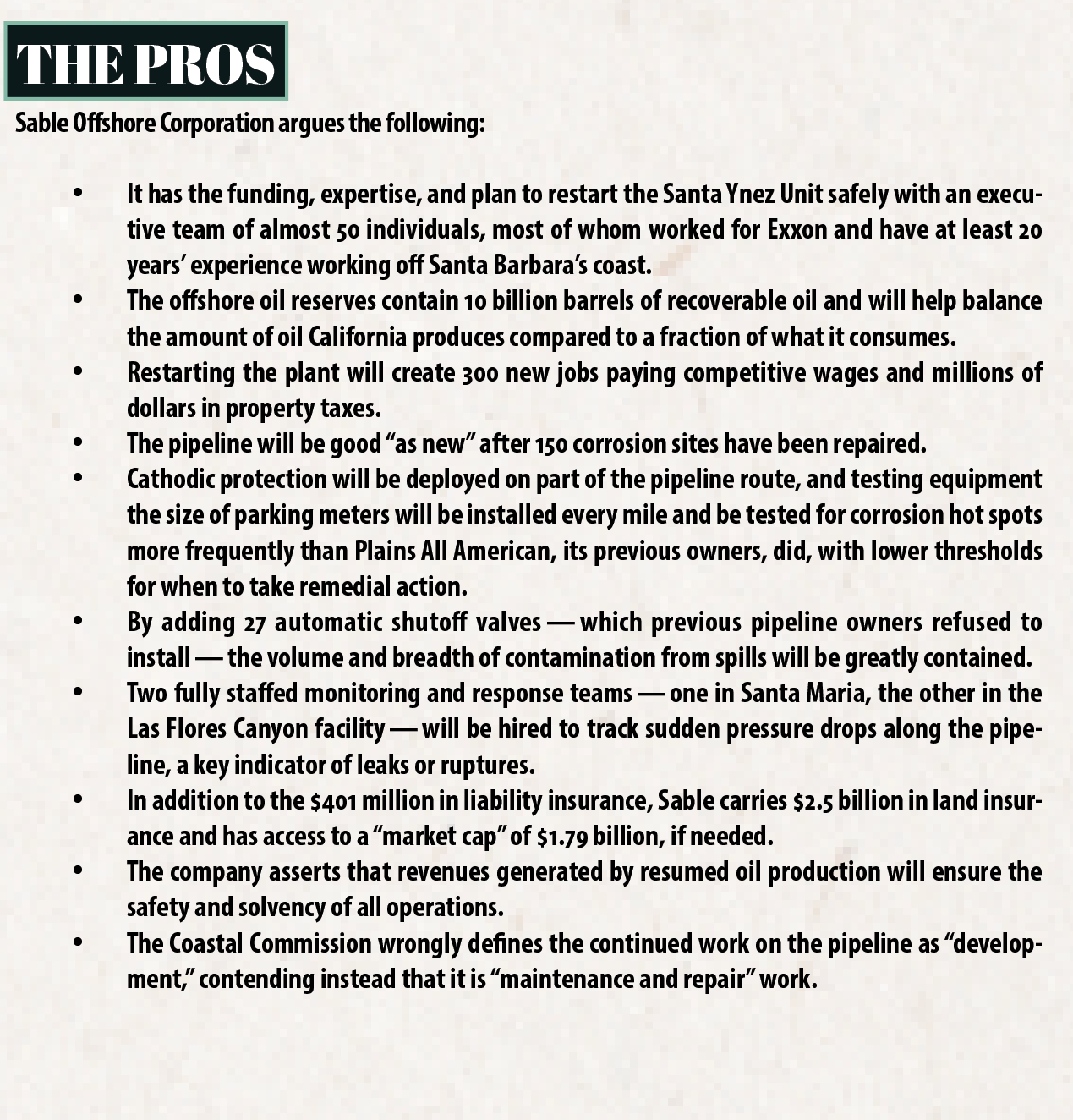
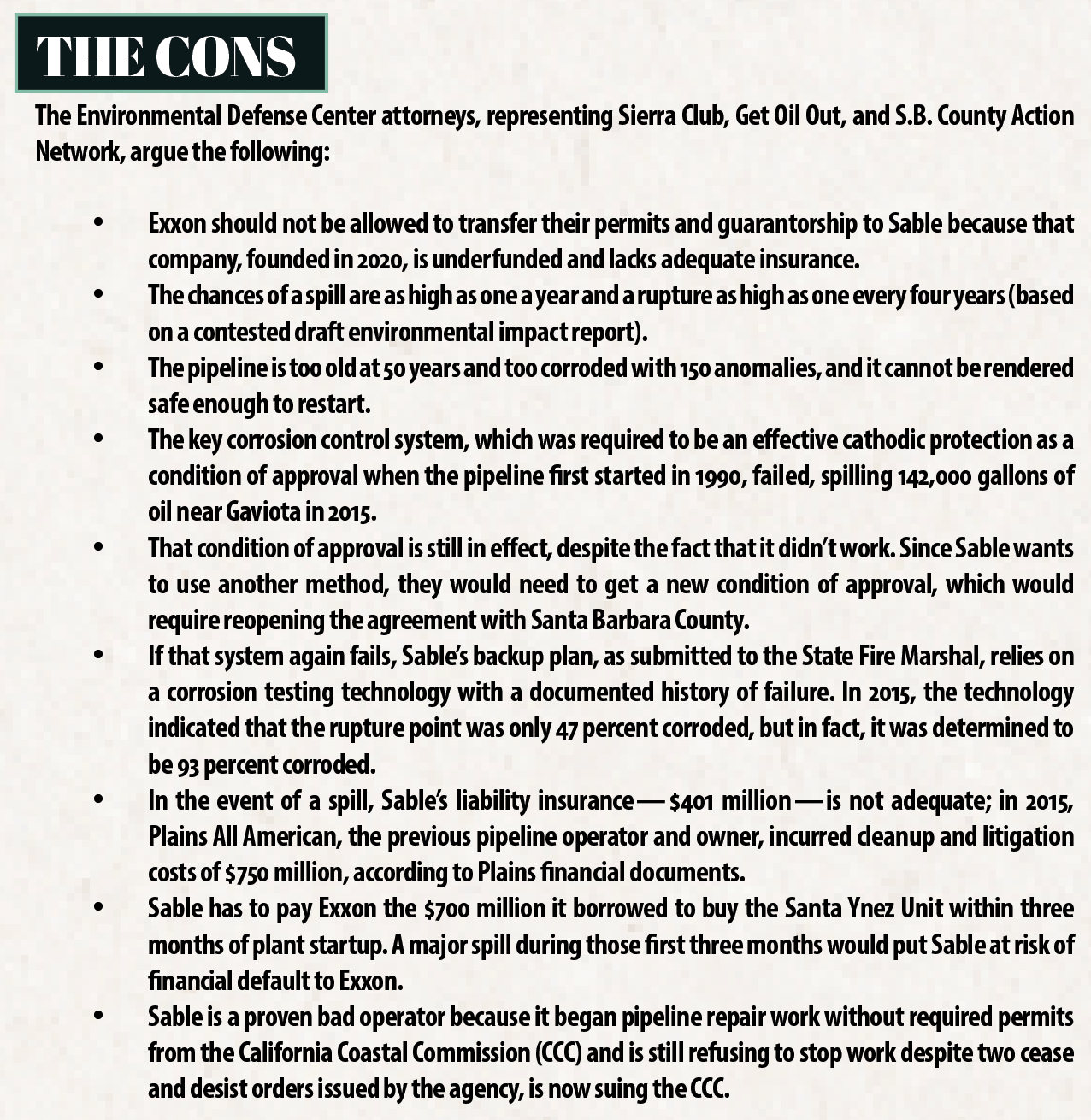
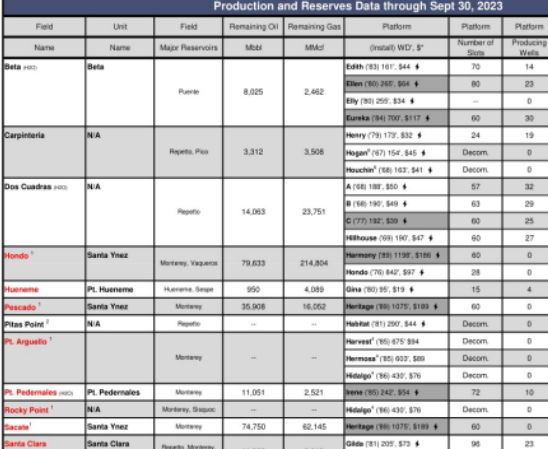
Below are the pros and cons of the SYU restart as cited by the Independent. (Clarification: The 10 billion bbl oil reserves number (“pros” slide) is at least an order of magnitude too high and is perhaps a typographical error. BSEE’s June 2023 data sheet (excerpt pasted at the end of this post) indicates remaining oil reserves of 190 million bbls for the 3 SYU fields. Adding the gas reserves ups the total to 243 million bbls of oil equivalent (boe). Additional reserves could likely be confirmed with new extended reach wells, but anything more than 1 billion bbls would be highly unlikely. Sable’s investor presentation (p.5) indicates 646 million bbl of Remaining Total Net Estimated Contingent Resources.)
“If we continued to fight this out in court, [Sable] likely would have sought to recover lost revenue from the pipeline not being in operation,” said Supervisor Steve Lavagnino. “That could amount to millions of dollars the County would be on the hook for.”
The Environmental Defense Center and others are calling for the County to retract their agreement with Sable and hold a public hearing on the matter. That appears to be unlikely.
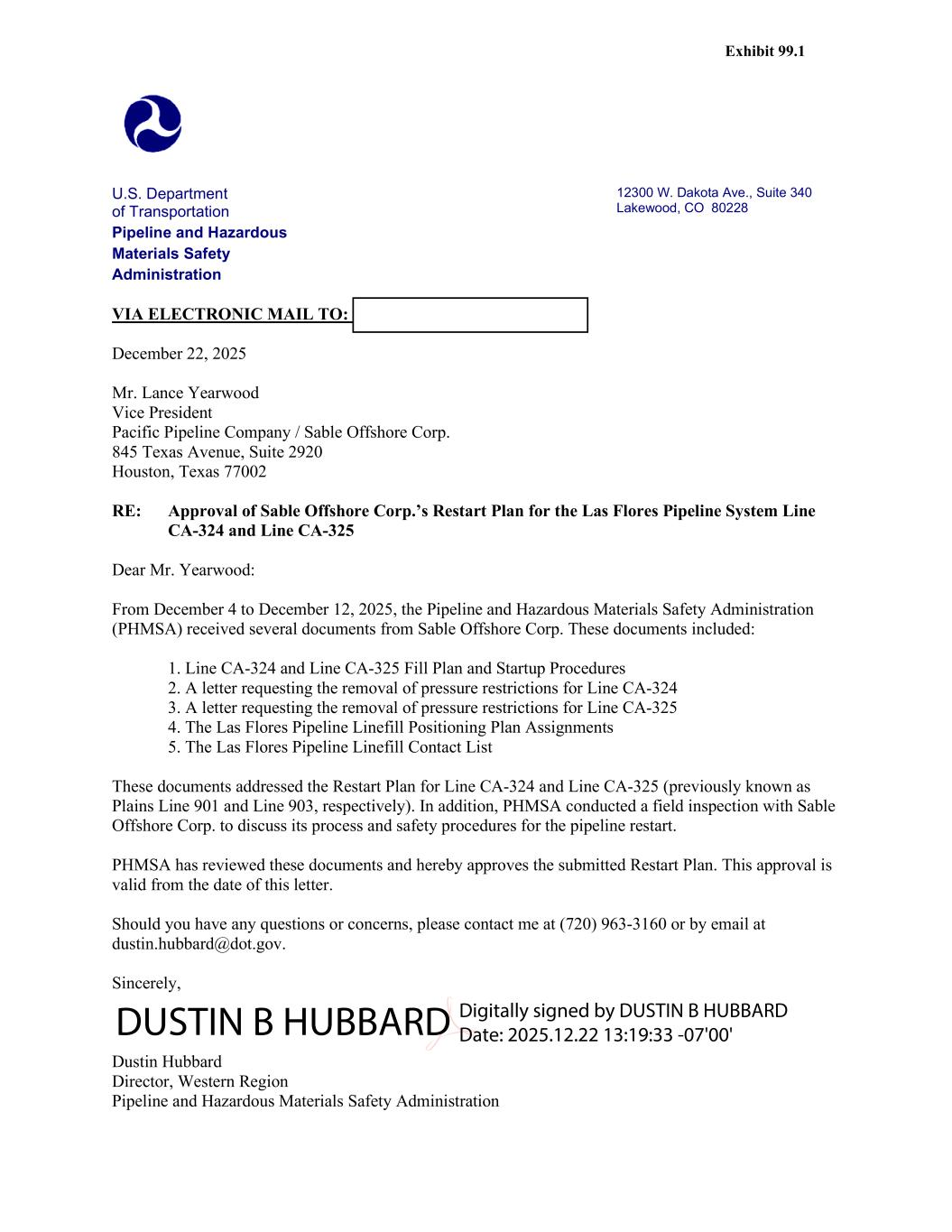
Remaining hurdles for Sable include approval by the State Fire Marshall after the valves are installed and operational, State Lands Commission approval of lease assignments from Exxon to Sable, and approval of the oil spill contingency plan by the State Dept. of Fish and Wildlife.
Sable believes they can resume production this year. That seems unlikely, but a 2025 restart is now a distinct possibility.
An assessment prepared for Hunterbrook Capital draws the same conclusions regarding the prospects for production, calling the restart “a pipe dream” (presumably the pun was intended given the pipeline permitting quagmire). Hunterbrook’s chart (pasted below) illustrates the regulatory labyrinth facing Sable.
Hunterbrook has also flagged Sable’s ability to continue as a “going concern.” That may be a valid concern, but Sable’s success is very much in Exxon’s best interest. Exxon must have evaluated Sable and been comfortable with their management. Otherwise, they wouldn’t have made the deal.
Does Exxon want the massive SYU headache to revert back to their portfolio, as provided for in their agreement with Sable, if production doesn’t restart by January 1, 2026? Unless Exxon thinks they have a better option than Sable, they will presumably be flexible about the deadline.
Meanwhile, a judge denied the temporary restraining order requested by Sable to prohibit release of redacted portions of their oil spill contingency plan. Sable had argued that revealing “trade secrets” and specific locations and vulnerabilities of the pipelines could pose a “threat to national security.”
California State Lands Commission decision on the pipeline right of ways (ROWs) in state waters. (Those ROWs had expired.)
Transfer of leases to Sable – Environmental groups, the California Coastal Commission and/or other parties could file suit challenging the transfer of the leases to Sable.
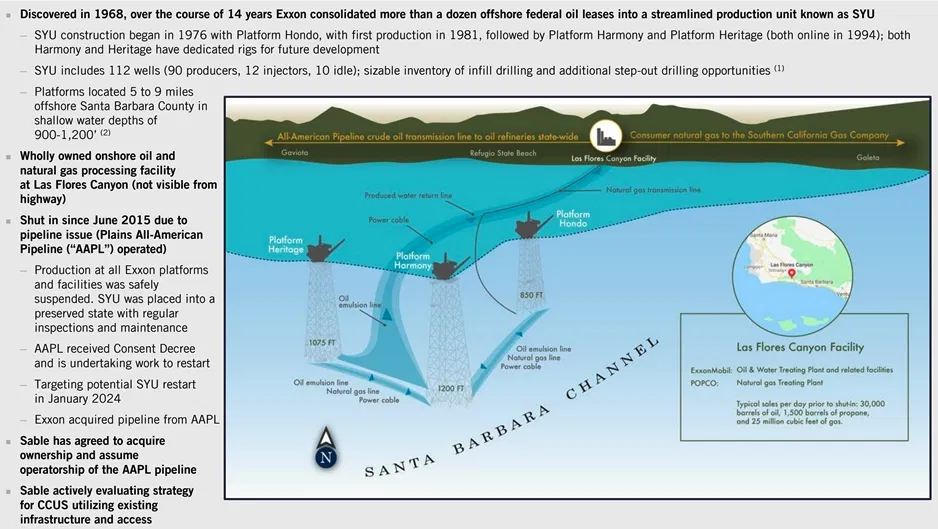
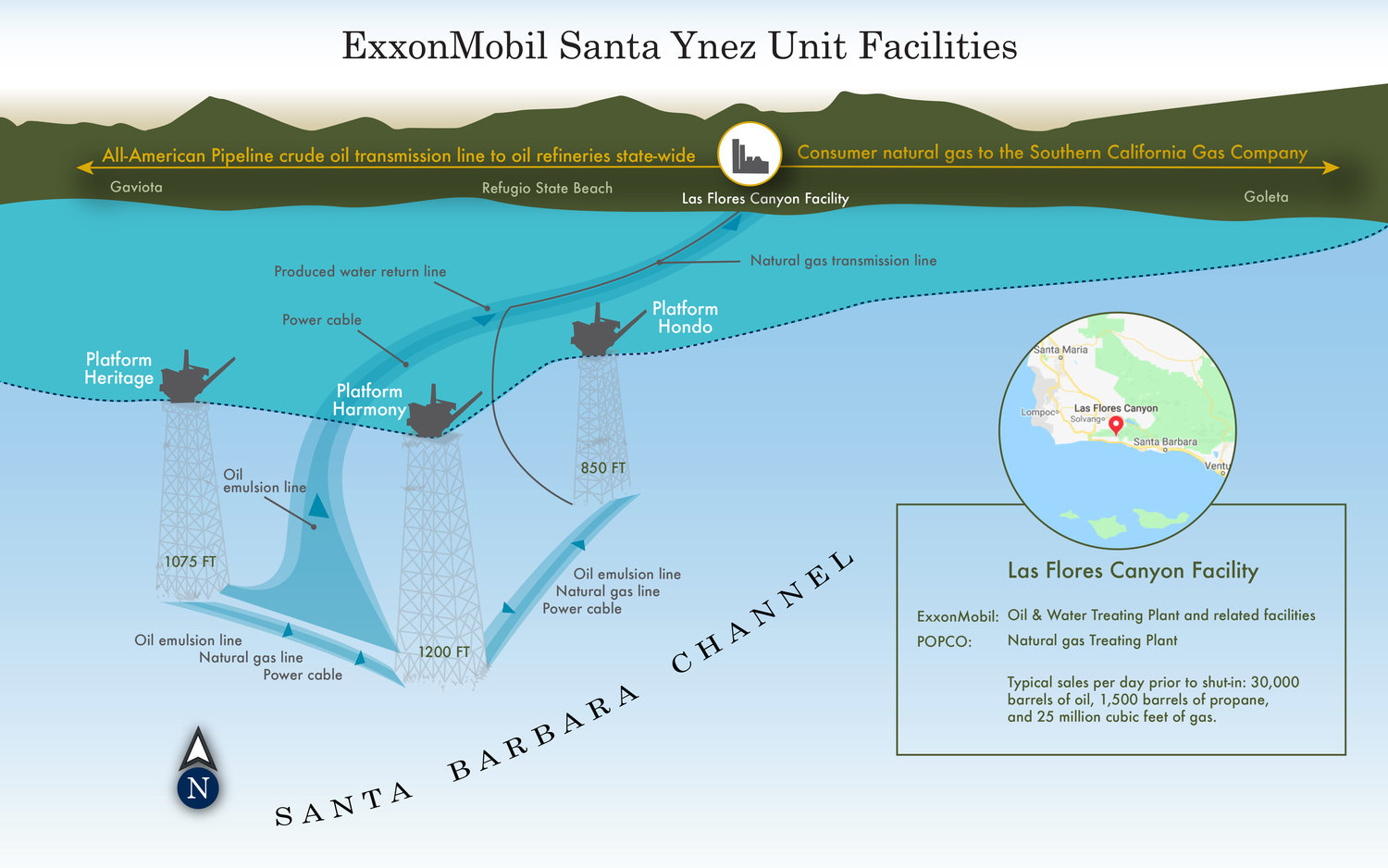
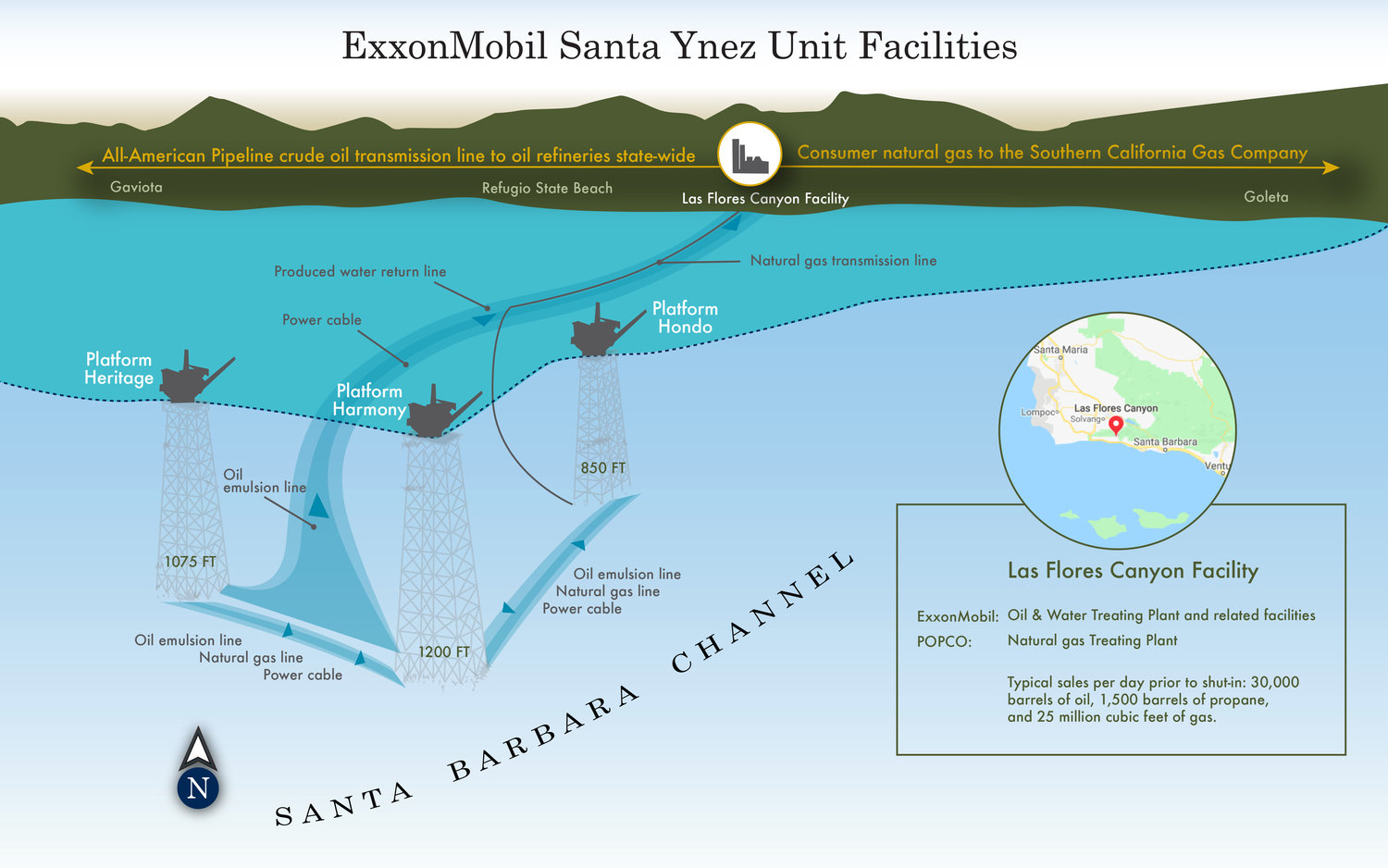
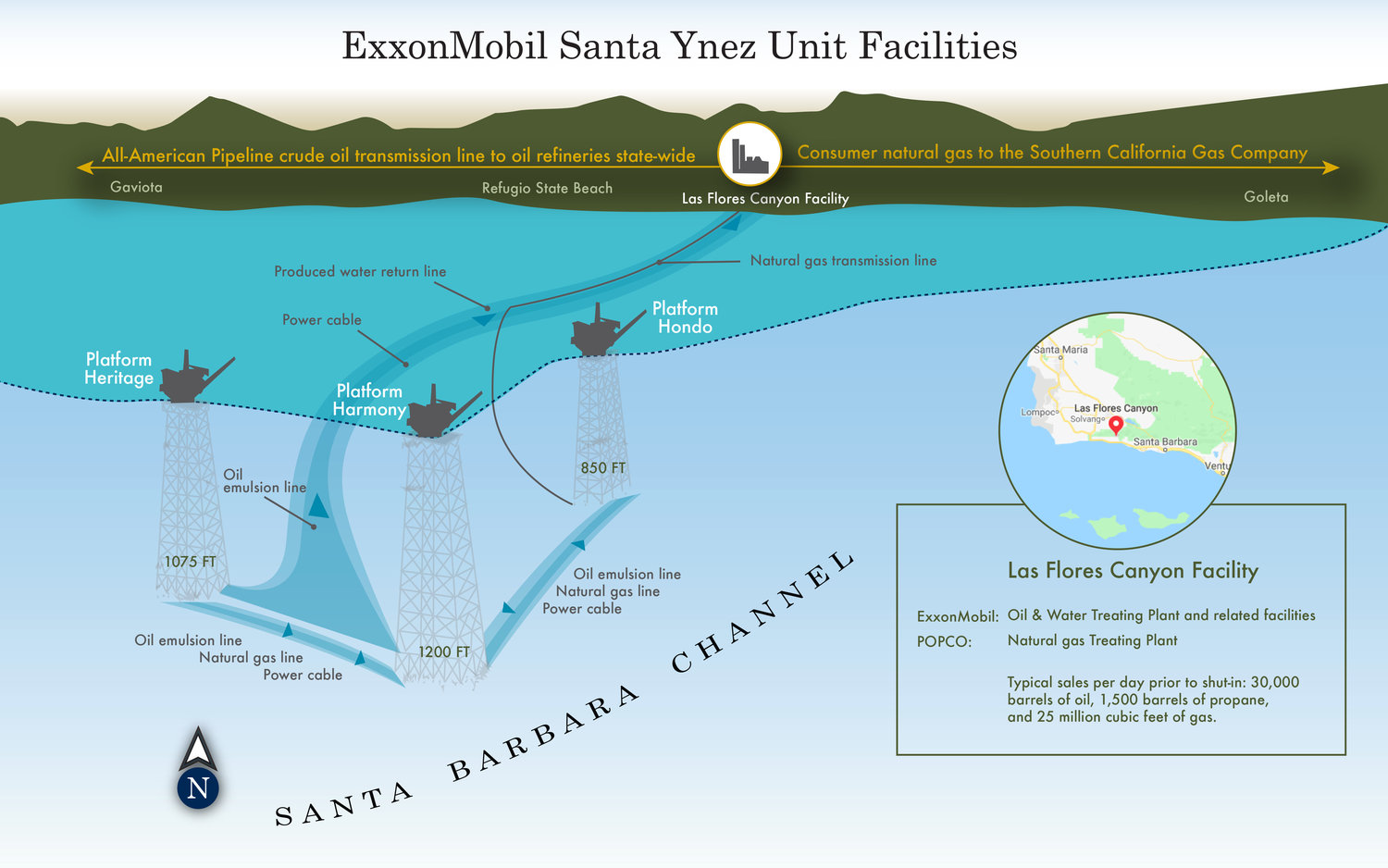
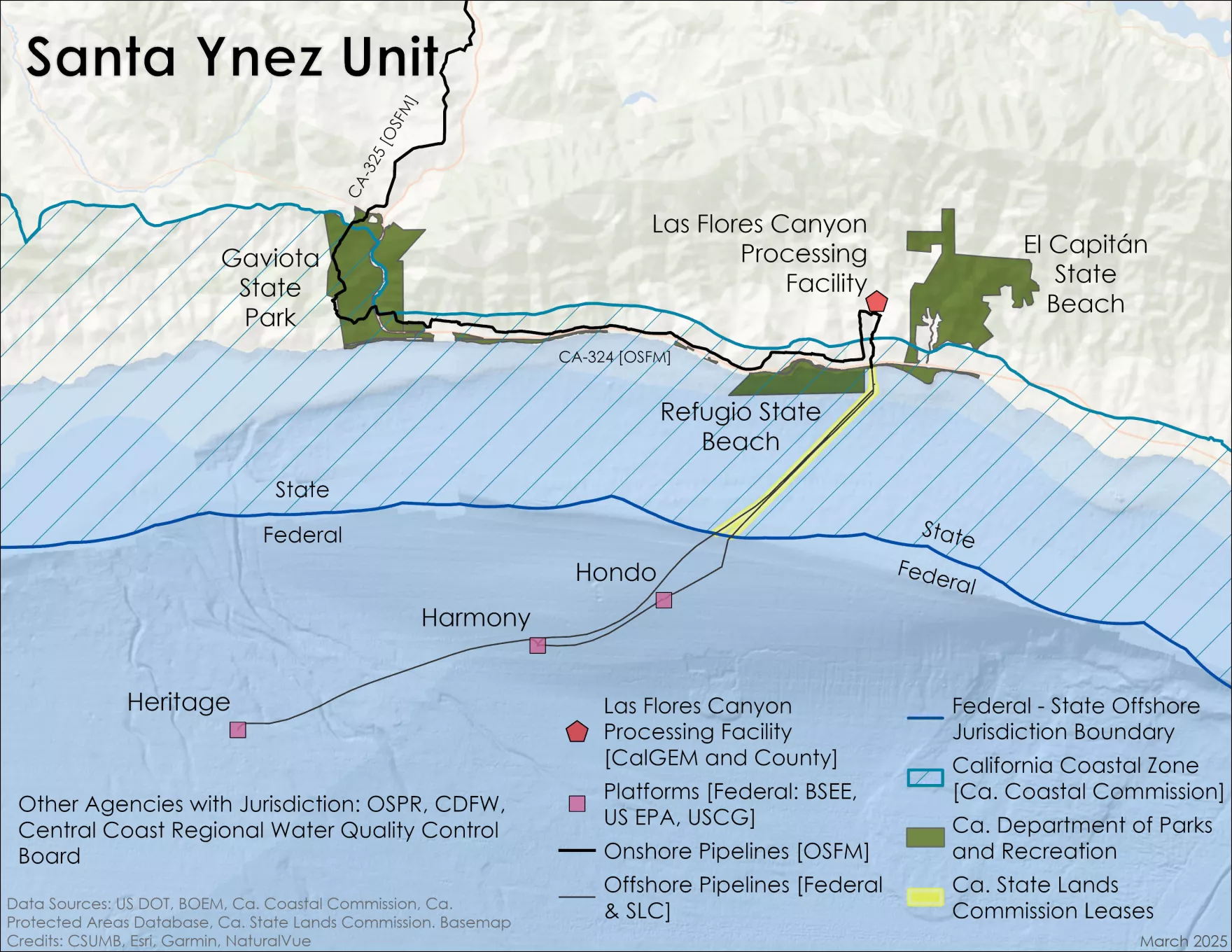
According to John, the question is not whether production will resume in 2024, but whether it will ever resume. And John reminds us that as of 1/1/2026, the SYU and all of the headaches revert to Exxon. See the SYU overview below: