Feeds:
Posts
Comments

Posts Tagged ‘ohmsett’

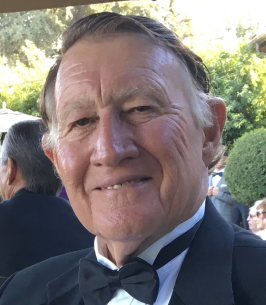
Ed Tennyson

Edward J. Tennyson passed away last Friday at his Smith Mountain Lake, Virginia home. Ed worked in the Department of the Interior’s offshore program for more than 20 years, and arguably has done more than any single individual to advance oil spill response capabilities. A few of Ed’s many achievements:

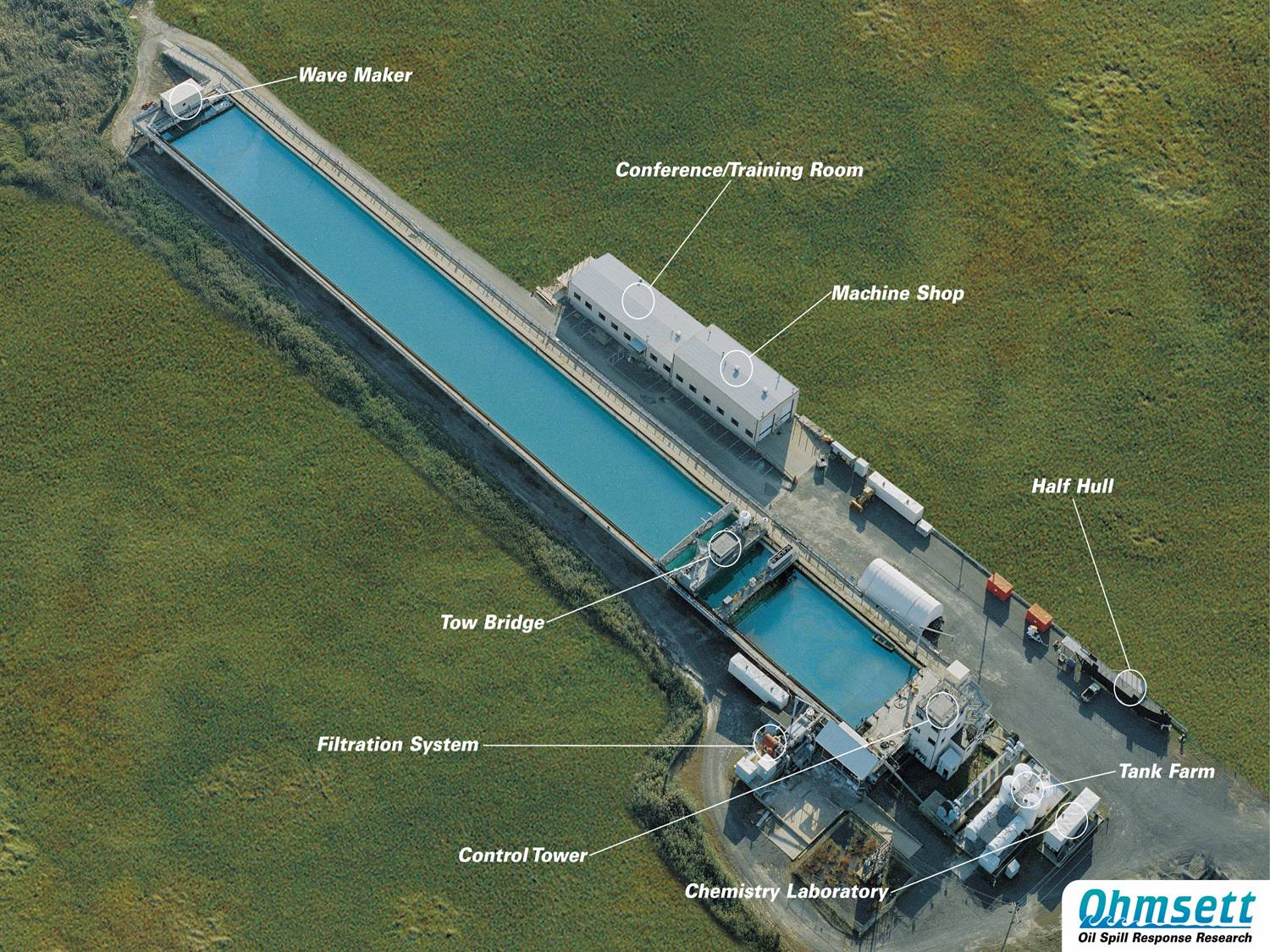
  • Ohmsett: EPA operated the Ohmsett spill response test tank in Leonardo, New Jersey, beginning in the early 1970s, but the facility fell into disrepair in the 1980s. Thanks to Ed’s vision and persistence, and the enactment of the Oil Pollution Act of 1990, the Minerals Management Service (MMS) began restoring the facility. Ed led the effort and did everything from operating forklifts to designing upgrades. Senator Frank Lautenberg (NJ) and a host of dignitaries participated in the grand reopening event in 1992. It was an amazing day, and Ohmsett, MMS’s only industrial facility, has exceeded even Ed’s lofty expectations. 
  • Burning oil slicks: Ed and a few of his US and international partners were the first to consider in situ burning as an oil spill response method. After some lab work, Ed proposed larger scale testing at Ohmsett in the presence of ice. The testing was amazingly successful, removing almost all of the oil. When Ed told a leading skeptic about the impressive results, his response was “you didn’t do it right.” 😀 
  • Newfoundland burn: Because research spills were prohibited in US waters, Ed worked with his Canadian partners to conduct an in situ burning test offshore Newfoundland in 1993. Ed was an amazing leader during any kind of field trials, and was always the first person on the dock directing team members to their stations!
  • Remote sensing: Ed’s research led to a patent on the use of shipborne radar for locating oil slicks. Ed greatly advanced this capability by developing tools for airborne mapping and thickness determinations. As Ed frequently said, “90% of the oil is in 10% of the area.” By identifying where the oil was thickest, you could optimize spill response. (Ed was also an expert at identifying slicks with what he called his mach 20 eyeball 😀).
  • Chemical treatment: Ed was a leader in researching dispersants, herding agents, and other chemical methods for preventing spills from impacting shorelines or other sensitive areas.

Ed was an entertaining and informative speaker and was often called upon to brief congressional panels, and discuss his research at public meetings and professional conferences. He was rightfully a media darling and was often contacted for comments on oil spill response matters. Perhaps his most famous quote was in the Wall Street Journal during the Valdez spill in Prince William Sound. Ed described the spill response as follows: “Like mowing a 40 acre field with a 1/4 inch lawn mower.” 😉

RIP Ed, you made a difference!
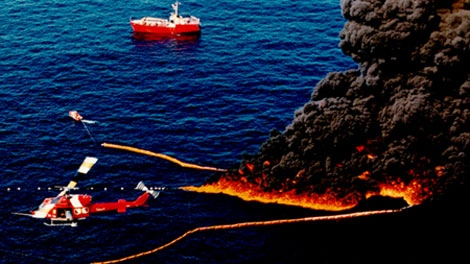
Newfoundland Offshore Burn Experiment, 1993

Read Full Post »

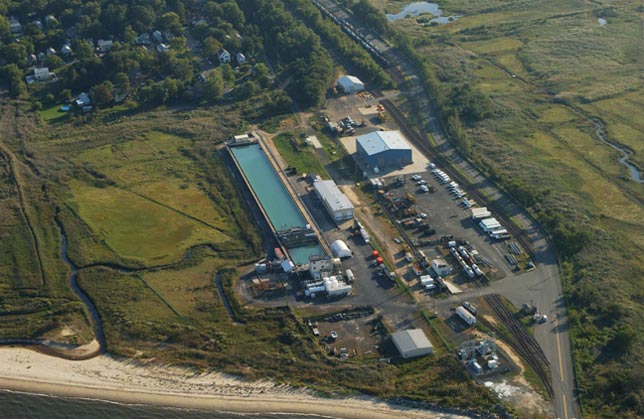
My involvement with Ohmsett dates back to the 1970s when EPA operated the facility and I was on the Ohmsett Interagency Technical Committee. The facility fell into disrepair in the late 1980s. Thanks largely to the vision and initiative of my Minerals Management Service (MMS) colleague Ed Tennyson and the enactment of the Oil Pollution Act of 1990, the MMS began restoring the facility in 1990 and resumed testing activities in 1992. Senator Frank Lautenberg (NJ) and a host of dignitaries participated in the grand reopening event.

The facility has lived up to the hype and the current BSEE leadership team seems committed to continuing the testing and innovation. For more information about testing at Ohmsett, including renewable energy concepts, check their website. For an excellent summary of Ohmsett activities from 1992-97, see this paper.

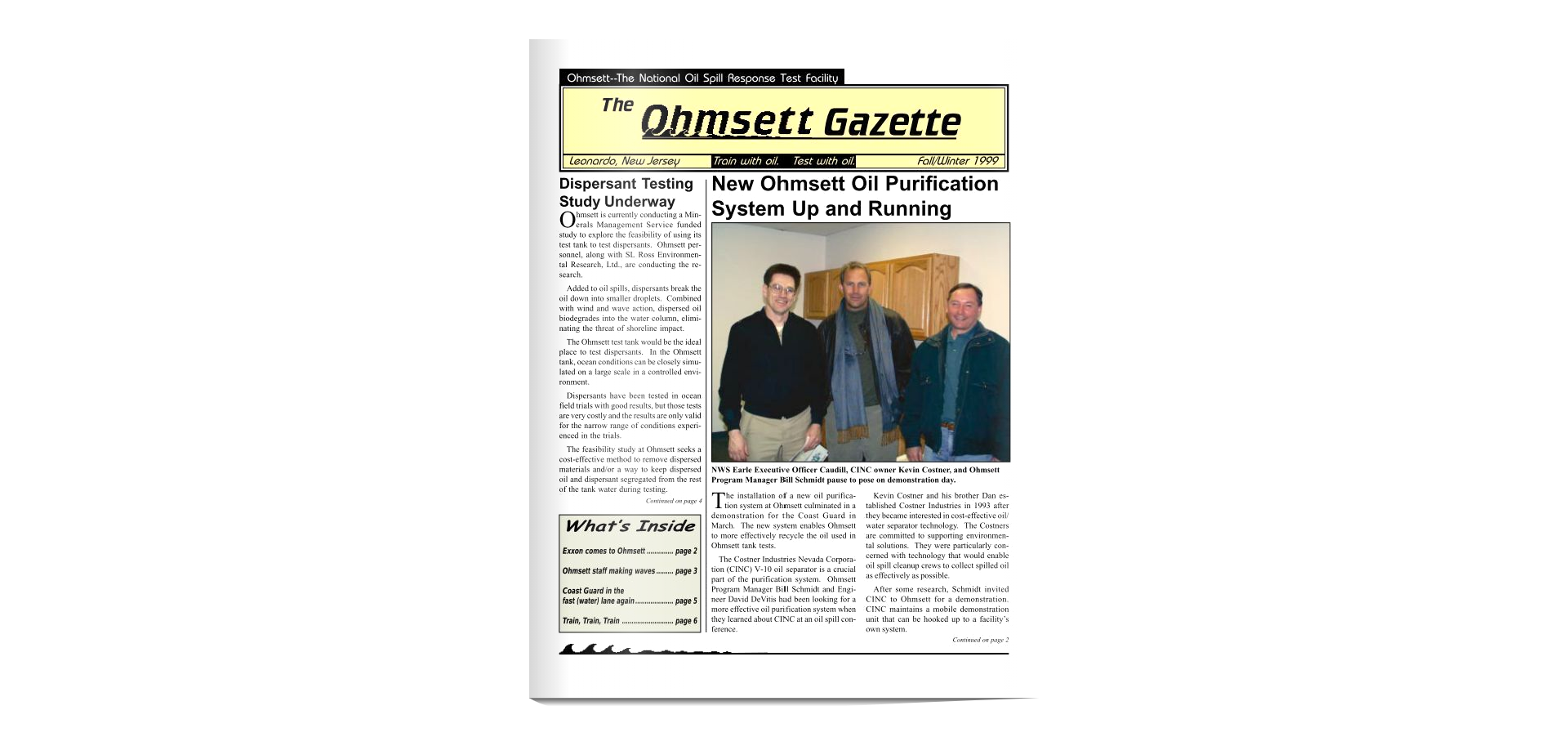
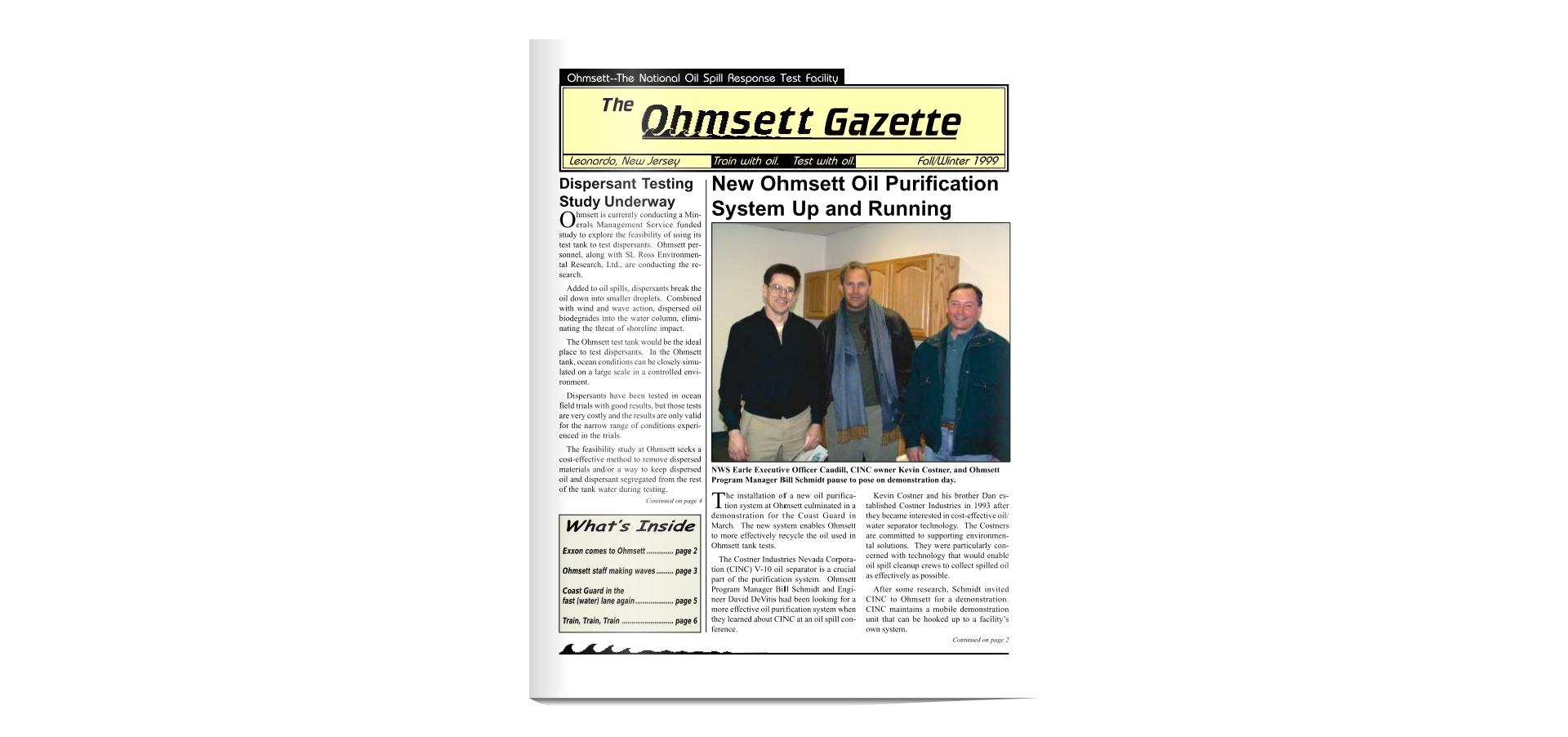
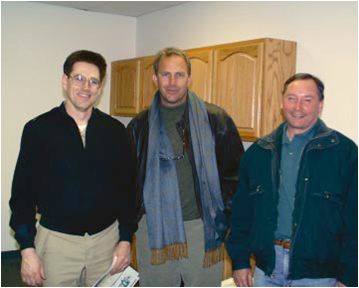
Among the many companies to test equipment at Ohmsett is one that was partially owned by actor Kevin Costner. See the article and photo below. If you build it (and maintain it), they will come!

Read Full Post »

Charles Smith

I’m very sad to report the passing of a leading offshore safety researcher and long-time colleague, Dr. Charles Smith. Charles was a pioneering structural engineer who joined the US Geological Survey’s Conservation Division (then the offshore safety regulator) in ~1977 to establish the Technology Assessment and Research (TAR) Program.  With the thinnest of budgets, Charles formed partnerships that addressed the gamut of offshore safety issues. Some of his accomplishments:

  • Working with the Offshore Technology Research Center (Texas A&M) and others, Charles sponsored projects that led to the successful investigation of deepwater production concepts including TLPs, Spars, FPSOs, and semisubmersibles.  These designs are now the mainstays of deepwater development worldwide.
  • Organized well control projects that included the establishment of the deepwater well control research facility at Louisiana State University. 
  • Established the first ever offshore earthquake measurement network in the Pacific Region. The measurement system at Platform Grace in the Santa Barbara Channel successfully recorded 5 earthquakes and the structural responses at multiple locations on the platform.
  • Conducted research that led to new hurricane design standards for offshore structures and topsides equipment.
  • Working with colleagues at Berkeley and Stanford, conducted groundbreaking research on human and organizational factors affecting offshore safety. This was the basis for important safety culture studies that followed.
  • Studied pipeline risks and corrosion management for structures and pipelines.
  • Studied decommissioning options and their comparative environmental effects. 
  • Assessed arctic development options including gravel and ice islands and monopod concepts.
  • Conducted structural reviews leading to the renovation of the Ohmsett spill response test facility.
  • Participated on organizing committees for the International Conference on Ocean, Offshore, and Arctic Engineering (OMAE).
  • Along with representatives from Norway, the UK, Brazil. Canada, Mexico, Australia, and New Zealand, founded the International Committee on Regulatory Authority Research and Development (ICRARD).

Charles was the only offshore regulatory engineer to be selected as one of 10 finalists for the prestigious NSPE Federal Engineer of the Year award. (Keep in mind that the US government employs more than 130,000 engineers.) In 2009, the year of his retirement from Minerals Management Service, he was inducted into the Offshore Energy Center’s Hall of Fame (Galveston, TX) as as a Technology Pioneer for Health, Safety, and the Environment.   

After retirement Charles moved to Newfoundland and continued working on offshore safety issues with Memorial University, Canadian regulators, and industry representatives.  He and his wife Elaine built a lovely home overlooking the water in Bay Roberts. He was proud to be a citizen of both the US and Canada, and both countries were beneficiaries of his long and enormously successful career. Here is his obituary.

IMG_1766.JPG
Charles and his wife Elaine with my wife and me and John Gregory and his wife at the Offshore Energy Center Hall of Fame induction gala (Houston, 2009). Bud

Read Full Post »

Watching Kevin Costner at the beginning of the “Field of Dreams” game in Iowa reminds me that Kevin visited the MMS Ohmsett facility in New Jersey in 1999. He and his brother had developed an oil purification system that was being tested at Ohmsett (“Tank of Dreams?”). In the picture below, Kevin is flanked by Ohmsett Manager Bill Schmidt and Engineer Dave DeVitis. Were it not for the heroic efforts of Ed Tennyson and other MMS employees, Ohmsett would have been abandoned in the 1980s. More on that in a later post.

Read Full Post »

Ohmsett

Yesterday’s Platt’s Oilgram News included an excellent Gary Gentile piece about Ohmsett and the recent visit by BOEMRE Director Bromwich and Admiral Zukunft of the Coast Guard. Both had high praise for this outstanding oil spill response test facility which has contributed greatly to improved understanding of boom and skimmer performance, in situ burning, and chemical treating agents. This quote from the Platt’s article gives you a sense of the facility’s importance:

AbTech Industries spent two days at OHMSETT testing a new polymer it hopes will be able to sop up hydrocarbons from produced water or water used in hydraulic fracturing. The company pumped saltwater contaminated with Louisiana crude at rates of up to 250 gallons per minute through its filtering system. “The facility is tremendously unique,” AbTech Chief Operating Officer Jonathan Thatcher said in an interview. “I don’t know where else we would go where we could pump up to 250 gallons per minute for days on end and contaminate it. It allows you to go and make any mistakes you need to make.”

As we have said before, those who claim that there has been no progress in spill preparedness either have no real interest in spill response or have not been paying attention. Much has been accomplished.

Kudos to spill response visionaries like Ed Tennyson and John Gregory, MMS employees who had been pushing for the re-opening of Ohmsett since EPA closed the facility in the mid-1980’s.  After the Valdez spill in 1989 they received the necessary support, and the facility has been going strong since its re-opening in 1992.

Read Full Post »

Ohmsett

The seemingly endless crowing about the absence of improvements in spill response capabilities is a story by itself. This topic warrants a full discussion when time permits, but for now I’ll offer a few comments and observations:

  • The Macondo offshore spill response was unprecedented and impressive, and the lessons learned will be applied to improve spill response preparedness around the world.
  • Those who claim that there has been no progress in spill preparedness either have no real interest in spill response or have not been paying attention.
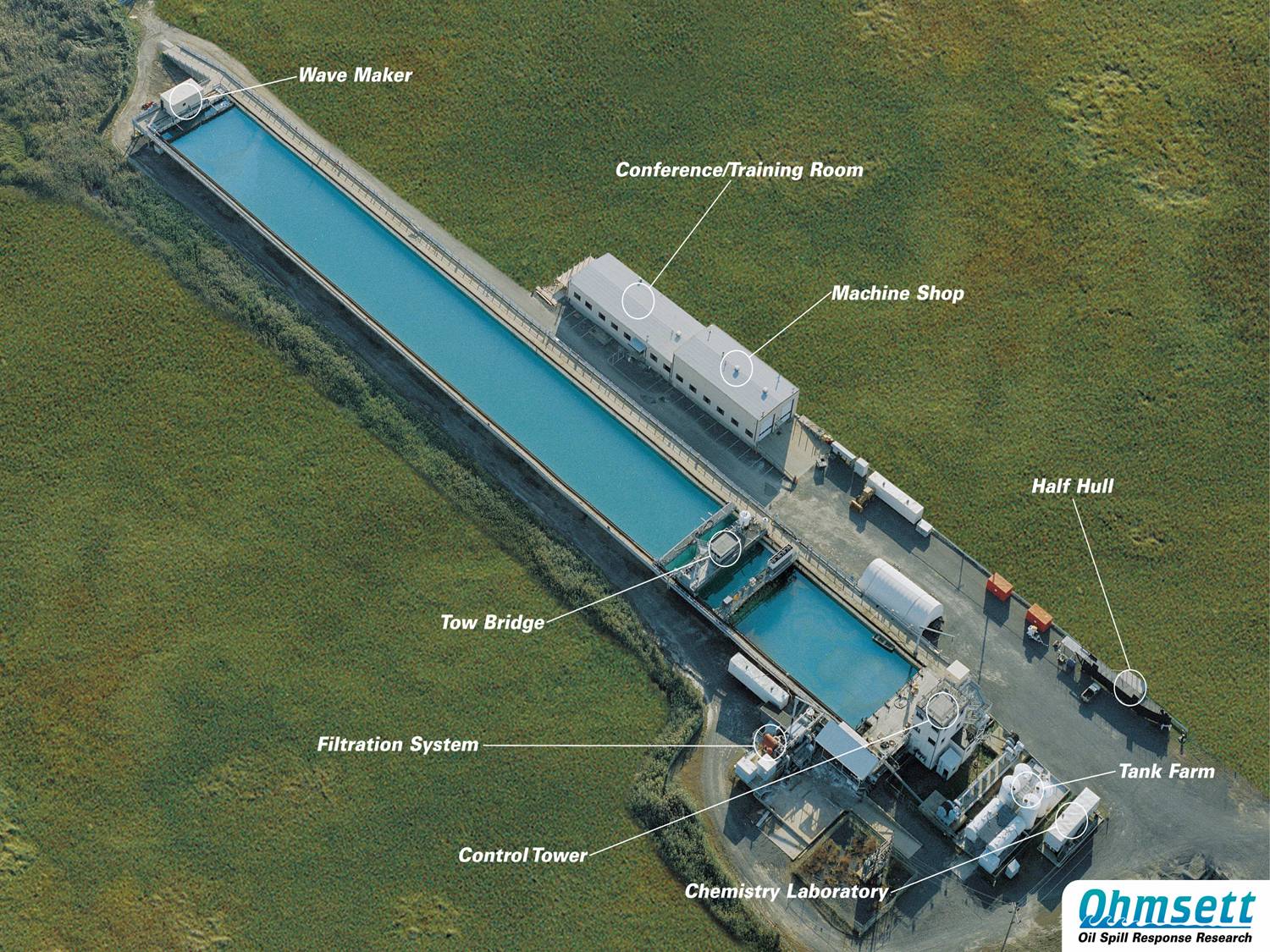
  • Even in the lean years following the Valdez oil spill research surge, the much-maligned MMS continued to conduct important burning, dispersant, remote sensing, and mechanical cleanup studies, while upgrading and expanding the use of the nation’s major oil spill response test facility – Ohmsett (pictured above).  This research was effectively applied during the Macondo spill and smaller, less publicized incidents. Click here for a nice summary of the program and here for the very extensive list of projects and links to the reports. Domestic and international partnerships, most notably with Norway and Canada, helped sustain this important research.
  • Despite periodic attempts to reprogram Ohmsett funding, MMS was able to continue to support this outstanding research facility.  Learn more about Ohmsett.
  • During the blowout, the networks featured the snake oil salesmen and hucksters who peddle super-sorbents and oil-consuming substances during every major spill.  That time should have been given to response experts and serious oil spill researchers.
  • Former industry executives with no real spill response experience trumpeted, without any documentation, claims of extraordinary recovery rates elsewhere (usually in places where no one gets to watch). Their favorite concept, supertanker response systems, received a lot of air time until the “Whale” tanker-skimmer flopped as predicted.
  • You would think that Kevin Costner’s very good separator (tested at Ohmsett in 1999!) was the only advance in response technology. Perhaps more movie and TV stars should get involved with spill response. Charlie (Oil) Sheen would no doubt attract interest to the cause. 🙂

NWS Earle Executive Officer Claudill, Kevin Costner, and Ohmsett Manager Bill Schmidt (1999 photo at Ohmsett)

Read Full Post »

Ohmsett

The top team that demonstrates the ability to recover oil on the seawater surface at the highest oil recovery rate (ORR) and recovery efficiency (RE) will win the $1 million Grand Purse. Second place will win $300,000 and third place will win $100,000 in purses

Are you confident that your innovative oil skimmer is better than the rest?  Now is the chance to prove it.  Amaze the world, win a million bucks, and put yourself in position for some major contracts.  Skimmer vs. skimmer in a challenging test tank competition.

Show us what ‘ya got!  We’ll be watching!

Link for more information.

Read Full Post »

We have heard plenty about Macondo’s real, imagined, and convenient villains, but very little about the heroes.  Let’s pay tribute to them:

  1. First and foremost the eleven men who lost their lives exploring for energy for our economy and security.  Sadly, were it not for the massive spill, their sacrifice would have received little public attention.
  2. The rescue crews who brought the other 115 workers safely to shore.
  3. The responders who worked under difficult conditions to minimize the environmental effects of the spilled oil.
  4. The relief well crews who demonstrated how complex drilling operations should be conducted.
  5. The ROV and well intervention teams.  The performance of the ROVs and subsea tools is perhaps the biggest Macondo success story.  Their pioneering work will be studied in developing the well intervention, capping, and collection plans that will be a part of future drilling programs.
  6. The people of Louisiana, who despite their personal adversity continue to believe that energy, fishing, and other offshore interests can and must co-exist.
  7. The MMS oil spill research program.  In the lean years following the Valdez oil spill research surge, MMS continued to conduct important burning, dispersant, remote sensing, and mechanical cleanup studies, while upgrading and expanding the use of the nation’s major oil spill response test facility – Ohmsett.
  8. The Unified Command scientists who are providing comprehensive scientific data about the effects of the spill, and refuse to be swayed by sensational media reports.
  9. Oil consuming bacteria!
  10. Others?

Read Full Post »

NWS Earle Executive Officer Caudill, Kevin Costner, and Ohmsett Manager Bill Schmidt (1999 photo at Ohmsett)

Leading researchers from around the world are drawn to the Minerals Management Service’s Ohmsett facility at Naval Weapons Station Earle in New Jersey to test their oil spill response theories and equipment.  Kevin Costner’s oil separator, which has received much recent attention, is well known to MMS and Ohmsett. The Costner Industries system is used to separate and recycle  the oil used for Ohmsett testing.  Learn more about Ohmsett including testing capabilities for renewable energy devices.

Ohmsett - Pool of Dreams

Read Full Post »

I haven’t posted recently for a variety of reasons, but I see that folks are still visiting the blog.  Thanks for checking-in.  For those who are formulating their own views about what really happened and why, the documents at the House Energy and Commerce Committee site are mandatory reading.

Also, many thanks to those who have asked about my testimony before the Senate Committee on Energy and Natural Resources.  My statement is here. Kudos to Chairman Bingaman and the very capable committee staff for their thoughtful and professional approach to these hearings.

Read Full Post »

Older Posts »