BOE is reviewing BSEE compliance data and available incident reports for 2022. The Honor Roll companies will be announced later this month. Our preliminary finding is that 9 of the more than 120 operating companies met the high standard that we have established for this recognition. Our criteria:
Must average <0.3 incidents of noncompliance (INCs) per facility-inspection. Note that each facility-inspection may include multiple types of inspections (e.g. production, pipeline, pollution, Coast Guard, site security, etc). On average, each facility-inspection included 3.25 types of inspections in 2022. (Here is a list of the types of inspections that may be performed.)
Must operate at least 3 production platforms and have drilled at least one well (i.e. you need operational activity to demonstrate compliance and safety achievement).
May not have a disqualifying event (e.g. fatal or life-threatening incident, significant fire, major oil spill). Due to the extreme lag in updates to BSEE’s incident tables, investigation and news reports are used to make this determination.
Pacific and Alaska operations are considered separately.
BOE an independent, unsponsored blog that is dedicated to offshore safety, pollution prevention, energy production, effective regulation, and responsible energy policy. If you would like to submit a post, leave a comment to that effect at any time.
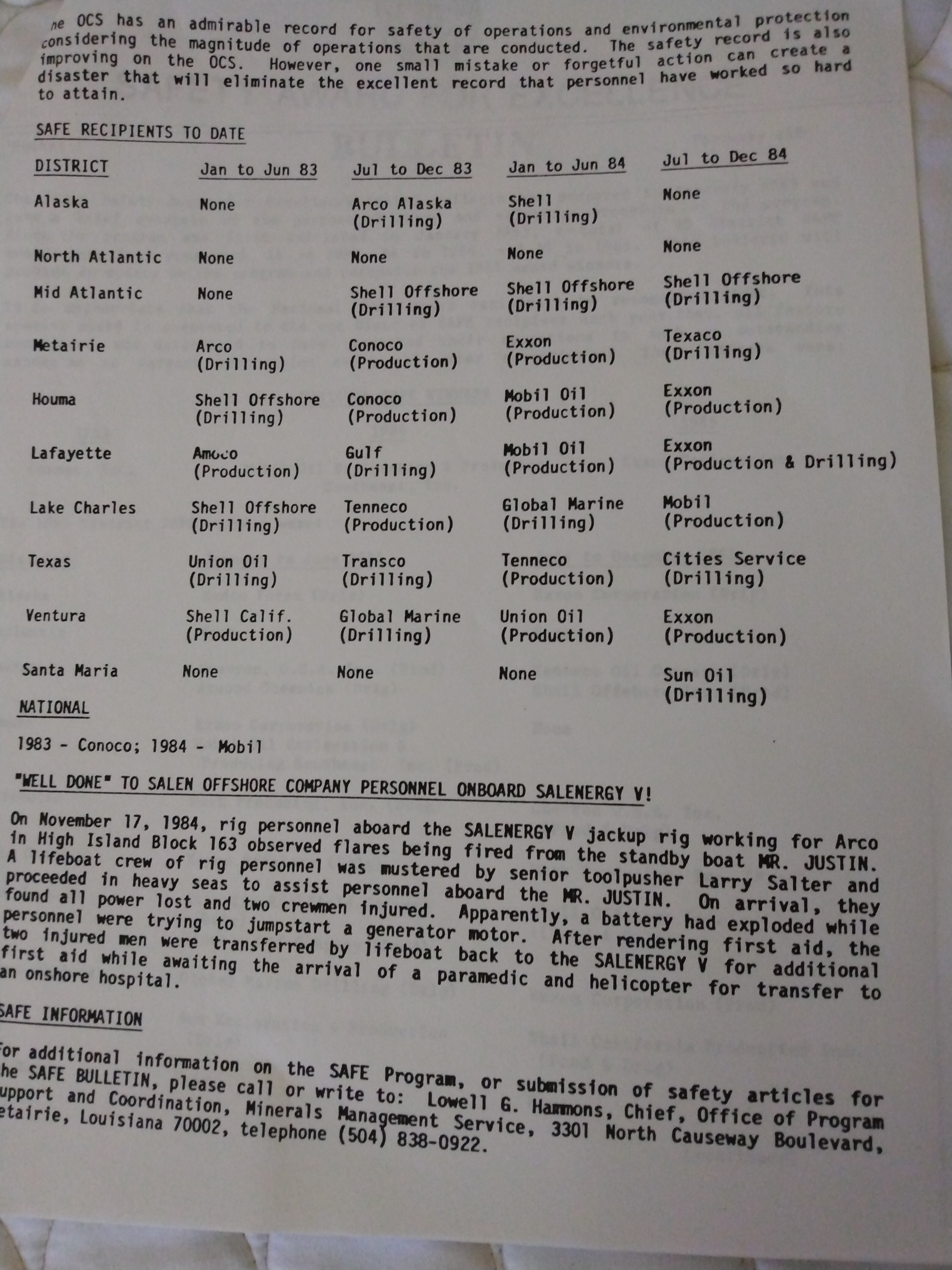
The Safety Award for Excellence (SAFE) program was initiated in 1983 by Lowell Hammons, a senior executive in the Minerals Management Service, the OCS safety regulator at the time. The objective was “to promote interest in and recognition of operational safety and environmental protection on the OCS.” In that regard, the program was highly effective.
Companies could not self-nominate or be nominated by other companies. District winners were selected by MMS district personnel based on compliance and incident data, and inspector evaluations. The national SAFE winner was selected using data and input from all districts. Companies rightfully took great pride in the recognition, and the SAFE program helped drive the development of safety management systems and safety culture initiatives.
Attached is a list of the award winners for 1983 and 1984. Also note the recognition for the Salenergy jackup crew members who rescued injured and endangered personnel from a distressed vessel. Such heroism was not uncommon.
Prior to April 20, 2010, 25,000 wells had been drilled in US Federal waters over the previous 25 years without a single well control fatality, an offshore safety record that was unprecedented in the U.S. and internationally. Well control was the keystone of every operator and drilling contractor’s safety program and the Minerals Management Service regulatory program, which included a pioneering well control research facility at LSU, standards, prescriptive rules, and comprehensive training requirements.
The future of the offshore program was bright. The Obama administration had included an Atlantic OCS lease sale in the 5-year OCS Oil and Gas Leasing Program for 2010-2015. This would have been the first Atlantic sale since 1983. I participated in a hearing held by a Florida Senate committee that was seriously considering oil and gas leasing in Florida State waters. Even in California, there was some support, led by a group known as Stop Oil Seeps, for new offshore exploration and production .
Everything changed on April 20, 2010, when BP’s Macondo well blew out. Eleven workers lost their lives, the most in a single US offshore incident since 1968, when 11 died in a fire and explosion at West Delta Block 23. In the history of the US offshore program, only a 1964 gas blowout (Eugene Island Block 273) caused more fatalities (22). (There were also tragic helicopter crashes in 1977 and 1984 at South Marsh Island Block 128 and Eugene Island Block 190 that killed 17 and 14 offshore workers respectively.) The Macondo blowout was more than a safety disaster, it was also a pollution spectacular that dominated the news for the next 3 months.
Pre-Macondo BP:
As is often the case with large organizations, the BP story is complex. BP said all the right things about safety and environmental protection, and seemed to mean them and practice them. They had comprehensive safety and risk management programs. They were at the vanguard in promoting personal safety among employees including the now common (and sometimes a bit contrived) practice of opening meetings with safety messages. All of that was no doubt consistent with their “beyond petroleum” rebranding (2002). However, the corporate image was badly tarnished by the 2005 Texas City refinery explosion that killed 15 workers and a 5000 barrel pipeline spill on the North Slope of Alaska in 2006.
BP’s deepwater Gulf of Mexico exploration programs had been very successful. BP produced more oil in the 2 years prior to the blowout than any other US offshore operator – 117 million barrels in 2008 and 188 million barrels in 2009. Their 2009 oil production total is still the highest in history for any US offshore operator (something I hadn’t realized until I checked the figures for this post.)
The compliance record for BP’s production facilities in 2008 and 2009 was “beyond” excellent. While BSEE does not publish the details needed to distinguish INCs by facility and operation, my recollection is that inspection of the thousands of components on their production platforms did not result in even a single incident of non-compliance (INC) in 2008, and there were no production safety or pollution incidents. BP was named a finalist for the MMS SAFE Award to be presented at OTC in May, 2009. However, pointing further to their corporate inconsistencies, BP’s drilling compliance record was not as good, and qualitative feedback from MMS inspection personnel indicated some safety and compliance issues. This input may have been a hint at the drilling program management issues that surfaced after the blowout. In light of these concerns about BP’s drilling operations, Devon Energy was presented the National SAFE Award in the “High Activity Operator” category.
I retired from MMS on 1/2/2010 and was thus not involved in the deliberations for the 2009 SAFE Awards. I understand that BP was the leading candidate to be presented the award in May 2010. However, the way the program worked was that finalists in each category were named in advance, but the winners were not announced until the awards luncheon. The reasons for this approach were to build suspense and avoid a situation where the winning company was involved in a significant incident prior to the presentation. This had never been an issue in the 30 year history of this awards program.
In light of the tragic events of April 20, the 2010 SAFE awards luncheon was cancelled, as it most definitely should have been. That said, I remain a strong believer in recognizing safety achievement. The MMS SAFE Awards were the only offshore safety awards determined by the safety regulator based on incident and compliance data and input from inspectors, the people who are most familiar with each company’s operations and the effectiveness of their safety programs. The awards program drew attention to best practices, information sharing, and safety leadership. The recipients and all staff that contributed to the company’s success were rightfully proud of their achievement. You could not nominate yourself or be nominated for SAFE awards; only the companies with the best safety and compliance records were considered. Past performance is never a guarantee of future success, but MMS SAFE Award winners earned the recognition they received and continued to be top performers.
Tomorrow: Macondo revisited, Part 3: The delayed cementing standard
… to be able to speak openly and candidly about issues that have been an important part of my professional life for 50 years. Thankful for our First Amendment rights; they must be protected.
Whether you represent Big Oil, Big Gas, Big Wind, Big Green, Big Climate, Big Stick (regulators 😀), Big Swamp (Washington DC friends 😉), or none of the above, thank you for visiting this modest, independent, and rather obscure blog.
Over the next couple of weeks, I will be posting about an interesting study that links compliance and safety, some unpublished thoughts on the Macondo blowout 12 years later, and comments on the industry push for carbon sequestration in the Gulf of Mexico (sorry advocates, I’m not a fan).
Regardless of your faith, nationality, political views, or thoughts about world events and offshore energy, I hope you have the opportunity to spend time with friends and family this weekend.
The International Regulators’ Forum (IRF) does a good job of compiling safety performance data for offshore oil and gas operations in member countries. Because these data are collected by the respective regulators and compiled in accordance with established guidelines, we consider the IRF compilations to be the most credible international incident summary data for the offshore industry.
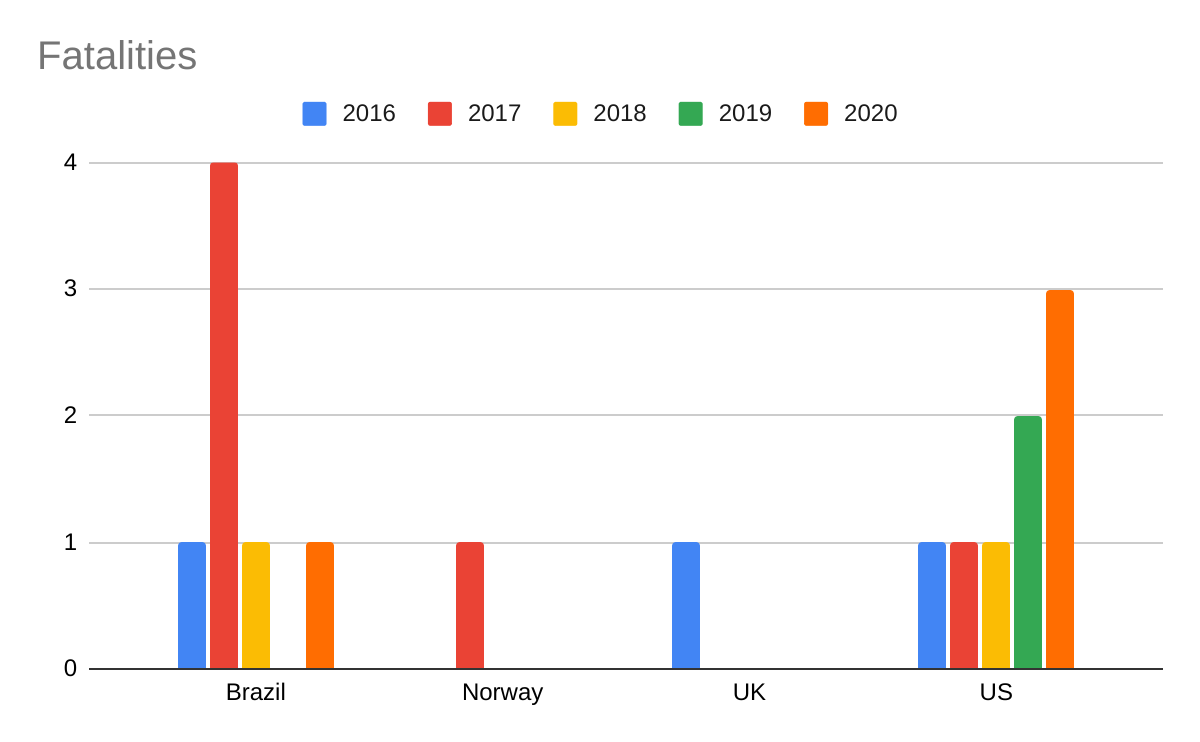
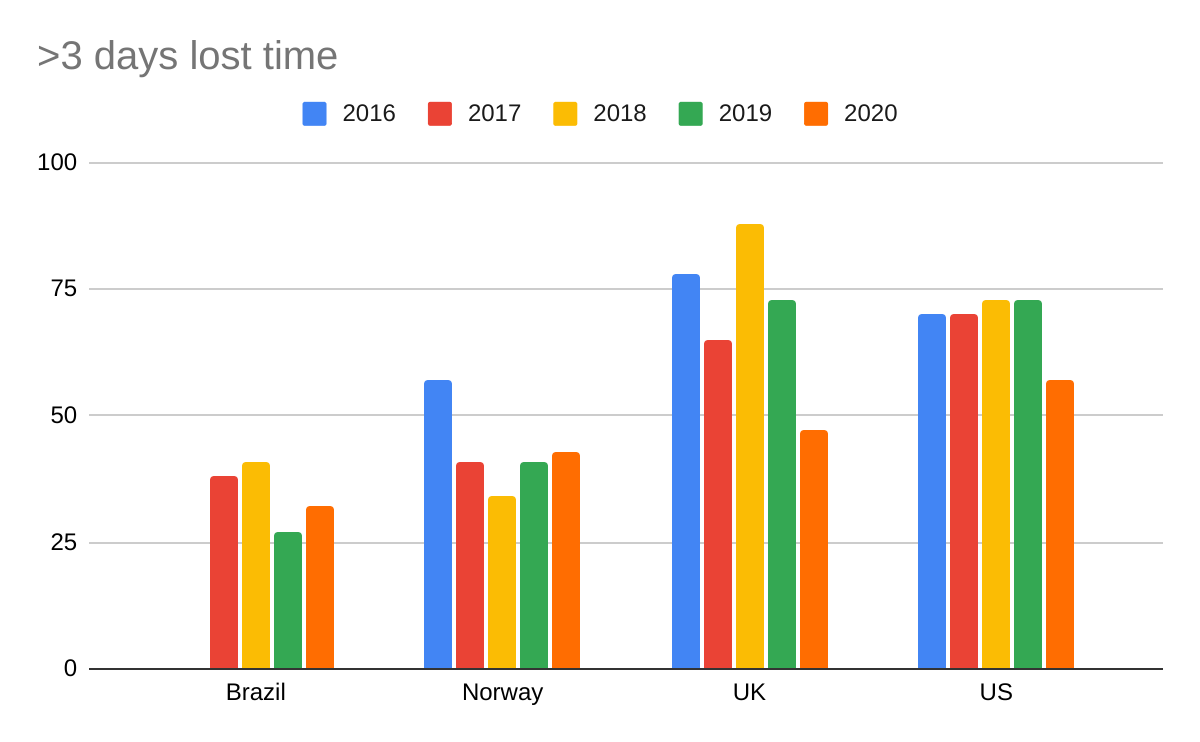
BOE looked at the numbers for the IRF countries with the highest level of activity in terms of hours worked – Brazil, Norway, UK, and US. These countries accounted for 90% of the total hours worked in 2020, the last year for which data are available. The 2020 hours worked (millions) were also relatively similar for the 4 countries: Norway – 41.2, UK – 42.4, US – 50.4, Brazil – 50.7. The differences in hours worked were somewhat greater in the prior years, but not dramatically so.
We charted the fatality and lost-time (>3 days) data (below). Our intent at this point is to draw attention to the IRF data sets, not to assess and compare performance. We do think the overall safety performance in these and other IRF countries, while far from perfect, is quite good given the hundreds of millions of hours worked, complexity of operations, logistical challenges, and difficult operating environments. We recommend that the IRF prioritize the timely posting of these data, and begin providing causation information so that companies and other interested parties can better identify performance issues and safety trends.
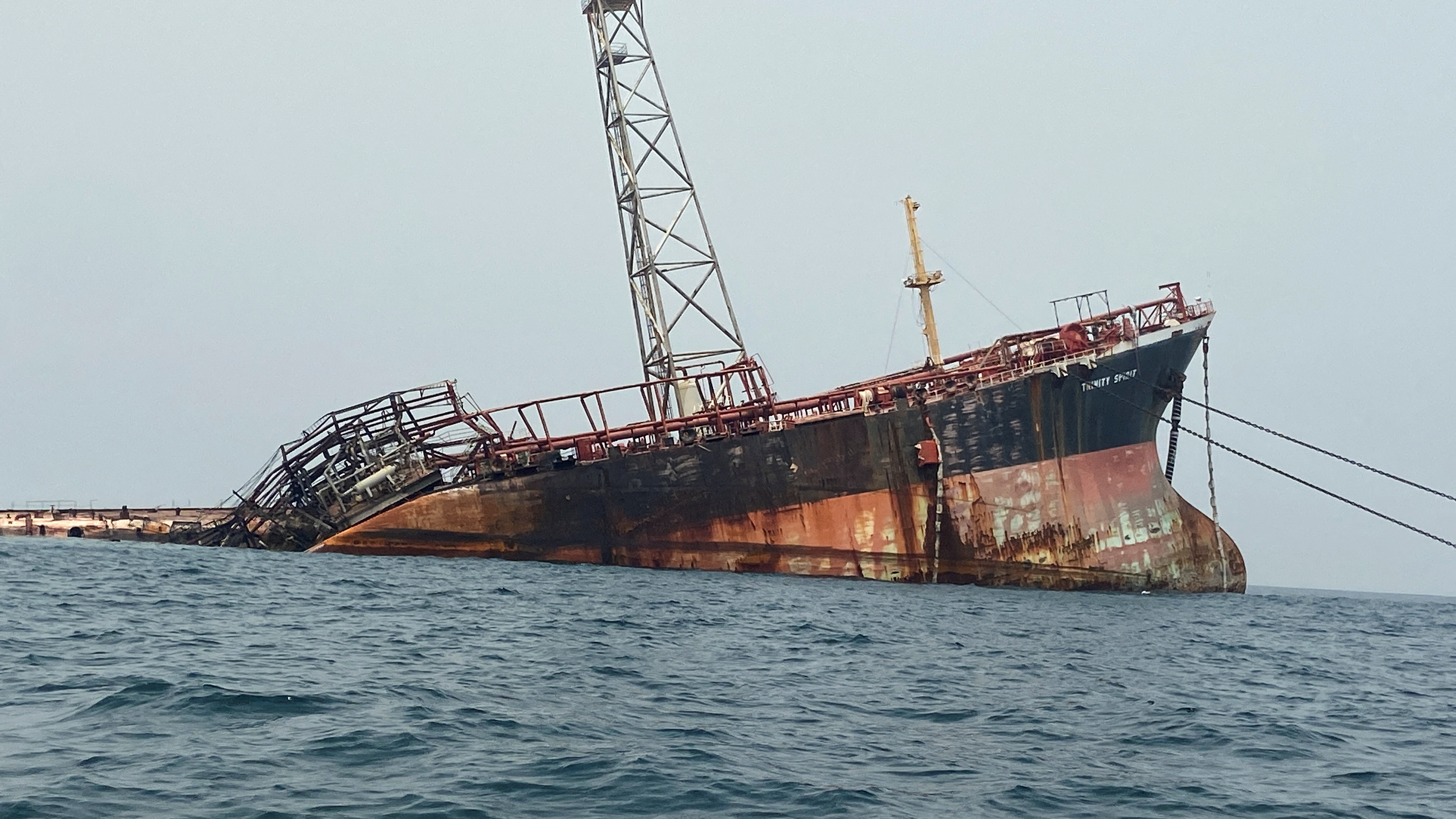
Six weeks after the Trinity Spirit fire, there is still no public accounting of the number of fatalities and injuries. The initial reports were incomplete and inconsistent, even with regard to the number of people on the vessel at the time of the incident.
Linked below is an excellent compliance and incident data update by Jason Mathews. COVID-19 statistics are included. Kudos to BSEE’s Gulf of Mexico Region for their timely and comprehensive reviews and safety alerts.The collection, analysis, and timely publication of incident data are critical to safety achievement and continuous improvement.



 Bud's Offshore Energy (BOE)