Feeds:
Posts
Comments

Posts Tagged ‘Magne Ognedal’

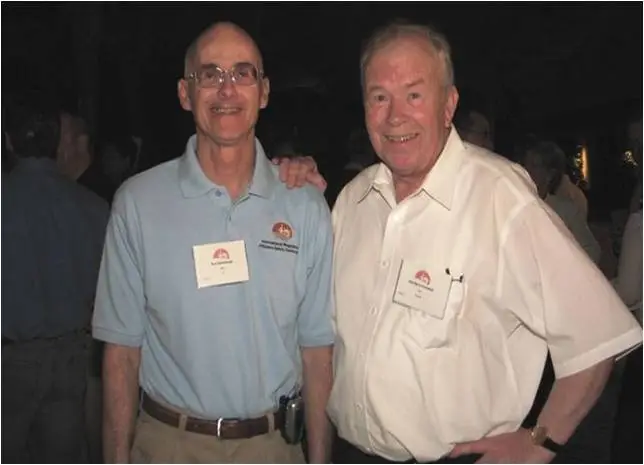
Bud and Odd (2008 photo)
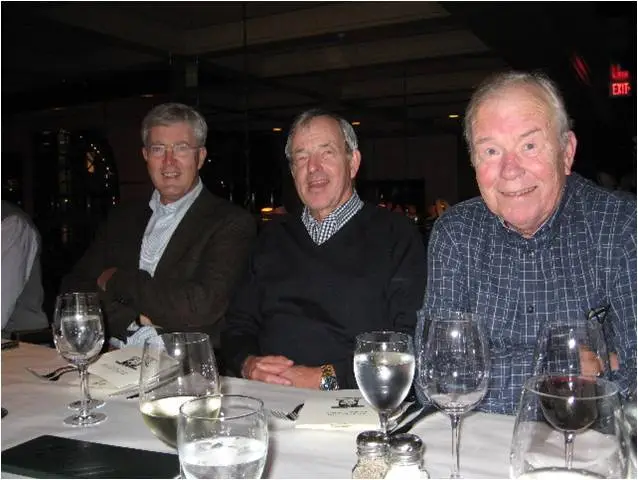
L to R: Jan de Jong (Inspector General, State Supervision of Mines, the Netherlands), Max Ruelokke (CEO, Canada – Newfoundland and Labrador Offshore Petroleum Board), and Odd FInnestad

Yesterday, I learned that Odd Bjerre Finnestad passed away on Christmas Eve, 2021. Odd was an international safety leader, a founder of the International Regulators’ Forum (IRF), and a driving force behind the IRF book, “A legacy of safety.”

In 2003, the US Minerals Management Service honored Odd, two other Norwegians, Magne Ognedal and Gunnar Berge, and Taf Powell from the UK, with International Leadership Awards for their outstanding leadership in facilitating the exchange of information among offshore regulatory agencies, encouraging cooperation on offshore safety and pollution prevention issues, coordinating participation in the development of international standards, cooperating on safety audits and research projects, compiling incident data, exchanging training information and discussing materials and equipment issues.

Odd was also an important contributor to this blog during the difficult times following the Montara and Macondo blowouts in 2009 and 2010.

Pasted below is the English language version of the excellent obituary that appeared in the Stavanger Aftenblad. RIP Odd; your impressive contributions to offshore safety are greatly appreciated.

Memorial: Odd Bjerre Finnestad died on Christmas Eve 2021, aged 79.
Odd was employed by the Norwegian Petroleum Directorate (OD) in 1980, later the Petroleum Safety Authority (Ptil) when resource and safety management was divided into two agencies in 2004. He worked there until his retirement in 2013.

Born in the maritime city of Stavanger, he chose a maritime career. As a young naval officer, he met his Anna Dorothy in Londonderry in Northern Ireland. They married in 1967, and our thoughts go out to her and the rest of the family today.
His maritime education and experience led Odd to a scholarship position at the Norwegian Institute of Maritime Research and a research program focusing on personal safety at sea. This was an important experience as head of the Section for Worker Protection and the Working Environment in NPD.

Even though most of the Working Environment Act had been applied to permanent installations on the Norwegian continental shelf as early as 1977, demands for employee participation and tripartite cooperation met resistance in parts of the industry.

Odd took on the big challenges with great commitment. On the drilling deck there was still something of the cowboy culture, where safety and the working environment had poor conditions. Several of the residential quarters appeared to be barrack-like accommodation and little had yet been arranged for women in the new industry.

He was concerned that the professional environment should have professional diversity, and that the work should be anchored in research and development. At a time when the share of women offshore was minimal, he was a driving force behind realizing the film project “Norwegian continental shelf – also for women”.

The major accidents with the Bravo blowout in 1977 and the Alexander L Kielland disaster in 1980 had documented the risks in the business in the worst possible way. With these as a backdrop, he participated in the work to develop a new supervision scheme with subsequent information work. This laid the foundation for a three-year engagement at the International Labor Organization (ILO) in Geneva from 1989, where he worked on a global study on various inspection regimes related to the working environment.

For the rest of his professional life, Odd was closely linked to international cooperation at government level. The most important arena was the International Regulators ́ Forum (IRF) where the Ptil director represented the Norwegian authorities. The forum meets annually, but much of the work takes place through ongoing contact between the participating countries. This is where Odd’s ability to see connections and make strategic contacts came in handy. He actively contributed to the IRF developing a culture for rapid and effective exchange of information on risk levels, regulations and supervision.

Odd monitored all channels almost around the clock, in order to convey news of interest. Often before these were picked up by the world press. He thereby also became an important contributor to Ptil’s information environment.

It is a pioneer in Ptil’s role as watchdog and promoter of safety and the working environment in the petroleum industry who has now passed away. We will remember Odd as a committed colleague and friend.


Read Full Post »

Remembering the 123 offshore workers who lost their lives on this day in 1980 in one of the offshore industry’s great tragedies 🙏

See the excellent interview with Magne Ognedal that describes the evolution of Norway’s highly regarded offshore regulatory regime following the Alexander Kielland tragedy.

Photo: Norwegian Petroleum Museum

Read Full Post »

BOE applauds retired offshore regulators Ian Whewell (UK HSE) and John Clegg (NOPSA Australia) for their excellent participation in yesterday’s hearings. No one is wiser than a retired regulator. 😉

Also, Magne Ognedal overcame technical glitches to make an important long-distance contribution from Norway.  Those who have not yet read our interview with Magne should take the time to do so.  In this interview, which was conducted before Macondo, Magne concisely answers most of the questions about the Norwegian regime and regulatory philosophy that have arisen since the blowout.

Read Full Post »

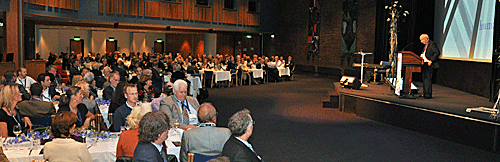
Firstly, major kudos to the Canadians for organizing a great conference in Vancouver, a wonderful city.  The Newfoundland-Labrador and Nova Scotia Petroleum Boards, and the National Energy Board were outstanding hosts, and Max, Howard, Stuart, Sean, Bharat, and the folks at Venue West did a great job with the arrangements. The International Regulators’ Offshore Safety Conference was a huge success thanks to their efforts.

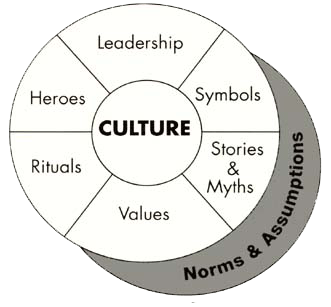
The international leaders in Vancouver were in full agreement that the key to long term safety achievement is the strength and vitality of the safety culture in the operating companies, contractors, and regulatory organizations.  How is such a culture encouraged and achieved?  As NOPSA CEO Jane Cutler has said “safety culture is what you do when no one is watching.”  Inspections are a necessary regulatory tool, but if they are too frequent they send the message that the government is responsible for safety, and that operators and workers can relax their guard.  As Magne Ognedal (PSA-Norway) has frequently said, safety must be managed by the “owner” of the facility and the risk, with the government holding the owner accountable and insisting on excellence.

Steve Walker, UK HSE chief, said that regulators must encourage a “beyond compliance” culture and serve as catalysts for learning and achievement. Regulators can never be satisfied; they should be negative thinkers searching for the operations, processes, and behaviors that might trigger the next major accident.  Dr. Mark Fleming from St. Mary’s University in Halifax believes that safety culture can in fact be regulated, not in the traditional sense, but by requiring companies to have systems in place for promoting and measuring the organizational culture.

Regulators must also look at their own safety culture.  Are they focused solely on compliance and “command and control,” or are they investigating risks, assessing management programs, and evaluating performance?  Are regulatory employees free to investigate and inquire, or are they mere implementers of management directives?  Are employees rewarded for sustaining the hierarchy or challenging  the status quo?  Are they expected to explain why accidents can’t happen again or figure out how they can?

Much more on these and other Vancouver topics in the near future.

Read Full Post »

BOE does not officially resume posting until 30 August, but we wanted to make sure you were aware of Magne Ognedal’s recent remarks to Upstream

“It is very frustrating,” Ognedal said. “We do not have the information we need to finish the job. We know from the transcripts of the inquiry that the Macondo and Montara blowouts appear to have very similar causes.  However we cannot draw any conclusions until we have access to the report.”

I also suggest that you read the text of Magne’s excellent speech during the Safety Luncheon at ONS in Stavanger.

Magne Ognedal Addresses ONS Safety Luncheon

Read Full Post »

Dette kan skje igjen (This could happen again)~ Magne Ognedal, Director General, Petroleum Safety Authority Norway

Magne’s quote in the Stavanger Aftenblad acknowledges that tragic accidents like the Macondo/Horizon blowout or Alexander Kielland sinking could happen again (see English translation of full article by BOE Europe Chief Odd Finnestad).  Magne goes on to say:

We must appreciate there are risks associated with our petroleum activities, and in our yearly risk assessments we attempt to put in concrete terms what those inherent risks are.  It is up to our national political system to determine whether this risk picture should be accepted or not.

and

We must endeavor to learn from whatever happens around the world, and if there is something that is also relevant to Norway we must apply those lessons, both regulators and industry

Industry and government officials would be wise to follow Magne’s lead and avoid “can’t happen here” statements.  A few of these statements were made in the US after the Montara (Timor Sea) blowout, and we know how that worked out.

Some very experienced and capable offshore managers have had “there but for the grace of God go I” moments in the wake of this disaster.  They know that this is not the time for boasting, piling-on, or schadenfreude.  Like Magne, real leaders are focused on monitoring the investigations, studying the findings and recommendations, and applying the lessons as necessary to further reduce their operating risks and the risks of others who conduct offshore oil and gas operations.

Read Full Post »

My experience is that you unfortunately often need a major accident or even a disaster to engender political support for streamlining regulatory regimes.   Moreover, history shows that major accidents apparently must happen in your own jurisdiction to have such an effect on political support. Magne Ognedal

Magne’s astute comment repeatedly came to mind while I was reading the Montara testimony.  Our political systems are good at reacting, but are not so good at making tough decisions when the spotlight is elsewhere.  Crises provide the political capital needed to make major changes, but seldom yield the best solutions.

Will the Montara blowout provide the impetus needed for other countries to review and improve their offshore regulatory regimes?  These Montara issues should be of concern to all of us:

  1. Multiple regulators with unclear divisions of responsibility
  2. Regulatory gaps and overlap
  3. Ineffective use of standards and best practices
  4. Lack of clarity regarding operator and contractor responsibility and accountability
  5. Balancing goal-setting with prescription
  6. Monitoring operations effectively without taking “ownership”
  7. Applying regulatory resources efficiently and where the risk is greatest
  8. Absence of meaningful performance measures for operators and regulators
  9. Authority to remove rogue operators
  10. Ability to update standards and regulations in a timely manner
  11. Weaknesses in training programs for operators, contractors, and regulators

I’ll stop at ten (now eleven :)).

Many of these issues will be discussed at the International Regulators’ Offshore Safety Conference in Vancouver (18-20 October). I hope you plan to attend!

Read Full Post »