Feeds:
Posts
Comments

Posts Tagged ‘macondo’

the Mexican government’s recent decision to anoint Pemex operator of the billion barrel Zama field would seem to merit further scrutiny. Houston-based Talos Energy discovered the Zama field in 2017. The field underlies both Pemex and Zama acreage, and there are common reservoirs. Per Bloomberg:

Mexico’s energy ministry has designated Petroleos Mexicanos as the operator of the country’s largest oil discovery by private companies, in the latest sign of the government’s nationalist approach to the energy industry.

Talos said it was “very disappointed” with the decision and will explore “legal and strategic options” regarding Zama. The company added that the energy ministry had informed Talos of its “sudden” decision only three days after the driller received a letter directly from Pemex arguing for operatorship.

Bloomberg, 7/5/2021

The Mexican government’s decision is indicative of the Lopez Obrador administration’s commitment to rolling back the reforms that had encouraged private sector participation in Mexican offshore exploration and development.

Questions had already been raised about Pemex’s ability to fund Zama development and operate the field safely. This week’s deadly incident and a July pipeline fire add to those concerns. In light of the background political and financial issues, will it be possible to for Pemex and the Mexican regulators to conduct a fully independent investigation of the tragic fire that just occurred?

Read Full Post »

Phil Rae piece in Fuel Fix

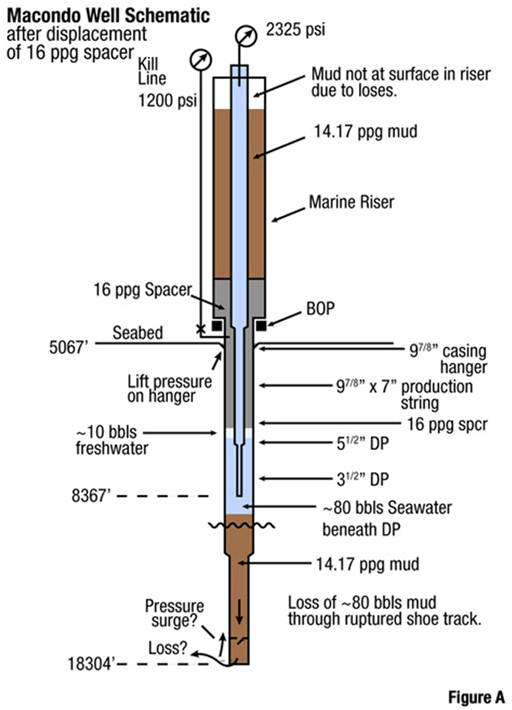
  1. The well clearly had losses through the shoe during the initial displacement of the heavy spacer with seawater, immediately prior to the negative test.
  2. Allowing for, and accepting, losses of ~80 bbls during spacer displacement, explains ALL pressure and flow anomalies without the need to create or invoke undocumented and unsubstantiated valve closures or manipulations that contradict witness testimony of events. It also eliminates the need to adopt unrealistically-low pump efficiencies for the rig pumps, hypothetical washed-out tubing and ridiculously high viscosities for the drilling mud, in an effort to fit questionable computer models.
  3. Despite extensive examination by investigators and the publication of several reports, the fact that the well experienced losses, making it even more severely underbalanced than was planned, has been given little credence or has received little or no attention, despite several clear indications that this was the case. While this statement regarding losses may be self-evident, its significance on the outcome at Macondo merits closer examination since it explains many previous, apparently-contradictory aspects of the disaster.
  4. Under-displacement of heavyweight spacer, as a result of losses during displacement, caused U-tubing and partial evacuation of the kill line, the lower end of which was later refilled with heavyweight spacer, driven by pressure and flow from the formation. The vacuum, initially, and subsequent invasion of heavy fluid rendered the kill line useless for monitoring the well since the line was effectively blind to pressure changes in the well.
  5. While initial flow into the well was through the shoe, pressure above the casing hanger seal during the negative test was reduced to levels that could have allowed the casing to lift, compromising the seal and possibly also allowing flow from the external annulus.
  6. The well encountered further losses during the second displacement (to displace the riser), after completion of the negative test. These losses, which were perhaps as much as 200 bbls, effectively replaced heavy mud with sea water in the casing below the drill pipe. This further underbalanced the well to the point that it was being kept under control only by pumping friction pressure. As the pump rate was reduced prior to shut down for the sheen test, effectively reducing system backpressure, the now severely underbalanced well began to flow.

Read Full Post »


oil-eating bacteria

Woods Hole Oceanographic Institute scientists have published important new findings on the rapid bacterial degradation of the Macondo spill.

They found that bacterial microbes inside the slick degraded the oil at a rate five times faster than microbes outside the slick—accounting in large part for the disappearance of the slick some three weeks after Deepwater Horizon’s Macondo well was shut off.


Read Full Post »

Dauphin Island tarballs, May 2011

Cheryl’s update after reviewing the latest reports:

  • There is a USCG unified command specific to BP spill residue after storms.
  • The tarballs are not considered toxic, just an unattractive nuisance.
  • Tarball cleanup on Dauphin Island was halted on May 1 to protect nesting birds.
  • BP estimates a total Macondo spill volume of about 4 million bbl as opposed to the government estimate of 4.9 million bbl.
  • BP estimates that 850,000 barrels were captured, burned or skimmed off the water.
  • 1,260 people remain employed in spill cleanup as of [July 14, 2011], down from a peak of 48,200 a year ago

Articles of interest:

Alabama.com

WALA New Orleans

Bloomberg Business Week 

Read Full Post »

Much ado about nothing courtesy of the Associated Press:

Copies of the forms submitted by more than 100 inspectors, engineers and permit reviewers in five Gulf coast offices were obtained by the AP under the Freedom of Information Act. Personal information, such as the names of the employees, their friends and their family members, was blacked out to protect privacy. But the companies with ties to government workers were disclosed, and they represent a who’s who of the offshore oil and gas industry, from majors like Chevron, Shell and BP to smaller companies such as W&T Offshore Inc., Ankor Energy LLC and Hilcorp Energy Co.

So yesterday we linked an article about proposed legislation that would, among other things, require that offshore inspectors have “at least three years experience in the oil and natural gas field.” Today, we read contradictory (and silly) comments like the one below in the AP piece that criticize such experience. How would you like to be an oil and gas inspector or prospective offshore regulator?

“It’s nearly impossible to determine where the oil industry ends and the government’s regulatory agency begins,” said Scott Amey of the Project on Government Oversight, after reviewing AP’s data. “These new instances indicate that BOEMRE staff are connected to individuals and oil companies, which raises concerns about lax oversight and the integrity of the agency. Without enhanced enforcement authority and independent oversight of these potential conflicts, I’m uncertain that BOEMRE can assure the public that it is truly watchdogging the offshore oil industry.”

Give these people a break. I have seen absolutely no evidence that improper government-industry relationships or compromised inspections had anything to do with the Macondo blowout or any other recent incident. Inspection and engineering personnel are under continuous scrutiny well beyond what most employees would accept, and recuse themselves from assignments if there could be even a perception of a conflict of interest.

The US offshore program, and every other safety regulator, needs people who understand the operations and technology that they regulate. These regulators need to communicate regularly with industry personnel on operational and regulatory issues. Too little interaction with their professional peers is a greater danger than too much. You don’t advance safety technology and procedures, and resolve concerns, without communication.

DOI offshore personnel have had and will continue to have more than enough oversight; time to move on to another cause.

Read Full Post »

Very interesting findings for those interested in the fate of spilled oil:

The deep sea entrainment of water-soluble hydrocarbons has far-reaching implications for deep water oil spills. Our results demonstrate that most of the C1-C3 hydrocarbons and a significant fraction of water-soluble aromatic compounds were retained in the deep water column, whereas relatively insoluble petroleum components were predominantly transported to the sea surface or deposited on the seafloor, although the relative proportions are not known.

The resulting apportionments of hydrocarbon transfers to the water column and atmosphere are therefore very different for a deep water oil spill versus a sea-surface oil spill. During seasurface oil spills, highly water-soluble components such as BTEX, C3-benzenes, and naphthalene quickly volatilize and are rapidly lost to the atmosphere within hours to days, thereby limiting the extent of aqueous dissolution into the water column. In the case of the Deepwater Horizon oil spill, however, gas and oil experienced a significant residence time in the water column with no opportunity for the release of volatile species to the atmosphere. Hence, water-soluble petroleum compounds dissolved into the water column to a much greater extent than is typically observed for surface spills.

Read Full Post »

I don’t buy the argument that industry and regulators have paid too much attention to personal safety at the expense of process safety. Casualties from falls, falling objects, helicopter crashes, and other workplace activities have been persistent, and safety management programs must emphasize practices and procedures that will reduce occurrence rates.

Also, process safety has hardly been ignored. API RP 14 C has proven to be an effective safety analysis procedure for addressing undesirable events associated with each process component of a production facility.  For more complex facilities, Deepwater Operating Plans and API RP 14J, “Recommended Practice for Design and Hazard Analysis for Offshore Production Facilities, ” are good risk management supplements to RP 14C.

That said, we need better programs for sustaining the focus needed to further reduce the probability of low frequency, high consequence events.  When memories about the most recent disaster start to fade, what do we do to keep workers on edge and prevent complacency? What more can be done to prevent events with enormous consequence potential?  Some thoughts:

  1. Establish programs to remind employees about past disasters – how they happened and how they could have been prevented. How many offshore workers know the chain of events that led to the Santa Barbara blowout, Ocean Ranger sinking, Alexander Kielland capsizing, Piper Alpha fire and explosion, Ixtoc blowout, and other historic incidents? When discussing international incidents, we need to explain how our facilities or region might have been vulnerable under similar circumstances.
  2. Present information on minor incidents that could have escalated into disasters, emphasizing what could have gone wrong and why.
  3. Don’t just focus on the last disaster.  While addressing the operational and organizational issues that surfaced at Montara and Macondo, we also must assess incident data and identify activities and practices that could lead to the next disaster.
  4. Operators should not rely on the regulator to manage their operations. Reading about Montara and Macondo, one senses that the regulators were called on to referee internal company disputes and protect the operators and contractors from themselves.
  5. Regulators should not be making day-to-day operating decisions. Regulators should make sure that the regulations are clear and that operators have effective management procedures for adjusting programs as new information is obtained. Regimes that provide for regulator approval of each activity or adjustment promote operator complacency and are not in the best interest of safety over the long term.
  6. Service companies and contractors must challenge operators and regulators.  Operators should expect contractors to think and question, not to simply execute orders. There are impressive examples of contractors insisting on safety improvements, and being willing to forego business rather than compromise on safety.
  7. All sectors of the offshore industry should participate in standards development. Effective standards are dependent on diverse input.
  8. Industry and government leaders should promote innovation. Obvious weaknesses should be identified and industry should be challenged to propose solutions. For example, why do concerns about “false alarms” preclude automatic alarm activation (see Transocean’s Macondo report)? Data from redundant sensors can be analyzed by predictive software that is capable of quickly identifying real events. Similarly, why have advances in BOPE, including monitoring systems, been so slow? Why are BOP capabilities still poorly understood? Why are well integrity and casing pressure issues (producing wells) so common?

Read Full Post »

Links

Animation of Transocean’s BOP analysis

Transocean’s BOP Defense:

Forensic evidence from independent post-incident testing by Det Norske Veritas (DNV) and evaluation by the Transocean investigation team confirm that the Deepwater Horizon BOP was properly maintained and did operate as designed. However, it was overcome by conditions created by the extreme dynamic flow, the force of which pushed the drill pipe upward, washed or eroded the drill pipe and other rubber and metal elements, and forced the drill pipe to bow within the BOP. This prevented the BOP from completely shearing the drill pipe and sealing the well.

In other words, Transocean contends that properly maintained BOPE was not up to the task of shutting-in and securing a high-rate well. If true, this finding has significant implications for the offshore industry.  I’m looking forward to reading the government’s findings on the BOP failure when the Joint Investigation Team report is issued next month.


Read Full Post »

BP settled Macondo litigation with Weatherford, manufacturer of the float equipment equipment used in the Macondo well. The failure of this equipment was a key contributing factor in the Macondo blowout. Under the agreement, Weatherford will pay BP $75 million.  This money will be applied to the $20 billion Macondo trust fund.

Weatherford is the first of BP’s contractors to formally agree with BP that the entire industry can and should learn from the Deepwater Horizon incident. Accordingly, Weatherford has committed to working with BP to take actions to improve processes and procedures, managerial systems, and safety and best practices in offshore drilling operations. BP and Weatherford will encourage other companies in the drilling industry to join them in this improvement and reform effort.

Comments:

  1. $75 million seems like a rather modest payment by Weatherford given the magnitude of Macondo damage costs. BP will “indemnify Weatherford for compensatory claims resulting from the accident.”  Presumably, Weatherford’s sales agreements provide good legal protection.
  2. One of the root causes of the Montara blowout was also a float collar failure. That float collar was also supplied by Weatherford.  I’m surprised that this common cause and supplier have received almost no attention. Of course, no one has paid much attention to Montara, either before or after Macondo. Had more attention been paid to the Montara inquiry, Macondo might have been avoided.  (Note that most of the post-Macondo commentary still implies that deep water is the threat even though Montara was in 80 m of water and the root causes of Macondo were not water depth related).
  3. When do we learn more about the “improvement and reform effort” described in the quote above?

Read Full Post »

High-ranking congressmen made a concerted effort to financially distance themselves from BP in the aftermath of the Deepwater Horizon oil spill, either by reducing or altogether dumping their stock holdings, according to a Center for Responsive Politics analysis of lawmakers’personal financial disclosure documents released Tuesday. 

House Speaker John Boehner (R-Ohio) and Sen. John Kerry (D-Mass.) gave up all or a significant amount of their holdings in BP after the 2010 spill, which leaked an estimated 205 million gallons of oil in the Gulf of Mexico and killed 11 oil platform crew members in the initial explosion. Open Secrets Blog

Financial decision? Moral leadership? Fear of guilt by association? Washington front-running? Political weakness? I wonder where they reinvested their money.

More on lawmakers’ finances.

Read Full Post »

« Newer Posts - Older Posts »