
Decision Making Within the Unified Command
The Use of Surface and Subsea Dispersants During the BP Deepwater Horizon Oil Spill
The Challenges of Oil Spill Response in the Arctic
The Amount and Fate of the Oil
Posted in accidents, well control incidents, tagged accidents, blowouts, Deepwater Horizon, drilling, Gulf of Mexico, macondo, National Commission, offshore oil, safety, well control on October 6, 2010| Leave a Comment »
Posted in accidents, well control incidents, tagged accidents, blowouts, Deepwater Horizon, drilling, Gulf of Mexico, macondo, offshore oil, safety, well control on October 6, 2010| Leave a Comment »
Absent live streaming or television, the Times Picayune seems to be providing the best coverage of the Coast Guard – BOEM Macondo hearings in New Orleans. While the legal sparring has attracted the most press interest, two other items in this Times Picayune article caught my attention.
Part of Keplinger and Fleytas’ duties was to monitor indicators of gas detectors and alarms from the bridge. Keplinger was busy showing visiting BP and Transocean officials a video-game-style simulator for 45 minutes to an hour before the explosions, he said, but he insisted that Fleytas was keeping him abreast of readouts of the rig’s systems.
Comment: Just as school teachers shouldn’t have been flying in the space shuttle, “tourists” shouldn’t have been visiting a complex drilling operation when the crew was in the process of setting production casing and suspending a potentially dangerous well. While the visit was well-intended, the last thing the crew needed on that night was to be distracted by a group of corporate executives. The distraction they caused was comparable to driving on a dangerous highway while getting text messages from your boss. Visiting windows should be limited to relatively low-risk operations (e.g. when drilling ahead prior to reaching target intervals), and these windows should immediately close if complications develop.
Keplinger flashed some anger at Capt. Curt Kuchta, captain of the Deepwater Horizon rig, during his testimony. He noted that a fellow rig worker, Chris Pleasant, had to ask Kuchta three times whether to disconnect the rig from the wellhead before he got the go-ahead.
Comment: One of the benefits of drilling from a floating and dynamically positioned rig is the ability to move off location if trouble arises. The failure to disconnect the riser and move away from the well at the first indication of flow contributed significantly to the tragic consequences. The technical and human factors that prevented such a disconnect must be thoroughly examined.
Further comment: The absence of live streaming of these important safety hearings is inexcusable. If a senator or governor were testifying, I expect that the cameras would be there.
Posted in accidents, well control incidents, tagged accidents, Australia, blowouts, BOEMRE, Coast Guard, cspan, Deepwater Horizon, drilling, Gulf of Mexico, macondo, Montara, offshore oil, oil spill, well control on October 5, 2010| 2 Comments »
Posted in Regulation, tagged Australia, Jane Cutler, leadership, macondo, NOPSA, safety on October 3, 2010| Leave a Comment »
I’m privileged to work with some great people who are passionate about improving safety. This role within NOPSA provides me with a great opportunity to make a difference and allows me to foster a really proactive work culture, removing obstacles that make it harder for people to do their work well.
Almost everyone involved with offshore safety is passionate about their work and wants to make a difference. Unfortunately, they are often frustrated by administrative and organizational processes that prevent them from identifying and addressing important safety issues in the most effective and efficient manner. While there has been much post-Macondo talk about safety policy, there has been little discussion about the organizational constraints that stifle initiative and creativity within regulatory programs. The focus should be on enabling bright and dedicated people to create and sustain an optimal regulatory environment for safety achievement by the operating companies and their contractors.
Posted in accidents, well control incidents, tagged accidents, blowouts, David Dykes, Deepwater Horizon, drilling, Gulf of Mexico, Hung Nguyen, investigation, Jason Mathews, Kirk Malstom, macondo, offshore oil, safety, Sylvia Murphy, well control on October 2, 2010| Leave a Comment »
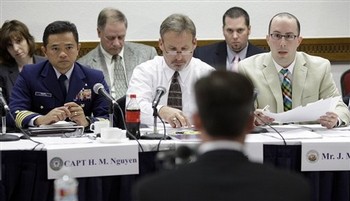
Capt. Hung Nguyen, David Dykes, and Jason Mathews question the witness. Sylvia Murphy and Kirk Malstrom monitor attentively from the 2nd row.
I would assume that one of the CSpan stations will be covering the hearings, but their broadcast schedule for next week has not yet been posted.
Posted in accidents, Offshore Energy - General, Regulation, tagged accidents, blowouts, Deepwater Horizon, drilling, macondo, offshore oil, regulations, safety, safety management, SEMS, well control on September 30, 2010| 2 Comments »
Today, BOEM released fact sheets describing the Drilling Safety and Safety and Environmental Management (SEMS) rules. The complete documents will be available for review as soon as they are published in the Federal Register.
Based on the fact sheet, the Drilling Safety Rule does not appear to include any significant surprises. The rule seems to be generally consistent with the recommendations in Secretary Salazar’s 27 May Safety Measures Report to the President (the “30-Day Report”). This is an Interim Final Rule that will be effective upon publication.
According to the fact sheet, the SEMS Rule will incorporate all elements of API RP 75 into BOEM regulations. This is an improvement, in my opinion, from the proposed rule which incorporated only 4 elements of RP 75. The effective date for this rule is not indicated in the fact sheet.
Posted in Uncategorized, tagged accidents, Australia, blowouts, Canada, macondo, Newfoundland, NOPSA, offshore oil, safety, safety culture, well control on September 30, 2010| Leave a Comment »
Safety culture is how the organization behaves when no one is watching.
Also, NOPSA’s September Newsletter has some interesting updates including information on the jackup failure offshore China.
And how does a reporter question the humility of engineers? 🙂
Engineers do amazing things, but they aren’t always as smart as they think, nor their systems as robust as they seem on paper.
Posted in cuba, tagged accidents, cuba, Gulf of Mexico, hurricanes, macondo, mooring, offshore oil, oil spill, safety on September 30, 2010| Leave a Comment »
 In our last Cuba update, we noted that their next deepwater well always seems to be a year away. So it came as no surprise when we saw this in a New York Times article:
Yet next year, a Spanish company will begin drilling new wells 50 miles from the Florida Keys — in Cuba’s sovereign waters.
Comment: We have been hearing this for five years. Will the well really be spudded next year?
The nascent oil industry in Cuba is far less prepared to handle a major spill than even the American industry was at the time of the BP spill. Cuba has neither the submarine robots needed to fix deepwater rig equipment nor the platforms available to begin drilling relief wells on short notice.
Comments: (1) Not a good time for the US to be lecturing Cuba about oil spills. (2)In the event of a spill, all well intervention, relief well, and spill response equipment would no doubt be made available to Cuba without hesitation and with the full support of the US government. (3)A Cuban blowout is unlikely because every operator and contractor in the world will be focusing on well integrity and BOP performance issues that were factors in the Macondo blowout. (4)Informed international contacts have advised us that Cuban offshore officials are knowledgeable and committed to internationally accepted safety and pollution prevention standards.
My biggest concern with regard to Cuban offshore operations, assuming a moored rig is used, is that the rig would be set adrift during a hurricane and that anchors, mooring lines, or hulls could damage coral reefs and other sensitive seafloor features. In the US, the MMS and industry did a lot of good work on mooring risk assessments and improved anchoring systems and mooring lines. Given the significant probability that Cuban rigs will be exposed to hurricane conditions, it is imperative that US and Cuban specialists meet to discuss these issues. Once a rig is adrift, there is not much that can be done to stop it.
Also, in an award winning project, a multi-agency US government team demonstrated enhanced satellite monitoring capabilities that provide timely information on the location of evacuated rigs. These capabilities can be combined with gps systems to ensure continuous rig-tracking.
US-Cuban cooperation on offshore safety and pollution prevention issues is in the best interest of both countries, and should be encouraged without hesitation.
Posted in accidents, tagged accidents, bp, macondo on September 29, 2010| Leave a Comment »
BP has announced a new safety unit and other organizational changes. For more on the changes, see the Upstream report.
From a BOE perspective, the most interesting comment in the BP release was this Bob Dudley quote:
Our response to the incident needs to go beyond deepwater drilling. There are lessons for us relating to the way we operate, the way we organize our company and the way we manage risk.
I hope the rest of the offshore industry has the same view and is prepared to work together to assess and mitigate operational risks. To date, industry has reacted impressively to issues raised since the Macondo well blew out on 20 April. However, what is being done to identify operational and safety risks that could trigger the next disaster? When will complete, consistent, and verified international incident data be collected and published?. How do you manage risks without such data? Why weren’t the lessons from Montara quickly disseminated around the world? If they were, Macondo may have been prevented.
Posted in accidents, well control incidents, tagged accidents, Australia, blowouts, BOE, Colin Leach, Deepwater Horizon, macondo, Montara, offshore oil, safety, well control on September 28, 2010| Leave a Comment »
 We have commented frequently about the similarities between the Montara and Macondo blowouts, particularly the root cause casing shoe issues. In this post, Colin Leach draws attention to the float shoe and collar issues that permitted oil and gas to enter both wells. Click here to view the full post.
 The Bly report (page 70) noted some significant “inconsistencies” in the operation of the float shoe/float collar (see full post). This is so similar in nature to the “inconsistencies” in the 9 5/8″ cement job on the Montara well to be scary. The bottom line is that both disasters could have been prevented if these “inconsistencies” had been recognized and additional barriers placed above the float collar. In fact even if there are no “inconsistencies”, the placing of an additional barrier or so seems like an exceptionally prudent step, which would not take that much time or effort.
 Bud's Offshore Energy (BOE)