Feeds:
Posts
Comments

Posts Tagged ‘Invenergy’

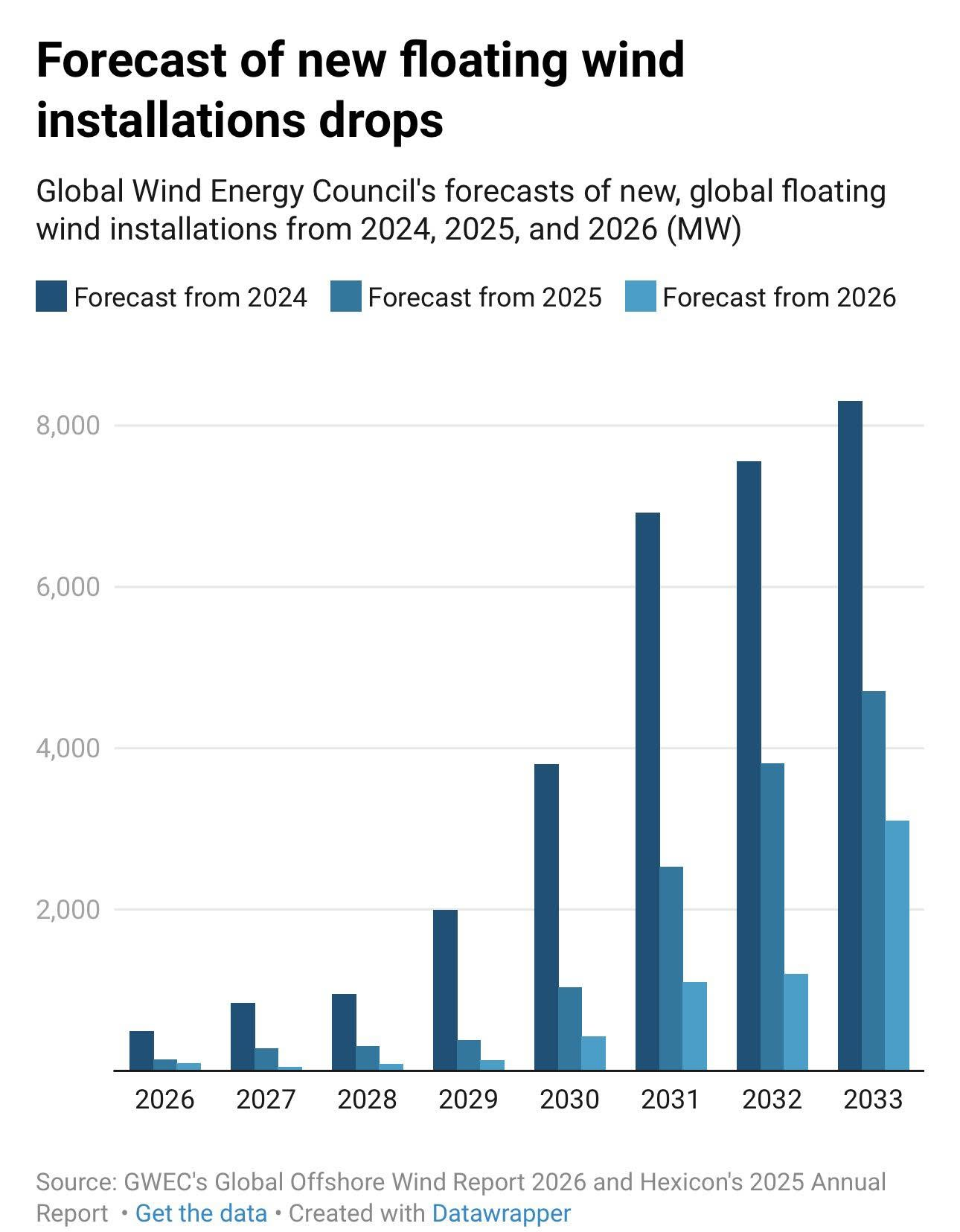
GWEC, the voice of the wind industry, continues to scale down estimates for floating turbines. In 2024, the GWEC expected 835MW of floating wind to be installed in 2027. Last year, this was lowered to 278MW, and expectations dropped further in the 2026 report to just 42MW. A similar trend applies to GWEC’s forecasts for the following years.

Despite strong support from the State, California’s offshore wind sector faces major challenges:

  • Deepwater technology: California offshore wind development is totally dependent on expensive and still unproven floating turbine technology. Norway, once a world leader in floating wind, has lost enthusiasm and is now requiring floating projects to be ‘quality-assured.’
  • Infrastructure: Major port upgrades, new transmission lines to bring power ashore, and specialized vessels are required. The supply chain is immature.
  • Costs: High capital costs plus storage costs (e.g. batteries) for reliability.
  • Environmental and stakeholder issues: Opposition to industrializing the coast.
  • Worldwide struggles for the wind industry.

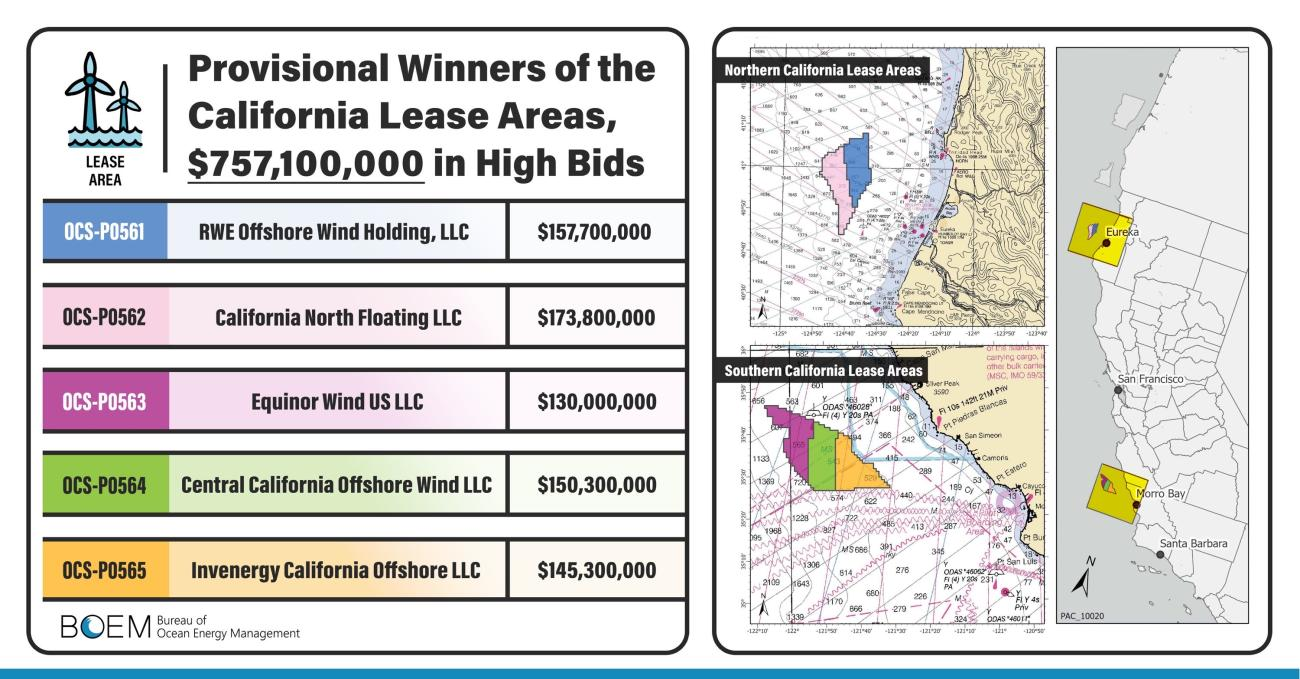
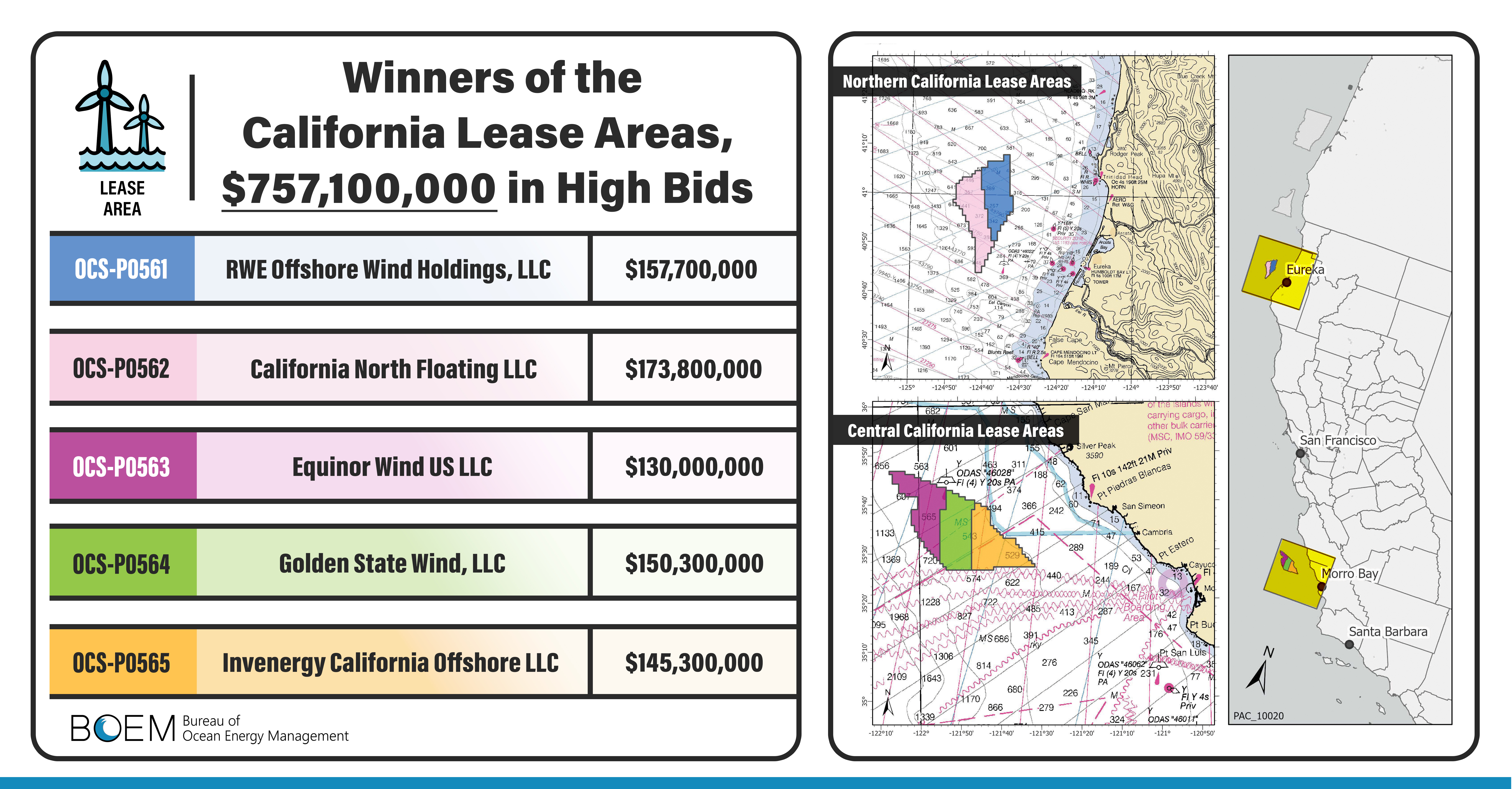
Two of the three Central Coast wind lessees (diagram below) have agreed to lease buyback deals. A lease cancellation letter is attached. The State is challenging the buyback agreements, and is thus in the difficult position of opposing deals that the wind developers voluntarily agreed to and believe are in their best interest. Does the State lose regardless of the outcome of their challenge?

The third Central Coast lessee, Equinor, is curtailing wind investments and has no plans to pursue new offshore wind projects in the US. A buyback deal with Equinor would be complicated by the company’s Empire Wind commitments, and is probably unnecessary given that Equinor has taken itself out of the game.

The two Northern California leases are still active, but the focus has been on regional planning. Funding for necessary infrastructure projects is uncertain and any wind lease development is far in the future.
Read Full Post »

WASHINGTON  Today, the Department of the Interior announced a settlement agreement with affiliates of Invenergy, North America’s largest privately held developer, owner, and operator of independent power infrastructure, aimed at strengthening American security and lowering costs, advancing goals central to President Donald Trump’s Energy Dominance Agenda.

As part of the settlement agreement, Invenergy will voluntarily terminate its affiliates’ four offshore wind leases located in the New York Bight, Central Coast of California and the Gulf of Maine totaling $765 million, and redirect that amount towards other domestic energy sources with the demonstrated capability to deliver reliable, affordable power, including the development of natural gas-fired power plants in Indiana, Wisconsin, Iowa, Kansas, and Missouri and geothermal power generation projects in the Western U.S.

Read Full Post »

The table below illustrates the dramatic decline in bidding for Atlantic wind leases over the past 2 years. (The California sale is also included in the table.)

offshore areasale dateleases soldacres leasedbonus bids
($ millions)
$/acre
NY/NJ2/20226488,0004,3708955
California12/20225373,268757.12028
Central Atl.8/20242277,94892.65333
Gulf of Maine10/20244439,09621.9 50

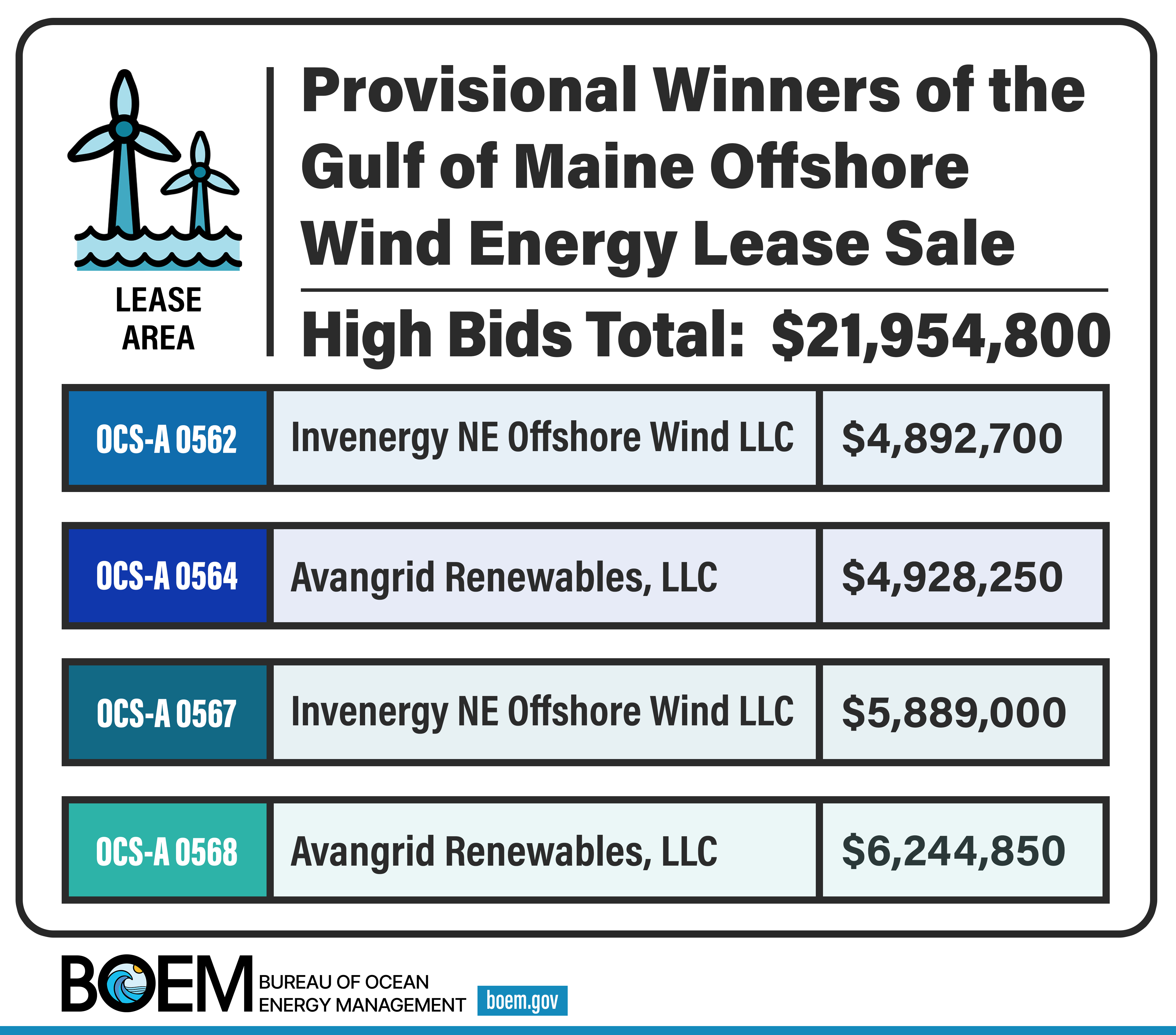
Accepting that bidding at the 2/2022 sale, which averaged nearly $9000/acre, was irrationally exuberant, bidding at this week’s sale was still incredibly weak. Even the bids at the Central Atlantic sale, just 2 months ago, averaged $333/acre, 6.7 times higher than the Gulf of Maine bids.

Energy giants Equinor, Repsol, and Total were among the eligible Gulf of Maine bidders that opted not to participate.

Do the Gulf of Maine bids pass BOEM’s fair market value tests? Apparently so; the sale notice established $50/acre as the minimum bid, and that is where the bidding started and ended. Invenergy and Avangrid had no competition and presumably got the tracts they wanted at the lowest possible price. We’ll see how this works out for the companies and power consumers.

Read Full Post »

Four of the eight tracts that were offered received bids. Only two companies participated, and the amounts were a fraction of the bids submitted for just two leases at the last Central Atlantic sale.

Read Full Post »

Only Equinor is a familiar name to the offshore oil and gas industry, so here are some blurbs about the other high bidders.

California North Floating, LLC, is a subsidiary of Copenhagen Infrastructure Partners (CIP). Since entering the US offshore market in 2016, CIP has built a leading offshore wind position through its affiliate Vineyard Offshore. This includes Vineyard Wind 1, the country’s first commercial scale offshore wind project which is currently under construction, as well as two lease areas under development totaling approximately 5.0 GW off the coast of Massachusetts and New York.

Central California Offshore Wind is managed by an East Coast offshore wind energy company, Ocean Winds North America LLC, which formed a joint venture with the Canada Pension Plan Investment Board to win the lease. Ocean Winds has more than 10 years of experience in floating offshore wind, most notably through the development and operation of Windfloat Atlantic (offshore Portugal), the world’s first fully commercially operational floating offshore wind farm

Equinor, a Norwegian company, is a major international oil and gas producer, an important wind energy investor, and a leader in the development of floating wind turbine technology. Equinor operates the Hywind Tampen floating offshore wind farm which will supply power to Norwegian offshore oil and gas fields.

Invenergy and its affiliated companies develop, own, and operate large-scale renewable and other clean energy generation and storage facilities in the Americas, Europe and Asia. Invenergy’s home office is located in Chicago, and it has regional development offices in the United States, Canada, Mexico, Spain, Japan, Poland, and Scotland.

RWE Renewables has experience covering the offshore and onshore wind energy value chain from development to construction and operation. These activities are the responsibility of two functional units, “Unit Renewables Europe & Australia” and “Unit Offshore Wind”, as well as the subsidiary RWE Renewables Americas. RWE Renewables also invests in large-scale solar projects and supports power producers, plant operators and other stakeholders in the development, construction and operation of photovoltaic and solar energy plants as well as in the construction of battery storage systems. The focus is on large-scale industrial projects.

Read Full Post »