Feeds:
Posts
Comments

Posts Tagged ‘DOE’

Reuters and others report that zinc from a new Chevron well has contaminated oil production destined for an Exxon refinery via Shell’s Mars Pipeline System. Because contaminated crude may cause maintenance issues and reduces the quality of refined products, Exxon will not accept crude from the Mars system until the zinc issue has been resolved.

The Mars system delivers about 575,000 bopd raising concerns about supplies to Gulf Coast refineries. But fear not, DOE authorized the delivery of up to 1 million barrels of oil from the Strategic Petroleum Reserve to the Exxon’s Baton Rouge refinery.

(Ironically, yesterday’s post pointed to the importance of the SPR and questioned the decision to drastically reduce crude oil purchases. This zinc incident is likely to be minor, and Exxon will repay the SPR in kind. However, more serious regional, domestic, and international events could call for much greater SPR withdrawals.)

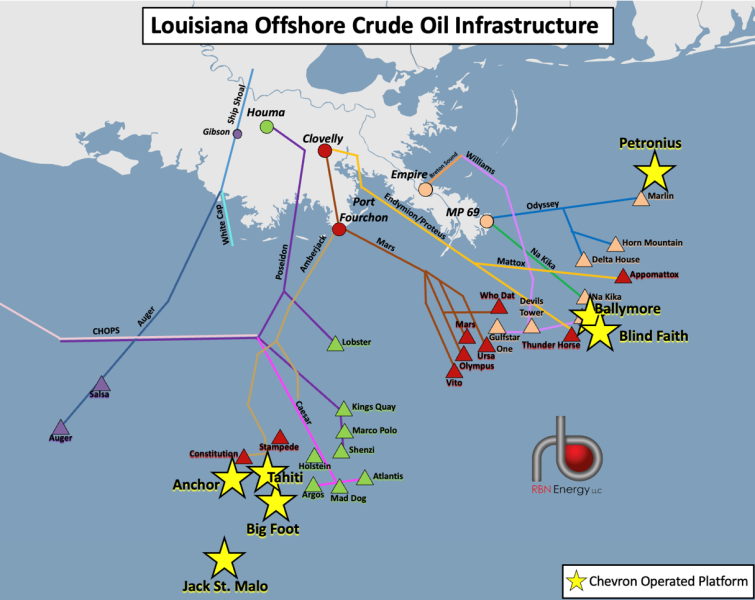
The above map shows Chevron platforms that connect with the Mars system at Port Fourchon.

Speculation/commentary:

  • The well/platform responsible for the zinc contamination has not been identified. Given that production is ramping up at Chevron’s Anchor facility, a new well on that platform may be the source of the zinc. Other Chevron platforms that connect to the Mars system are indicated in the diagram above.
  • Given that zinc in crude oil is rare, a well completion fluid containing zinc bromide may be the culprit.
  • Note the integration of offshore production streams, and the involvement of 3 industry super-majors. These companies are highly competitive, as evidenced by the Chevron-Exxon Stabroek dispute, but are also cooperative in producing, transporting, and refining oil and gas. However, they and other majors are restricted (rather illogically) from bidding jointly for leases.

Read Full Post »

Three years ago, the Colorado Oil and Gas Association brought smiles to our faces by recognizing North Face for their hypocrisy in refusing to sell jackets to an oil industry service company.

North Face, whose products are dependent on oil and gas, was given the Association’s first ever Customer Appreciation Award to draw attention to the company’s hypocrisy and chutzpah.

Fast forward three years and Chris Wright, the man behind the North Face award, has been nominated to be Secretary of Energy! BOE enthusiastically endorses this nomination!

Chris Wright’s bio: MIT engineer, shale gas innovator, entrepreneur, and more

Read Full Post »

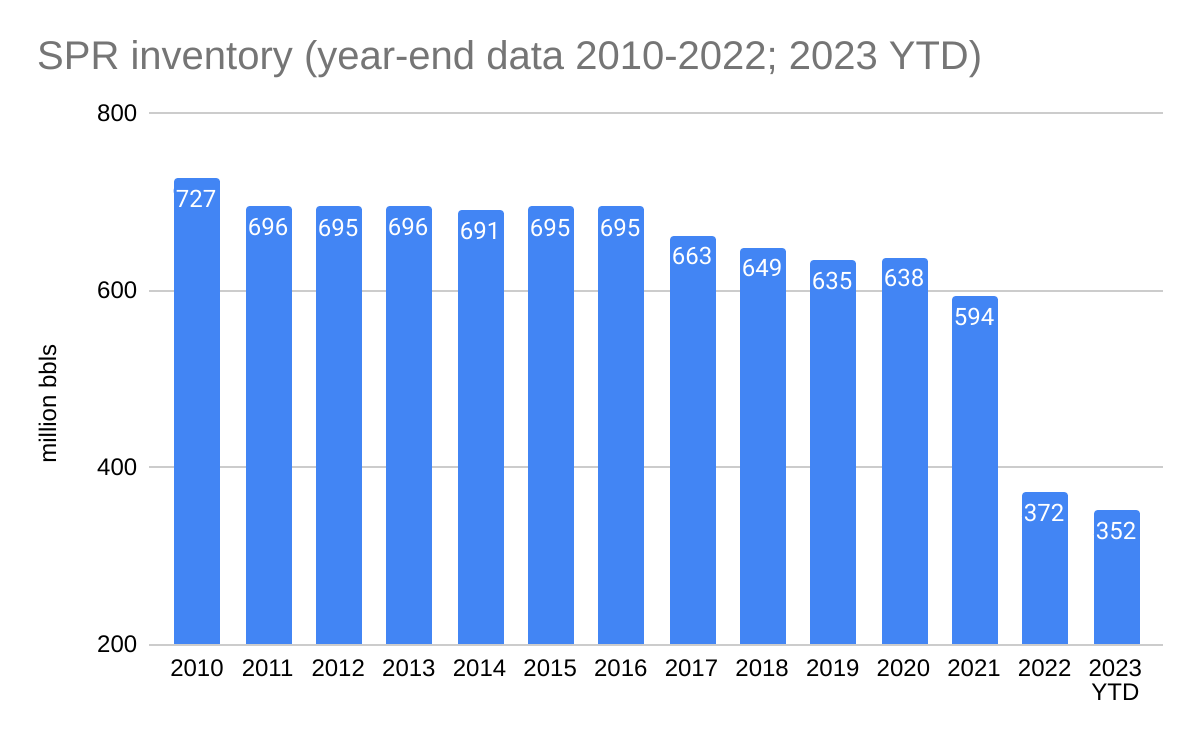
After announcing that the planned 40 million barrel SPR refill would be the equivalent of the massive 180 million barrel withdrawal, DOE has halted the refill at < half the planned amount. There is no end in sight for the SPR deficit (chart below).

Citing rising oil prices, the DOE said, “We will not award the current solicitations for the Bayou Choctaw SPR site and will solicit available capacity as market conditions allow.” Three million barrels of oil had been slated for delivery to the Bayou Choctaw SPR site in August and September.

Forbes

Read Full Post »

U.S. crude oil stockpiles in the Strategic Petroleum Reserve (SPR) at year-end will be at or exceeding the level prior to a massive 180 million barrel sale two years ago, U.S. Energy Secretary Jennifer Granholm said on Monday.

While the Department of Energy only expects to replenish by the end of this year about 40 million barrels since the 180 million sale, another 140 million barrels that would have been drained from 2024-2027 will stay in the SPR due to the cancellation in 2022 of congressionally mandated sales.

The department declined to provide a final number of stocks expected to be in the reserve at the end of the year.

Reuters

Reality check:

  • 40 million is not equal to 180 million.
  • Not withdrawing 140 million more bbls does not add 140 million bbls to the depleted reserve.
  • Based on the Secretary’s comments, the over-under for the reserve at the end of the year is 390 million bbls. (Take the “under.”)

The actual SPR status:

Sec. Granholm is also quoted as saying the administration’s LNG permitting pause “will be long behind us by this time next year.” Skeptics might see this as confirmation that the permitting pause was strictly for election year political purposes.

Read Full Post »

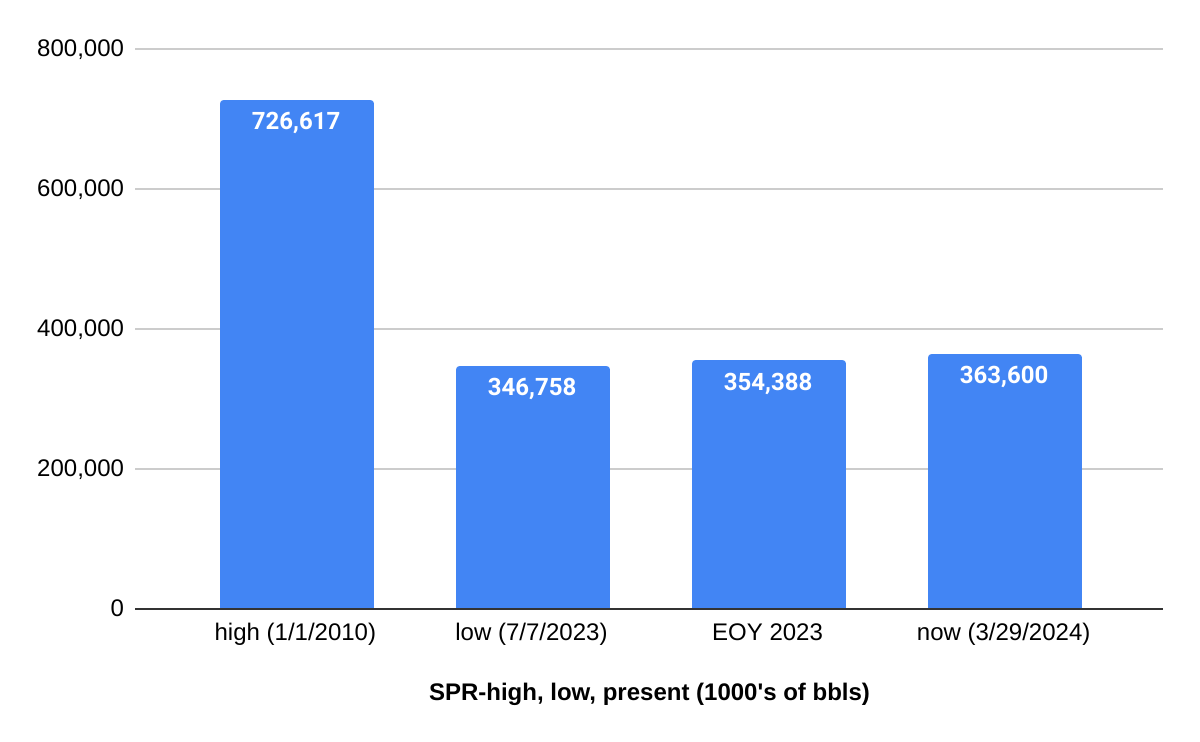
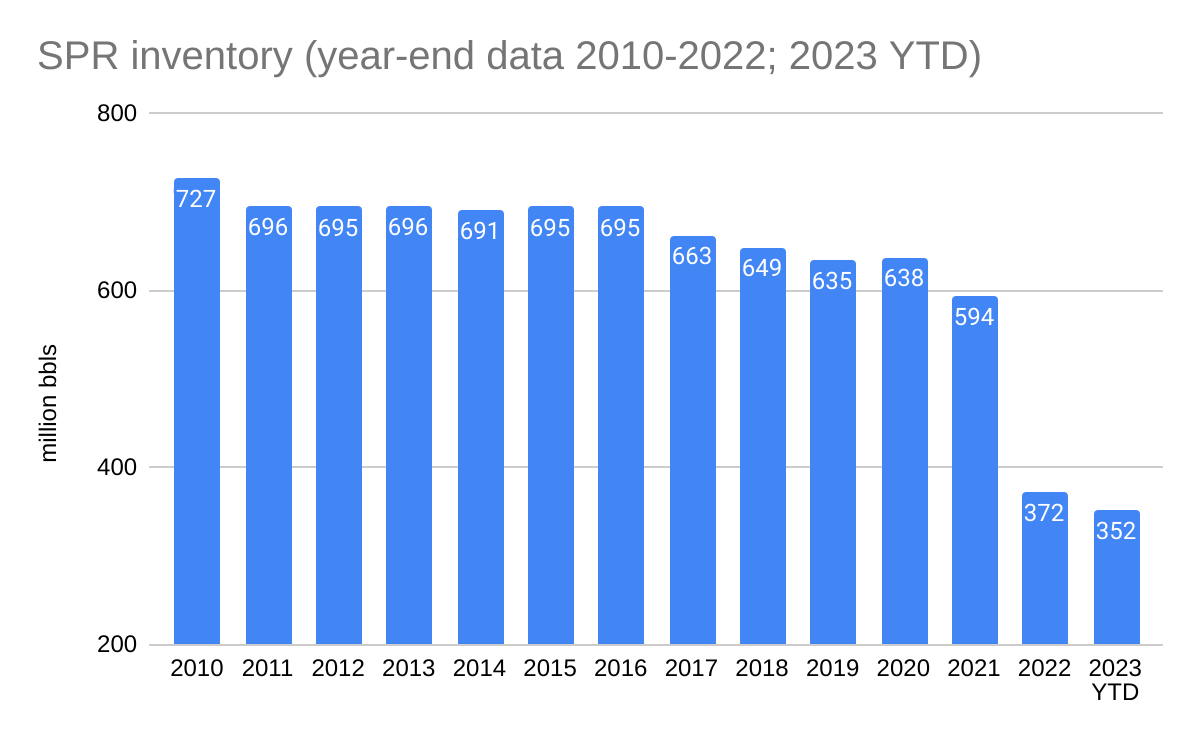
Huh? Since 9/1/2023, the SPR has increased from 350.34 million bbls to 351.9 million bbs, a total of only 1.56 million bbls. From the historic low of 346.76 bbls on 7/7/2023, the SPR has increased by just 5.14 million bbls, and remains at only 48% full. The total refill since the 2023 low amounts to only 0.7% of capacity.

DOE knew that refilling the SPR would be a very slow process given the significant acquisition, operational, and maintenance challenges. Nonetheless, political concerns about oil prices were prioritized and the reserve was recklessly depleted.

Prediction: The SPR will still be <400 million bbls at the end of 2024.

Read Full Post »

As has been previously discussed on this blog, the renewable energy source that shows the greatest promise for generating the power needed to support economic growth is ultradeep geothermal.

This JPT article nicely describes the opportunities and challenges

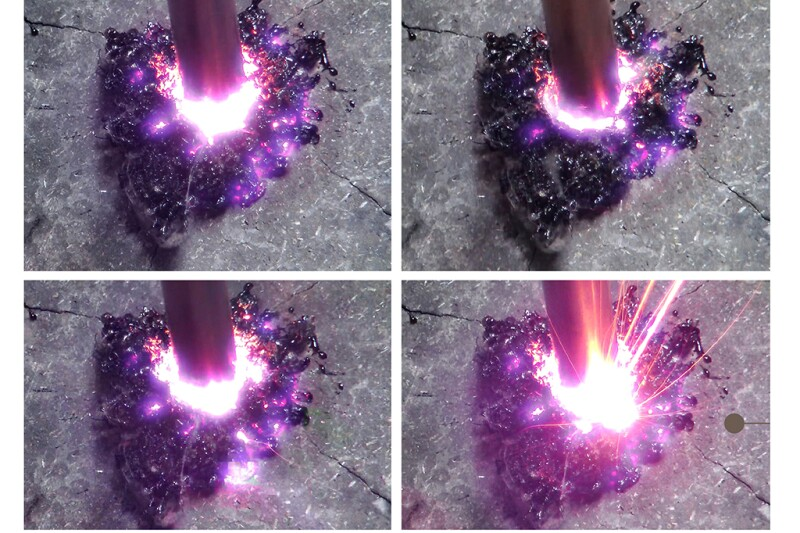
Microwave drilling test. Source JPT/Quaise Energy

Good comparison of drilling into hard basement rock with conventional and millimeter wave (microwave) technologies:

The technical readiness level (TRL) for microwave drilling reflects that it has yet to be field tested. The drilling rate includes an estimated amount of flat time. The levelized cost of energy (LCOE) is an all-in estimate of the cost per megawatt-hour (MWh). Source: JPT/Quaise Energy.

Quaise Energy’s first full-scale testing of a hybrid drilling rig combining conventional rotary drilling and millimeter wave drilling capabilities is scheduled for 2024.

Read Full Post »

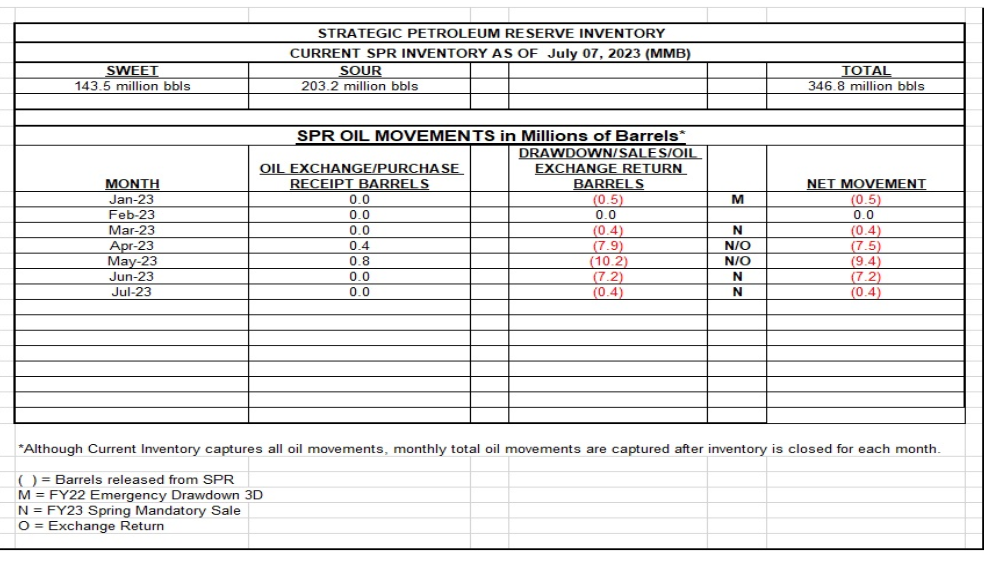
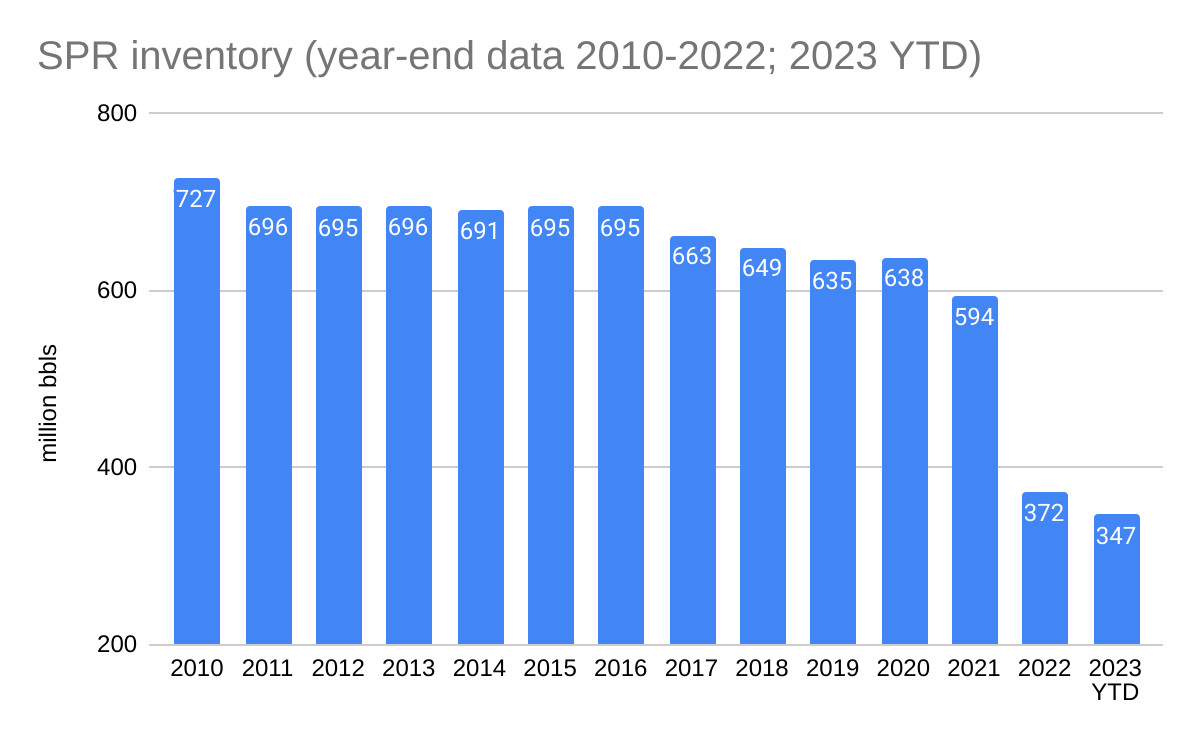
The Strategic Petroleum Reserve is ⬇ to 346.8 million barrels, the lowest volume since August 19, 1983, when the SPR was still being filled.

But fear not, 6 million barrels, which is less than 1/4 of the amount withdrawn just in 2023 YTD, are to be added in the fall, and Secretary Granholm assures us that the SPR will be refilled (but not completely and maybe not until the Administration’s second term 😀).

Keep in mind that DOE only intends to buy when prices are <$72/bbl, that the maximum refill rate is 685,000 bopd, and that acquisition, operational, and maintenance delays are to be expected .Filling the reserve to its 727 million barrel capacity was a 28 year process.

Read Full Post »

WASHINGTON, D.C. — Today, the U.S. Department of Energy’s (DOE) Office of Petroleum Reserves announced that contracts have been awarded for the acquisition of 3 million barrels of U.S. produced crude oil for the Strategic Petroleum Reserve (SPR).  These contracts follow the Request for Proposal that was announced on May 15, 2023. Furthering the Biden-Harris Administration’s three-part replenishment plan, DOE also announced a new Notice of Solicitation to purchase approximately 3.1 million additional barrels of crude oil to the Big Hill SPR site this September.

DOE (6/9/2023)

The Strategic Petroleum Reserve is now down to 351.7 million bbls, the lowest since 8/26/1983. The 6 million bbls in contracted and proposed purchases will replace only 30% of the oil withdrawn just in 2023 YTD, 2.0% of the amount withdrawn since 1/1/2021, and 1.6% of the volume needed to refill the SPR to capacity.

Given that 2024 is an election year, the prospects for substantial purchases next year would seem to be poor.

Read Full Post »

A big step forward:

The Department of Energy approved Alaska Gasline Development Corp’s (AGDC) exports of LNG from the project to countries with which the United States does not have a free trade agreement.

Backers of the roughly $39 billion project hope it will be operational by 2030 if it gets investments and all required permits. The LNG would be exported mainly to countries in Asia.

Reuters

53 years of history in 93 seconds:

The basics:

Alaska LNG

Read Full Post »

Jennifer Granholm

Energy Secretary Jennifer Granholm last month said it would be difficult for the U.S. to take advantage of low oil prices to replenish the Strategic Petroleum Reserve because of maintenance at two of the four sites.

The Financial Times reported, citing people familiar with Saudi Arabia’s thinking, that Riyadh was “irritated” by that comment. In any case, it came on top of stress in the financial sector that had dragged oil prices as low as $64 in March.

Market Watch

As previously posted, the SPR is easier to drain than fill. The reserve is still flat-lined at 371.6 million barrels or about half full.

Read Full Post »

Older Posts »