
For those interested in California offshore decommissioning, attached is an excellent update presented at a 2020 forum by my former colleague John Smith.
Posted in California, decommissioning, Offshore Energy - General, tagged California, decommissioning, John B Smith on September 24, 2021| Leave a Comment »
For those interested in California offshore decommissioning, attached is an excellent update presented at a 2020 forum by my former colleague John Smith.
Posted in California, Offshore Energy - General, Regulation, tagged BOEM, BSEE, decommissioning, Hogan, Houchin, OIG, Santa Barbara Channel on September 21, 2021| Leave a Comment »
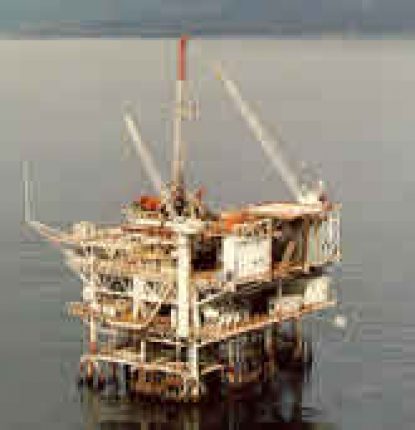
Platforms Hogan and Houchin were installed 52 and 53 years ago respectively on Lease OCS P-0166 in the Santa Barbara Channel. The lease, which had initially been issued to Phillips Petroleum, Cities Service Oil Co., and Continental Oil Co., was assigned to Signal Hill Service effective 2/19/1991. The assignment was approved despite concerns within the Minerals Management Service (MMS) about the financial strength of Signal Hill and the technical competence of Pacific Operators Offshore Inc (POOI), the affiliate that would operate the facilities.
Three decades of frustration followed for MMS, BOEM, and BSEE regulators in the Pacific Region. Per the terms of the assignment, Signal Hill was required to establish an Abandonment Escrow Account, funded from oil production revenue, with a “target balance” equal to the abandonment cost, plus 25 percent. These payments were seldom made in a timely and consistent manner.
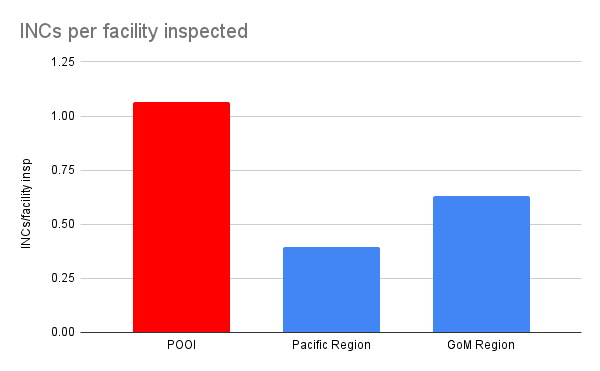
Compliance with safety regulations was also poor. In that regard, violations data are consistent with anecdotal reports from inspectors. POOI accounted for a high percentage of the regional Incidents of Noncompliance (INCs), and Platforms Hogan and Houchin had INC/inspection ratios that were far higher than Pacific or Gulf of Mexico platform averages (see inspection data below).
| INC’s | Warnings | Component Shut-ins | Facility Shut-ins |
| POOI | 485 | 562 | 46 |
| All companies (Pacific Region) | 1965 | 3103 | 281 |
| POOI % of total | 24.6 | 18.1 | 16.4 |
A 9/20/2020 Inspector General report found significant irregularities in the use of funds from an offshore production company’s escrow account. While the IG’s summary (pasted below in its entirety) doesn’t say so, the company is assumed to be Signal Hill.
The OIG investigated allegations that an offshore oil and gas production company improperly paid operational expenses with money from an escrow account dedicated to paying expenses related to decommissioning offshore platforms in Federal waters.
DOI OIG, 9/20/2020
We found that the company routinely used funds from its decommissioning account to pay what appeared to be various operating expenses. We also found instances where the company appeared to claim reimbursement for duplicate expenses.
Based on our findings, the company submitted credits and adjustments, totaling $1.9 million, to the decommissioning account to cover these expenses and other disbursements. In addition, we referred a number of unresolved expenses for non-decommissioning activities to the Bureau of Safety and Environmental Enforcement and the Bureau of Ocean Energy Management for resolution.
We referred this matter to the U.S. Department of Justice, which declined to pursue it.
Questions:
Posted in decommissioning, Gulf of Mexico, offshore, Offshore Energy - General, tagged BOEM, BSEE, decommissioning, financial assurance, GAO, WP on August 16, 2021| Leave a Comment »
A recent Washington Post (WP) article, based in part on a March 2021 General Accountability Office (GAO) report, raises interesting pipeline decommissioning issues, but might benefit from some additional context, which I have attempted to provide below:
In remarks to the WP, Syed Khalil, a coastal restoration geologist for the State of Louisiana, commented that they have enough sand to meet their short term needs, but future needs were a major concern. The Gulf of Mexico Offshore Sand Management Working Group would seem to be the best mechanism for timely action and a workable, long-term action plan. The minutes of their meetings are quite instructive. Rulemaking is not a solution unless the parties want to tie their fate to both the 25 year pipeline rule rewrite (draft published in 2007, another draft coming? final?) and the contentious and similarly interminable financial assurance rule.
Posted in accidents, Offshore Energy - General, Regulation, tagged abandonment, BOEMRE, decommissioning, Gulf of Mexico, idle iron, safety on September 16, 2010| 1 Comment »
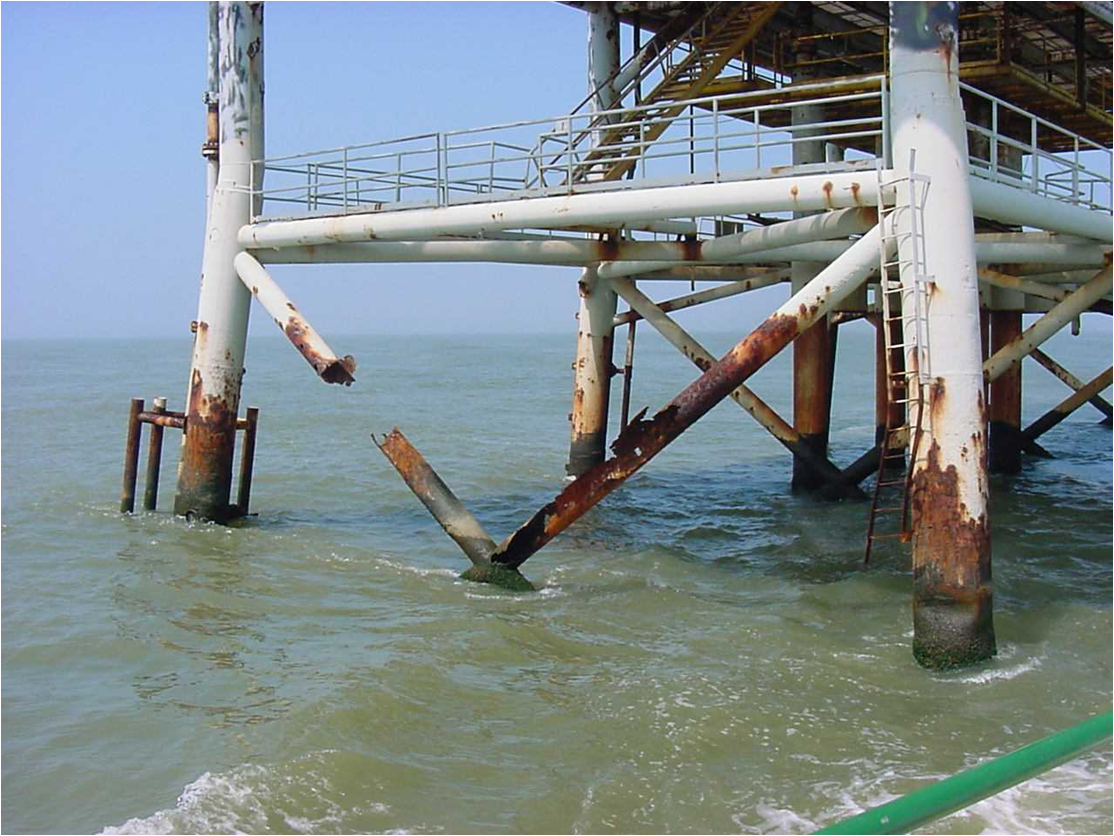
The Bureau of Ocean Energy Management, Regulation, and Enforcement (BOEMRE) has issued a Notice to Lessees and Operators (NTL) that specifies deadlines and other requirements for plugging and abandoning non-producing wells and removing platforms that no longer have utility. In my view, this regulatory action is necessary, appropriate, and consistent with authority provided in the Subpart Q (for quit :)) Decommissioning regulations. Post-hurricane experiences have demonstrated the enormous costs, operational challenges, and safety and environmental risks associated with plugging damaged wells and removing toppled platforms.
 Bud's Offshore Energy (BOE)