Feeds:
Posts
Comments

Posts Tagged ‘Coast Guard’

This is inexcusable if true:

A federal investigation into the October oil spill that paved the Orange County coast has been stalled for several months as authorities await approval to cut, remove and analyze part of the ruptured pipeline.

LA Times

Coast Guard and National Transportation Safety Board investigators currently have to rely on video captured during underwater pipeline inspections. Without a more detailed forensic examination of the damage in a lab, investigators won’t know whether to continue with their original investigation or move the investigation in a new direction.

LA Times

It’s not good when bureaucratic processes stall an important investigation. Hopefully the responsible agencies will be sufficiently embarrassed to get the investigation moving.

Read Full Post »

Due to water currents and a robust emergency clean-up effort, local beaches and ocean were re-opened on Oct. 11. By mid October, walking along the wide, sandy beaches there’s no sign of the spill as dolphins and surfers share the waves against a backdrop of cargo ships, oil rigs and the soft silhouette of Catalina Island.

Santa Cruz Sentinel

Further confirmation of the lower spill volume:

“Right now, there’s high confidence that the spill was approximately 24,696 gallons. The exact number won’t be able to be verified until the investigation has been completed. But there’s high confidence in that number,” Shaye said.

LCDR Shaye to the Sentinel

“Our world environment is very resilient, which is a positive thing,” Shaye said. “As far as the birds and wildlife; there have been some deaths, as happens in this kind of situation. But quite a few have been rehabilitated and released back into their environment.

LCDR Shaye to the Sentinel

Kudos to the responders. The training and response exercises worked!

Read Full Post »

As we have been suggesting for several days, the initial spill estimate was too conservative (high) and assumed near total losses from the pipeline. The Coast Guard has now established a “minimum” estimate which is identical to the spill volume cited in footnote 2 of the PHMSA Order. This estimate was presumably determined after a review of meter data.

Coast Guard Capt. Rebecca Ore said at a media briefing that officials “have assessed and verified pipeline data, and made a determination that the minimum amount of crude oil released from that pipeline is 588 barrels of oil,” which equals about 24,696 gallons.

OC Register

The Coast Guard is not backing off the original estimate entirely hedging that “it’s still possible the leak is of roughly the size that’s been reported.” Meanwhile, the mayor of Huntington Beach has expressed some optimism:

Asked whether the lower estimate of oil released could mean beaches reopen sooner, Huntington Beach Mayor Kim Carr said she was “cautiously optimistic that it will be sooner than later.”

OC Register

Read Full Post »

and they will presumably do so with an emergency final rule. This will be interesting. Over-under on the days until publication? Number of public comments?

And since the Coast Guard functions as OSHA on the Outer Continental Shelf, will they be enforcing the offshore industry’s compliance with this mandate? BSEE inspectors?

Read Full Post »

Comprehensive and timely incident data are critical for risk assessments, preventing recurrences, training and safety management programs, assessing the performance of the industry and individual companies, and driving safety culture. The National Academies 2021 review of BSEE’s inspection program included a number of recommendations related to data management including this one:

Recommendation 2. To further its goal of increasing data transparency and facilitating its internal and external use, BSEE should invest in more advanced and creative data collection, analytic and visualization tools, and infrastructure; corresponding data management, analysis, and evaluation capabilities among its personnel; and an outward-facing, online data system that can be navigated with ease and kept current across all fields for the purpose of encouraging and facilitating safety analyses.

National Academies Report, 2021

Unfortunately, BSEE’s incident data are not updated and posted in a timely manner. As we approach September 2021, the 2020 incident statistics are still not publicly available. These incidents include at least one rig fatality that neither BSEE nor the Coast Guard announced at the time of occurrence one year ago today (8/23/2020) or subsequently. The only public information about this fatality is the following self-serving statement by the operator:

“This is a routine operation that was executed with no time pressure as the rig disconnection had been decided well in advance,” Total said.

Upstream

A 37-year old man died, but according to the operator there is nothing to see here. This is not the type of statement you would expect from a company with a leading safety culture.

The keystone of BSEE’s primary mission, protecting workers and the environment, is timely incident information that is regularly reviewed and updated. Continuous improvements in safety are dependent on continuous improvements in data management and analysis. BSEE can do much better, as can other regulators, the offshore industry, and those of us who are interested and concerned observers.

Read Full Post »
A Coast Guard MH-65 Dolphin helicopter crew from Air Station Houston, Texas, medevacs an oil rig crew member experiencing a cardiac event on the Hoover-Diana oil platform, 150 miles east of Corpus Christi, Texas, Aug. 19, 2021. The helicopter crew successfully transported the man to the University of Texas Medical Branch in Galveston, Texas, in stable condition. (U.S. Coast Guard video, courtesy Sector/Air Station Corpus Christi)

US Coast Guard

But what happened to industry medevac capabilities? Or is this simply a matter of Hoover-Diana’s isolation?

Read Full Post »

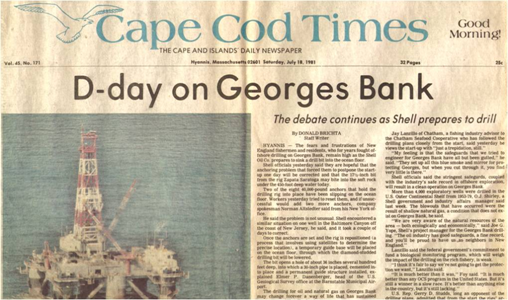
40 years ago today, drilling began on the first two exploratory wells on Georges Bank, a large seafloor feature that separates the Gulf of Maine from the Atlantic Ocean. The Cape Cod Times headline (below) attests to the drama that was unfolding 155 miles southeast of Nantucket. After years of debate, oil embargoes, gas lines, and the threat of future supply disruptions had tipped the political balance in favor of offshore leasing, and OCS Sale No. 42 (North Atlantic) was held one week before Christmas in 1979. Looking back, I find it remarkable that only 19 months elapsed between the lease sale and the initiation of drilling. During that time, bids were evaluated, exploration and spill response plans were drafted by the operating companies and reviewed by the Federal regulators and six coastal states, fisheries issues were addressed, and a comprehensive monitoring program was developed and initiated. Perhaps most impressive was the manner in which government (Federal and State), industry, and academic professionals with very different personal opinions about offshore drilling collaborated to assess and monitor impacts and mitigate risks.

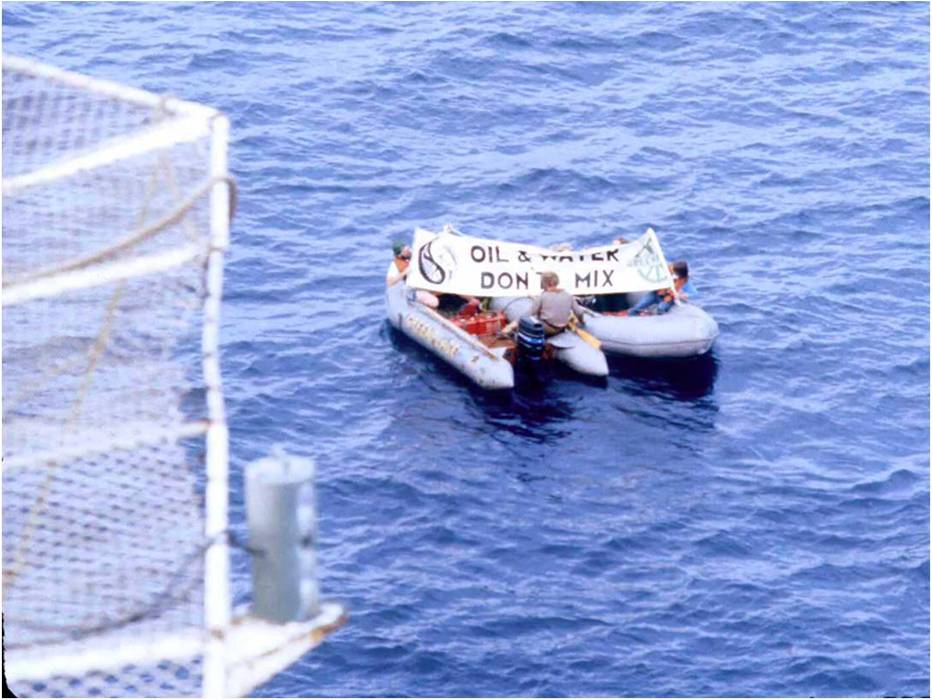
The protesters pictured above were dispatched to the Zapata Saratoga drilling rig from the Greenpeace vessel Rainbow Warrior. Given the remote location, the protest was unexpected. However, the drilling operation was not disrupted and no action was taken against the protesters. Four years later, the Rainbow Warrior was bombed by French commandos while in port in Auckland, NZ prior to planned protests against French nuclear testing in the South Pacific. Sadly, one crew member was killed during this incident.

Below is a list of the exploratory wells that were drilled on Georges Bank. In addition, two off-structure geologic test wells were drilled in 1976 and 1977. None of the wells discovered commercially significant oil and gas resources. However, gas shows led to erroneous press reports such as the article below. In 2000, the Minerals Management Service (MMS) published a summary of the geologic findings.


Operator
Lease No.
Block/Well
Rig

___________

Water
Depth
(ft.)


_________


Lat/Long
Miles SE
Nantucket

____________


Onsite


__________


Spud

________


Offsite


_________


Well
Depth
(ft. )

________

Exxon
0170
133/1
Alaskan Star
22540°49’05”
67°56’03”
112
7/22/817/24/81 11/24/81 13,808

Shell
0218
410/1
410/1R
Saratoga
45240°34’24”
67°12’32”
155
7/10/81
8/8/81
7/24/81
8/10/81
8/8/81
3/31/82
875
15,043

Mobil
0200
312/1
Midland
26040°39’27”
67°45’55”
125
11/21/8112/8/816/27/8219,652

Exxon
0153
975/1
Alaskan Star
20941°00’24”
67°37’19”
125
11/24/8111/25/813/10/8214,313

Tenneco
0182
187/1
Alaskan Star
30040°46’15”
67°23’19”
140
3/10/823/12/828/22/8217,744

Shell
0210
357/1
Saratoga
26540°36’51”
67°44’41″1
128
4/2/824/14/829/27/8219,090

Conoco
0179
145/1
Aleutian Key
30040°49’59”
67°17’06”
145
5/9/825/13/828/25/8214,115

Mobil
0196
273/1
Midland
30240°41’04”
67°30’12”
140
6/28/826/30/829/13/8215,190
Excerpted from “Georges Bank Exploratory Drilling, 1981-1982” by EP Danenberger

Regulatory policy lessons from the Georges Bank experience:

  • Regulators with overlapping responsibilities function best as a joint authority, particularly at the field level.  While MOUs/MOAs tend to be primarily for the purpose of protecting regulatory turf, joint authorities focus on the specific mission and how the performance objectives they can best be achieved. Capt. Barry Eldridge had the foresight to co-locate a USCG Marine Safety Detachment, headed by Bob Pond, adjacent to the USGS office at Barnstable Municipal Airport.  This facilitated cooperative reviews, coordinated inspections, and joint exercises.  This collaboration led to the first ever unannounced offshore response drills.    Similar USCG/DOI organizational arrangements have proven effective in the Pacific and in the Gulf of Mexico, particularly for monitoring hurricane preparations and responses.
  • Strive to conduct regulatory functions at a single field office.  USGS had the foresight to assign exploration plan review, environmental assessment, and coordination with State government responsibilities to our district office.  As a result, our environmental specialists, geologists, engineers, and inspectors worked together, along with our State and Federal partners, from the initial planning to the decommissioning stages.  Positive working relations were developed and everyone was informed and involved.  A subsequent reorganization changed the structure of our office and led to greater control from Washington, which (unsurprisingly) was not helpful.  
  • Transparency may be a bit of a buzzword, but it’s critical to regulatory success.  Other than proprietary geologic information and well reports, we fully informed our regulatory partners about the status of activities, all incidents and near-misses, and any operational issues. Conveying news that is not-so-good, like the mooring failures that were experienced by 2 Georges Bank rigs, is part of the mission.
  • Those regulating the operations should be informed about and a part of the environmental monitoring programs. Our office worked closely with the Woods Hole and other scientist conducting the comprehensive Georges Bank Monitoring Program.  In support of Mike Bothner, USGS Woods Hole scientist, we tracked every drilling fluid additive, and verified the materials that were available on each rig.  Mike conducted a material balance on the barite and looked for chromium and other metals in sediments near the well sites. His outstanding work is summarized in this paper.  

Read Full Post »

In their comments on the Coast Guard’s Deepwater Horizon Joint Investigation Team Report, Transocean made these statements about BOP maintenance standards incorporated in MMS drilling regulations:

By glossing over the contours of the regulatory language, the Draft Report unilaterally converts API Recommended Practice 53 from an advisory guideline into a mandatory requirement. Notwithstanding the Draft Report’s insistence otherwise, the API’s recommendation that the BOP “should” be disassembled and inspected according to the manufacturer’s guidelines is not mandatory. The API clarifies that the word “should” indicates a recommended practice for which a comparably safe alternative is available or which may be impractical or unnecessary in some conditions. In contrast, to denote a recommended practice that is “advisable in all circumstances,” the API uses the word “shall.” The API also emphasizes that “the formulation and publication of API standards is not intended in any way to inhibit anyone from using any other practices.” Though it recommends specific practices, API acknowledges that “equivalent alternative installations and practices may be utilized to accomplish the same objectives.” On its face, the language of API RP 53 makes clear that the recommendation that the BOP “should” be disassembled and inspected in accordance with the manufacturer’s guidelines is a recommendation, and nothing more.

Although the MMS regulations governing BOP maintenance incorporate API RP 53 sections 17.10 and 18.10 by reference, this does not convert the API’s recommendations into a mandatory requirement. As the MMS has clarified, “[t]he legal effect of incorporation by reference” is merely that “the material is treated as if it were published in the Federal Register.”

Treating API RP 53 as if it had been published in the Federal Register does not imbue its language with more regulatory significance than it had before. The API’s recommendations regarding BOP maintenance—as well as the API’s acknowledgement that alternative practices “may be utilized to accomplish the same objectives”—remain recommendations, not requirements.  Transocean’s complete comments are posted on their website.

I’ll withhold my comments on the above statements, except to say that my opinion differs substantially from Transocean’s.

More significantly, these and other recent industry and government comments demonstrate the complexity of standards policy issues. How are standards most effectively applied by operators in formulating safety management programs, operating plans, and safety cases? Contractors? How should deviations from standards be assessed and documented? How should regulators use standards? To what extent should standards be incorporated into regulations? What is the appropriate role for regulators in standards development? These issues may prove to be more challenging than updating technical requirements. Stay tuned!

Read Full Post »

Like the National Commission on the BP Deepwater Horizon Oil Spill and Offshore Drilling, the Montara Commission of Inquiry, the Norwegian government, and leading safety and regulatory authorities around the world, the IADC recognizes the risks associated with complex, multi-agency regulatory regimes. A single authority should be responsible and accountable for safety and pollution prevention at offshore facilities, and should draw on the expertise of other agencies and organizations as necessary to achieve performance objectives. 

The safety and environmental  risks associated with fragmented or compartmentalized regulation include gaps, overlap, confusion, inconsistencies, and conflicting standards. Industry and governmental personnel spend too much time coordinating with multiple parties and not enough time managing safety and environmental risks.

Link to IADC comments.  Key quotes:

IADC continues to be concerned by seemingly duplicative regulatory requirements imposed by the Coast Guard and BOEMRE, particularly where the agencies appear to have divergent views regarding the placement of regulatory responsibility.

One cannot holistically address safety when faced with the unyielding and overlapping demands of multiple narrowly-focused regulatory agencies.

Read Full Post »

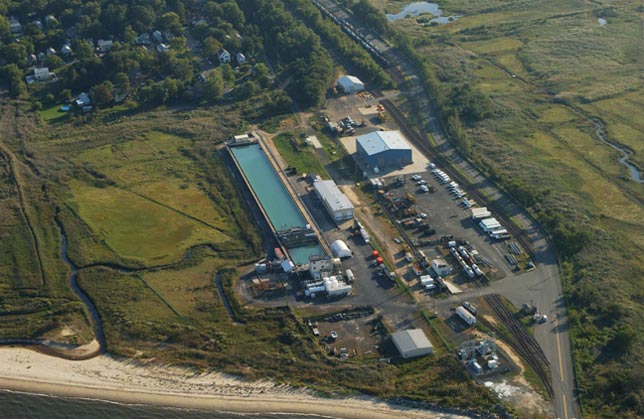
Ohmsett

Yesterday’s Platt’s Oilgram News included an excellent Gary Gentile piece about Ohmsett and the recent visit by BOEMRE Director Bromwich and Admiral Zukunft of the Coast Guard. Both had high praise for this outstanding oil spill response test facility which has contributed greatly to improved understanding of boom and skimmer performance, in situ burning, and chemical treating agents. This quote from the Platt’s article gives you a sense of the facility’s importance:

AbTech Industries spent two days at OHMSETT testing a new polymer it hopes will be able to sop up hydrocarbons from produced water or water used in hydraulic fracturing. The company pumped saltwater contaminated with Louisiana crude at rates of up to 250 gallons per minute through its filtering system. “The facility is tremendously unique,” AbTech Chief Operating Officer Jonathan Thatcher said in an interview. “I don’t know where else we would go where we could pump up to 250 gallons per minute for days on end and contaminate it. It allows you to go and make any mistakes you need to make.”

As we have said before, those who claim that there has been no progress in spill preparedness either have no real interest in spill response or have not been paying attention. Much has been accomplished.

Kudos to spill response visionaries like Ed Tennyson and John Gregory, MMS employees who had been pushing for the re-opening of Ohmsett since EPA closed the facility in the mid-1980’s.  After the Valdez spill in 1989 they received the necessary support, and the facility has been going strong since its re-opening in 1992.

Read Full Post »

« Newer Posts - Older Posts »