Feeds:
Posts
Comments

Posts Tagged ‘CCS’

I vote for stupid comment.

The CEO of Italian power firm Enel has cast doubt on the continued benefit of using gas to produce electricity, telling CNBC it is “stupid” and that cheaper and better alternatives are now available.

“You can produce electricity better, cheaper, without using gas … Gas is a precious molecule and you should leave it for … applications where that is needed,” he added.

Francesco Starace to CNBC

Gas is scarce and expensive in Europe because of bad foreign and energy policy decisions, most notably dependence on Russia and unrealistic expectations regarding renewables. Mr. Starace seems intent on doubling down on the latter. Of course, Enel is a large renewable energy generator and a natural gas purchaser and consumer (not a producer). His comments are thus rather self-serving.

I do agree with Enel on CCS:

Although the company could rely on carbon offsets or carbon capture to hit that target, Bernabei said the technology has failed to take off, despite receiving funding from the EU and national governments. He said there is no reason to expect that situation to change, especially since carbon capture and storage, or CCS, technology is not guaranteed to eliminate 100% of emissions.

“These are very big and complex projects. And at the end, they will not solve the problem,” Bernabei said. “We already tried CCS in the past and it didn’t lead to success. So why do it again?”

SPGlobal

Read Full Post »

Background:

Questions:

  • What are the costs per ton of offshore carbon sequestration including emissions collection, offshore wells and platforms, the associated pipeline infrastructure, ongoing operational and maintenance costs, and decommissioning?
  • What is the timeframe given that the starting point is likely years away?
  • How long would CO2 sequestration continue.
  • Who pays? Polluters? Federal subsidies? Tax credits?
  • Who is liable for:
    • safety and environmental incidents associated with these projects?
    • CO2 that escapes from reservoirs, wells, and pipelines (now and centuries from now)?
    • decommissioning?
    • hurricane preparedness and damage?
  • For Gulf of Mexico sequestration, how much energy would be consumed per ton of CO2 injected? Power source? Emissions?
  • To what extent will these operations interfere with other offshore activities?
  • Relatively speaking, how important is US sequestration given:
  • What are the benefits of offshore sequestration relative to investments in other carbon reduction alternatives?
  • Will BOEM conduct a proper carbon sequestration lease sale with public notice (as required by BOEM regulations) such that all interested parties can bid?
    • What will be the lease terms?
    • Environmental assessment?
    • How will bids be evaluated?
  • What happens to the Exxon bids if the Judge’s Sale 257 decision is reversed?
  • What is the status of the DOI regulations mandated in the legislation with an 11/15/2022 deadline?
    • When will we see an Advanced Notice or Notice of Proposed Rulemaking?
    • Given that DOI has no jurisdiction over the State waters and onshore aspects of these projects, what is the status of parallel regulatory initiatives?
  • Finally and most importantly, how does drilling offshore sequestration wells instead of exploration and development wells increase oil and gas production?
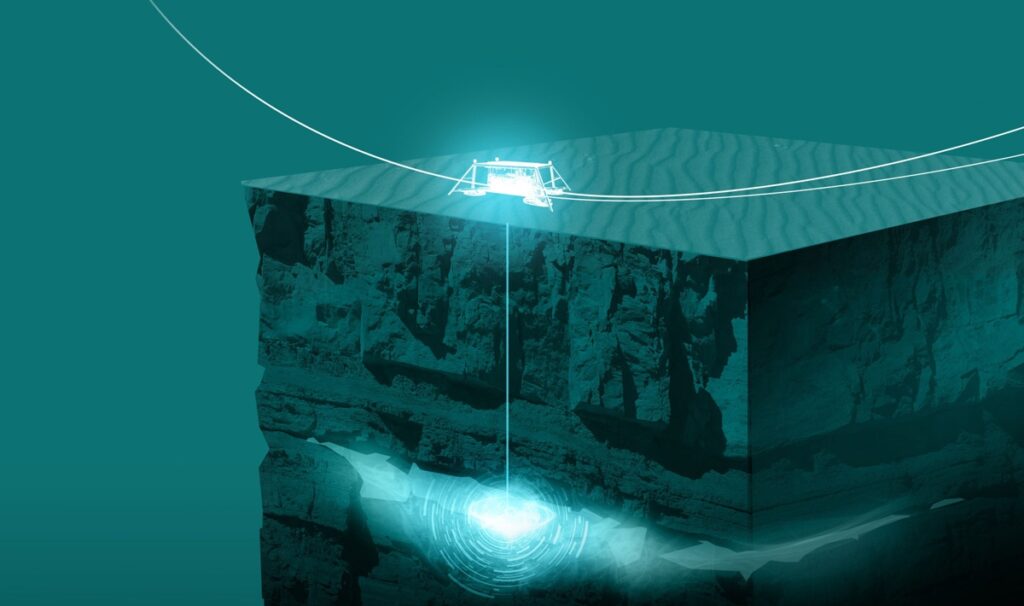
highly simplified conceptual diagram

Read Full Post »

Grateful….

… to be able to speak openly and candidly about issues that have been an important part of my professional life for 50 years. Thankful for our First Amendment rights; they must be protected.

Whether you represent Big Oil, Big Gas, Big Wind, Big Green, Big Climate, Big Stick (regulators 😀), Big Swamp (Washington DC friends 😉), or none of the above, thank you for visiting this modest, independent, and rather obscure blog.

Over the next couple of weeks, I will be posting about an interesting study that links compliance and safety, some unpublished thoughts on the Macondo blowout 12 years later, and comments on the industry push for carbon sequestration in the Gulf of Mexico (sorry advocates, I’m not a fan).

Regardless of your faith, nationality, political views, or thoughts about world events and offshore energy, I hope you have the opportunity to spend time with friends and family this weekend.

For those who observe Easter…..

Read Full Post »

The judge correctly dismissed the unfounded claim that new oil and gas leasing would preclude wind development in the Gulf. BOE comments:

  • The number of GoM platforms is down 75% from its peak and continuing to decline.
  • Most new production is in the deepwater GoM and is accomplished with very few, remote and widely dispersed facilities. There are currently only 57 deepwater platforms across the entire Gulf.
  • The wind industry appreciates the synergy between offshore oil and gas and offshore wind operations. Indeed the oil industry has been very supportive of offshore wind, and some of the same operating companies and contractors are major players in both industries.
  • t has been 17 years since the enabling legislation was passed, yet we are still awaiting the first commercial wind project in the US Atlantic. You can’t blame the oil and gas industry for that delay. To the contrary, one can make the case that the presence of oil and gas operations would have accelerated Atlantic wind development.
  • The enabling legislation for offshore wind was drafted by the agency that managed the offshore oil and gas program and recognized the compatibility of oil and wind development. Wind development is clearly a high priority for BOEM, the current OCS land manager.

Will the Administration appeal the court decision to vacate the lease sale or does the decision assist them by reinstating their leasing pause? How will the conflict between the DC court decision and the injunction invalidating the leasing pause (Federal Court for the Western District of Louisiana) be resolved?

What does this mean for the 94 leases that were to have been acquired for carbon sequestration purposes? Will BOEM have a proper CCS sale after conducting an environmental assessment, determining bidding terms and evaluation criteria, and publishing a Notice of Sale? Or will there be a legislative end run that authorizes the issuance of the leases without these steps?

Read Full Post »

Quite a bit per the GAO, and their report only deals with DOE management of demonstration projects. The Infrastructure Bill authorizes $2.5 billion for commercial projects (and much more for other CCS purposes).

DOE provided nearly $684 million to eight coal projects, resulting in one operational facility. Three projects were withdrawn—two prior to receiving funding—and one was built and entered operations, but halted operations in 2020 due to changing economic conditions. DOE terminated funding agreements with the other four projects prior to construction.

DOE provided approximately $438 million to three projects designed to capture and store carbon from industrial facilities, two of which were constructed and entered operations. The third project was withdrawn when the facility onto which the project was to be incorporated was canceled.

GAO

So DOE’s actual success ratio was 0.182 (2 for 11) – not very compelling.

With regard to proposals for offshore carbon sequestration, who will be liable for future cost overruns, operating losses, infrastructure failures including pipeline and well leaks, and decommissioning costs? Who ensures that there will never be any leakage from CO2 disposal reservoirs? Does all of this fall on the Federal government?

Corporations that want to engage in carbon sequestration for commercial or other purposes should fund the projects with their own revenues or fees charged to the companies whose emissions they are collecting. The Outer Continental Shelf is publicly owned and those wishing to dispose of substances should pay a usage fee, be responsible for all costs, and be liable for pollution and damages.

Read Full Post »

Carbon capture and storage
NPD

Several actors have approached the ministry with a desire to be allocated two specific areas for storage of CO 2 . One area in the North Sea and one in the Barents Sea were therefore announced on 10 September in accordance with the storage regulations.

By the application deadline of 9 December, the ministry had received applications from five companies. The Ministry will process the received applications and allocate area in accordance with the storage regulations during the first half of 2022.

Ministry of Petroleum and Energy, Norway

Contrast the situation in Norway with Exxon’s apparent attempt to acquire 94 Gulf of Mexico leases at Oil and Gas Lease Sale 257 solely for CCS purposes. BOEM’s Notice of Sale made no mention of CCS, and there had been no environmental or economic assessment of CCS activity.

And how much will the public pay for grand CCS ventures that (although interim measures) will take years to initiate, add new safety and environmental risks, and may never achieve their objectives? The public burden will no doubt include direct subsidies, tax credits, increased petrochemical prices, and the erosion of purchasing power associated with the resulting inflation pressures.

More on Sale 257 and the CCS bidding.

Read Full Post »

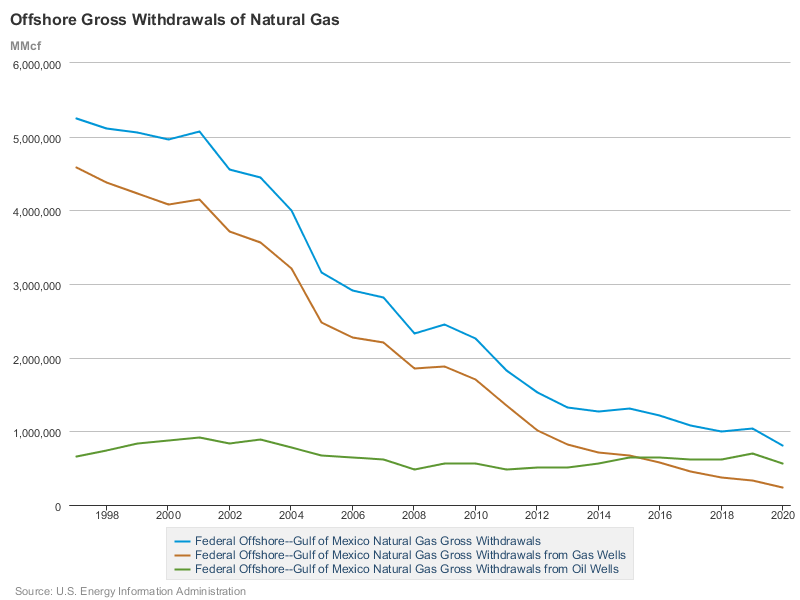
Offshore gas production (see chart below) has declined for the past 20 years and now accounts for only 4% of total US gas production, down from 20% in 2005 and 25% in the 1990s. Associated gas production (oil-well gas) has remained relatively constant owing to the strength in deepwater GoM oil production. 73% of 2020 gas production was from deepwater wells, and was mostly oil-well gas. Associated gas production surpassed nonassociated gas production (gas-well gas) in 2016 and the latter has continued to decline.

The case for natural gas has been well documented (see the EQT letter linked below). Recent natural gas advocacy has emphasized the carbon/GHG advantages given that methane (CH4) is essentially a hydrogen transporter that emits far less CO2 than other fossil fuels when burned. However, natural gas’s other important air quality advantages – low NOx. SO2, and particulate emissions – have greater local significance from a human health standpoint. Those who have ridden a bike behind a natural gas powered bus have no doubt experienced the natural gas advantage firsthand. These buses are literally a breath of fresh air!

Other environmental advantages of offshore natural gas, particularly nonassociated gas, receive less attention but are nonetheless significant. Advantages of nonassociated offshore gas include the following:

  • Fewer wells required than for shale gas
  • No risk of fresh water contamination
  • Platforms provide beneficial reef effects
  • Minimal space preemption and land disturbance relative to onshore gas production and wind/solar operations
  • Low facility density and navigation risks relative to wind operations;
  • Lower elevation and fewer view-shed, aesthetic, and aviation issues than for wind
  • Minimal avian risks relative to on- and offshore wind operations
  • Minimal spill risk relative to oil and associated gas production
  • Significantly less flaring than for oil well gas. While the overall % of US offshore gas production that is flared is low (approx. 1.0 -1.5% from 2016-2020 per EIA data), the % of gas-well gas that is flared has historically been less than 0.5%.

Low natural gas prices and competition from nimble and efficient shale operations have constrained offshore gas exploration. Ultradeep (subsurface) drilling has shown promise from a gas resource perspective but has proven to be expensive and operationally challenging. Some independent producers are still acquiring gas prone shelf tracts and that needs to be encouraged. Consideration should be given to incentives such as making nonassociated gas production royalty free. That would certainly seem preferable to subsidizing complex, expensive, and uncertain carbon disposal operations on offshore leases.

Read Full Post »

What, if anything, will the Judge say about the leases that are intended to be carbon sequestration sites? How can BOEM sell OCS leases for purposes that were neither announced nor environmentally assessed? What do EarthJustice and the other plaintiffs think about the sequestration bids given that the environmental community is split on CCS?

Who is going to pay the enormous cost of sequestration on the Outer Continental Shelf – platforms, wells, pipelines, processing equipment, maintenance, monitoring, decommissioning, and more? The Federal government (i.e. taxpayers) features large in this grand scheme, and will no doubt be assuming most of the economic and performance risks. And all of these costs are for disposal purposes, not for offshore energy production of any kind.

Together with the bipartisan infrastructure bill enacted in November, which included more than $12 billion in funding for carbon capture and carbon removal technologies, the Build Back Better legislation would hand fossil fuel companies nearly every item on their carbon capture wishlist.

Inside Climate News

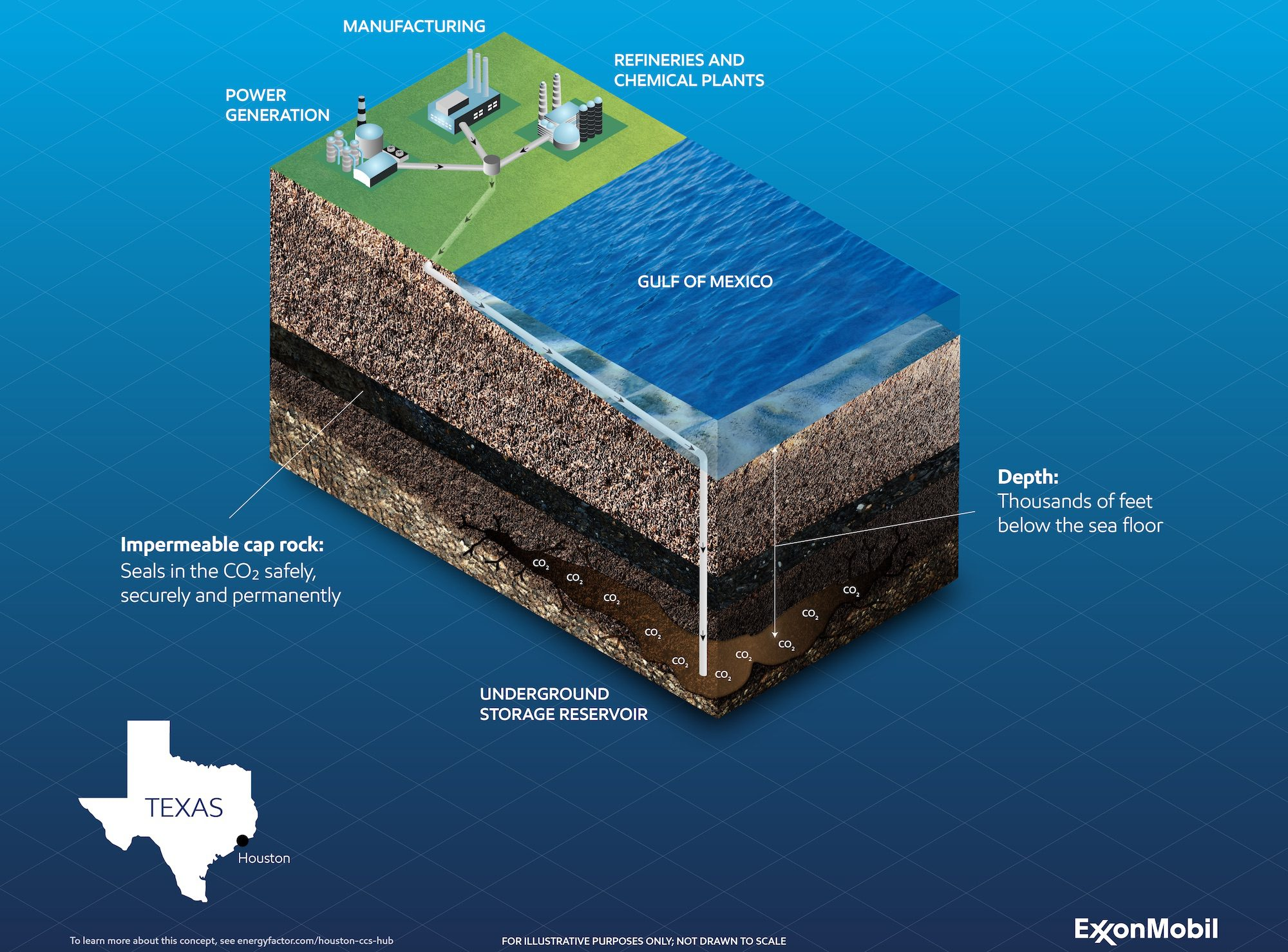
The reality of offshore CCS is not anywhere near as simple as portrayed in the slick graphic below:

houston ccs hub
ExxonMobil

Read Full Post »

The text below, excerpted from the Infrastructure Bill (signed 2 days before Sale 257), requires the Federal government to provide funding for commercial CCS projects. $2.5 billion is appropriated. Given these incentives, how does BOEM possibly issue leases for CCS purposes when there was no public notice (as required by 30 CFR § 556.308) that CCS bids would be accepted at the oil and gas lease sale?

SEC. 40305. 
e) Large-scale Carbon Storage Commercialization Program.--
        ``(1) In general.--The Secretary shall establish a commercialization program under which the Secretary shall provide funding for the development of new or expanded commercial large-scale carbon sequestration projects and associated carbon dioxide transport infrastructure, including funding for the feasibility,site characterization, permitting, and construction stages of project development.
(h) Authorization of Appropriations.--There is authorized to be appropriated to the Secretary to carry out this section $2,500,000,000 for the period of fiscal years 2022 through 2026.

Read Full Post »

The plan was for SCS Energy’s PurGen One plant in Linden, NJ to burn coal to generate electricity and produce fertilizer. SCS proposed to inject 90% of the CO2 into subsurface reservoirs 70 miles offshore. The project faced strong opposition and was ultimately nixed by the State. The plan had been presented to the Federal offshore regulator (MMS), but the company was advised that there was no legal framework for disposing CO2 beneath the OCS.

Read Full Post »

« Newer Posts - Older Posts »