Posts Tagged ‘bp’
Macondo spill cost estimate is now $40 billion
Posted in accidents, well control incidents, tagged accidents, blowouts, bp, Deepwater Horizon, drilling, Gulf of Mexico, macondo, offshore oil, oil spill, safety, well control on November 2, 2010| Leave a Comment »
Industry Response Needs To Go Beyond Deepwater Drilling
Posted in accidents, tagged accidents, bp, macondo on September 29, 2010| Leave a Comment »
BP has announced a new safety unit and other organizational changes. For more on the changes, see the Upstream report.
From a BOE perspective, the most interesting comment in the BP release was this Bob Dudley quote:
Our response to the incident needs to go beyond deepwater drilling. There are lessons for us relating to the way we operate, the way we organize our company and the way we manage risk.
I hope the rest of the offshore industry has the same view and is prepared to work together to assess and mitigate operational risks. To date, industry has reacted impressively to issues raised since the Macondo well blew out on 20 April. However, what is being done to identify operational and safety risks that could trigger the next disaster? When will complete, consistent, and verified international incident data be collected and published?. How do you manage risks without such data? Why weren’t the lessons from Montara quickly disseminated around the world? If they were, Macondo may have been prevented.
Deep water is not the problem – Update
Posted in accidents, well control incidents, tagged accidents, blowouts, bly, BOE, bp, Deepwater, Deepwater Horizon, drilling, Gulf of Mexico, macondo, Montara, offshore oil, safety, well control on September 28, 2010| 1 Comment »
As previously posted (July 27, 2010), deep water had little to do with the well integrity problems and other contributing factors leading to the Macondo blowout. The Bly (BP) report further confirms this position.
Of the eight key findings in the Bly report (listed below), only number 4 could be considered to be more of a deepwater issue. The BOP failures may also have been influenced by deepwater factors. However, as previously noted, surface BOPs have a much higher failure rate than subsea stacks.
While the Montara blowout was in relatively shallow water, slight variations of findings 1 through 4 were the primary causes of that accident.
BP findings:
- The annulus cement barrier did not isolate the hydrocarbons.
- The shoe track barriers did not isolate the hydrocarbons.
- The negative-pressure test was accepted although well integrity had not been established.
- Influx was not recognized until hydrocarbons were in the riser.
- Well control response actions failed to regain control of the well.
- Diversion to the mud gas separator resulted in gas venting onto the rig.
- The fire and gas system did not prevent hydrocarbon ignition.
- The BOP emergency mode did not seal the well.
Macondo: Different Country, Same Questions
Posted in accidents, tagged accidents, bly, bp, Commons, Gulf of Mexico, Jack Ryan, macondo, offshore oil, oil spill, safety, Tony Hayward, UK, well control on September 16, 2010| Leave a Comment »
If you haven’t heard BP executives answer the same questions (long string, centralizers, cement bond log, BOP failure, etc, etc) often enough during appearances before Congress, you can watch a UK House of Commons committee ask them to Tony Hayward and Mark Bly on cspan’s recording of yesterday’s hearing. This excellent legislative teamwork is further evidence of that special relationship between the US and UK.
I do wish that both government’s would show more interest in some of the lower profile incidents that also have major international significance. Perhaps they can coax Venezuela to release information about the Aban Pearl sinking. Even though I follow Hugo Chavez’s tweets :), I’ve learned nothing of significance about that accident.
In light of yesterday’s post about negative pressure testing, I was interested in this comment by Tony Hayward at the Common’s hearing:
We clearly have taken a lot of action to clarify and provided much greater rigor around the assessment of the negative pressure test.
Can BP tell us more?
Relief well intercept – necessary operation, science project, moral imperative, or face-saving gesture?
Posted in accidents, well control incidents, tagged accidents, blowouts, BOE, bp, Deepwater Horizon, Gulf of Mexico, macondo, relief well, top kill, unified command, well control on September 12, 2010| Leave a Comment »
BOE has previously commented that completion of the Macondo relief well appeared to be unnecessary, and and that the intercept adds additional risk to the plugging and abandonment operation. Pasted below are disconcerting Unified Command and BP statements about the intercept followed by BOE comments:
I have stated over and over again, let me be perfectly clear. I am the National Incident Commander. I issue the orders. This will not be done until we complete the bottom kill. Admiral Allen, 5 August 2010
Comment: While I believe Admiral Allen has performed well in the difficult and thankless job of incident commander (as did Admiral Landry before him) and wanted to make it clear that the government was in charge of this operation, this strong statement appears to have painted the Unified Command into a corner.
… in response to BP’s request to consider foregoing the relief well, the government scientific technical team has determined that the benefits of the bottom kill procedure outweighs the risks. (14 August letter from Admiral Allen to BP)
Comment: Reading between the lines, we assume that at least some BP engineers favored foregoing the relief well intercept, and wanted to proceed with a conventional plugging and abandonment operation. Was their proposal given serious consideration? How could it have been given the Admiral’s prior statements about completing the relief well?
We are currently working with BP engineers and our science team to look at test results and do investigations to lead us to the best way to mitigate any risk of intercepting the annulus and increasing the pressure in the annulus. Admiral Allen, 16 August
Comment: Much attention continues to be focused on mitigating the risks of an operation that appears to be unnecessary.
There are several reasons for the relief well to be completed, including demonstrating that the difficult procedure can be done, providing more scientific data about the leak and giving closure to an oil-weary public. BP CEO Bob Dudley, 29 August
Comments: This BP statement seems to contradict their prior request to forgo completion of the relief well. With regard to Mr. Dudley’s rationale for completing the relief well, I’ll offer the following:
- If BP believes they need to demonstrate relief well intercept capability (not necessary in my view), they should drill into one of the thousands of depleted wells in the Gulf, not Macondo.
- This is not a risk-free science project. Are the risks and delays justified?
- The “oil-weary public” needs an offshore industry that is committed to safety and pollution prevention, not symbolic gestures.
And in order to speed the process up, but also ensure that we had the right pressure controls on the well, I’ve signed a directive out to BP earlier this morning, directing them to take a series of measurements on the well head that would allow us to ascertain whether or not the seal in the ring – in the casing hanger were in place and had not lifted and, if that was the case, then to be able to put what we call a sleeve over the top of it that would basically walk that down to the point where it could withstand over one million pounds of pressure and would obviate the need to be able to cement the annulus at the top.
And subject to BP providing me the plans and the results of those tests, that would allow us to go ahead and proceed more quickly without having to cement the top of the annulus. And based on a revised schedule from BP, we might be able to accelerate going ahead and finishing out the relief well. Admiral Allen, 10 September
Comment: Let me get this straight. They are going to put off the cementing of the annulus, which will have to be done anyway and would provide a barrier should something go wrong with the intercept, so they can conduct tests (that would be unnecessary if they first cemented the annulus) for the purpose of expediting completion of the long-delayed relief well? Huh?
BP – Transocean Dispute Heats Up
Posted in accidents, well control incidents, tagged accidents, blowouts, bp, Cameron, Halliburton, macondo, offshore oil, safety, transocean, well control on September 9, 2010| 1 Comment »
Transocean slams the BP Macondo report:
However, rig owner Transocean slammed the report, saying: “This is a self-serving report that attempts to conceal the critical factor that set the stage for the Macondo incident: BP’s fatally-flawed well design.”
BOE Comment: At a time when the safety of oil and gas operations is rightfully under intense scrutiny, this ugly dispute further undermines public confidence in offshore exploration and development. BP, Transocean, Halliburton, Cameron, and other feuding companies need to resolve their disputes so they can fully and credibly participate in the critical industry and governmental programs that are addressing offshore safety and pollution prevention issues.
BP Report Released
Posted in accidents, well control incidents, tagged accidents, blowouts, bp, Deepwater Horizon, drilling, Gulf of Mexico, macondo, offshore oil, oil spill, safety, well control on September 8, 2010| Leave a Comment »
Our main interest was in the flow path and BOP issues:
Flow path:
The investigation team concluded that hydrocarbon ingress was through the shoe track, rather than through a failure in the production casing itself or up the wellbore annulus and through the casing hanger seal assembly.
BOP:
- The explosions and fire very likely disabled the emergency disconnect sequence
- The condition of critical components in the yellow and blue control pods on the BOP very likely prevented activation of another emergency method of well control, the automatic mode function (AMF), which was designed to seal the well without rig personnel intervention upon loss of hydraulic pressure, electric power and communications from the rig to the BOP control pods. An examination of the BOP control pods following the accident revealed that there was a fault in a critical solenoid valve in the yellow control pod and that the blue control pod AMF batteries had insufficient charge; these faults likely existed at the time of the accident.
- Remotely operated vehicle intervention to initiate the autoshear function, another emergency method of operating the BOP, likely resulted in closing the BOP’s blind shear ram (BSR) 33 hours after the explosions, but the BSR failed to seal the well.
BP’s flow path assessment is consistent with our expectations. Early on, while most of the attention was focused on the annulus, we thought that flow inside the production casing was a distinct possibility. With regard to the BOPs, BP’s explanation is a more complete than we expected at this time, given that the stack has just been recovered.
More to follow.
Rumor: BP’s internal report to be released on Wednesday.
Posted in accidents, well control incidents, tagged accidents, blowouts, Bly Report, BOE, bp, Deepwater Horizon, drilling, Gulf of Mexico, macondo, offshore oil, safety, well control on September 6, 2010| Leave a Comment »
 BOE has received unconfirmed reports that BP’s internal investigation into the causes of the Macondo blowout will be released on Wednesday (8 September) in Washington, DC. The investigation team of more than 70 engineers and other staff has been headed by Mark Bly, BP’s Group VP for Safety and Operations. Stay tuned!
BP Issues Report on Macondo Response
Posted in accidents, well control incidents, tagged accidents, blowouts, bp, Coast Guard, Deepwater Horizon, drilling, Gulf of Mexico, macondo, offshore oil, oil spill, relief well, safety, unified command, well control on September 3, 2010| Leave a Comment »
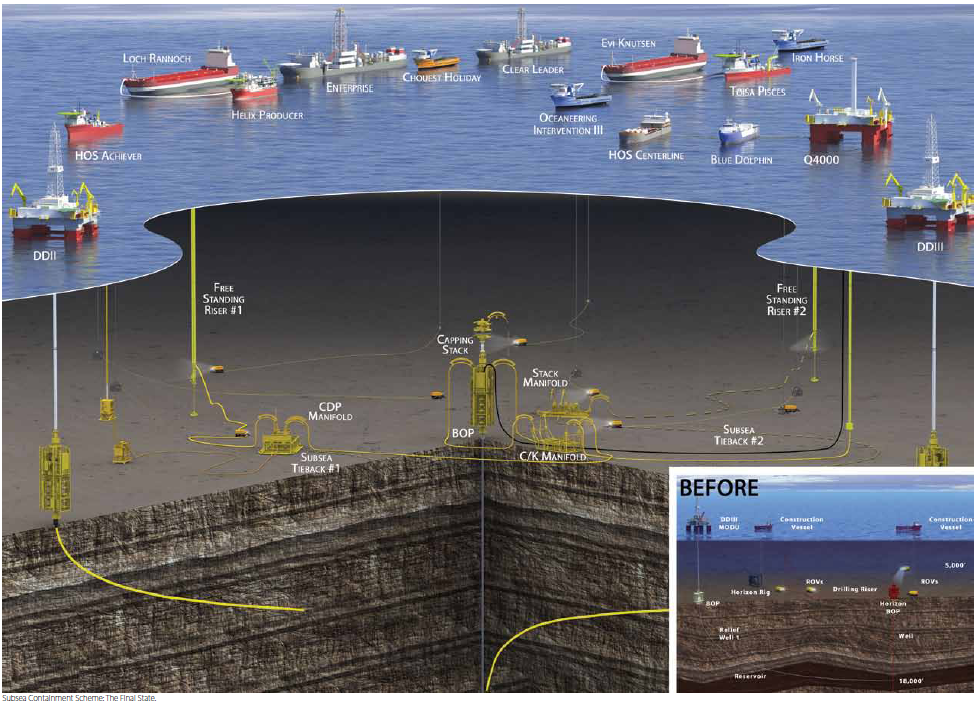
BP has issued a report on the response capabilities and innovative new technology and procedures demonstrated following the Macondo blowout. While the report is somewhat promotional (understandably), the information is summarized and compiled in a useful manner and underscores the magnitude of the response. Although most close observers probably have issues with certain actions taken by BP or the Unified Command, one cannot deny the unprecedented size and complexity of the response. We can only imagine how chaotic this response could have been if the operator did not have the resources and the will to mount such an enormous effort.
I hope BP will be similarly forthcoming with the results of their internal review of the blowout’s causes. When will that very important report be released?
At some point, BP’s candid observations on the functioning and effectiveness of the Unified Command system would also be helpful. The more we can learn about the differences of opinion and problems that arose during the response, the better we can prepare for future incidents. Will any of the official investigations be looking into these aspects of the response? At BOE, we are particularly interested in the well intervention, capping, containment, and relief well decisions.
BP audit of DWH leaked
Posted in Uncategorized, tagged blowouts, bp, Deepwater Horizon, drilling, Gulf of Mexico, macondo, offshore oil, oil spill, safety, transocean, well control on August 8, 2010| Leave a Comment »
A newspaper says it has obtained an internal audit conducted by BP PLC on the Deepwater Horizon oil rig that details severe safety flaws months before the Gulf of Mexico spill.
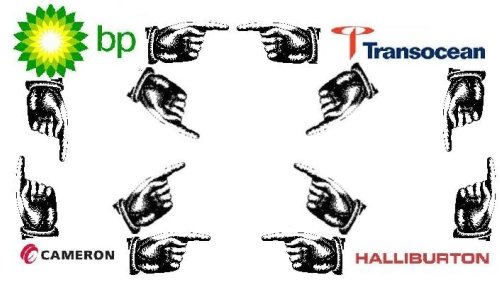
Comment: Was this a planned leak? If so, how does this strengthen BP’s legal position? The DWH had deficiencies (bad for Transoocean), but BP knew about the deficiencies and didn’t ensure that they were corrected (worse for BP?). As indicated by the poster below (More “Mike Talk”), the poor working relationship between the operator and contractor may have been the real core problem.
 Bud's Offshore Energy (BOE)