Feeds:
Posts
Comments

Posts Tagged ‘bp’

While the official BOEMRE-USCG and National Commission/Chief Counsel investigation reports were quite good and there are countless court documents and ad hoc reviews of the blowout, some important Macondo issues have not been fully addressed. BOE will touch on these issues periodically starting with the decision to terminate the top kill operation on 5/28/2010.

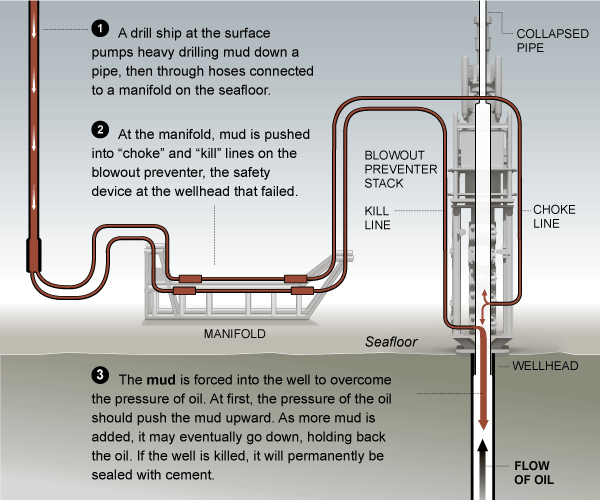
The top kill operation (see diagram above) was intended to overcome and halt the flow of oil by pumping heavy mud into the well bore.  The operation was not successful because the pumping rate and mud weight did not generate sufficient pressure.  Per an excellent paper by Dr. Mayank Tyagi and colleagues at LSU  (Analysis of Well Containment and Control Attempts in the Aftermath of the Deepwater Blowout in MC252):

It is very likely that if the top kill had been designed to deliver more than 109 bpm of 16.4 ppg drilling fluid below the BOP stack for a sustained period, the Macondo blowout could have been stopped between May 26-28, 2010. Given that the well was successfully shut-in with the capping stack in July, and that the subsequent bullhead (static) kill was successful, certainly a higher rate top kill would have been successful at that time.

The American Thinker, citing the New York Times, reports that Energy Secretary Chu stopped the top kill operation over the objections of some BP engineers. While it was reasonable to be concerned about possible casing leaks and the fracturing of subsurface formations, the subsequent (7/15/2010) closure of the capping stack demonstrated that the well had sufficient integrity to support the top kill operation. Questions regarding why a higher rate top kill effort was not attempted and how that decision was made are therefore important and merit discussion. Did the Macondo well flow unnecessarily into the Gulf for an additional 48 days (5/28-7/15)? Did the National Incident Command facilitate or delay source control?

Keep in mind that the NIC almost made a similar mistake in July. Even after the capping stack successfully shut-in the well on 7/15, Incident Commander Thad Allen (USCG) continued to call the closure of the capping stack a temporary test and threatened to require BP to resume flow from the well. Fortunately, informed input from experienced engineers prevailed. The well remained shut-in and the static well-kill operation was successful.

Read Full Post »

Dauphin Island tarballs, May 2011

Cheryl’s update after reviewing the latest reports:

  • There is a USCG unified command specific to BP spill residue after storms.
  • The tarballs are not considered toxic, just an unattractive nuisance.
  • Tarball cleanup on Dauphin Island was halted on May 1 to protect nesting birds.
  • BP estimates a total Macondo spill volume of about 4 million bbl as opposed to the government estimate of 4.9 million bbl.
  • BP estimates that 850,000 barrels were captured, burned or skimmed off the water.
  • 1,260 people remain employed in spill cleanup as of [July 14, 2011], down from a peak of 48,200 a year ago

Articles of interest:

Alabama.com

WALA New Orleans

Bloomberg Business Week 

Read Full Post »

You be the judge.

Read Full Post »

BP settled Macondo litigation with Weatherford, manufacturer of the float equipment equipment used in the Macondo well. The failure of this equipment was a key contributing factor in the Macondo blowout. Under the agreement, Weatherford will pay BP $75 million.  This money will be applied to the $20 billion Macondo trust fund.

Weatherford is the first of BP’s contractors to formally agree with BP that the entire industry can and should learn from the Deepwater Horizon incident. Accordingly, Weatherford has committed to working with BP to take actions to improve processes and procedures, managerial systems, and safety and best practices in offshore drilling operations. BP and Weatherford will encourage other companies in the drilling industry to join them in this improvement and reform effort.

Comments:

  1. $75 million seems like a rather modest payment by Weatherford given the magnitude of Macondo damage costs. BP will “indemnify Weatherford for compensatory claims resulting from the accident.”  Presumably, Weatherford’s sales agreements provide good legal protection.
  2. One of the root causes of the Montara blowout was also a float collar failure. That float collar was also supplied by Weatherford.  I’m surprised that this common cause and supplier have received almost no attention. Of course, no one has paid much attention to Montara, either before or after Macondo. Had more attention been paid to the Montara inquiry, Macondo might have been avoided.  (Note that most of the post-Macondo commentary still implies that deep water is the threat even though Montara was in 80 m of water and the root causes of Macondo were not water depth related).
  3. When do we learn more about the “improvement and reform effort” described in the quote above?

Read Full Post »

High-ranking congressmen made a concerted effort to financially distance themselves from BP in the aftermath of the Deepwater Horizon oil spill, either by reducing or altogether dumping their stock holdings, according to a Center for Responsive Politics analysis of lawmakers’personal financial disclosure documents released Tuesday. 

House Speaker John Boehner (R-Ohio) and Sen. John Kerry (D-Mass.) gave up all or a significant amount of their holdings in BP after the 2010 spill, which leaked an estimated 205 million gallons of oil in the Gulf of Mexico and killed 11 oil platform crew members in the initial explosion. Open Secrets Blog

Financial decision? Moral leadership? Fear of guilt by association? Washington front-running? Political weakness? I wonder where they reinvested their money.

More on lawmakers’ finances.

Read Full Post »

Hundreds of witnesses expected.

The trial won’t proceed quickly, if the parties call all the witnesses on their lists.

Transocean’s roster of 304 included 82 of its own employees, 87 from oil company BP, and 18 from cement contractor Halliburton.

BP listed 71 witnesses from Halliburton, 110 others, plus anyone else who has been or will be deposed.

The United States listed 56 from BP, 32 from Halliburton, and 76 others.

Read Full Post »

Fair or harsh? You be the judge.

Federal prosecutors are considering whether to pursue manslaughter charges against BP Plc (BP/) managers for decisions made before the Gulf of Mexico oil well explosion last year that killed 11 workers and caused the biggest offshore spill in U.S. history, according to three people familiar with the matter. Bloomberg

Read Full Post »

On 9 November 2010, the Petroleum Safety Authority Norway (PSA) conducted an audit of BP Norge’s follow-up of new work processes within drilling and well activities using information and communication technology (ICT)

summary of the audit

Read Full Post »

Great Australian Bight

Per the Sydney Morning Herald, BP has been granted the right to explore for oil and gas in the Bight area offshore South Australia.

Our energy security will be greatly enhanced by opening up new geological frontiers and reducing our dependence on imports. Resources and Energy Minister Martin Ferguson

Read Full Post »

A colleague sent a link to a Marathon Oil Company Macondo presentation that was posted by the Houston Chronicle. The presentation was intended for internal training and discussion purposes.

Firstly, I applaud Marathon for ensuring that the blowout is studied and debated within the company. Hopefully, they did the same thing for Montara, have a good internal system for studying accidents throughout the industry, and thoroughly investigate all of Marathon’s incidents and near misses.

I thought Marathon’s comments about safety culture were particularly interesting, including these on slide 58:

Although harder to define and measure, and even more difficult to regulate, we pointed to our culture as the single most important differentiating attribute when comparing us to BP.

In a recent meeting with an individual who has numerous dealings with BP, he observed that regardless of the purpose of the gathering (planning session to morning rig call), it is almost impossible to determine who is ultimately responsible and accountable for the operation being discussed. Evidence of this exists in the very report this presentation was derived from.
I wonder what convinces Marathon that their safety culture is superior. The above anecdote, while interesting, doesn’t tell us much. Prior to Macondo (and perhaps even after the blowout), I’ll bet most BP employees thought that they had a strong safety culture. Ditto for Transocean. Does Marathon have any better evidence demonstrating the strength of their safety culture? If not, what makes them so confident? Does Marathon have a process for assessing and monitoring the attitude and commitment of their employees? Have they conducted regular internal surveys to gauge safety culture? My sense is that they have not. If they had, they could make their case without the very subjective comparison with BP.

Read Full Post »

« Newer Posts - Older Posts »