Feeds:
Posts
Comments

Posts Tagged ‘bp’

Transocean slams the BP Macondo report:

However, rig owner Transocean slammed the report, saying: “This is a self-serving report that attempts to conceal the critical factor that set the stage for the Macondo incident: BP’s fatally-flawed well design.”

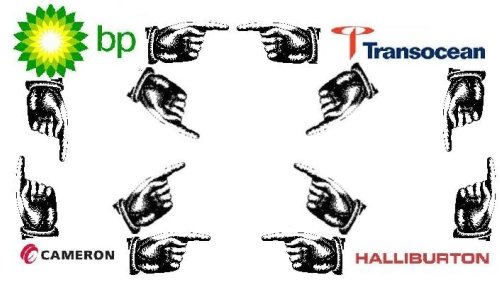
BOE Comment: At a time when the safety of oil and gas operations is rightfully under intense scrutiny, this ugly dispute further undermines public confidence in offshore exploration and development.  BP, Transocean, Halliburton, Cameron, and other feuding companies need to resolve their disputes so they can fully and credibly participate in the critical industry and governmental programs that are addressing offshore safety and pollution prevention issues.

Read Full Post »

Here is the link.

Our main interest was in the flow path and BOP issues:

Flow path:

The investigation team concluded that hydrocarbon ingress was through the shoe track, rather than through a failure in the production casing itself or up the wellbore annulus and through the casing hanger seal assembly.

BOP:

  1. The explosions and fire very likely disabled the emergency disconnect sequence
  2. The condition of critical components in the yellow and blue control pods on the BOP very likely prevented activation of another emergency method of well control, the automatic mode function (AMF), which was designed to seal the well without rig personnel intervention upon loss of hydraulic pressure, electric power and communications from the rig to the BOP control pods. An examination of the BOP control pods following the accident revealed that there was a fault in a critical solenoid valve in the yellow control pod and that the blue control pod AMF batteries had insufficient charge; these faults likely existed at the time of the accident.
  3. Remotely operated vehicle intervention to initiate the autoshear function, another emergency method of operating the BOP, likely resulted in closing the BOP’s blind shear ram (BSR) 33 hours after the explosions, but the BSR failed to seal the well.
BP’s flow path assessment is consistent with our expectations.  Early on, while most of the attention was focused on the annulus, we thought that flow inside the production casing was a distinct possibility.  With regard to the BOPs, BP’s explanation is a more complete than we expected at this time, given that the stack has just been recovered.
More to follow.

    Read Full Post »

    BOE has received unconfirmed reports that BP’s internal investigation into the causes of the Macondo blowout will be released on Wednesday (8 September) in Washington, DC.  The investigation team of more than 70 engineers and other staff has been headed by Mark Bly, BP’s Group VP for Safety and Operations.  Stay tuned!

    Read Full Post »

    BP has issued a report on the response capabilities and innovative new technology and procedures demonstrated following the Macondo blowout. While the report is somewhat promotional (understandably), the information is summarized and compiled in a useful manner and underscores the magnitude of the response.  Although most close observers probably have issues with certain actions taken by BP or the Unified Command, one cannot deny the unprecedented size and complexity of the response.  We can only imagine how chaotic this response could have been if the operator did not have the resources and the will to mount such an enormous effort.

    I hope BP will be similarly forthcoming with the results of their internal review of the blowout’s causes.  When will that very important report be released?

    At some point, BP’s candid observations on the functioning and effectiveness of the Unified Command system would also be helpful. The more we can learn about the differences of opinion and problems that arose during the response, the better we can prepare for future incidents.  Will any of the official investigations be looking into these aspects of the response?  At BOE, we are particularly interested in the well intervention, capping, containment, and relief well decisions.

    Read Full Post »
    A newspaper says it has obtained an internal audit conducted by BP PLC on the Deepwater Horizon oil rig that details severe safety flaws months before the Gulf of Mexico spill.

    link

    Comment: Was this a planned leak?  If so, how does this strengthen BP’s legal position?  The DWH had deficiencies (bad for Transoocean), but BP knew about the deficiencies and didn’t ensure that they were corrected (worse for BP?).  As indicated by the poster below (More “Mike Talk”), the poor working relationship between the operator and contractor may have been the real core problem.

    Read Full Post »

    Has US bloodlust at BP gone too far?

    Many will argue that BP deserves to die, and anger is entirely understandable. But critics should be careful what they wish for. America is a nation with a tradition of due process and everybody – even “big oil” – is entitled to a fair trial.

    Read Full Post »

    • “Worst environmental disaster in US history” –  Reporters may want to wait until all of the data are in before making those kind of statements.  Largest oil spill doesn’t necessarily equate to the worst environmental disaster.  Some very large spills have had minimal long-term environmental damage, while the effects of some smaller spills have been quite serious.  The extensive long-term monitoring program will give us the answers.
    • Loss of wetlands – Louisiana has experienced serious wetland losses for years with little attention from the national media.  The barrier islands, which were approved by Admiral Allen, have been on the drawing board for some time and are primarily for wetlands restoration purposes.  Ironically, these islands may not have been approved and funded were it not for the oil spill.
    • BP employees – I’d like to see some reporting from the standpoint of typical BP employees.  Their lives have also been shattered.  The very existence of their company, which has lost 1/4 of its market value, is threatened.  While few BP employees had anything to do with the Macondo disaster, they are all working hard to set things right and continue their domestic and international operations.  It must be frustrating to realize that no matter how hard they work, it won’t be good enough to satisfy the critics.
    • Will the national reaction do more damage than the spill?  US production is threatened in the Gulf and elsewhere, and jobs are already being lost.  Preventing offshore drilling and production doesn’t prevent oil consumption.  As long as we consume oil, there will be a risk of spilling it during the production and transportation process.  We need to better manage those risks.  We didn’t eliminate tanker transport after Valdez, and we shouldn’t eliminate offshore exploration and production in the wake of Macondo.  Let’s not boycott ourselves and make OPEC the primary beneficiary of this disaster.
    • “Nationalize BP”- Just when you thought the commentary couldn’t get any sillier, you hear this kind of nonsense.  Hugo Chavez must be smiling.

    Read Full Post »

    « Newer Posts