Feeds:
Posts
Comments

Posts Tagged ‘BOEMRE’

Tommy Beaudreau, an Obama appointee during the turbulent months following the Macondo blowout, has announced that he will be leaving the Department of the Interior (DOI) at the end of the month.

Tommy first served as Senior Advisor in the Bureau of Ocean Energy Management, Regulation, and Enforcement (BOEMRE), a transition bureau in the wake of the blowout, and was later named Director of the Bureau of Ocean Energy Management (BOEM), one of the two new bureaus that were established to manage the offshore program. He subsequently served as DOI Chief of Staff, and was appointed Deputy Secretary in 2021.

Tommy was a strong leader and an energy moderate. He was highly regarded by the rank and file in BOEMRE and BOEM.

The press release announcing his departure is very professional with appropriate quotes from Secretary Haaland and Tommy. No reasons for his resignation are provided. However, given his balanced perspective on energy development, it would not be wildly speculative to suggest that he might have been a bit uncomfortable working in the policy bubble that produced documents like the latest offshore leasing plan.

Read Full Post »

Much ado about nothing courtesy of the Associated Press:

Copies of the forms submitted by more than 100 inspectors, engineers and permit reviewers in five Gulf coast offices were obtained by the AP under the Freedom of Information Act. Personal information, such as the names of the employees, their friends and their family members, was blacked out to protect privacy. But the companies with ties to government workers were disclosed, and they represent a who’s who of the offshore oil and gas industry, from majors like Chevron, Shell and BP to smaller companies such as W&T Offshore Inc., Ankor Energy LLC and Hilcorp Energy Co.

So yesterday we linked an article about proposed legislation that would, among other things, require that offshore inspectors have “at least three years experience in the oil and natural gas field.” Today, we read contradictory (and silly) comments like the one below in the AP piece that criticize such experience. How would you like to be an oil and gas inspector or prospective offshore regulator?

“It’s nearly impossible to determine where the oil industry ends and the government’s regulatory agency begins,” said Scott Amey of the Project on Government Oversight, after reviewing AP’s data. “These new instances indicate that BOEMRE staff are connected to individuals and oil companies, which raises concerns about lax oversight and the integrity of the agency. Without enhanced enforcement authority and independent oversight of these potential conflicts, I’m uncertain that BOEMRE can assure the public that it is truly watchdogging the offshore oil industry.”

Give these people a break. I have seen absolutely no evidence that improper government-industry relationships or compromised inspections had anything to do with the Macondo blowout or any other recent incident. Inspection and engineering personnel are under continuous scrutiny well beyond what most employees would accept, and recuse themselves from assignments if there could be even a perception of a conflict of interest.

The US offshore program, and every other safety regulator, needs people who understand the operations and technology that they regulate. These regulators need to communicate regularly with industry personnel on operational and regulatory issues. Too little interaction with their professional peers is a greater danger than too much. You don’t advance safety technology and procedures, and resolve concerns, without communication.

DOI offshore personnel have had and will continue to have more than enough oversight; time to move on to another cause.

Read Full Post »

Ohmsett

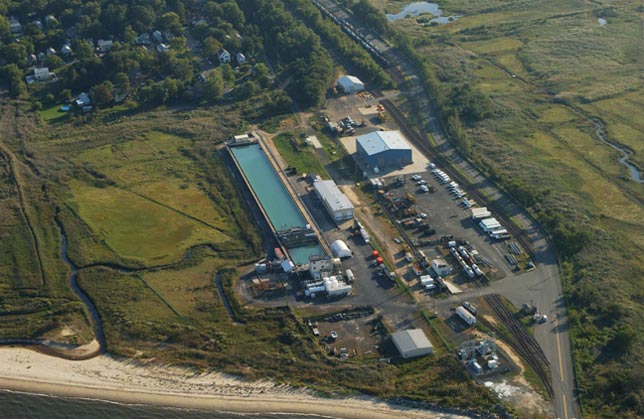
Yesterday’s Platt’s Oilgram News included an excellent Gary Gentile piece about Ohmsett and the recent visit by BOEMRE Director Bromwich and Admiral Zukunft of the Coast Guard. Both had high praise for this outstanding oil spill response test facility which has contributed greatly to improved understanding of boom and skimmer performance, in situ burning, and chemical treating agents. This quote from the Platt’s article gives you a sense of the facility’s importance:

AbTech Industries spent two days at OHMSETT testing a new polymer it hopes will be able to sop up hydrocarbons from produced water or water used in hydraulic fracturing. The company pumped saltwater contaminated with Louisiana crude at rates of up to 250 gallons per minute through its filtering system. “The facility is tremendously unique,” AbTech Chief Operating Officer Jonathan Thatcher said in an interview. “I don’t know where else we would go where we could pump up to 250 gallons per minute for days on end and contaminate it. It allows you to go and make any mistakes you need to make.”

As we have said before, those who claim that there has been no progress in spill preparedness either have no real interest in spill response or have not been paying attention. Much has been accomplished.

Kudos to spill response visionaries like Ed Tennyson and John Gregory, MMS employees who had been pushing for the re-opening of Ohmsett since EPA closed the facility in the mid-1980’s.  After the Valdez spill in 1989 they received the necessary support, and the facility has been going strong since its re-opening in 1992.

Read Full Post »

News: BOEMRE releases report on the September 2010 Mariner Fire in the Gulf of Mexico.
BOE Comments:

  • Good report and relatively timely. Nice job by the team.
  • Good discussion of the heater-treater and production safety issues.
  • This was a very serious incident and lives were jeopardized. Sadly, no oil spill means no public attention.
  • Why didn’t the Coast Guard participate in the investigation? Will they be reporting on the haphazard evacuation?
  • Age old question: Is the rather extensive discussion of violations appropriate for an accident report? Should violations and enforcement actions be managed independently from accident investigations?
BOE: Floating liquefaction facilities open interesting possibilities for producing natural gas in remote offshore locations, possibly including the arctic.  The first FLNG facility will be 488 m from bow to stern! Offshore to the future!
BOE: Lots of posturing and not much in the way of meaningful proposals from either party. Unlike Australia, the US has not responded to its blowout with necessary legislative action, most notably the establishment of a single offshore safety and pollution prevention regulator.
BOE: Engineers solve problems when given the opportunity and encouragement. JL Daeschler is busy at the drawing board!
News: Greenland rolls on. despite Greenpeace protests. Cairn Energy has begun a second summer of drilling.
Views: Last summer’s results must have been sufficiently encouraging to justify further exploration. 
News: Hurricane season officially begins tomorrow.
BOE: There has been surprisingly little public discussion about the offshore industry’s preparations. Hopefully, everyone is ready.
BOE: Where is the worldwide commitment from industry and government? This problem can and must be fixed!

Read Full Post »

Giant metal shears successfully sliced and closed pipe full of runaway crude in the early moments of last April’s Deepwater Horizon disaster, but the oil blasted through rubber gaskets around the blades and unleashed the nation’s largest spill, according to sources familiar with an ongoing investigation. Houston Chronicle

That would be consistent with the video evidence recorded on the Q4000, but we still need a lot more information about the timing of the shear ram closure, the position of the ram and drill pipe before and after shearing, maintenance, and other important BOP issues.

Kudos to the Chronicle for their ongoing coverage of Macondo issues.

Read Full Post »

Link

Salazar and Bromwich also announced that they are establishing a permanent advisory body through which the nation’s leading scientific, engineering, and technical experts will provide input on improving offshore drilling safety, well containment, and spill response. Secretary Salazar has asked former Sandia National Laboratory Director Tom Hunter to lead the body, which will be called the Offshore Energy Safety Advisory Committee (Safety Committee).

The new Bureau of Ocean Energy Management (BOEM) will be responsible for managing development of the nation’s offshore resources in an environmentally and economically responsible way. Functions will include: Leasing, Plan Administration, Environmental Studies, National Environmental Policy Act (NEPA) Analysis, Resource Evaluation, Economic Analysis and the Renewable Energy Program.

The new Bureau of Safety and Environmental Enforcement (BSEE) will enforce safety and environmental regulations. Functions will include: All field operations including Permitting and Research, Inspections, Offshore Regulatory Programs, Oil Spill Response, and newly formed Training and Environmental Compliance functions.


Read Full Post »

Encouraging and prudent decision:

The Bureau of Ocean Energy Management, Regulation and Enforcement (BOEMRE) today notified 13 companies whose deepwater drilling activities were suspended by last year’s deepwater drilling moratorium that they may be able to resume those previously-approved activities without the need to submit revised exploration or development plans for supplemental National Environmental Policy Act (NEPA) reviews. Before resuming those activities without additional NEPA review, however, the companies must comply with BOEMRE’s new policies and regulations.

The resumption of operations on suspended wells was the major concern of some operators and had the potential to delay anticipated new production.

Read Full Post »

Washington Post report:

Workers on the doomed Gulf of Mexico oil rig were distracted by multiple activities going on simultaneously and didn’t try to shut the well until 49 minutes after potentially explosive gas particles began flowing in, a BP vice president told a federal investigative panel Wednesday.

Read Full Post »

There were so many simultaneous activities — starting with the displacing of mud to the pumping of fluids overboard — it was difficult to see what was going on. John Gisclair, Sperry Sun (see Times Picayune summary of yesterday’s BOEM-Coast Guard hearing)


John Gisclair


Too much at once? Hurrying to finish the job? Cost concerns?  No one in charge? Distracted by managers visiting the rig? One or more of these human and organizational factors appears to have contributed to the blowout.

Similarly, the rigid commitment to “batching” the development wells (for efficiency reasons) seems to have been a factor contributing to the Montara blowout in the Timor Sea.  If after removing the corrosion cap on the production casing, the work on the H1 well had continued in series (i.e. casing tied-back, BOP installed, and well secured) before moving on to another well, this blowout may have been prevented.

At both Macondo and Montara, time pressures (perceived or real) may also have affected the way negative-pressure tests were conducted or assessed.  These tests should have detected the influx of hydrocarbons via the shoe track.

Read Full Post »

Safety and Environmental Management Systems

This rulemaking will incorporate in its entirety and make mandatory the AmericanPetroleum Institute’s Recommended Practice 75, Development of a Safety andEnvironmental Management Program for Offshore Operations and Facilities, with respectto operations and activities under the jurisdiction of BOEMRE. This final rule will applyto all OCS oil and gas and sulphur operations and the facilities under BOEMREjurisdiction including drilling, production, construction, well workover, well completion,well servicing, and DOI pipeline activities.

The rule will become effective on November 15, 2010.

Read Full Post »

Older Posts »