June 3, 2011 by offshoreenergy
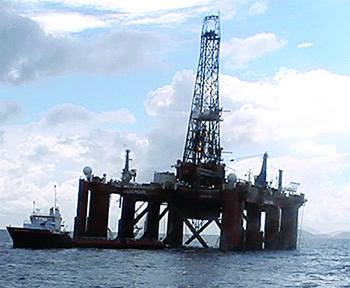
Aban Pearl listing off Trinidad in August 2009
While our interest in the sinking of the Aban Pearl pertains to what went wrong and why, former PDVSA board member Gustavo Colonel continues to question Aban Pearl contracting irregularities. Is PDVSA refusing to release the report on the Aban Pearl sinking so as not to draw further attention to these contracting issues?
The whole Board is responsible for the loss of about 800,000 barrels per day of oil production; for the fraudulent certification of “proven oil reserves” in the Orinoco heavy oil region; for the irregular contracting, with a ghost company, of the offshore drilling barge Aban Pearl for twice the amount really paid to the owners of the barge; for the importing of 180,000 tons of food that later went to rot in Venezuelan ports but provided some of the members of the board with millions of dollars in criminal profits; and in numerous other corrupt practices that are well documented.
Posted in accidents | Tagged aban pearl, accidents, offshore drilling, safety | Leave a Comment »
June 2, 2011 by offshoreenergy
Like the National Commission on the BP Deepwater Horizon Oil Spill and Offshore Drilling, the Montara Commission of Inquiry, the Norwegian government, and leading safety and regulatory authorities around the world, the IADC recognizes the risks associated with complex, multi-agency regulatory regimes. A single authority should be responsible and accountable for safety and pollution prevention at offshore facilities, and should draw on the expertise of other agencies and organizations as necessary to achieve performance objectives.
The safety and environmental risks associated with fragmented or compartmentalized regulation include gaps, overlap, confusion, inconsistencies, and conflicting standards. Industry and governmental personnel spend too much time coordinating with multiple parties and not enough time managing safety and environmental risks.
Link to IADC comments. Key quotes:
IADC continues to be concerned by seemingly duplicative regulatory requirements imposed by the Coast Guard and BOEMRE, particularly where the agencies appear to have divergent views regarding the placement of regulatory responsibility.
One cannot holistically address safety when faced with the unyielding and overlapping demands of multiple narrowly-focused regulatory agencies.
Posted in accidents, Offshore Energy - General, Regulation | Tagged accidents, Coast Guard, Deepwater Horizon, IADC, macondo, Montara, Norway, offshore drilling, Regulation, safety | 2 Comments »
June 1, 2011 by offshoreenergy
Daily Mail
The people of Blackpool may have barely felt a shudder, but the repercussions could be wide-reaching.
Measuring just 1.5 on the Richter scale, the seaside town escaped a recent earthquake totally unscathed.
But it was the latest in a series of ‘natural’ disasters, that are not considered natural at all – they are man-made.
Now the UK’s only ‘shale’ gas drilling project has been suspended after it emerged that the controversial technique may have caused the tremors.
Posted in drilling | Tagged earthquakes, shale gas, UK | Leave a Comment »
June 1, 2011 by offshoreenergy
“It would seem to me, reading between the lines, that the cockpit crew weren’t confident of the information that was being presented to them on the data displays. Maybe — and it’s only a maybe — they took some action that led to the stall warning, and the plane stalling and then being unable to correct it.”
The above quote from a new article on the Air France crash should sound familiar to BOE readers. At both Montara and Macondo, the evidence of hydrocarbon influxes was clear, but personnel misinterpreted or ignored that information. Was this wishful thinking on their part? Was their training flawed? Lack of sleep? Overstressed? Distracted? These issues need to be carefully studied.
Improving well control preparedness is not simply a matter of modifying stack design. The thought processes and human response tendencies that contribute to well control incidents and other accidents must be fully considered. Monitoring systems must provide timely, accurate, and understandable information, and training programs must teach workers not to rationalize negative signals, but to respond with caution pending further assessment. Trainers must remind students about past disasters and how they could have been prevented.
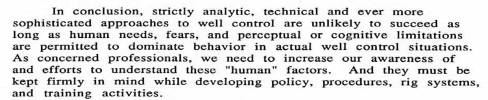
Nearly 20 years after it was written, Paul Sonnemann’s excellent paper on the Psychology of Well Control (excerpt below) is even more relevant today. We need to build upon and apply the lessons.
Posted in accidents | Tagged accidents, Air France 447, blowouts, BOP, Deepwater Horizon, macondo, Montara, offshore drilling, safety, Sonnemann, well control | Leave a Comment »
June 1, 2011 by offshoreenergy
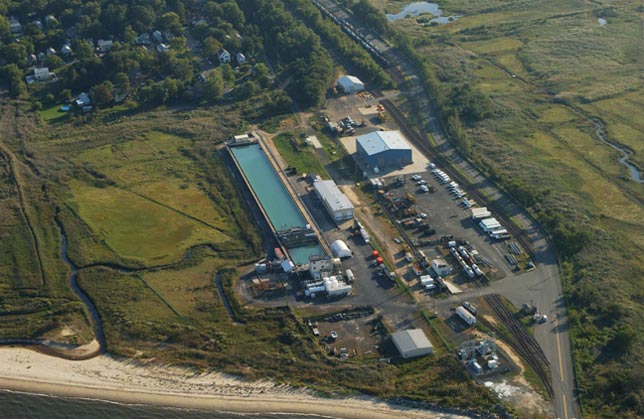
Ohmsett
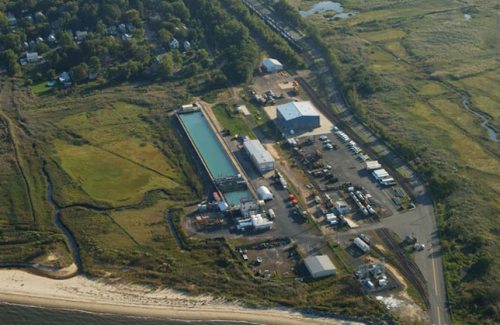
Yesterday’s Platt’s Oilgram News included an excellent Gary Gentile piece about Ohmsett and the recent visit by BOEMRE Director Bromwich and Admiral Zukunft of the Coast Guard. Both had high praise for this outstanding oil spill response test facility which has contributed greatly to improved understanding of boom and skimmer performance, in situ burning, and chemical treating agents. This quote from the Platt’s article gives you a sense of the facility’s importance:
AbTech Industries spent two days at OHMSETT testing a new polymer it hopes will be able to sop up hydrocarbons from produced water or water used in hydraulic fracturing. The company pumped saltwater contaminated with Louisiana crude at rates of up to 250 gallons per minute through its filtering system. “The facility is tremendously unique,” AbTech Chief Operating Officer Jonathan Thatcher said in an interview. “I don’t know where else we would go where we could pump up to 250 gallons per minute for days on end and contaminate it. It allows you to go and make any mistakes you need to make.”
As we have said before, those who claim that there has been no progress in spill preparedness either have no real interest in spill response or have not been paying attention. Much has been accomplished.
Kudos to spill response visionaries like Ed Tennyson and John Gregory, MMS employees who had been pushing for the re-opening of Ohmsett since EPA closed the facility in the mid-1980’s. After the Valdez spill in 1989 they received the necessary support, and the facility has been going strong since its re-opening in 1992.
Posted in Uncategorized | Tagged BOEMRE, Coast Guard, ohmsett, oil spill research | Leave a Comment »
May 31, 2011 by offshoreenergy
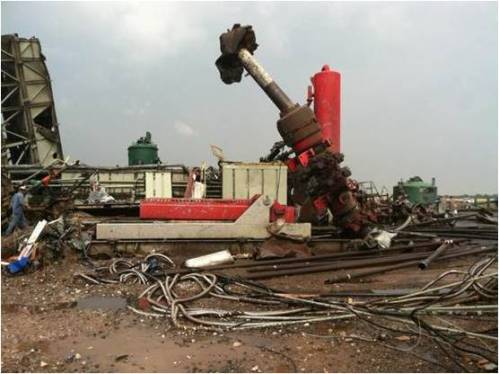
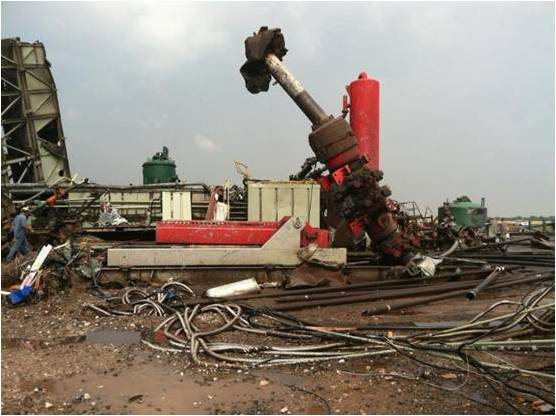
A BOE contributor sent pictures of Cactus Rig 117, which was destroyed by a tornado on May 24, 2011, near Calumet, Oklahoma. The F5 tornado was 1/2 mile wide with winds up to 210 mph. Fortunately, no one was injured.
Posted in accidents | Tagged drilling, Oklahoma, rig, tornado | Leave a Comment »
May 31, 2011 by offshoreenergy
News: BOEMRE releases report on the September 2010 Mariner Fire in the Gulf of Mexico.
BOE Comments:
- Good report and relatively timely. Nice job by the team.
- Good discussion of the heater-treater and production safety issues.
- This was a very serious incident and lives were jeopardized. Sadly, no oil spill means no public attention.
- Why didn’t the Coast Guard participate in the investigation? Will they be reporting on the haphazard evacuation?
- Age old question: Is the rather extensive discussion of violations appropriate for an accident report? Should violations and enforcement actions be managed independently from accident investigations?
BOE: Floating liquefaction facilities open interesting possibilities for producing natural gas in remote offshore locations, possibly including the arctic. The first FLNG facility will be 488 m from bow to stern! Offshore to the future!
BOE: Lots of posturing and not much in the way of meaningful proposals from either party. Unlike Australia, the US has not responded to its blowout with necessary legislative action, most notably the establishment of a single offshore safety and pollution prevention regulator.
BOE: Engineers solve problems when given the opportunity and encouragement. JL Daeschler is busy at the drawing board!
News: Hurricane season officially begins tomorrow.
BOE: There has been surprisingly little public discussion about the offshore industry’s preparations. Hopefully, everyone is ready.
Posted in accidents, cuba, drilling, Florida, Offshore Energy - General | Tagged Australia, BOEMRE, BOP, Cairn, Coast Guard, FLNG, Greenland, hurricanes, Mariner Energy, NOAA, Shell | 1 Comment »
May 20, 2011 by offshoreenergy
Offshore Energy Leaders,
Due to major travel and work commitments, blog posting will be limited for the next few weeks.
Thanks for visiting the site and for your interest in offshore safety, energy and regulatory policy issues.
Bud
Posted in Uncategorized | Leave a Comment »
May 18, 2011 by offshoreenergy

PSA release and link to report:
The direct cause of the incident was that the container being lifted began swinging too much and got caught up in another container. A deck worker standing in an unsecured area was struck and injured.
This incident could potentially have killed the person concerned. Substantial material damage could also have been caused.
Posted in accidents | Tagged accidents, cranes, Gullfaks A, lifting incident, Norway, PSA, safety | Leave a Comment »
« Newer Posts - Older Posts »