Attached is an outstanding presentation by Jason Mathews that reviews the latest Gulf of Mexico incident data and trends. The collection and analysis of incident data are critical to safety achievement and continuous improvement, and are among an offshore energy regulator’s most important functions. Kudos to BSEE’s Gulf of Mexico Region for their timely and comprehensive reviews and alerts.
For those interested in California offshore decommissioning, attached is an excellent update presented at a 2020 forum by my former colleague John Smith.
The growing interest in green hydrogen inspired me to write a post about Rick Carrier, a war hero and visionary who is largely unknown to the offshore energy community. Rick’s plan for a Mid-Atlantic wind-hydrogen demonstration project was the first offshore wind proposal submitted to the Minerals Management Service, the bureau that initiated the offshore wind program in the U. S.
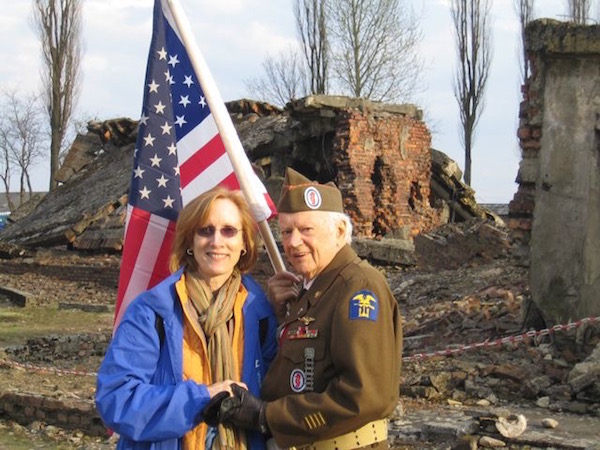
Rick Carrier lived an amazing life – WWII hero, artist, playwright, diver, conservationist, green hydrogen pioneer, and more. Perhaps most noteworthy were his military accomplishments. He was among the first Americans to land on Utah Beach during the D-Day invasion. He subsequently became the first allied soldier to discover the Buchenwald concentration camp. The next day, April 11, 1945, he marched into the camp with Patton’s Third Army and liberated the prisoners. Rick is pictured above at the 2012 March of The Living, an annual walk down the 3-kilometer path from Auschwitz to Birkenau. In June of 2014, Rick returned to Normandy for a ceremony marking the 70th anniversary of D-Day. Later that year, the President of France awarded him the Chevalier of the Legion of Honor — France’s highest honor.
Rick founded the USA Bald Eagle Command in 1975 to protect the endangered American Bald Eagle. The organization’s efforts played a role in President Reagan’s declaration of June 20, 1982 as National Bald Eagle Day. Through the efforts of this and other conservation groups, the Bald Eagle was removed from the Endangered Species list in 2007.
Rick’s green hydrogen proposal was yet another patriotic venture. Through his non-profit, Bald Eagle Energy, he sought to demonstrate the commercial potential for using offshore wind energy to produce hydrogen from sea water. Unfortunately, the framework for permitting such projects had not yet been established. While we tried to find a way to make the project possible, the obstacles were too great.
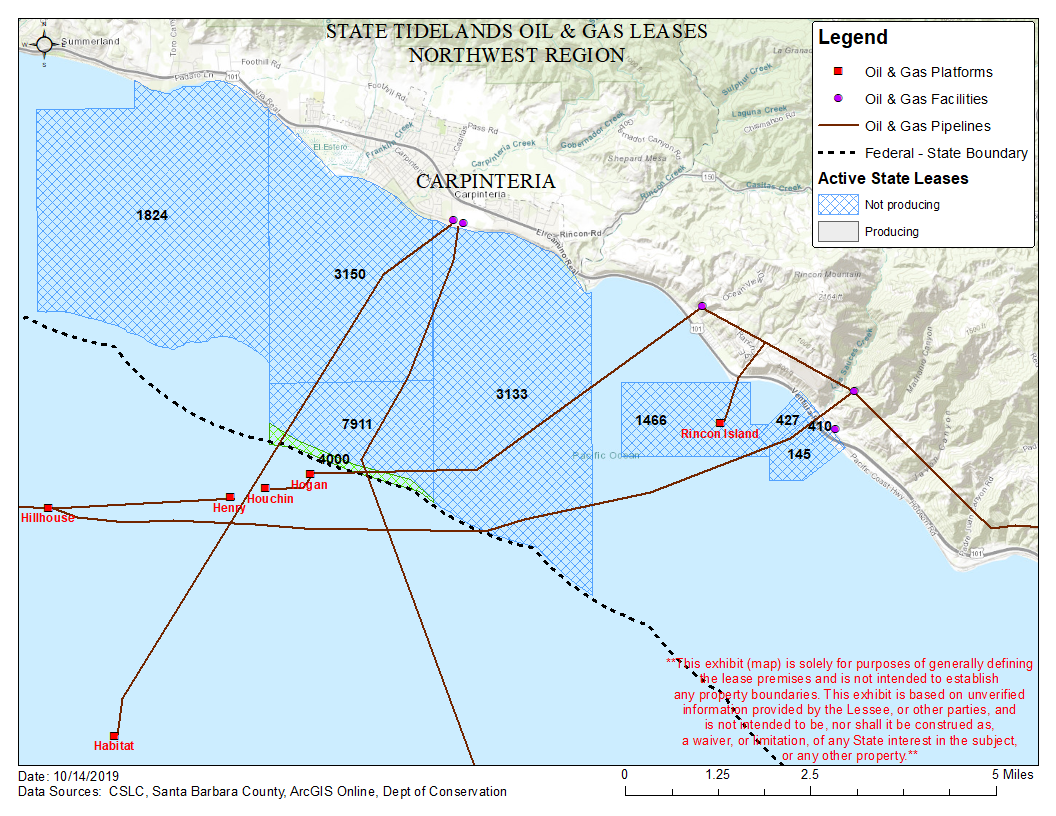
The troubled past of Platforms Hogan and Houchin extends into California State waters. In the 1990’s, Signal Hill and affiliates launched plans to drill directionally from Hogan into adjacent State leases 4000, 7911, and 3133 (see map above). These plans were dubious from the outset given MMS (Federal regulator) concerns about Hogan’s structural integrity. The planning process was never successfully concluded and the 3 State leases were terminated in 2019. For full details see this California State Lands Commission report:
In a related action, the State is suing Signal Hill for unpaid rentals on the pipeline lease that carried production from Hogan to shore. The amount due is approximately $287,000.
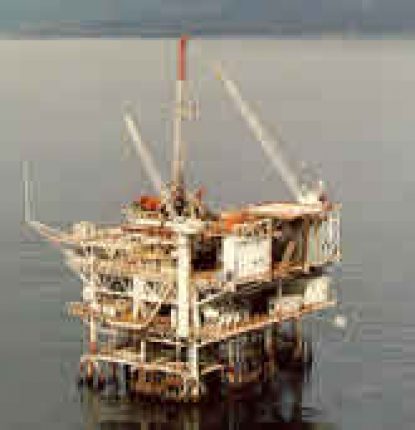
Platforms Hogan and Houchin were installed 52 and 53 years ago respectively on Lease OCS P-0166 in the Santa Barbara Channel. The lease, which had initially been issued to Phillips Petroleum, Cities Service Oil Co., and Continental Oil Co., was assigned to Signal Hill Service effective 2/19/1991. The assignment was approved despite concerns within the Minerals Management Service (MMS) about the financial strength of Signal Hill and the technical competence of Pacific Operators Offshore Inc (POOI), the affiliate that would operate the facilities.
Three decades of frustration followed for MMS, BOEM, and BSEE regulators in the Pacific Region. Per the terms of the assignment, Signal Hill was required to establish an Abandonment Escrow Account, funded from oil production revenue, with a “target balance” equal to the abandonment cost, plus 25 percent. These payments were seldom made in a timely and consistent manner.
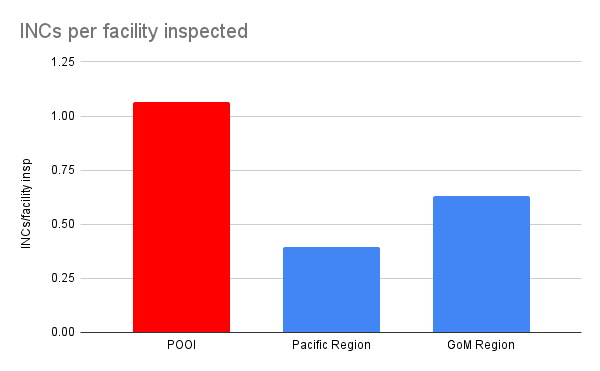
Compliance with safety regulations was also poor. In that regard, violations data are consistent with anecdotal reports from inspectors. POOI accounted for a high percentage of the regional Incidents of Noncompliance (INCs), and Platforms Hogan and Houchin had INC/inspection ratios that were far higher than Pacific or Gulf of Mexico platform averages (see inspection data below).
INC’s
Warnings
Component Shut-ins
Facility Shut-ins
POOI
485
562
46
All companies (Pacific Region)
1965
3103
281
POOI % of total
24.6
18.1
16.4
A 9/20/2020 Inspector General report found significant irregularities in the use of funds from an offshore production company’s escrow account. While the IG’s summary (pasted below in its entirety) doesn’t say so, the company is assumed to be Signal Hill.
The OIG investigated allegations that an offshore oil and gas production company improperly paid operational expenses with money from an escrow account dedicated to paying expenses related to decommissioning offshore platforms in Federal waters. We found that the company routinely used funds from its decommissioning account to pay what appeared to be various operating expenses. We also found instances where the company appeared to claim reimbursement for duplicate expenses. Based on our findings, the company submitted credits and adjustments, totaling $1.9 million, to the decommissioning account to cover these expenses and other disbursements. In addition, we referred a number of unresolved expenses for non-decommissioning activities to the Bureau of Safety and Environmental Enforcement and the Bureau of Ocean Energy Management for resolution. We referred this matter to the U.S. Department of Justice, which declined to pursue it.
Why haven’t BOEM, BSEE, or the OIG released the full report? The public and the offshore industry certainly have a right to know given the potential costs to the taxpayer and the reputational damage to the industry.
Why was a company with such a poor payment and compliance record allowed to withdraw funds from their decommissioning account to cover operating expenses?
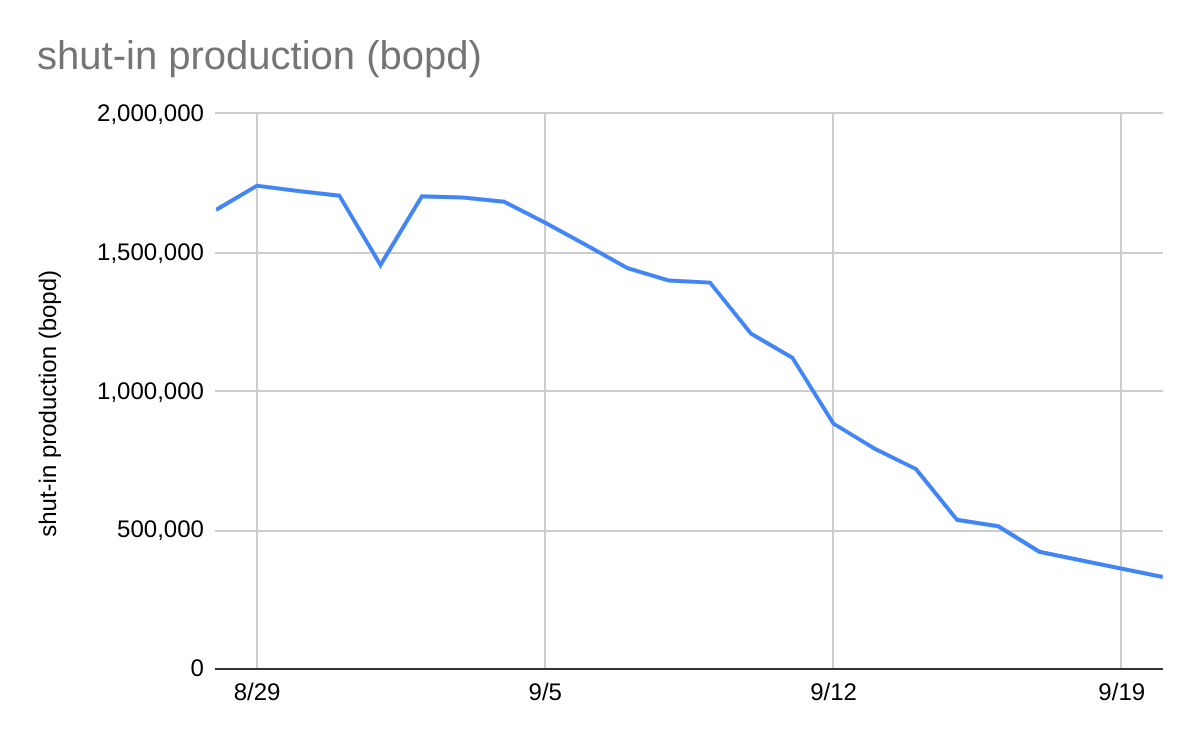
Shell’s damage assessment of the West Delta 143 (WD 143) platforms revealed significant structural damage. Shell estimates that that the WD-143 “A” platform facilities will be off line for repairs until the end of 2021, and that the facilities on our WD-143 “C” platform will be operational in Q4 2021. Shell expects to resume production from their Olympus platform, which flows across the WD-143 “C” platform, in Q4 2021, and from their Mars and Ursa facilities, which flow across the WD-143 “A” platform, in Q1 2022.
Mars, Olympus, and Ursa account for most of the GoM production that remains shut-in as a result of Hurricane Ida.
European power prices have spiraled to multi-year highs on a variety of factors in recent weeks, ranging from extremely strong commodity and carbon prices to low wind output.
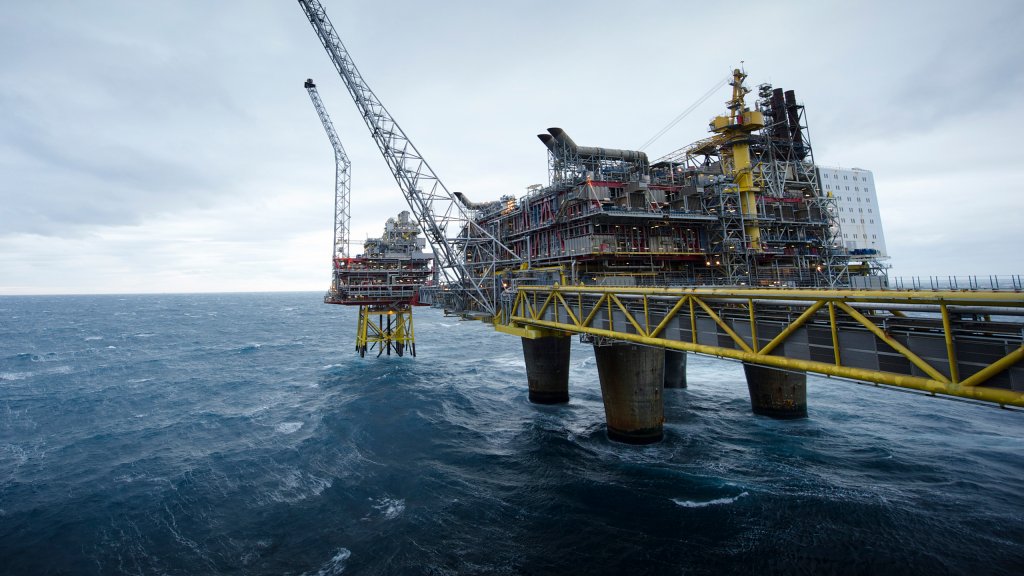
Equinor and its partners have received permission to increase gas exports from two fields on the the Norwegian continental shelf to supply the tight European market. Production permits for the Oseberg and Troll fields have each been increased by 1 billion cubic meters (bcm) for the gas year starting 1 October.
The House Oversight Committee has requested that executives from Exxon, Shell, Chevron, BP, and testify on October 28th.
“We are deeply concerned that the fossil fuel industry has reaped massive profits for decades while contributing to climate change that is devastating American communities, costing taxpayers billions of dollars and ravaging the natural world,” Oversight Chairwoman Carolyn Maloney, D-N.Y., and Rep. Ro Khanna, D-Calif., wrote in a letter to oil executives.
Expect moral outrage, sloganeering, and finger pointing (the Washington salute). A link for viewing the hearing will be posted at the committee website.