- DC Federal Court decision on Gulf of Mexico Oil and Gas Lease Sale 257: Will the Court uphold the 11/17/2022 sale? If the Court upholds the sale, will BOEM accept the carbon sequestration bids without having announced that tracts would be offered for those purposes, and without advising about lease terms and bid analysis procedures?
- Investigation reports for the 6 fatal US offshore incidents in 2020: When will these overdue reports be issued? Also, we know that there were at least two 2021 fatalities? When will those reports be issued?
- Platforms Hogan and Houchin, Santa Barbara Channel: When will we learn more about the Inspector General’s findings regarding the improper use of decommissioning funds? Why was the lessee, Signal Hill, allowed to withdraw funds from those accounts for purposes unrelated to decommissioning? How does this affect the liability of predecessor lessees?
- Investigation of the Huntington Beach pipeline spill: When will the the joint investigation team report be issued? To what extent can the pipeline operator be held liable for a leak caused by anchor dragging, particularly given the leak detection limitations for low pressure pipelines?
- Globetrotter 2 incident during Hurricane Ida: When will the Coast Guard issue their report on the delayed relocation of the Noble Globetrotter 2 drillship during Hurricane Ida? In light of this incident, the fatality on the Pacific Khamsin prior to Tropical Storm Laura (2020), and similar incidents, further attention to the timely relocation of dynamically positioned drillships would seem to be in order.
- US offshore drilling and production trends: With several deepwater fields scheduled to begin producing in 2022, will GoM oil production meet or exceed the August 2019 peak of 2.044 million BOPD, at least temporarily? Will exploratory drilling activity increase to levels needed for reserve replacement? Will the prolonged decline in US offshore gas production be reversed?
- Russell Peterson liftboat tragedy (2008): Will the Coast Guard ever explain why their investigation report in unavailable?
Posted in accidents, decommissioning, energy policy, hurricanes, Offshore Energy - General | Tagged 2020 offshore fatalities, Beta Unit pipeline, Globetrotter II, Hogan and Houchin, Huntington Beach, Khamsin, Lease Sale 257, offshore production, Russell Peterson | Leave a Comment »

Per our 10/20/2021 post about this Saudi recreation venture, below is a nice promotional video. This greatly exceeds what we had envisioned many years ago!
Posted in decommissioning, rigs-to-reefs, Uncategorized | Tagged rigs-to-recreation, rigs-to-resorts, rigs-to-rides, rigs-to-roar, Saudi Arabia | Leave a Comment »
“We will need gas throughout the transitional phase,” government spokesman Steffen Hebestreit said.
oilprice.com
Germany has a very strong Green lobby that has now become part of the ruling coalition. Despite an anti-fossil fuel discourse, the Greens have now apparently accepted the necessity of at least one fossil fuel, perhaps not least because Germany has plans to shut down all of its nuclear power plants by the end of this year.
oilprice.com
Posted in energy policy, natural gas | Tagged Deutschland, energy transition, Green Party, natural gas | Leave a Comment »
Last month (12/2021), BSEE finally posted the 2020 incident statistics. Unfortunately, no details or incident summaries are provided for the 6 fatalities. The fatalities are simply classified as “occupational” (4) or “non-occupational” (2). As a result, we still know very little about these fatal incidents 13 – 24 months after they occurred.
The BSEE spreadsheet advises that 3 of the 4 “non-occupational” fatalities are being investigated, but the reports are still “pending.” Why the long delay? The National Commission, BOEMRE-CG, and NAE investigations of the Macondo tragedy were completed (and reports published) in less time.
No explanation is provided as to why the 4th occupational fatality is not being investigated.
Also, investigations of the preparedness and response aspects of the 2 non-occupational fatalities would have been beneficial. What was the cause of death? What medical screening procedures were in place? What treatment capabilities were available at the facility? How much time was required to transport the workers to hospitals? These are important considerations for the offshore community.
Below is a summary of the publicly available information for the 6 fatalities:
- 1/14/2020: A worker died on a Diamond drillship on a lease (Mississippi Canyon 822) operated by BP. According to BSEE this was a non-occupational fatality. Per the listing of investigations, no investigation was conducted.
- 5/16/2020: A worker died on a Fieldwood platform (Ewing Bank 826 A). Per BSEE, this was an occupational fatality and the investigation is still pending. There were no media reports or company announcements.
- 6/2/2020: A worker died on the Valaris DS-18 drillship working for EnVen Energy at Green Canyon 767. Per BSEE, this was a non-occupational fatality and no investigation was conducted.
- 6/20/2020: A worker died on at the Green Canyon 18 A platform operated by Talos. Per BSEE, this was an occupational fatality but no investigation is indicated for this incident. No media reports or company announcements could be found.
- 8/23/2020: A worker died on the Pacific Khamsin drillship working for Total at Garden Banks 1003. A month later, at an Investors’ Day presentation, Total announced that the incident occurred while the crew was preparing to move the rig to avoid Tropical Storm Laura. Total’s statement included this defensive statement: “This is a routine operation that was executed with no time pressure as the rig disconnection had been decided well in advance.” Per Total, the findings of their investigation were shared with the regulators in Sept. 2020, but BSEE advises that their investigation is still pending.
- 12/2/2020: A worker died on DCOR’s Platform Gilda in the Santa Barbara Channel offshore California. The BSEE investigations update provides no information on the status of the investigation. Per local media, 3 men fell from the platform and others jumped into the water to assist. No information is provided on the reason why the 3 men fell.
The number of US OCS fatalities remains unacceptably high, and timely data sharing and investigations are needed to better assess causes and trends. In that regard, this recommendation from the 2016 National Academies report entitled “Strengthening the Safety Culture of the Offshore Oil and Gas Industry” merits further industry/government attention and action:
Recommendation 4.2.2: Because accident, incident, and inspection data all are needed to identify and understand safety risks and corrective actions, the committee recommends full transparency such that regulators make all these data readily available to the public in a timely way, taking into consideration applicable confidentiality requirements.
Posted in accidents, California, Gulf of Mexico, Offshore Energy - General | Tagged bp, BSEE, DCOR, EnVen, Fieldwood, national academies, offshore fatalities, safety culture, Talos, Total | Leave a Comment »
Declines in drilling activity and discoveries suggest that higher real oil prices are on the horizon. We may be fortunate enough to escape significant price hikes and supply disruptions over the next couple of years, but they are coming.
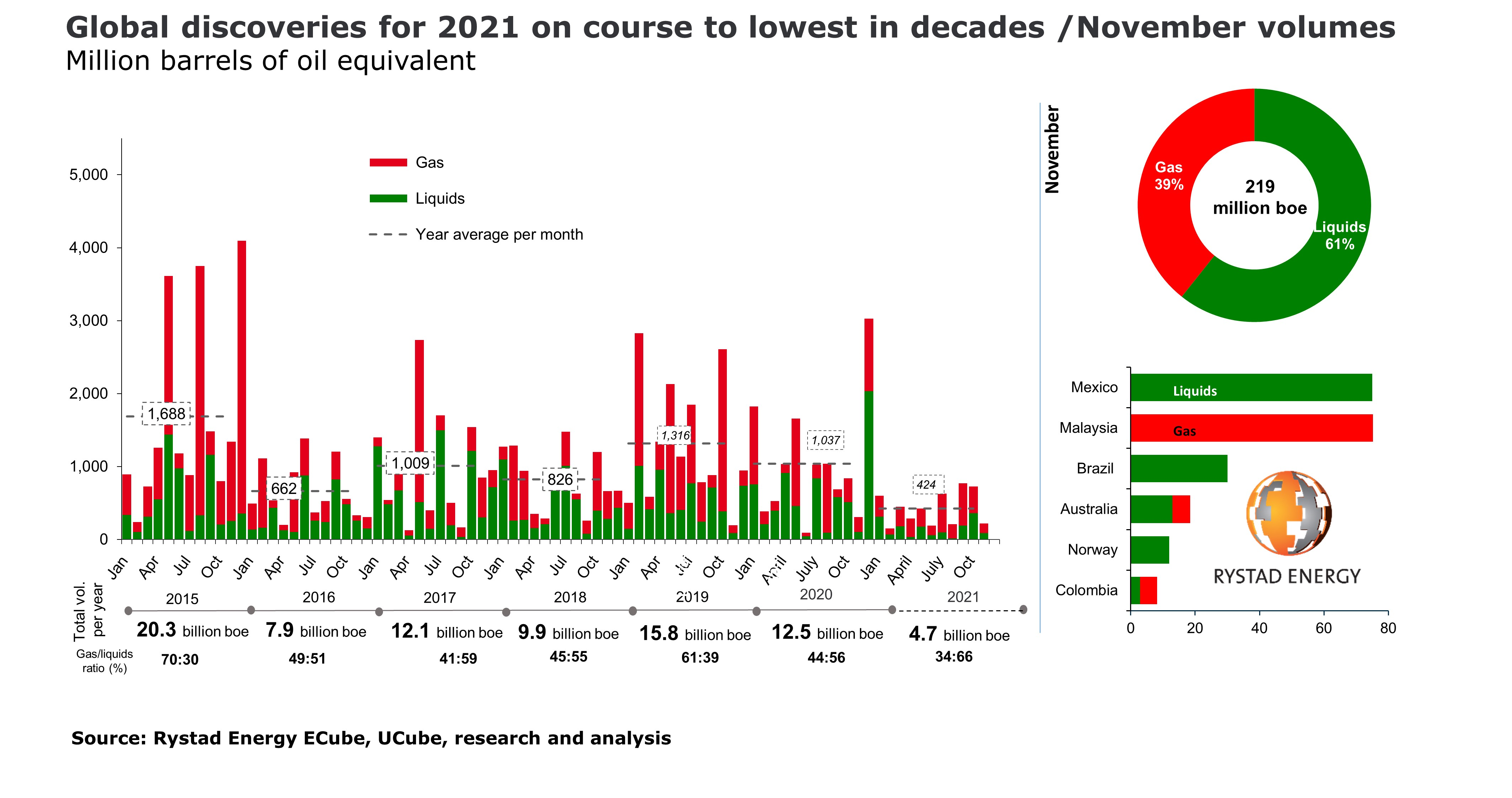
Rystad’s not-so-cheery pre-Christmas press release reported that, on a volume basis, 2021 oil and gas discoveries had sunk to the lowest level in 75 years.
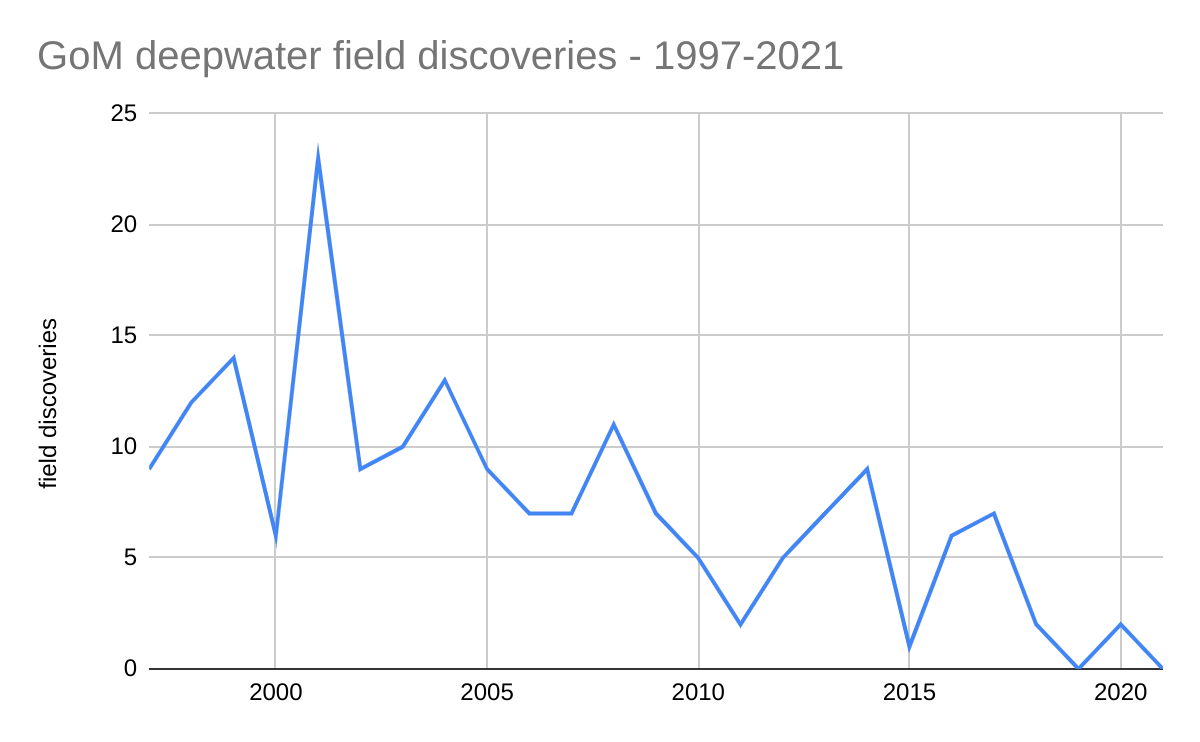
US offshore trends are even more troubling. Per BOEM’s database, no deepwater fields were discovered in 2021 and there were only 2 discoveries in the past 3 years (see chart below). HartEnergy reports 5 announced discoveries in 2021, none of which has been determined by BOEM to be commercially producible. Regardless of the status of those 2021 determinations, recent discoveries have not been sufficient to reach and sustain GoM production volumes at the 2019 peak (August) of 2.044 million BOPD. 2019 was the first year since 1982 without a confirmed deepwater discovery and the trend (below) is not encouraging. Schlumberger data through 2016 indicated GoM depletion rates greater than 20%, and the subsequent low discovery rates do not bode well for future production trends.
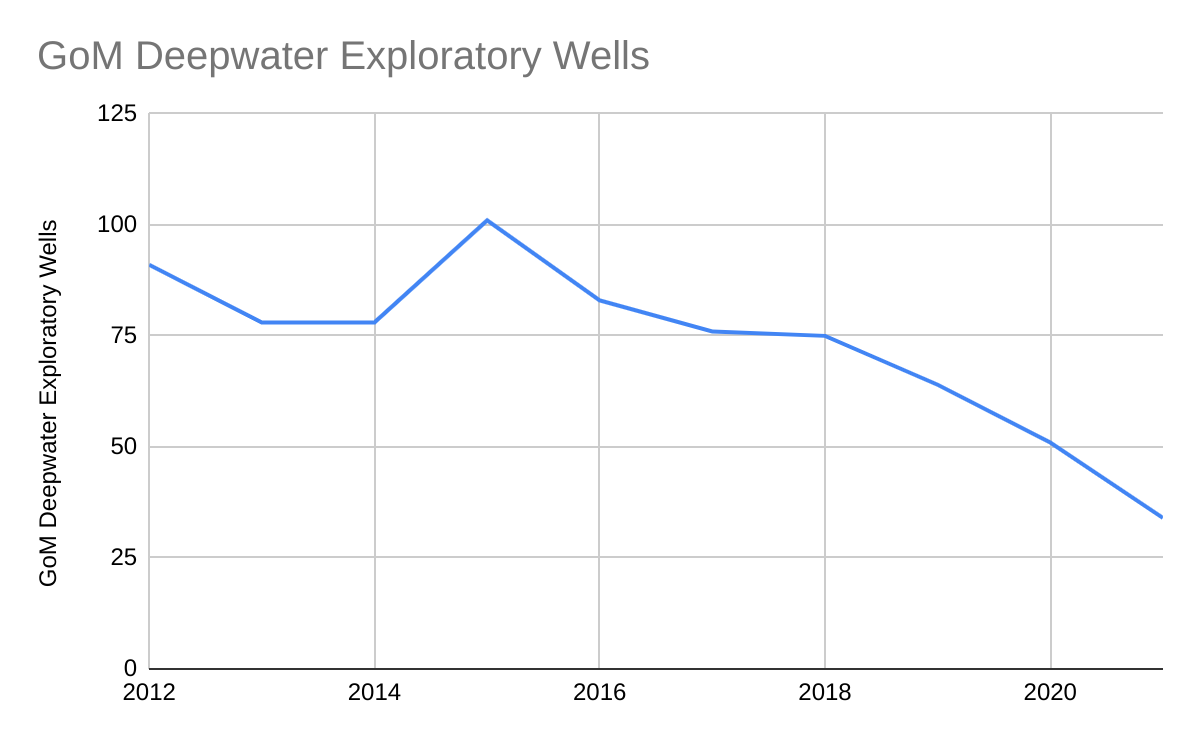
You can’t make discoveries without drilling and only 9 companies drilled deepwater GoM exploratory wells in 2021 (34 wells total). With the Pacific in decommissioning mode, the Atlantic and Eastern GoM off-limits, limited options offshore Alaska, and the decline of the GoM shelf, the deepwater GoM is the only important US offshore production option. The exploration numbers below are therefore concerning.
The shale revolution made the US a net oil exporter, but skepticism about shale production forecasts suggests the need for other supply sources. Given the shale uncertainty and the unrealistic expectations regarding the energy transition, greater US dependence on imported oil is on the horizon. This bodes well for OPEC, but not so well for US and international consumers.
Meanwhile, the US Dept. of Energy shows no evidence of concern about oil and gas production. Although oil and gas account for about 70% of our energy consumption, there has been no mention of either on the DOE homepage for months. DOE does express a strong interest in “energy justice.” Perhaps they can explain how increased imports and higher energy prices benefit the poor. They should also explain how oil imports are environmentally and economically superior to domestic oil and gas production, when the reality is exactly the opposite.
Posted in energy policy, Gulf of Mexico, Offshore Energy - General, Uncategorized | Tagged DOE, drilling trends, energy justice, oil discoveries, oil price forecast, Rystad | 2 Comments »
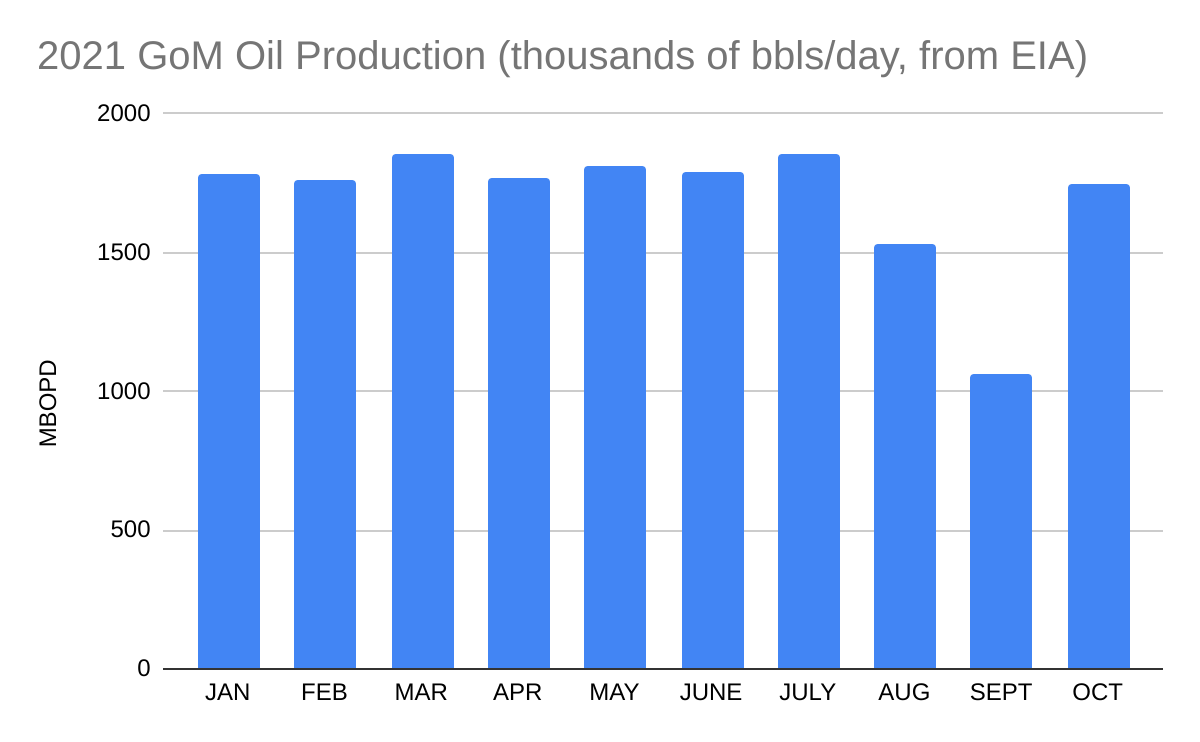
October production rebounded to 1.744 million BOPD from the 2021 low of 1.064 million BOPD in September (Hurricane Ida). November and December production should exceed 1.8 million BOPD.
Posted in Gulf of Mexico, hurricanes, Offshore Energy - General, oil | Tagged Gulf of Mexico, Hurricane Ida, October, production | Leave a Comment »
As we enter 2022, BOE salutes the outstanding Minerals Management Service (MMS) professionals who retired from the successor bureaus in 2021:
- Elsie Baker – Bureau of Safety and Environmental Enforcement (BSEE)
- Alton Bates – BSEE
- Roy Bongiovanni – BSEE
- Jane Carlson – BSEE
- Kim Coffman – Bureau of Ocean Energy Management (BOEM)
- Mark Eckl – BSEE
- Darryl Francois – BOEM
- Vanessa Grable – BSEE
- Lars Herbst – BSEE
- Bob Martinson – BOEM
- Mike Prendergast – BSEE
- Robert Ranney, – BSEE
- Julie Reynolds – BOEM
- Jane Roberts – BOEM
- Dennis Thurston – BOEM
- George Triebsch – Dept. of the Interior
- Elverlene Williams – BOEM
With very few exceptions, the career staff in the US offshore program are highly competent and dedicated to their safety, environmental, and resource management missions. I have also found this to be true for the professionals occupying similar positions elsewhere in the offshore world. Cultures, legislation, policies, and practices differ, but the objectives and commitment are similar.
Posted in Offshore Energy - General, Uncategorized | Tagged offshore safety regulators | Leave a Comment »
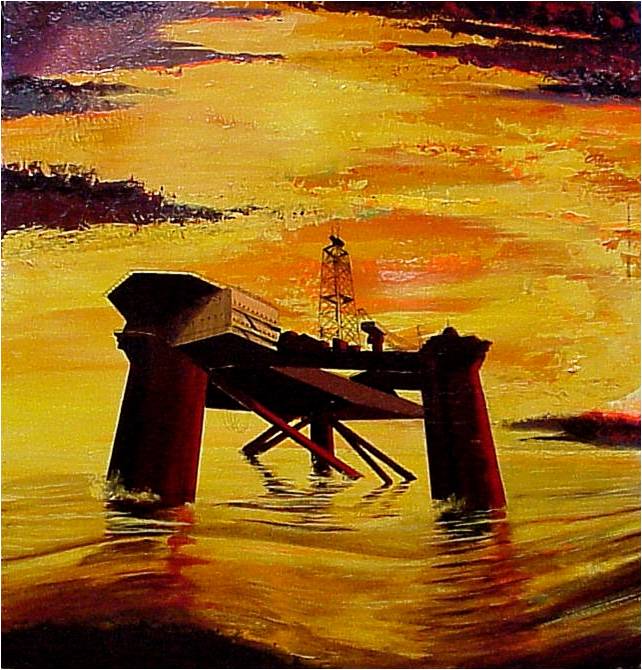
I’m sharing this photo of the masterpiece Rig at Sunset. Next year, BOE will explore the painting’s symbolism and cultural significance.
May the glow of Rig at Sunset guide, comfort, and inspire you in 2022! 😃
Posted in offshore, Offshore Energy - General, Uncategorized | Tagged Happy New Year 2022, masterpiece, Rig at Sunset | 2 Comments »
Quite a bit per the GAO, and their report only deals with DOE management of demonstration projects. The Infrastructure Bill authorizes $2.5 billion for commercial projects (and much more for other CCS purposes).
DOE provided nearly $684 million to eight coal projects, resulting in one operational facility. Three projects were withdrawn—two prior to receiving funding—and one was built and entered operations, but halted operations in 2020 due to changing economic conditions. DOE terminated funding agreements with the other four projects prior to construction.
DOE provided approximately $438 million to three projects designed to capture and store carbon from industrial facilities, two of which were constructed and entered operations. The third project was withdrawn when the facility onto which the project was to be incorporated was canceled.
GAO
So DOE’s actual success ratio was 0.182 (2 for 11) – not very compelling.
With regard to proposals for offshore carbon sequestration, who will be liable for future cost overruns, operating losses, infrastructure failures including pipeline and well leaks, and decommissioning costs? Who ensures that there will never be any leakage from CO2 disposal reservoirs? Does all of this fall on the Federal government?
Corporations that want to engage in carbon sequestration for commercial or other purposes should fund the projects with their own revenues or fees charged to the companies whose emissions they are collecting. The Outer Continental Shelf is publicly owned and those wishing to dispose of substances should pay a usage fee, be responsible for all costs, and be liable for pollution and damages.
Posted in CCS, climate, decommissioning, energy policy, Gulf of Mexico | Tagged CCS, DOE, GAO, infrastructure bill | Leave a Comment »
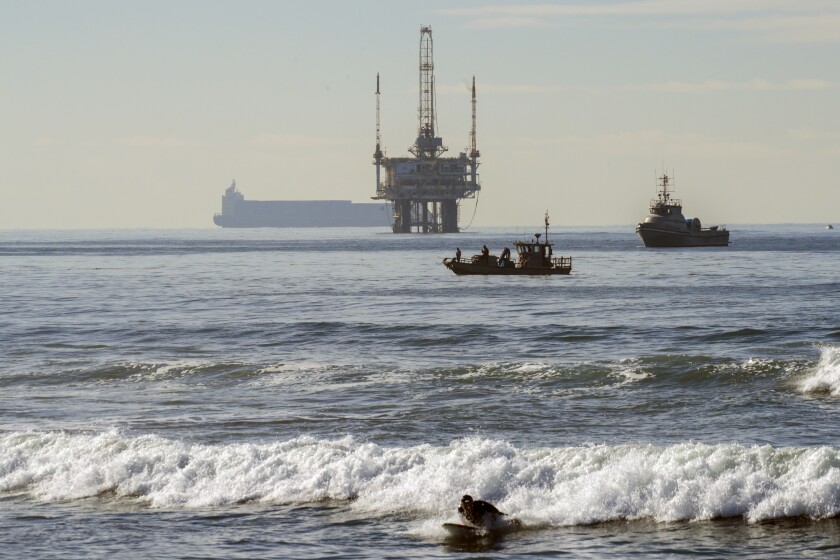

Per the LA Times, a DCOR pipeline has been identified as the source of a sheen in California State waters near Bolsa Chica State Beach. The pipeline transports oil from Platform Eva. All platform and pipeline operations in the vicinity have ceased.
Posted in California, Offshore Energy - General, pipelines | Tagged California, pipeline spill, Platform Eva | 2 Comments »

