Posted in climate, energy policy, pipelines | Tagged Mick Wallace MEP, Nord Stream | Leave a Comment »
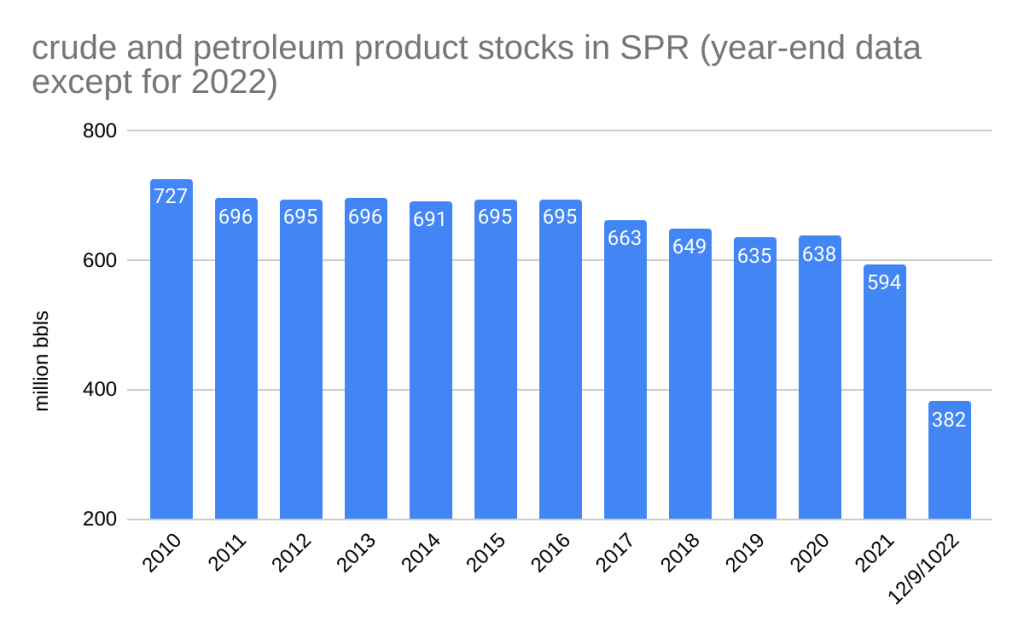
- down another 4.7 million bbs from the previous week (12/2/2022)
- lowest reserve volume since 1/6/1984
- 212 million bbls withdrawn this year
- EIA data
Posted in energy policy | Tagged SPR depletion, Strategic Petroleum Reserve | Leave a Comment »

As we approach the end of 2022, I’m still waiting for:
- Nord Stream Pipelines sabotage report(s): Will Denmark, Germany, and Sweden publish reports? Will the responsible parties be identified? I surely hope this wasn’t a US/UK operation.
- Huntington Beach Pipeline Spill investigation report: >14 months since the spill and still no report. What vessel(s) struck the pipeline? The pipeline operator seems to have had minimal responsibility but has been vilified. How will the vessel owner(s) be penalized?
- Offshore Incident Statistics (BSEE): Still no data for 2021 or 2022. The previous OCS safety regulator (MMS) updated these tables at the end of each quarter.
- BSEE/Coast Guard investigation reports for two 2020 GoM occupational fatalities that have yet to be documented. Also waiting for the reports on a 1/24/2021 fatality, a 5/15/2021 explosion and fatality, and a 3/25/2022 fatality. Lives were lost. When will we find out what happened and why?
- Decommissioning status and liability update for Platforms Hogan and Houchin, Santa Barbara Channel.
- (2008) Russell Peterson liftboat fatality offshore Delaware. This was the first fatality associated with the US offshore wind program. The Coast Guard has yet to issue a report.
- (2010) Sinking of the Aban Pearl semisubmersible offshore Venezuela. No report was issued.
- Summary of the incidents on the “BOE watch list” in 2011.
Posted in accidents, California, Gulf of Mexico, pipelines | Tagged aban pearl, BSEE, Hogan and Houchin, Huntington Beach, NordStream, offshore incidents, Russell Peterson | Leave a Comment »
This rather arrogant and condescending policy makes neither good business sense nor good social sense (unless you support energy poverty), but I’m sure the executive team is proud. That said, they do seem to have left themselves with a fair amount of wiggle room.
In line with the policy, we will no longer provide new lending or capital markets finance for the specific purpose of projects pertaining to new oil and gas fields and related infrastructure when the primary use is in conjunction with new fields.
We will continue to provide finance or advisory services to energy sector clients at the corporate level, where clients’ transition plans are consistent with our 2030 portfolio-level targets and net zero by 2050 commitment.
HSBC
Posted in climate, energy policy, UK, Uncategorized | Tagged finance, HSBC, oil and gas | Leave a Comment »
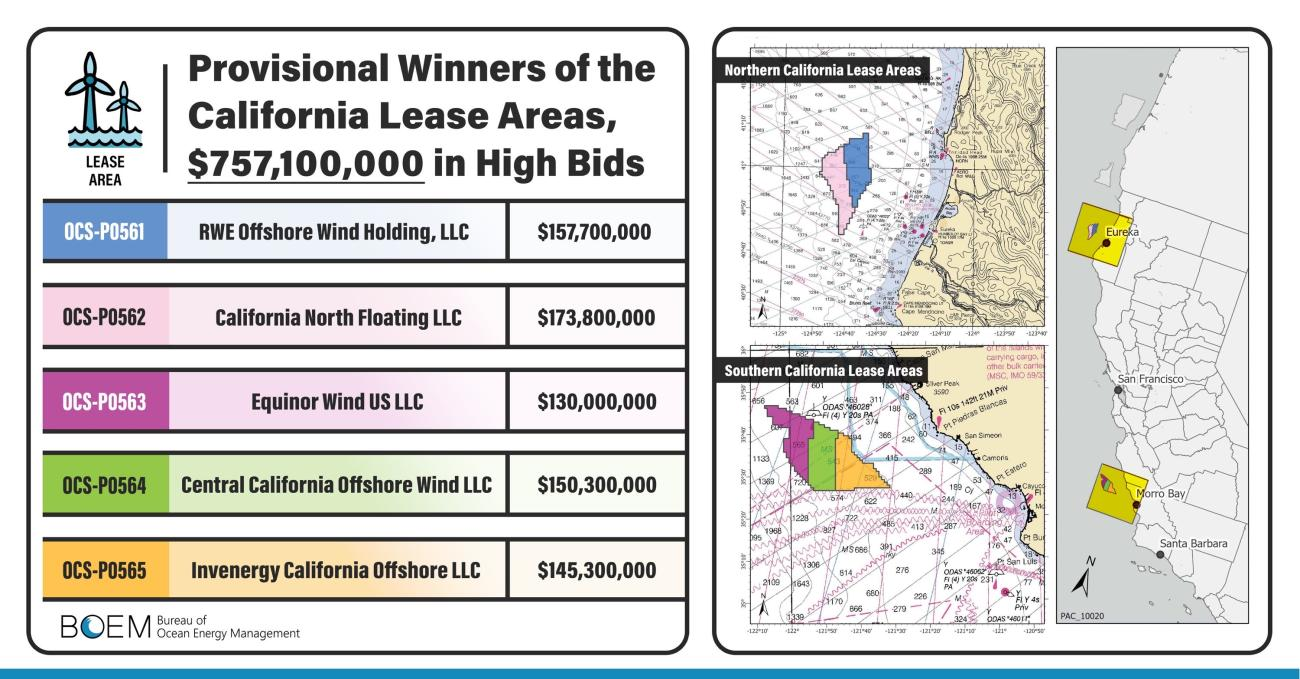
Only Equinor is a familiar name to the offshore oil and gas industry, so here are some blurbs about the other high bidders.
California North Floating, LLC, is a subsidiary of Copenhagen Infrastructure Partners (CIP). Since entering the US offshore market in 2016, CIP has built a leading offshore wind position through its affiliate Vineyard Offshore. This includes Vineyard Wind 1, the country’s first commercial scale offshore wind project which is currently under construction, as well as two lease areas under development totaling approximately 5.0 GW off the coast of Massachusetts and New York.
Central California Offshore Wind is managed by an East Coast offshore wind energy company, Ocean Winds North America LLC, which formed a joint venture with the Canada Pension Plan Investment Board to win the lease. Ocean Winds has more than 10 years of experience in floating offshore wind, most notably through the development and operation of Windfloat Atlantic (offshore Portugal), the world’s first fully commercially operational floating offshore wind farm
Equinor, a Norwegian company, is a major international oil and gas producer, an important wind energy investor, and a leader in the development of floating wind turbine technology. Equinor operates the Hywind Tampen floating offshore wind farm which will supply power to Norwegian offshore oil and gas fields.
Invenergy and its affiliated companies develop, own, and operate large-scale renewable and other clean energy generation and storage facilities in the Americas, Europe and Asia. Invenergy’s home office is located in Chicago, and it has regional development offices in the United States, Canada, Mexico, Spain, Japan, Poland, and Scotland.
RWE Renewables has experience covering the offshore and onshore wind energy value chain from development to construction and operation. These activities are the responsibility of two functional units, “Unit Renewables Europe & Australia” and “Unit Offshore Wind”, as well as the subsidiary RWE Renewables Americas. RWE Renewables also invests in large-scale solar projects and supports power producers, plant operators and other stakeholders in the development, construction and operation of photovoltaic and solar energy plants as well as in the construction of battery storage systems. The focus is on large-scale industrial projects.
Posted in California, energy, Offshore Wind | Tagged California North Floating, California offshore wind sale, Central California Offshore WInd, Equinor, Invenergy, RWE Renewables | Leave a Comment »

Wer ist verantwortlich?
As reported by Tagespiegel, the EU states have agreed to better protect critical infrastructure. Yet apparently the status of the Nord Stream investigation(s) was not discussed. When will the findings be released? How and when will the responsible parties be identified?
Posted in accidents, energy, Offshore Energy - General, pipelines | Tagged EU, investigations, Nord Stream, pipeline leaks, sabotage | Leave a Comment »
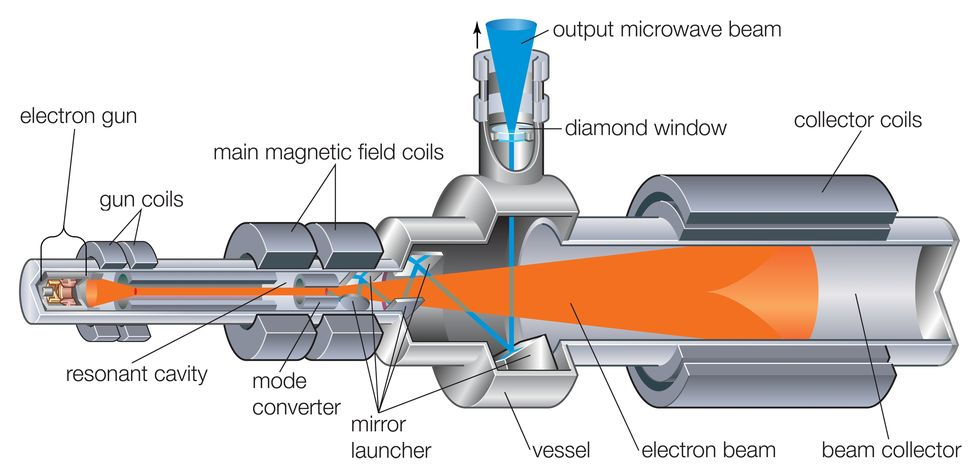
The hype for ultradeep geothermal is building, as it should be given the intermittency and energy density issues that limit the potential of other renewable energy options. However, the ability to drill 20 km into the earth’s surface with millimeter, rock-melting waves has yet to be demonstrated.
Conventional drilling technology gets you through sedimentary formations to the hard basement rock that lies below. That is where gyrotrons will be expected to vaporize rock to depths needed to tap into unlimited 900+ deg F geothermal energy. But questions regarding gyrotron reliability, hole stability, and material removal. Quaise Energy is working with DOE’s Oak Ridge lab to resolve these issues. Field tests are expected over the next few years with initial energy production in 2026. This is all very exciting, but even conventional drilling is seldom routine, so complications should be expected.
Here’s a very good video:

Posted in drilling, energy, Uncategorized | Tagged gyrotron, Oak Ridge Lab, Quaise Energy, ultradeep geothermal | Leave a Comment »
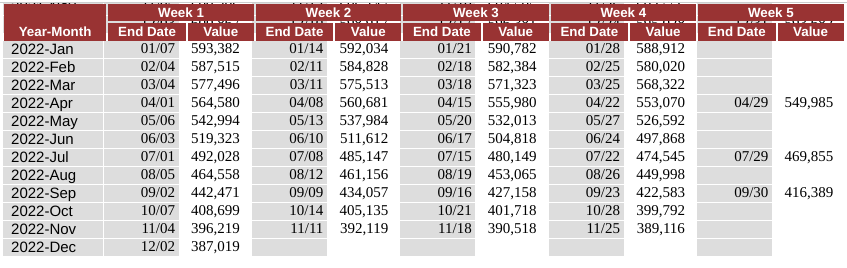
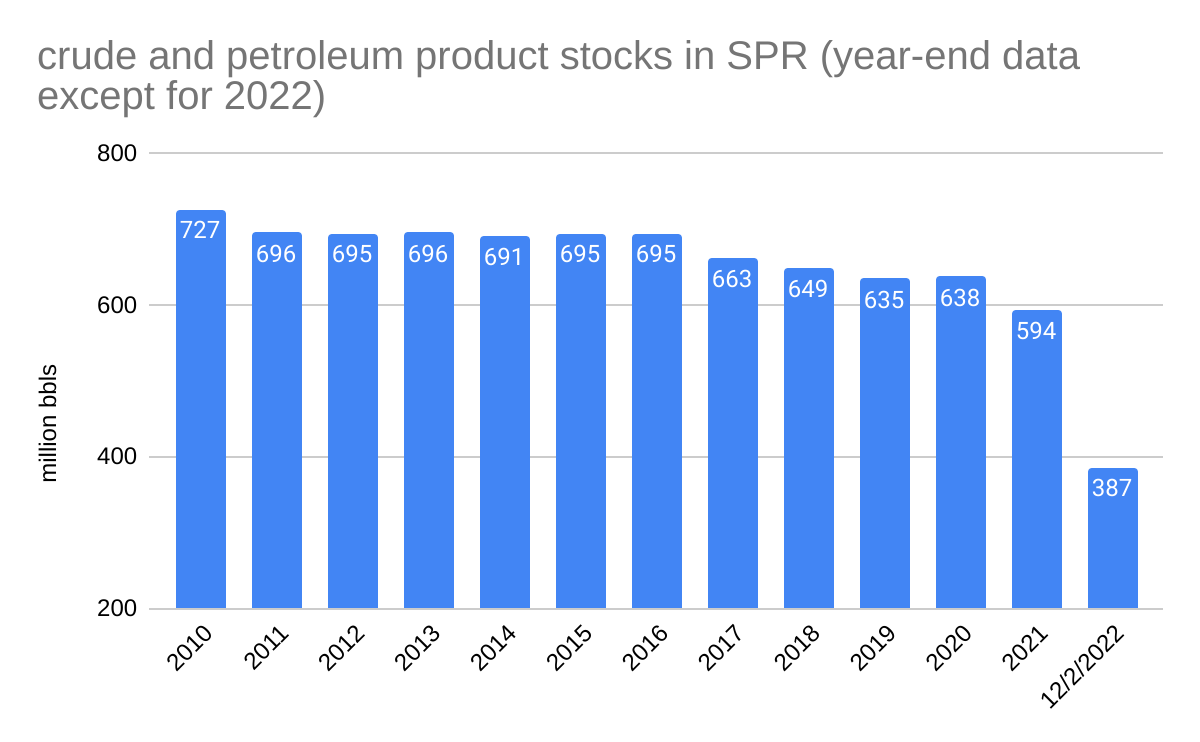
Down to 387 million bbls as of 12/2. Lowest SPR volume since 2/24/1984. 206 million bbls withdrawn in 2022. With WTI near $72/bbl, is this finally the end of the withdrawals?
Posted in energy policy | Tagged SPR depletion, Strategic Petroleum Reserve | Leave a Comment »
Despite the spectacular 2022 lease sales, not all is rosy for US offshore wind development.
In 2011, then-Interior Secretary Ken Salazar said the Obama administration had set a goal of “10 gigawatts of offshore wind generating capacity by 2020 and 54 gigawatts by 2030.” How has that worked? Well, 11 years after Salazar’s speech, the US has seven turbines operating offshore with a total of capacity of 42 megawatts — or some 9,958 megawatts short of the goal laid out by Salazar.
Gordon Hughes, a professor of economics at the University of Edinburgh, has found that the output of Europe’s offshore wind turbines has been declining by about 4.5% per year. In a report titled “Wind Power Economics: Rhetoric and Reality,” published by the London-based Renewable Energy Foundation in 2020, Hughes concluded that declining output will result in higher operating costs that will start to exceed revenues “after 12 or 15 years.
Forbes
Opposition to NJ offshore wind projects dominate DEP hearing
…addressing climate change through ocean “industrialization” using an “inefficient, expensive and largely untested strategy” was not the right path forward – Kari Martin, Clean Ocean Action
“By undertaking an industrialization project this big, it far outweighs any (climate change) benefit anybody’s ever talked about, or even tried to quantify,” he said. “The harms of this undertaking is, in my view, far worse than any benefits we could realize.” – Michael Dean, Middletown, NJ
Offshore Wind Farms Change Marine Ecosystems
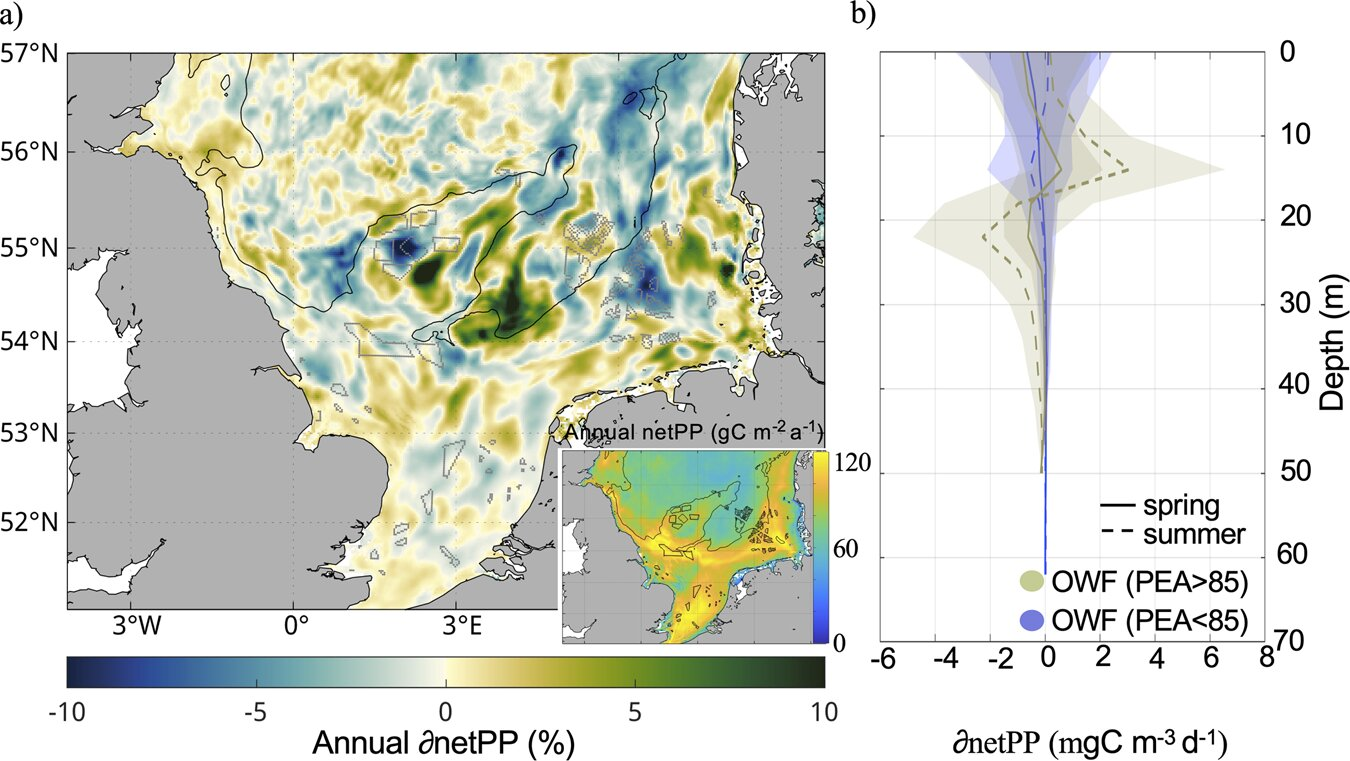
In their latest publication, (scientists at the Helmholtz-Zentrum Hereon) now show that large-scale wind farms can strongly influence marine primary production as well as the oxygen levels in and beyond the wind farm areas. Their results were published in the journal Communications Earth & Environment.
… For example, Nils Christiansen’s team proved that wake turbulences—air vortices caused by wind turbines—change the flow and stratification of the water beneath them. But the climate just above the sea surface is also being permanently changed, as another team led by Dr. Naveed Akhtar was able to show.
PHYS.org
Annual mean response of net primary productions (netPP) to atmospheric changes due to offshore wind farms
More:
Commonwealth Wind project paused indefinitely
Park City Wind project delayed
RODA files a motion for a summary judgement in its lawsuit over approval of the Vineyard Wind 1 project, touted as the nation’s first commercial scale offshore project.
Discouraging Spectator article on UK onshore wind.
Posted in energy policy, Offshore Energy - General, Offshore Wind | Tagged Gordon Hughes, Helmholtz-Zentrum Hereon, Kari Martin, Michael Dean, NJ offshore wind, Offshore Wind, RODA, wind farms change marine ecosystems | Leave a Comment »
California offshore wind sale: 5 leases, $757.1 million in high bids
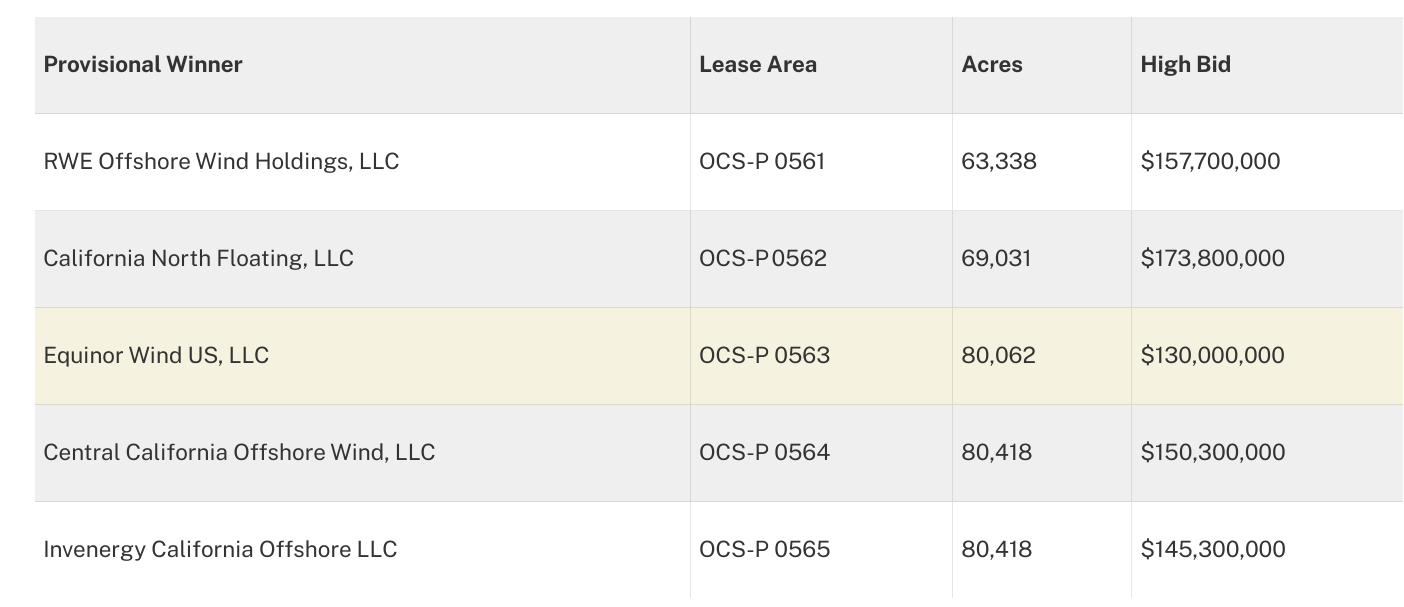
The California wind sale bidding, while lower than the record Atlantic sale in February, was extraordinary given that the 5 leases are relatively distant from shore (20+ miles) and in water depths (537 to 1284 m) that dictate the use of floating turbines. Generous subsidies, credits, and State mandates no doubt contributed to the seemingly inflated bidding, as did an auction system that is designed to maximize bonus payments.
Given the slow progress in US offshore wind development, the setbacks the industry is experiencing, the added challenges associated with commercial deepwater development, the potential cost burden on taxpayers and power customers, and the government’s financial and policy support, a more development-friendly leasing system would seem to be prudent. BOEM took a step in that direction with the with the limited training and supply chain credits provided for in the Sale Notice, but fundamental changes in the auction system may be desirable.
Posted in California, energy policy, Offshore Wind | Tagged BOEM, California offshore wind sale | Leave a Comment »
 Bud's Offshore Energy (BOE)