Feeds:
Posts
Comments

Archive for the ‘Regulation’ Category

  • Per the previous civil penalties post
  • Data are on a fiscal year basis (i.e. 2022 started on 10/1/2021 and ended on 9/30/2022)
  • These data are only for civil penalties paid in that year. Data for civil penalties referrals are not publicly available.
  • Nothing terribly surprising in the data. Fieldwood’s issues have been discussed at length.
  • Note (last chart) the lag between the date violations were observed and the date penalties were paid. This lag is significant but understandable given due process considerations.
  • Fastest payment: 6 months by Shell for an open hole that was not properly barricaded ($26,750 penalty, 2018).
  • Slowest payment: 54 months by LLOG for failing to install and maintain equipment properly (three 2016 violations)
  • Largest civil penalty paid: $512,900 by bp for a high-pressure gas release caused by the use of improper seals (May 8, 2018 violation).
  • Smallest civil penalty paid: $16,300 by Arena for the release of 1000 psi gas on October 16, 2018
  • The current maximum penalty amount is $52,646 per day, per violation.
  • To learn more about the specific cases.

Read Full Post »

Right whale – Atlantic
Rice’s whale – Gulf of Mexico

Both species are endangered, but the operating restrictions differ significantly:

North Atlantic wind leases: right whale restrictions GoM Lease sale 261: Rice’s whale restrictions
No leasing prohibitions or turbine-free areas have been established despite concerns raised by NOAA (see attached letter)All of the expanded Rice’s whale area is excluded from leasing (i.e. the entire area between the 100 and 400 m isobaths across the GoM)
seasonal 10 kt max speed for vessels > 65′year round 10 kt max for all vessels
vessel separation distance of 500 m for any sighted right whale or unidentified large marine mammalseparation distance of 500 m for any sighted Rice’s whale; if unsure, must assume whale is Rice’s
no visibility restrictions for vessel operationsvessels must avoid transit between dusk and dawn and other times of low visibility
no automatic identification system (AIS) requirementsvessels > 65′ must have AIS functioning at all times
no documentation requirementsmust maintain records to document compliance

Note (below) the proximity of existing and planned wind leases to moderate to high density RIght whale areas compared to the more speculative expanded Rice’s whale area in the central and western GoM that is predicted based on passive acoustic recordings.

Read Full Post »

The civil penalties provision in the 1978 OCS Lands Act (OCSLA) Amendments was flawed in that it stipulated that operators must be given time to take corrective action before a civil penalty could be assessed. The “time to take corrective action” requirement was confirmed by a 1983 Federal Court decision in Louisiana:

The Court agrees with Chevron’s construction of Section 24(b) and holds that civil penalties may only be imposed under Section 24(b) for violations which continue after the violator has been notified of the breach and has failed to correct it within a reasonable period allowed. This conclusion is based primarily upon a careful review of the pertinent statute. The first sentence sets forth the conditions of liability:

If any person fails to comply with any [provision of the Act] after notice of such failure and expiration of any reasonable period allowed for corrective action, such person shall be liable for a civil penalty of not more than $10,000 for each day of the continuance of such failure.

The court decision gutted the Minerals Management Service (MMS) civil penalties program. Civil penalties could no longer be assessed until the operators had been given time to correct their violations, even those that endangered workers and the environment.

Ironically, Congressman George Miller (D-CA), an ardent opponent of the offshore oil and gas program, proved to be an important MMS ally by adding language to the Oil Pollution Act of 1990 that amended the OCSLA civil penalties provision. The first draft of that language expanded the civil penalties authority to include violations that may constitute a threat of serious, irreparable, or immediate harm or damage to life, property, or the environment.

We were able to revise that draft by adding the words “or constituted” after “constitute” to cover situations where the threat was no longer present. For example, if an inspector found that a well had been drilled without required elements of the well control system in place, the threat may no longer be present at the time the violation was detected but it certainly was when the well was drilled.

The revived MMS civil penalties program was fair and effective, and BSEE seems to be administering the program in a similar manner. Civil penalties data for the past 4 years will be posted next week.

Congressman George Miller (CA)

Read Full Post »

See the attached document.

From a regulatory policy standpoint, this appears to be a strong filing. Operationally, the most important points pertain to the costly and premature Rice’s whale restrictions first discussed on this blog.

Most notably, the plaintiffs seek (p.39):

  1. A preliminary and permanent injunction striking, setting aside, and enjoining BOEM from implementing the specific challenged provisions of the Final Notice of Sale and Record of Decision for Lease Sale 261;
  2. An order vacating the specific challenged provisions of the Final Notice of Sale and Record of Decision for Lease Sale 261;
  3. An order compelling Defendants to proceed with Lease Sale 261 on September 27, 2023, without the challenged provisions;

Read Full Post »

The Bureau of Ocean Energy Management (BOEM) is extending the public comment period on our notice of proposed rulemaking (NPRM), “Risk Management and Financial Assurance for Outer Continental Shelf Lease and Grant Obligations,” by 10 days.

Federal Register

These comments were submitted 7 days (now 17 days) early 😀

Federal regulations: “decades to draft, days to comment”

Read Full Post »

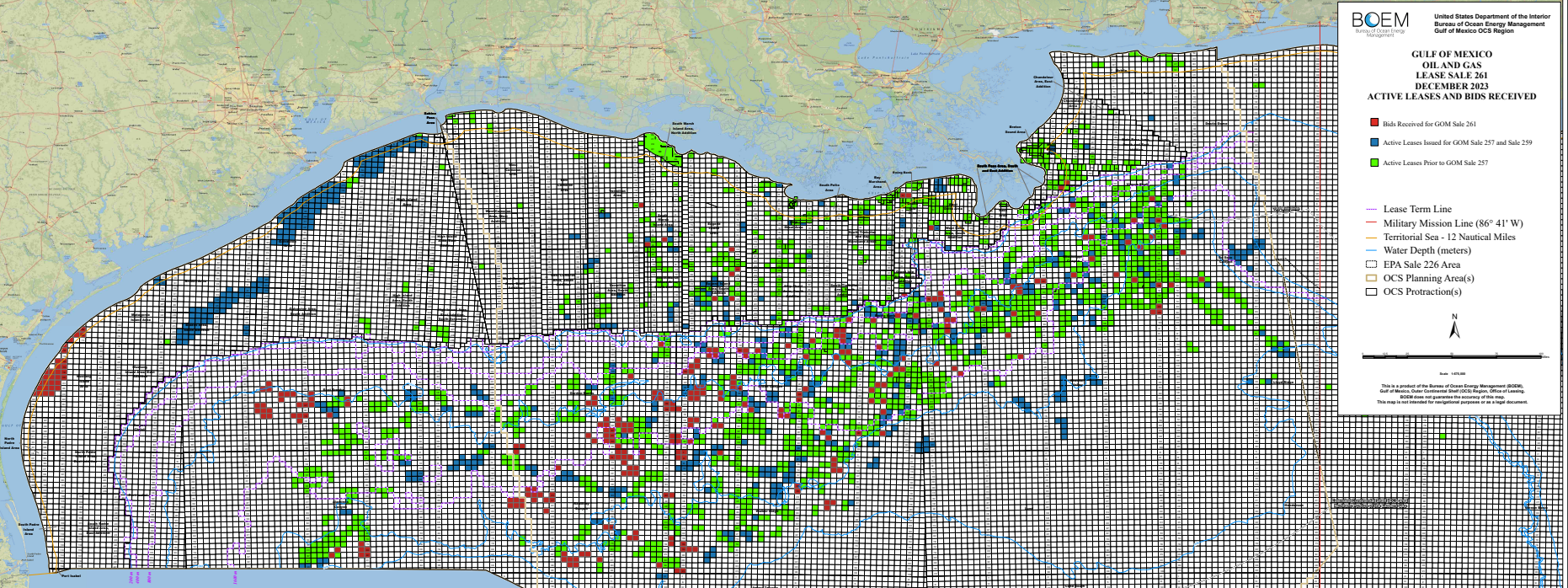
Lease Sale 261 stipulations

In addition to the lease stipulation, the entire expanded Brice’s whale area has been excluded from the lease sale. Senator Manchin strongly criticized that decision:

Let me be clear, the exclusion of more than 6 million productive acres from the upcoming offshore oil and gas lease sale in the Gulf of Mexico based on a settlement reached in the name of protecting Rice’s whale while conveniently only targeting oil and gas is yet another example of this Administration’s intentional undermining of the strong energy security provisions in the Inflation Reduction Act.

Senator Manchin

Read Full Post »

Published today.

Comments on the proposed rule.

Read Full Post »

The attached comments were submitted to BOEM via Regulations.gov. The comments address specific provisions of the proposed rule and include a recommendation to hold companies fully accountable for their lease transfers, but not for subsequent transfers in which they are not a party.

Do I get a t-shirt for being one of the first 2000 entries? 😀

Read Full Post »

Record low exploratory drilling: 2023 will be the third consecutive year with fewer than 50 deepwater exploratory well starts. The only other year this century with <50 deepwater exploratory well starts was 2010 when there was a post-Macondo drilling moratorium.

Low participation: Only 8 companies have started deepwater exploratory wells in 2023 YTD. Anadarko, Chevron, and Shell drilled 78% of the wells, with Shell alone accounting for 48%. Compare these numbers with 2001, when 24 companies drilled 149 deepwater exploratory wells.

Absence of new field discoveries: Per BOEM’s database, no deepwater fields have been discovered since March 2021 and there were only 3 discoveries in the past 5 years (see chart below)

Leasing and regulatory uncertainty: When will the 5 year leasing plan be finalized and how much will leasing be restricted? What will be the effect of the expanded Rice’s whale area on deepwater operations? To what extent is this expansion justified? What other legal and regulatory threats are on the horizon?

Unrealistic expectations regarding the “energy transition:” In a stunning introductory statement, the Proposed 5 Year Leasing Plan expressed concerns that new leases would produce too much oil and gas for too long. OPEC+ must love the way the US sanctions its own energy production, most notably the oil and gas resources of the OCS. More than 96% of the OCS is off-limits to oil and gas leasing, and the 5 year plan proposed to constrain leasing in the only areas that remain. The favored offshore wind program was intended to be a complement to, not a replacement for, the oil and gas program. Wind energy is limited by intermittency, space preemption, navigation, and wildlife protection concerns.

Some companies have visions of the GoM as a carbon dumping hub: The largest US oil company, which hasn’t drilled a well in the GoM in nearly 4 years and operates just one production platform, seeks praise and profit by sequestering CO2 beneath the Gulf while maximizing oil production elsewhere. How will this sustain economically and strategically important GoM oil and gas production?

Read Full Post »

1137 comments to date per Regulations.gov. This would imply one or more organized commenting campaigns.

I will share my comments on this blog after they have been submitted.

Read Full Post »

« Newer Posts - Older Posts »