Feeds:
Posts
Comments

Archive for the ‘natural gas’ Category

Very good Washington Post article.

As the global economy recovers and global leaders prepare to gather for a landmark conference on climate change, the sudden energy crunch hitting the world is threatening already stressed supply chains, stirring geopolitical tensions and raising questions about whether the world is ready for the green energy revolution when it’s having trouble powering itself right now.

In the United States, which as an energy producer has been spared the worst consequences of the crisis even as gasoline prices have hit their highest mark since 2014, Energy Secretary Jennifer Granholm suggested Wednesday that the Biden administration might sell off part of the country’s Strategic Oil Reserve or ban exports of crude oil.

Energy analysts warned that such moves could be self-defeating, and on Thursday the department backpedaled.

Energy analysts argue that Europe moved too quickly away from fossil-fueled power, before ensuring that sufficient renewable sources could take up the slack in an emergency. Caught halfway in a transition that should take decades, they say, Europe is now scrambling to find coal and gas to burn in its remaining traditional plants.

In Guangdong, China’s most populous province, authorities have banned the use of elevators in office buildings for the third floor and below, encouraged residents to use natural light as much as possible, and asked for air conditioners to be adjusted to higher temperatures. Beijing and Shanghai canceled annual light shows during the Golden Week holiday that spanned the first week of October.

Read Full Post »

European power prices have spiraled to multi-year highs on a variety of factors in recent weeks, ranging from extremely strong commodity and carbon prices to low wind output.

CNBC

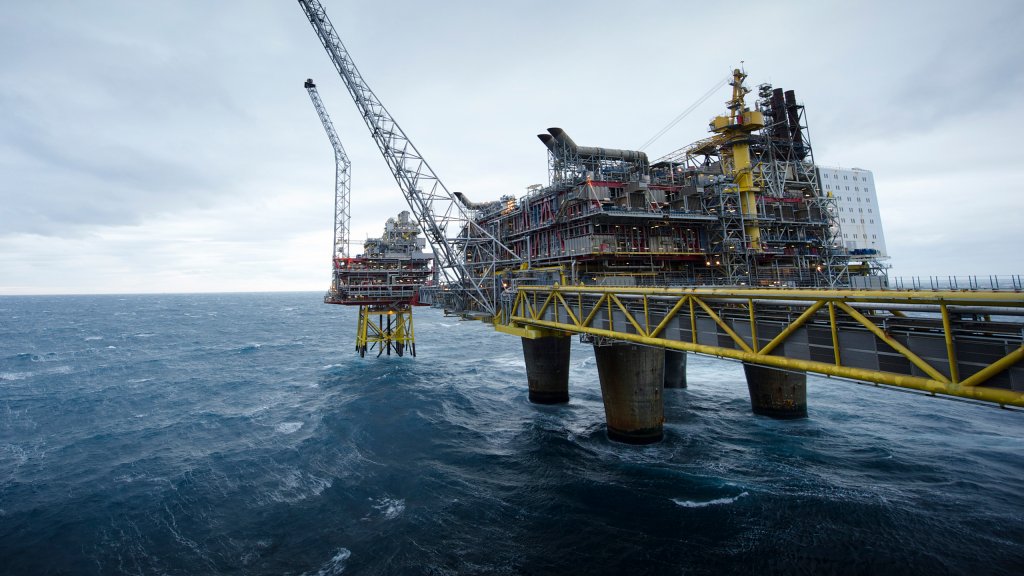
Equinor and its partners have received permission to increase gas exports from two fields on the the Norwegian continental shelf to supply the tight European market. Production permits for the Oseberg and Troll fields have each been increased by 1 billion cubic meters (bcm) for the gas year starting 1 October.

Equinor
Oseberg field centre in the North Sea
Equinor’s Oseberg field, North Sea.

I hope the folks organizing the 10/28 congressional hearing are paying attention, but somehow I doubt it.

Read Full Post »

In the early 1990’s, Department of the Interior (DOI) and Department of Energy (DOE) leadership dabbled at re-branding the OCS Oil and Gas Program by reversing the order of the words. Clever? Perhaps by Washington public relations standards. One senior manager even changed his license plate from “OCS OIL” to “MMS GAS” (not much competition for those tags 😃). Technical staff were less enthused about this simplistic marketing gimmick that misrepresented the historical and scientific facts about oil and gas production. For many years, natural gas was a byproduct of oil production that was commonly flared. (This practice continues in some regions of the world, although to a lesser extent than in the past.)

Understandably, the Oil and Gas Journal wasn’t very impressed by the change. I saved a copy of their 1/24/1994 editorial (attached) on the subject. Per the OGJ:

We at the Journal love natural gas. But that doesn’t warrant an attempt to repeal the laws of nature and ignore the weight of tradition by renaming everything “gas and oil” this and that.

John L. Kennedy, Editor, Oil and Gas Journal, 1/24/1994)

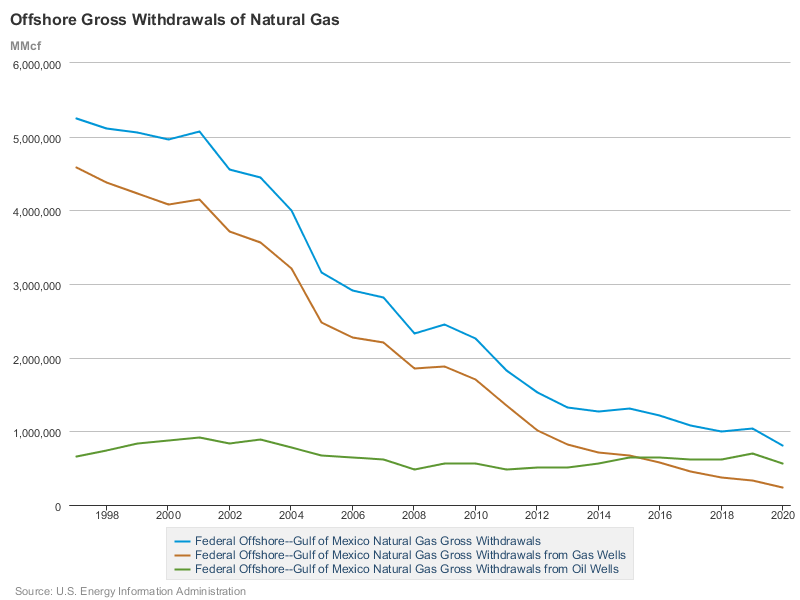
To their credit, BOEM and BSEE web pages and announcements during recent administrations (both parties) indicate a preference for the more traditional “oil and gas.” (The DOE website largely ignores the existence of either oil or natural gas.) Surprisingly, the American Petroleum Institute (API), an industry trade organization with more than 100 years of history, is now consistently using “natural gas and oil.” This rearrangement of words is not entirely consistent with the interest of API’s members. In the offshore sector, the primary interest of API members is in finding and producing oil. if you think otherwise, look at the EIA GoM gas production data. Most of the Gulf’s declining gas production is now associated with deepwater oil production, and BSEE rightfully requires that this gas be used for fuel or transported for sale. Similarly, gas is a secondary consideration for API members exploring in Alaska given that 35 trillion cu ft of North Slope gas still awaits a pipeline.

Oil companies, and those who represent them, should be proud of their current and historical role in producing oil (and gas) for our economy, security, and way of life; and of the men and women who have toiled to locate and produce petroleum resources for the benefit of society. Are there better energy alternatives? Perhaps, but issues with these alternatives remain to be resolved, and oil and gas will continue to be important. Let’s focus on producing these resources as safely, cleanly, and reliably as possible.

Read Full Post »

Cheryl Anderson forwarded this interesting Anchorage Daily News update on hydrate production research and linked information about the specific Department of Energy research projects.

The methane – carbon dioxide exchange project is particularly interesting and is summarized nicely by the Daily News:

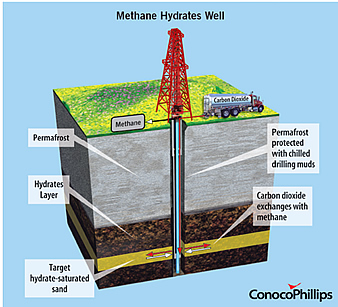
Conoco Phillips will try injecting carbon dioxide into the hydrate. Laboratory tests show that injecting carbon dioxide displaces methane, which comes out of the hydrate as a gas. The idea is that the carbon dioxide molecules take the place of the methane molecules in the hydrate, keeping it stable.

This could be neat, if it works. Carbon dioxide would be permanently sequestered, or stored, underground, while the methane is extracted and the hydrate is left intact.

One question the Conoco Phillips production test will attempt to answer is whether this reaction in the hydrate can occur fast enough for methane production to reach practical volumes.

The comment below is an understatement, but the enormous energy potential justifies the research.
This isn’t a slam dunk, though. The technical challenges are considerable.

Read Full Post »

Very interesting Wall Street Journal article.

First, thanks to the unexpected shale gas boom in the U.S., liquefied natural gas cargoes once planned for the U.S. have gone looking for new buyers. Result: European customers have been able to shake off Russian long-term contracts linked to the price of oil.

Russia insists the gas glut is temporary. It has tried to fight back by pushing gas sales to China. But now those talks are stalled over price thanks to Beijing’s discovery that—guess what?—China back home may have the biggest shale potential of all.

And the hits will keep on coming, upending a high-price dynamic and European dependency that have suited Russia very well (and, admittedly, also suited some of its customers, especially German utilities).

Will the great potential of shale gas be fulfilled? In the US? In Europe? Elsewhere?

But what the Lord giveth, European politics may fritter away. French campaigner Jose Bove, having failed to kick McDonald’s out of Paris, is now jawboning Poland against developing its reserves, handing a Polish-subtitled copy of “Gasland,” the U.S.-made antifracking documentary, recently to Poland’s president.

France in May passed a ban on fracking. Poland is the anti-France, set to take the European Union’s rotating presidency next month and determined to move ahead on fracking. A mystery wrapped in an enigma is Germany, with its precipitous decision to retire its nuclear plants, and its big, Russia-friendly investment in Nord Stream, a gas pipeline whose board is headed by former German Chancellor Gerhard Schroeder.

Read Full Post »

Per the Citizens Voice, no injuries were reported

The Atgas 2H well operated by Chesapeake Energy in Leroy Township blew out at around 2 a.m., according to Bradford County Emergency Management Agency Deputy Director Skip Roupp.

The well was in the process of being hydraulically fractured and Roupp characterized the spilled fluid as “mostly water … with some contaminants” but he did not know the exact composition of the fluid.

Evidently the crack is in the top part of the well below the blowout preventer,” he said, referring to a device used in emergency situations to choke off flow from a well. “They don’t really know what happened yet because they don’t have it controlled yet.”

Read Full Post »

Shale gas is important to the economic future of states like Pennsylvania. However, there are legitimate public concerns about environmental issues including the potential for contaminating freshwater supplies. Significant impacts are preventable with prudent operating practices and effective regulatory programs. So what directive does the responsible State agency issue to its inspectors?

Field inspectors and regional directors for the state Department of Environmental Protection have been told they must obtain approval from DEP Secretary Michael Krancer before issuing permits or enforcing regulations pertaining to Marcellus Shale drilling.. PostGazette.com

How would you like to be an inspector for an organization like that?

Unless this decision is promptly reversed, expect the following:

  1. The public will assume that politicians are micromanaging critical field inspection programs, and confidence in the regulatory program will be eroded.
  2. Inspectors will be unable to respond quickly when violations are observed. Morale will suffer. Skilled personnel will leave or lose motivation.
  3. Regulatory efficiency will decrease while costs increase.
  4. The operating companies will deal directly with the Secretary’s office, leaving field personnel out of the loop.
  5. The industry’s image will suffer. Effective regulation identifies those who are willing to cut corners and protects the leading companies.

Former DEP Secretary John Hangar commented on the State decision on his blog.

Read Full Post »

I just sent someone an email commenting that demand for Australian LNG (and their offshore gas production) was about to soar, but it  looks like the Wall Street Journal is already on this story.

A global shift away from nuclear power in response to the atomic plant crisis unfolding in Japan will likely spur a scramble for Australian energy, catapulting the country ahead of Qatar as the world’s biggest supplier of liquefied natural gas in the near future.

[OZLNG]

More Asian gas demand: China has suspended the approval of new nuclear projects.

Read Full Post »

“The Honda Civic GX (the only NGV available to U.S. consumers and repeat winner of the ACEEE Green List) has been so successful Honda predicts it will double GX sales in the U.S. this year after doubling them in 2009. Utah, Oklahoma and California have been very successful in building out natural gas infrastructure and deploying NGVs that are refueling with natural gas.” SeekingAlpha.com

While I don’t agree with everything in this article, the numbered points are right on target. Increased use of natural gas for transportation is the best near- and intermediate-term option for reducing oil consumption and imports, air emissions, and transportation costs.

Supply does not appear to be an issue in light of the numerous domestic options including shale gas, Alaskan gas, coalbed methane, and conventional onshore and offshore gas.  Given the proximity of enormous shale gas resources to major markets, shale gas is the featured attraction. However, this is an offshore blog, and from a strictly environmental perspective, offshore gas is the preferred option.  Why?

  • No freshwater contamination issues
  • Small environmental footprint – limited facilities needs and minimal space preemption
  • No production in or near residential areas
  • Potential production near major natural gas markets. For example, there is a natural gas discovery in the Atlantic approximately 100 miles southeast of the New York City area. (Before my geologist friends get upset, I will point out that the productive reservoirs are highly complex and further exploration is necessary to determine whether this field – the former Hudson Canyon Unit – and other Atlantic prospects are commercially viable.)
  • Potential for combining offshore gas and wind projects into offshore energy units that can ensure consistent power supply. (See slide below from a presentation by George Hagerman, Virginia Tech Advanced Research Institute)

Read Full Post »

All told, I think Pennsylvania is sitting on the largest gas reserve in the entire world. Scott Perry, director of the state’s Bureau of Oil and Gas Management at the 2010 Marcellus Summit

Rash statement? Hyperbole? Possibly, but shale gas is a game-changer for the northeastern US.  How effectively will the resource be exploited?  Will the true potential be realized?  Stay tuned.

Read Full Post »

« Newer Posts - Older Posts »