Feeds:
Posts
Comments

Archive for the ‘natural gas’ Category

Shale gas is important to the economic future of states like Pennsylvania. However, there are legitimate public concerns about environmental issues including the potential for contaminating freshwater supplies. Significant impacts are preventable with prudent operating practices and effective regulatory programs. So what directive does the responsible State agency issue to its inspectors?

Field inspectors and regional directors for the state Department of Environmental Protection have been told they must obtain approval from DEP Secretary Michael Krancer before issuing permits or enforcing regulations pertaining to Marcellus Shale drilling.. PostGazette.com

How would you like to be an inspector for an organization like that?

Unless this decision is promptly reversed, expect the following:

  1. The public will assume that politicians are micromanaging critical field inspection programs, and confidence in the regulatory program will be eroded.
  2. Inspectors will be unable to respond quickly when violations are observed. Morale will suffer. Skilled personnel will leave or lose motivation.
  3. Regulatory efficiency will decrease while costs increase.
  4. The operating companies will deal directly with the Secretary’s office, leaving field personnel out of the loop.
  5. The industry’s image will suffer. Effective regulation identifies those who are willing to cut corners and protects the leading companies.

Former DEP Secretary John Hangar commented on the State decision on his blog.

Read Full Post »

I just sent someone an email commenting that demand for Australian LNG (and their offshore gas production) was about to soar, but it  looks like the Wall Street Journal is already on this story.

A global shift away from nuclear power in response to the atomic plant crisis unfolding in Japan will likely spur a scramble for Australian energy, catapulting the country ahead of Qatar as the world’s biggest supplier of liquefied natural gas in the near future.

[OZLNG]

More Asian gas demand: China has suspended the approval of new nuclear projects.

Read Full Post »

“The Honda Civic GX (the only NGV available to U.S. consumers and repeat winner of the ACEEE Green List) has been so successful Honda predicts it will double GX sales in the U.S. this year after doubling them in 2009. Utah, Oklahoma and California have been very successful in building out natural gas infrastructure and deploying NGVs that are refueling with natural gas.” SeekingAlpha.com

While I don’t agree with everything in this article, the numbered points are right on target. Increased use of natural gas for transportation is the best near- and intermediate-term option for reducing oil consumption and imports, air emissions, and transportation costs.

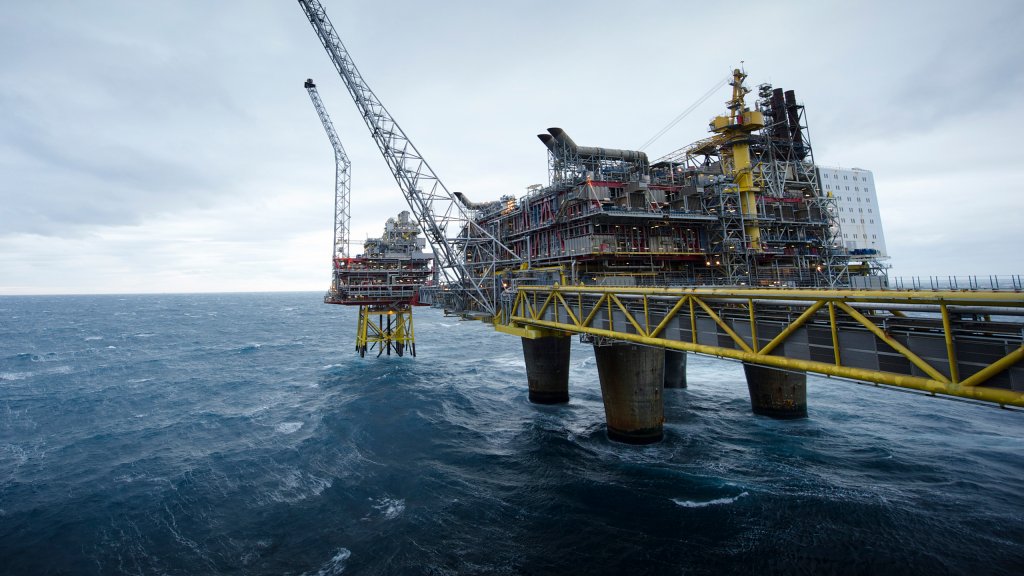
Supply does not appear to be an issue in light of the numerous domestic options including shale gas, Alaskan gas, coalbed methane, and conventional onshore and offshore gas.  Given the proximity of enormous shale gas resources to major markets, shale gas is the featured attraction. However, this is an offshore blog, and from a strictly environmental perspective, offshore gas is the preferred option.  Why?

  • No freshwater contamination issues
  • Small environmental footprint – limited facilities needs and minimal space preemption
  • No production in or near residential areas
  • Potential production near major natural gas markets. For example, there is a natural gas discovery in the Atlantic approximately 100 miles southeast of the New York City area. (Before my geologist friends get upset, I will point out that the productive reservoirs are highly complex and further exploration is necessary to determine whether this field – the former Hudson Canyon Unit – and other Atlantic prospects are commercially viable.)
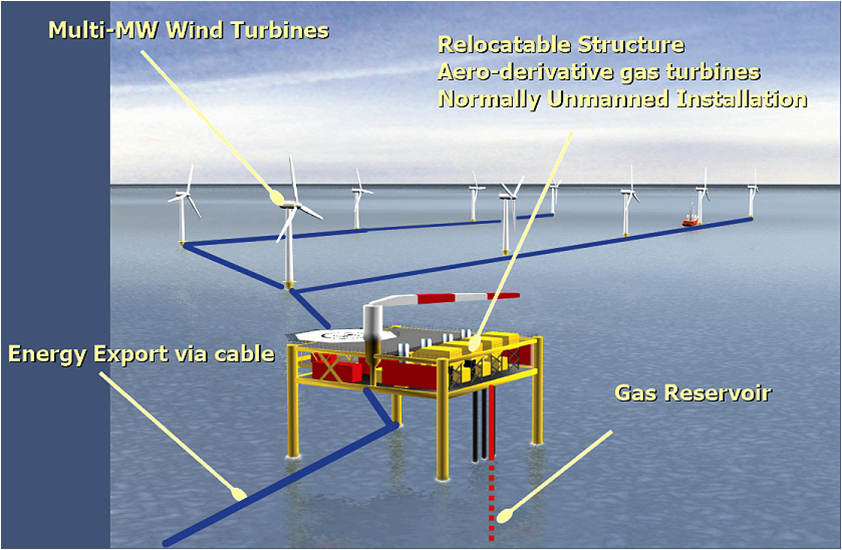
  • Potential for combining offshore gas and wind projects into offshore energy units that can ensure consistent power supply. (See slide below from a presentation by George Hagerman, Virginia Tech Advanced Research Institute)

Read Full Post »

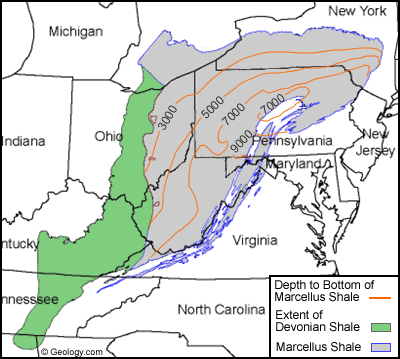
All told, I think Pennsylvania is sitting on the largest gas reserve in the entire world. Scott Perry, director of the state’s Bureau of Oil and Gas Management at the 2010 Marcellus Summit

Rash statement? Hyperbole? Possibly, but shale gas is a game-changer for the northeastern US.  How effectively will the resource be exploited?  Will the true potential be realized?  Stay tuned.

Read Full Post »

This New York Times article and video discuss the dispute on the island of Vinalhaven, Maine, about the noise associated with the island’s three wind turbines.

Comments:

-Locating wind projects offshore minimizes noise and visual issues, but increases costs and operational complexity.  There are always trade-offs.

-When all environmental impacts are considered, offshore natural gas is tough to beat: minimal visual impacts, none of the freshwater issues that are complicating shale gas development, few land use issues, little or no spill risk (depending how dry the gas is).  The trade-off is CO2 emissions. While combustion of natural gas emits 30% and 45% less CO2 than oil and coal respectively, the CO2 emissions are still significant.

Read Full Post »

We strongly caution natural gas power plants and other industries against the venting of high-pressure natural gas in or near work sites. This practice, although common, is inherently unsafe.

The U.S. Chemical Safety Board has issued an update on their investigation of the tragic explosion that killed six workers at a gas-fired power plant in Middletown, Connecticut.  The update includes important information for all facilities that handle natural gas and engage in gas purging.

This accident occurred during a planned work activity to clean debris from natural gas pipes at the plant. To remove the debris, workers used natural gas at a high pressure of approximately 650 pounds per square inch. The high velocity of the natural gas flow was intended to remove any debris in the new piping. At pre-determined locations, this gas was vented to the atmosphere through open pipe ends which were located less than 20 feet off the ground. These vents were adjacent to the main power generation building and along the south wall. The open pipe ends are visible here in the photographs.

gas venting from open pipe

In their investigation report, CSB will likely recommend alternative cleaning practices.

Read Full Post »

Those who don’t think natural gas is a renewable energy resource haven’t paid much attention to biomethane.  Biomethane can be collected from sewage sludge, landfills, grass, food waste, and agricultural waste.  Biomethane collection has 2 major benefits: (1) greenhouse gases emissions are prevented and (2) relatively clean energy is provided.  See this great article in Renewable Energy World.

Kudos to the city of Olso, which plans to fuel buses with biomethane.  The Oslo program has generated some clever headlines:

Flush Hour: Oslo to Run Buses on Biomethane

Norway or the Highway: Poo Powers Oslo Buses

The city’s two sewage plants have enough biomethane to provide fuel for the 80 buses, and if the trial is successful Oslo city council plans to convert all 400 of the public buses to run on biogas.

Read Full Post »

In 1973, while a graduate student at Penn State, I wrote a paper entitled “The Use of Natural Gas in Improving Air Quality.”  My professor, Richard Gordon, a terrific economist who greatly influenced my thinking about energy, liked the paper but thought I was too optimistic about the availability of natural gas.  The sense at the time was that natural gas was a premium energy source in short supply.

Fast forward to 2010.  Another Penn State professor, Terry Englander, estimates recoverable natural gas resources of 500 tcf for the Marcellus shale alone.  Annual gas consumption for the entire US is only about 23 tcf.  The whole world consumed about 113 tcf in 2008.

Dan Yergin is calling it the natural gas revolution.   Boone Pickens has called the US the “Saudi Arabia of natural gas.”  In addition to the shale gas, we have huge Alaskan gas reserves awaiting a pipeline (the economic viability of which may be threatened by the major discoveries in the lower 48). Prospects for ultra-deep gas in the Gulf of Mexico are also looking brighter in the wake of McMoRans major deep gas discovery.  There is excellent natural gas potential in the eastern Gulf near major gas markets, and at least one Atlantic state (Virginia) has expressed interest in renewed exploration in the Atlantic.

Given the dearth of good economic news, why isn’t more attention being given to this natural gas bonanza?  Boone Pickens and others are doing their part, but there should be a national dialogue on how we can use these resources to improve our economy, energy security, and the environment.

How about a parade down Constitution Avenue to celebrate our good fortune?

Celebrating the Natural Gas Revolution?

Read Full Post »

« Newer Posts