The sale could be held sooner. However, since BOEM asked for 37 days, I’m assuming that the sale will be on December 21.
In the 70 year history of the oil and gas leasing program, this will be the sale date that is closest to Christmas. Yet another major milestone for the offshore program! 😀
IT IS ORDERED and ADJUDGED that the Intervenors’ appeal is DISMISSED. As for BOEM’s limited appeal as to the timing of the sale, we hereby AMEND the district court’s preliminary injunction only to the extent that the deadline for conducting Lease Sale 261 shall now be thirtyseven days from the date of the issuance of the mandate in this appeal. IT IS FURTHER ORDERED that each party bear its own costs on appeal.
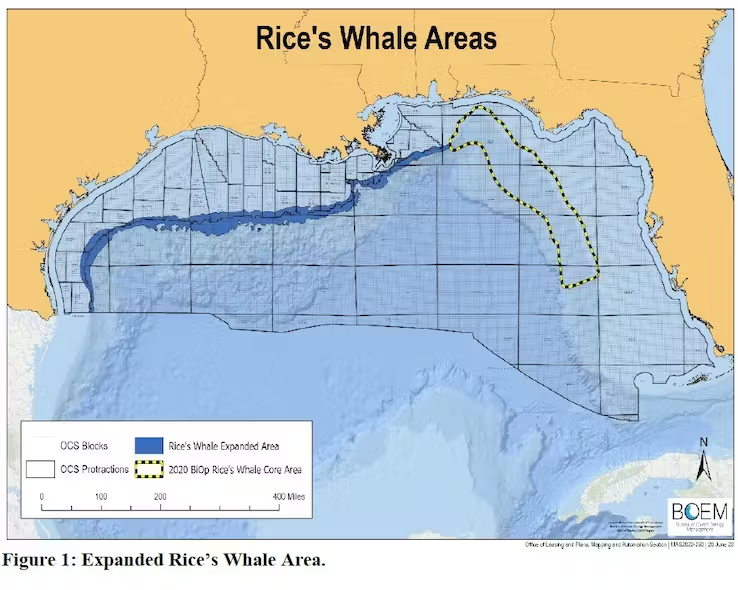
Today, the 5th Circuit Court of Appeals heard oral arguments in the appeal of the District Court’s injunction against the Rice’s whale tract deletions and operating stipulations for Sale 261.
If you want to listen to a recording of these arguments, you can do so at this link. The hearing was brief – only about 45 minutes.
Judging by the comments, it sounds like the Court will reach a decision soon. The Department of the Interior is asking for 37 days after the ruling to organize and hold the sales. The industry attorney seemed comfortable with that, so the sale should be prior to Christmas.
In light of the 5th Circuit’s order, holding the sale on 11/8 would have been messy for all sides in the Rice’s whale dispute. Seemingly, the only option for holding the sale prior to the Court’s decision on the injunction would have been the following:
Allow, but not accept, bids on the tracts in the Rice’s whale expanded area.
Add the Rice’s whale stipulations while providing notice that they might subsequently be removed.
Because the RIce’s whale stipulations would affect the value of all deepwater leases, bidders would be rolling the dice on the outcome of the case.
Also, absent legislative action, there will be no lease sale in 2024. This adds to the importance of Sale 261, and making sure the terms are understood.
As a result of the order issued by the United States Court of Appeals for the Fifth Circuit on October 26, 2023, in Louisiana v. Haaland (Case No. 23-30666), the Bureau of Ocean Energy Management (BOEM) is postponing Lease Sale 261, which was originally scheduled for September 27, 2023, and later scheduled for November 8, 2023, in response to judicial orders. Until the court rules, BOEM cannot be certain of which areas or stipulations may be included in the sale notice.
Potential bidders in Lease Sale 261 should not submit bids until BOEM provides additional instruction. BOEM will hold any bids already received and will hold the sale after it receives further direction from the Court of Appeals.
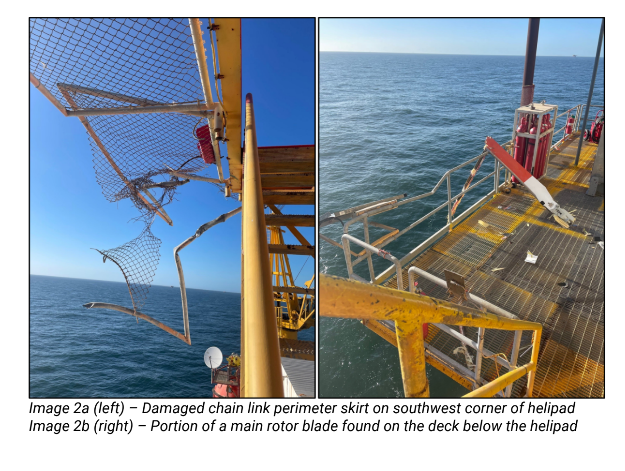
Per the IRF guidelines, “Helicopter operations at or near an Offshore Installation” are supposed to be counted. The fatal 12/29/2022 incident clearly happened at the platform’s helideck (photos below).
I take it that since the 5th Circuit stayed both the 9/21 and 9/25 orders, the mandate to hold the sale by 11/8 is also stayed. Ergo, it is assumed that the sale will be delayed pending a decision on the merits of the injunction. Oral arguments are scheduled for 11/13.
If the 5th Circuit’s decision facilitates timely resolution of the Rice’s whale deletions and stipulations, delaying the sale is probably the best outcome. Otherwise, the level of uncertainty would be unacceptable for many bidders.
Not a lawyer, but I take this to mean that the Judge’s injunction has been suspended and DOI may delete acreage and include the Rice’s whale stipulations in Sale 261 leases. The sale will be held on Nov. 8.
ORDER: IT IS ORDERED that the preliminary injunction entered by the Memorandum Order of September 21, 2023, as amended by the motions panel’s order of September 25, 2023, is STAYED pending the merits panel’s decision on appeal. LYLE W. CAYCE, CLERK United States Court of Appeals
“Stampede,” Gulf of Mexico: Hess 25% owner and operator, Chevron 25% owner
Most importantly, both companies have excellent safety and compliance records as evidenced by their Honor Roll achievements.
Hess is an attractive company with impressive assets. Were there other suitors?
Chevron is currently a partner on the Stampede, Esox, and Tubular Bells deepwater projects that are operated by Hess. There is thus an established deepwater development relationship.
The acquisition of Hess means that Exxon and Chevron will now be partners in Guyana. That should be interesting.
Chevron’s CEO Mike Wirth is quoted as saying “We’ve got too many CEOs per BOE, so consolidation is natural.” That comment seems a bit self-serving, but makes sense from the perspective of an acquiring CEO. Employees of the companies being acquired may have a somewhat different view.
In the Gulf of Mexico, will the combined company be greater than the sum of the parts in terms of lease acquisition, exploration, and development?
Will combining the companies limit the diversity of geological assessments and exploration strategies?
Consolidation affects participation in workshops and on committees engaged in assessing technology and developing standards. More limited participation in these activities, which are critical to offshore safety, was a justified concern of my former boss, the late Carolita Kallaur.
Add Hess to the list of important offshore operators that, for all intents and purposes, no longer exist. This list includes (among others): Amoco, Arco, Texaco, Getty, Gulf, Unocal, Sun, Anadarko, BHP, Mobil, Phillips (or Conoco), Noble Energy, Pennzoil, Kerr-McGee, and Newfield.