Feeds:
Posts
Comments

Archive for the ‘Gulf of Mexico’ Category

Impressively, 4 GoM operators with significant production and well activity did not incur a single civil penalty payment during the most recent 4 year period. Each of these operators also had low incident of noncompliance (INC) to inspection ratios. The companies are as follows:

Operator2022 oil production (million bbls) 2022 oil production rank2022 gas production (bcf)No. of platformsNo. of well starts (2019-2022)
Hess21.6746.535
Kosmos8.5147.8subsea tiebacks 6
Beacon7.21512.2subsea tiebacks4
Cantium4.7196.18637
  • All of these companies deserve kudos.
  • Cantium’s record is especially impressive given that most of their platforms were installed more than 40 years ago and some date back to the 1950s. They have also been a very active development well driller.
  • Hess is the 7th biggest oil producer and 5th biggest gas producer in the GoM. Hess CEO John Hess made some encouraging comments (pasted below) about the deepwater GoM at a recent energy conference.
  • While Kosmos and Beacon have somewhat lower violation and penalty exposure because their production is via subsea wells tied back to surface facilities operated by other companies, they are demonstrating that entrepreneurial deepwater independents can also be safety leaders.

“The Pickerel-1 prospect was our first (exploration well on the Mississippi Canyon 727) and we are delighted that it was an oil discovery. Black Pearl will be the next and that will hopefully be a tieback (to Tubular Bells with first oil expected mid-2024).

“Then we have a wildcat opportunity (the Vancouver exploration prospect) later in the year in the Green Canyon. With the other 80 exploratory blocks that we have in the Gulf, we will be actively drilling for the next several years,” Hess said.

OilNow

Read Full Post »

  • Per the previous civil penalties post
  • Data are on a fiscal year basis (i.e. 2022 started on 10/1/2021 and ended on 9/30/2022)
  • These data are only for civil penalties paid in that year. Data for civil penalties referrals are not publicly available.
  • Nothing terribly surprising in the data. Fieldwood’s issues have been discussed at length.
  • Note (last chart) the lag between the date violations were observed and the date penalties were paid. This lag is significant but understandable given due process considerations.
  • Fastest payment: 6 months by Shell for an open hole that was not properly barricaded ($26,750 penalty, 2018).
  • Slowest payment: 54 months by LLOG for failing to install and maintain equipment properly (three 2016 violations)
  • Largest civil penalty paid: $512,900 by bp for a high-pressure gas release caused by the use of improper seals (May 8, 2018 violation).
  • Smallest civil penalty paid: $16,300 by Arena for the release of 1000 psi gas on October 16, 2018
  • The current maximum penalty amount is $52,646 per day, per violation.
  • To learn more about the specific cases.

Read Full Post »

Right whale – Atlantic
Rice’s whale – Gulf of Mexico

Both species are endangered, but the operating restrictions differ significantly:

North Atlantic wind leases: right whale restrictions GoM Lease sale 261: Rice’s whale restrictions
No leasing prohibitions or turbine-free areas have been established despite concerns raised by NOAA (see attached letter)All of the expanded Rice’s whale area is excluded from leasing (i.e. the entire area between the 100 and 400 m isobaths across the GoM)
seasonal 10 kt max speed for vessels > 65′year round 10 kt max for all vessels
vessel separation distance of 500 m for any sighted right whale or unidentified large marine mammalseparation distance of 500 m for any sighted Rice’s whale; if unsure, must assume whale is Rice’s
no visibility restrictions for vessel operationsvessels must avoid transit between dusk and dawn and other times of low visibility
no automatic identification system (AIS) requirementsvessels > 65′ must have AIS functioning at all times
no documentation requirementsmust maintain records to document compliance

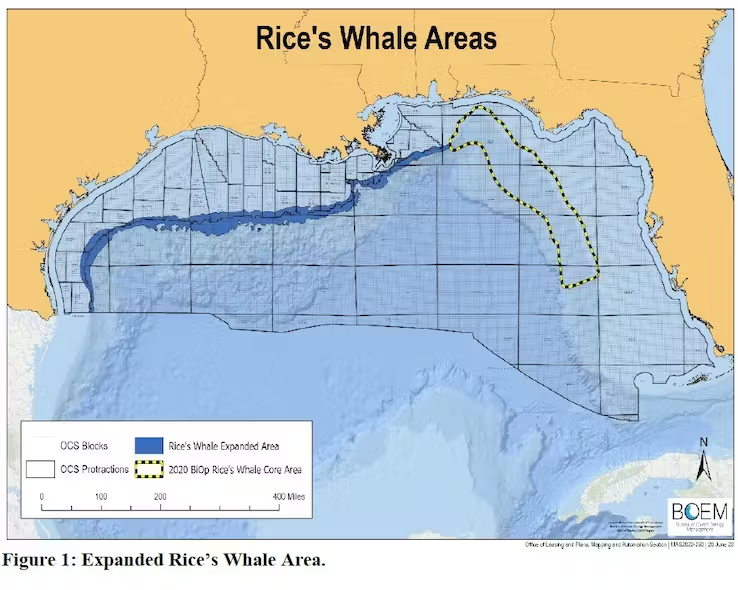
Note (below) the proximity of existing and planned wind leases to moderate to high density RIght whale areas compared to the more speculative expanded Rice’s whale area in the central and western GoM that is predicted based on passive acoustic recordings.

Read Full Post »

  • Field: Trion
  • Operator: Woodside
  • Partner: Pemex
  • Water depth: 2500 m (Mexico’s first ultra-deepwater project)
  • Distance from US maritime border: 30 km
  • Distance offshore: 180 km
  • Reserves: 324.7 million BOE proved, 478.7 million BOE probable
  • Production: Floating Production Unit with an oil production capacity of 100,000 B/D connected to an FSO vessel with a capacity of 950,000 bbl. Gas not used to power FPU will be reinjected
  • First oil: 2028
  • Only mentioned here 😉: The predicted Rice’s whale habitat extends southward between the 100 and 400 m isobaths into Mexican waters. Background.

Read Full Post »

For those interested in safety and compliance data, a good BSEE update for the Gulf of Mexico is attached.

Interestingly, (slide pasted below), there were 20% fewer Incidents of Noncompliance (INCs) per component inspected but 37% more INCs/inspection. This would seem to imply high INC rates at less complex (typically older) facilities with relatively fewer components.

Posted 2023 inspection data indicate high INC/inspection rates for Cox and affiliates Energy XXI GOM and EPL that have filed for bankruptcy. Through August, these companies have accounted for 44% (635/1457) of all INCs issued in 2023. This may explain, at least in part, the divergence in the 2 compliance measures.

Read Full Post »

The plaintiffs assert “insufficient and arbitrary environmental analyses, in violation of the National Environmental Policy Act (NEPA) and the Administrative Procedure Act (APA).” The court filing is attached.

For those who missed it, supporters of the lease sale have challenged some of the provisions.

All of this will have to be resolved in the next 3 weeks, as the congressionally mandated sale, scheduled for 27 September, (presumably) cannot be postponed.

Read Full Post »

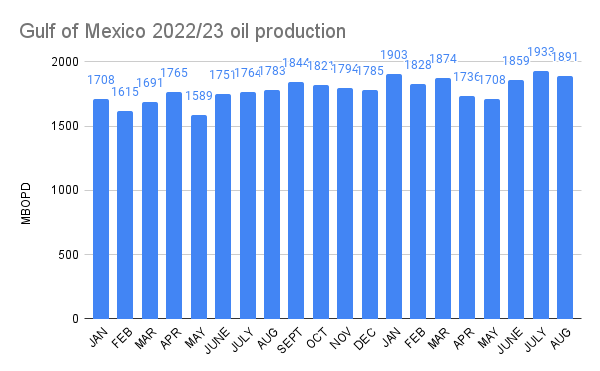
Gulf of Mexico oil production increased to 1.853 bopd in June which is more in line with production at the beginning of the year and the EIA 2023 forecast. Production remains well below BOEM’s 2.0 million bopd forecast for 2023.

Read Full Post »

The court filing is attached. See the previous post on this matter.

This Court should grant Plaintiffs—the State of Louisiana, the American Petroleum Institute (“API”), and Chevron U.S.A. Inc. (“Chevron”)—a preliminary injunction and prevent those unlawful provisions from permanently disrupting the result of the fast-approaching lease sale (which Congress has directed must occur by September 30, and which cannot be delayed without causing Plaintiffs even more serious injury).

Read Full Post »

Yesterday was not a good day for US offshore wind. Not only was the Gulf of Mexico wind lease sale disappointing, but Orsted announced US impairments of $2.3 billion causing their share price to fall to the lowest level in more than 4 years.

Unsurprisingly, Orsted management assumes no responsibility for the company’s poor performance, blaming supply chain problems, high interest rates and “a lack of new tax credits.” Outsiders might suggest that there were other factors such as irrational exuberance in the acquisition of wind leases at inflated prices, and unrealistic expectations regarding a complementary power source that is dependent on government mandates and subsidies.

“The situation in U.S. offshore wind is severe,” Chief Executive Mads Nipper told reporters on a conference call.

Reuters

Read Full Post »

Genesis, which is being decommissioned, has been fully evacuated. BSEE will no doubt have information on all evacuations and shut-ins tomorrow.

Read Full Post »

« Newer Posts - Older Posts »