Is it accurate to describe BOEM’s agreement with the Sierra Club as a “sue and settle” arrangement? a. If so, does BOEM intend to continue making decisions through “sue and settle” tactics? b. How can the Committee attain confidence that the BOEM is considering the interest of small businesses in its decision-making when its decisions are made behind closed doors with special interest groups?
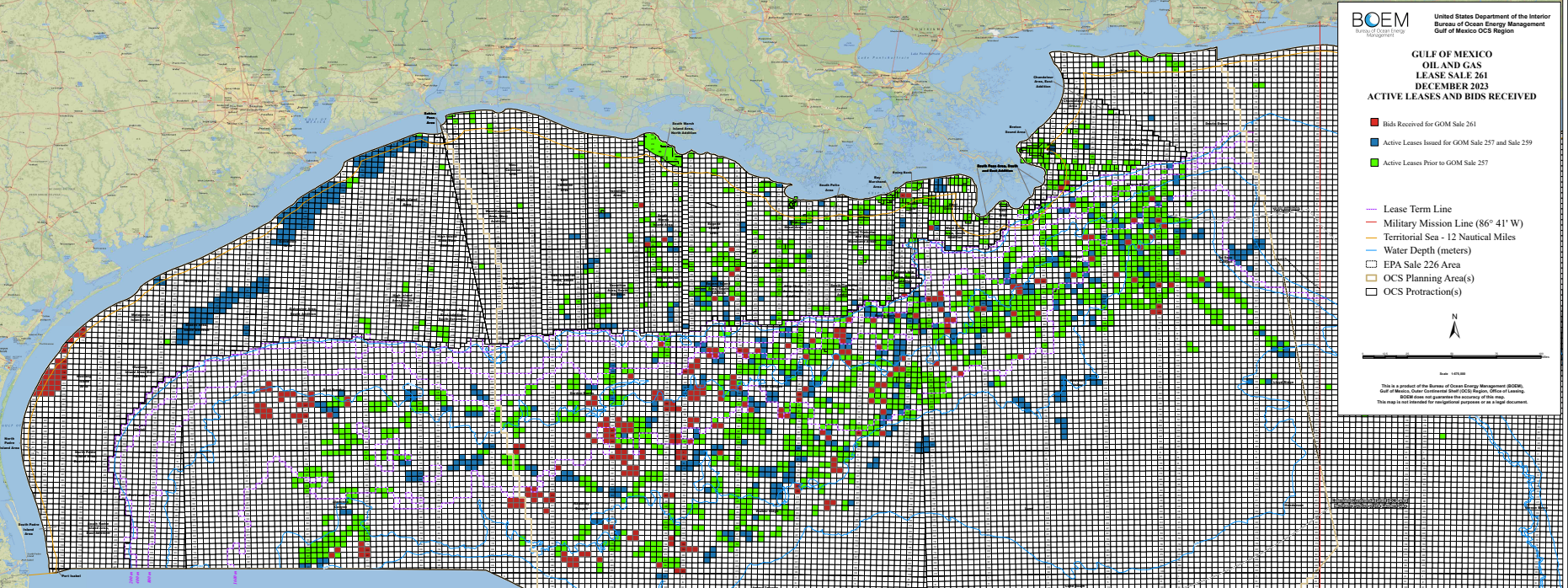
Last week, the 5th Circuit heard arguments on the appeal by Earthjustice et al of Judge Cain’s decision to remove the Rice’s whale restrictions from Sale 261 leases. The sale is to be held on Nov. 8 per the 5th Circuit’s order.
The acquisition will increase their Permian resource to an estimated 16 billion barrels of oil equivalent.
Exxon’s Permian production volume will more than double to 1.3 million barrels of oil equivalent per day, and is expected to increase to approximately 2 MOEBD in 2027.
If Exxon believes the consumption of oil and gas is harmful to society, as suggested by their CO2 disposal plans, perhaps they should be curtailing their oil and gas production business rather than expanding it.
Deepwater Gulf of Mexico production, which Exxon has shunned, has much lower carbon intensity than Permian production, but Exxon’s sole GoM interest is CO2 disposal. Shouldn’t a company that is intent on reducing upstream GHG emissions be active in the leading offshore region in that regard, the region that is adjacent to their world headquarters?
Ignore the significant oil and gas potential of arctic and subarctic Alaska, the Atlantic, the Pacific, and the Eastern Gulf of Mexico (where the best prospects are >125 miles from the coast of Florida).
“The proposed critical habitat has been deemed, by NMFS, to have the essential physical and biological features needed for the Rice’s whale to feed, breed, and reproduce. However, direct evidence for what oceanographic features within the 100-400 m isobath band identified by NMFS are required to sustain the Rice’s whale is lacking, and the extent of those truly important features elsewhere in the GOMx is uncertain and may not reach into the central or northwestern GOMx as predicted by the habitat based density model (Garrison et al. 2023). Even though there is evidence to support the possible occurrence of Rice’s whale near the FGBNMS in the northwestern GOMx, there are no data that show this area is being used to support important life history functions such as breeding, feeding, or migrating. Additionally, the sightings and acoustic detections that have been recorded there are much less frequent than those recorded for Rice’s whale in the core habitat in the northeastern GOMx. Based on the limited data available on the use and occurrence of Rice’s whale in the central and northwestern GOMx (one acoustic study (Soldevilla et al. 2022b), one confirmed sighting (NMFS 2018a) and a few unconfirmed sightings (Rosel et al. 2021)), there is insufficient scientific evidence to determine that essential features for Rice’s whale conservation are indeed present in the central and northwestern GOMx. In fact, data on the life-history requirements of Rice’s whale even in the core habitat are still lacking and need further investigation.“
EIAP’s key findings on the estimated economic impacts from these restrictions are summarized in the table below. Those are very significant costs given the uncertainty of the whale habitat in the central and western GoM.
Separate comments submitted by the Offshore Operators Committee are also quite strong. Their letter is attached.
The Polar Pioneer was once a good rig for sub-arctic operations, but is not at all similar to the modern drilling units that are used on the deepwater Gulf of Mexico leases that now account for 93% of OCS oil production and 76% of the natural gas. With the exception of the GoM shelf, which is laudably being gleaned by independent producers, the deepwater GoM blocks are all that is left of the once robust US offshore leasing program.
Unless the picture of the scrapped drilling rig is intended to be symbolic of the current state of the leasing program, the photo choice implies inattention to significant technical details. The document does not include a single picture of a deepwater drilling unit or production facility.
The current leasing policy as articulated in both the draft and final proposed program is to phase out oil and gas production:
The long-term nature of OCS oil and gas development, such that production on a lease may not begin for a decade or more after lease issuance and can continue for decades, makes consideration of net-zero pathways relevant to the Secretary’s determinations on how the National OCS Program best meets the Nation’s energy needs.
Basing leasing decisions on highly uncertain “net-zero pathways” would seem to be a considerable stretch of the Secretary’s authority under the OCS Lands Act. A strategic shutdown of the offshore oil and gas program, which would dramatically increase energy supply and security risks going forward, should be authorized by Congress. Even the threat of such a shutdown could have major economic implications.
The Proposed Final Program includes a maximum of three potential oil and gas lease sales – the fewest oil and gas lease sales in history – in the Gulf of Mexico Program Area scheduled in 2025, 2027 and 2029.
The plan looks good. It appears to be consistent with previous contingency plans. Offshore operations should not be impacted.
“During the shutdown BSEE will continue critical permitting, oversight, preparedness verification, and related activities that are necessary to protect workers and the environment from operations associated with conventional and renewable energy development on the Outer Continental Shelf. Approximately 40% of the 851 BSEE employees will be retained to accomplish these activities and will be designated as exempt, as their salaries will be funded from non-lapsing prior year carryover. Should an extended shutdown occur, exhausting current funding sources, all the exempt personnel would be designated as excepted as they are essential for life and safety.”
Federal funding lapses, real or threatened, are rather common. They range from false alarms to the extended shutdown of 35 days that occurred in 2018-19. In no case have offshore oil and gas operations been significantly affected. BSEE and its predecessors developed and implemented contingency plans that identified “essential employees” needed to monitor operations and review necessary permits.
Hopefully, DOI will provide clarity on these matters today, since a Federal government shutdown could begin at midnight tomorrow. Needless to say, any disruption in ongoing oil and gas production operations would have significant safety and economic implications.