Not a lawyer, but I take this to mean that the Judge’s injunction has been suspended and DOI may delete acreage and include the Rice’s whale stipulations in Sale 261 leases. The sale will be held on Nov. 8.
ORDER: IT IS ORDERED that the preliminary injunction entered by the Memorandum Order of September 21, 2023, as amended by the motions panel’s order of September 25, 2023, is STAYED pending the merits panel’s decision on appeal. LYLE W. CAYCE, CLERK United States Court of Appeals
“Stampede,” Gulf of Mexico: Hess 25% owner and operator, Chevron 25% owner
Most importantly, both companies have excellent safety and compliance records as evidenced by their Honor Roll achievements.
Hess is an attractive company with impressive assets. Were there other suitors?
Chevron is currently a partner on the Stampede, Esox, and Tubular Bells deepwater projects that are operated by Hess. There is thus an established deepwater development relationship.
The acquisition of Hess means that Exxon and Chevron will now be partners in Guyana. That should be interesting.
Chevron’s CEO Mike Wirth is quoted as saying “We’ve got too many CEOs per BOE, so consolidation is natural.” That comment seems a bit self-serving, but makes sense from the perspective of an acquiring CEO. Employees of the companies being acquired may have a somewhat different view.
In the Gulf of Mexico, will the combined company be greater than the sum of the parts in terms of lease acquisition, exploration, and development?
Will combining the companies limit the diversity of geological assessments and exploration strategies?
Consolidation affects participation in workshops and on committees engaged in assessing technology and developing standards. More limited participation in these activities, which are critical to offshore safety, was a justified concern of my former boss, the late Carolita Kallaur.
Add Hess to the list of important offshore operators that, for all intents and purposes, no longer exist. This list includes (among others): Amoco, Arco, Texaco, Getty, Gulf, Unocal, Sun, Anadarko, BHP, Mobil, Phillips (or Conoco), Noble Energy, Pennzoil, Kerr-McGee, and Newfield.
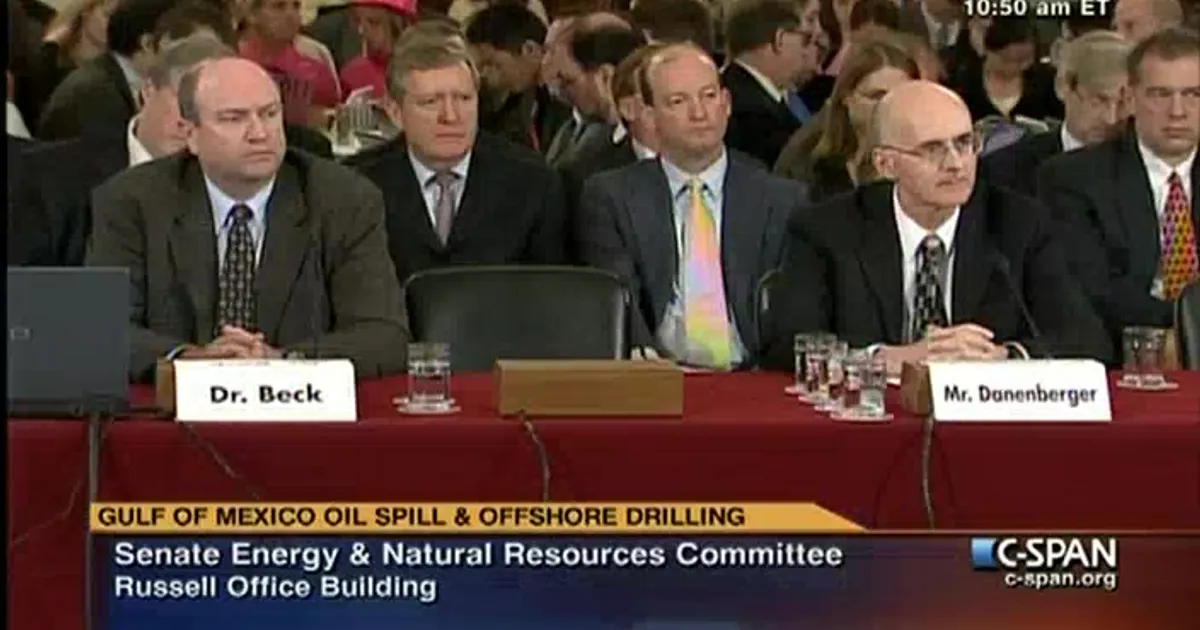
I was on the first panel to appear before a Senate committee during the Macondo blowout. All of the senators were respectful and professional with two exceptions, one of whom was Bob Menendez. Perhaps Senator Menendez’s penchant for political grandstanding was an indication of more significant character flaws.
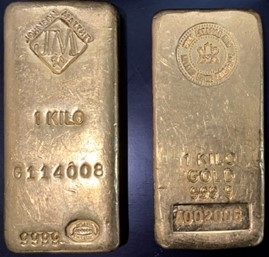
Robert Menendez Allegedly Agreed to Use His Official Position to Benefit Wael Hana, Jose Uribe, Fred Daibes, and the Government of Egypt in Exchange for Hundreds of Thousands of Dollars of Bribes to Menendez and His Wife Nadine Menendez, Which Included Gold Bars, Cash, and a Luxury Convertible
Last week, Sen. Menendez was cited for additional charges accusing him of accepting bribes from a foreign government and conspiring to act as a foreign agent.
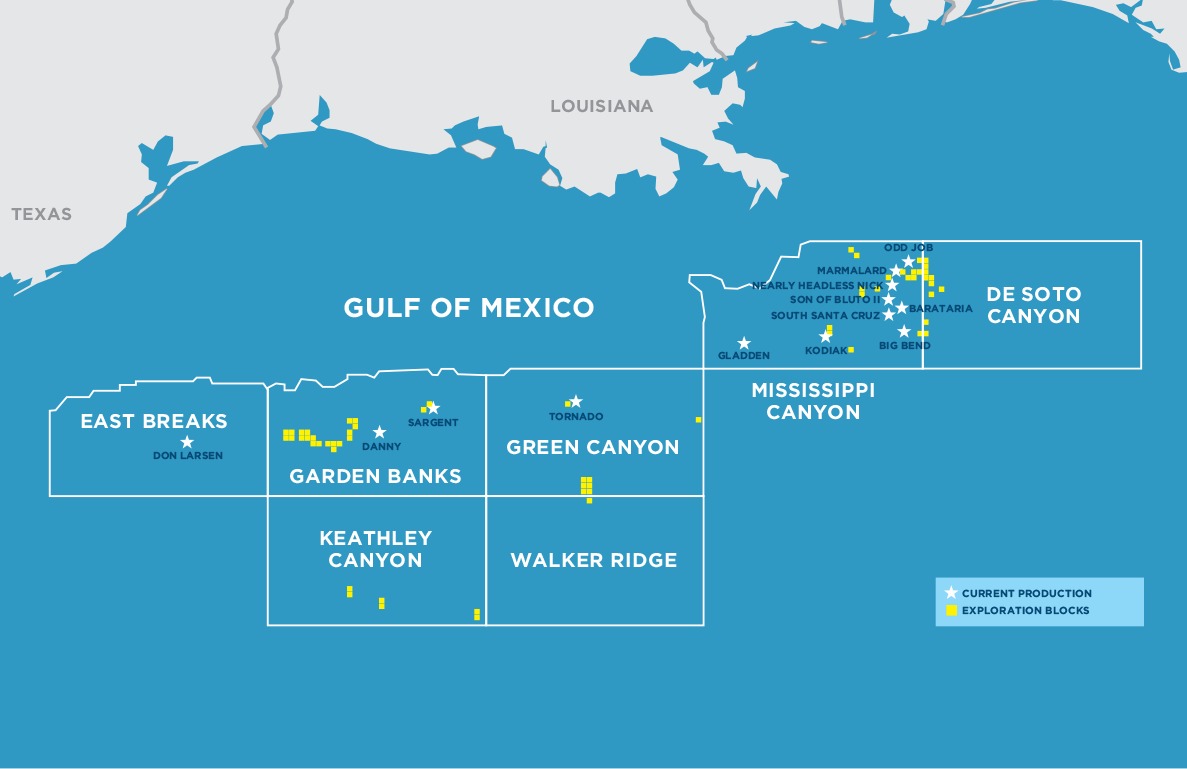
The Tiberius exploration well tested a four-way structural trap in the outboard Wilcox trend, located in Keathley Canyon Block 964. The well encountered approximately 250 feet (~75 meters) of net oil pay in the primary Wilcox target. Wireline logging has been completed and casing is currently being run to the target depth to enable the well to be used as a future oil producer. The Tiberius well is located in approximately 7,500 feet (2,300 meters) of water and was drilled to a total vertical depth of approximately 25,800 feet (7,800 meters).
BSEE data indicate that Kosmos has an excellent compliance record, having been cited for only 3 violations during 44 facility inspections (83 inspection types) since 1/1/2018.
One quibble: the Kosmos news release does not name the drilling unit or drilling contractor. The rig crew is the group most responsible for safely drilling the well.
Is it accurate to describe BOEM’s agreement with the Sierra Club as a “sue and settle” arrangement? a. If so, does BOEM intend to continue making decisions through “sue and settle” tactics? b. How can the Committee attain confidence that the BOEM is considering the interest of small businesses in its decision-making when its decisions are made behind closed doors with special interest groups?
Last week, the 5th Circuit heard arguments on the appeal by Earthjustice et al of Judge Cain’s decision to remove the Rice’s whale restrictions from Sale 261 leases. The sale is to be held on Nov. 8 per the 5th Circuit’s order.
The acquisition will increase their Permian resource to an estimated 16 billion barrels of oil equivalent.
Exxon’s Permian production volume will more than double to 1.3 million barrels of oil equivalent per day, and is expected to increase to approximately 2 MOEBD in 2027.
If Exxon believes the consumption of oil and gas is harmful to society, as suggested by their CO2 disposal plans, perhaps they should be curtailing their oil and gas production business rather than expanding it.
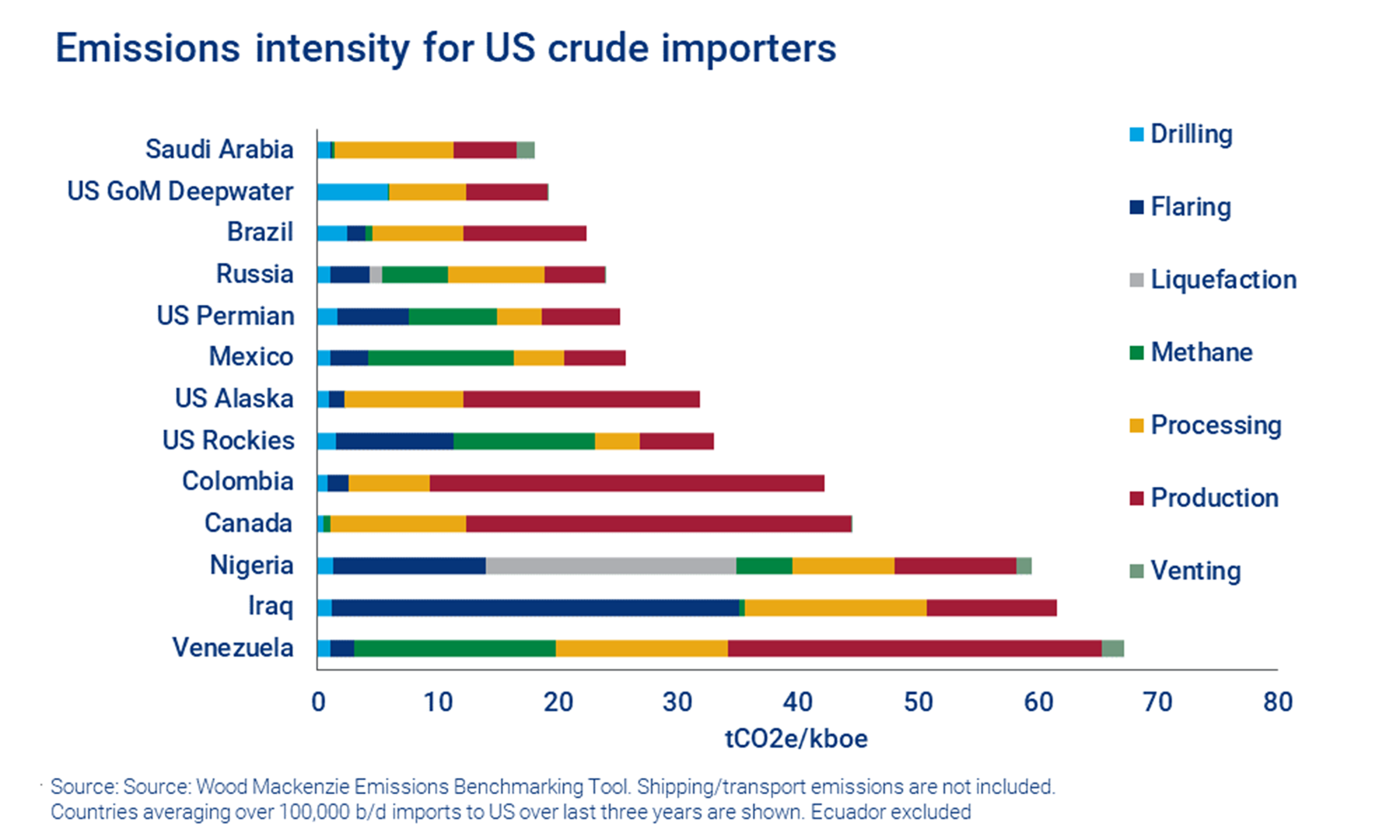
Deepwater Gulf of Mexico production, which Exxon has shunned, has much lower carbon intensity than Permian production, but Exxon’s sole GoM interest is CO2 disposal. Shouldn’t a company that is intent on reducing upstream GHG emissions be active in the leading offshore region in that regard, the region that is adjacent to their world headquarters?
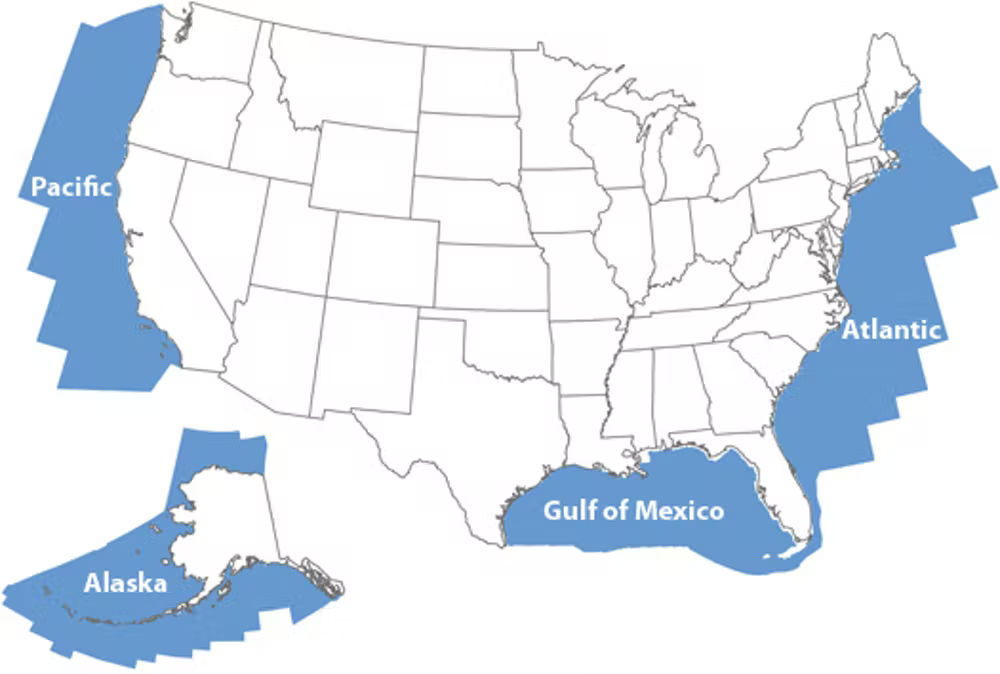
Ignore the significant oil and gas potential of arctic and subarctic Alaska, the Atlantic, the Pacific, and the Eastern Gulf of Mexico (where the best prospects are >125 miles from the coast of Florida).
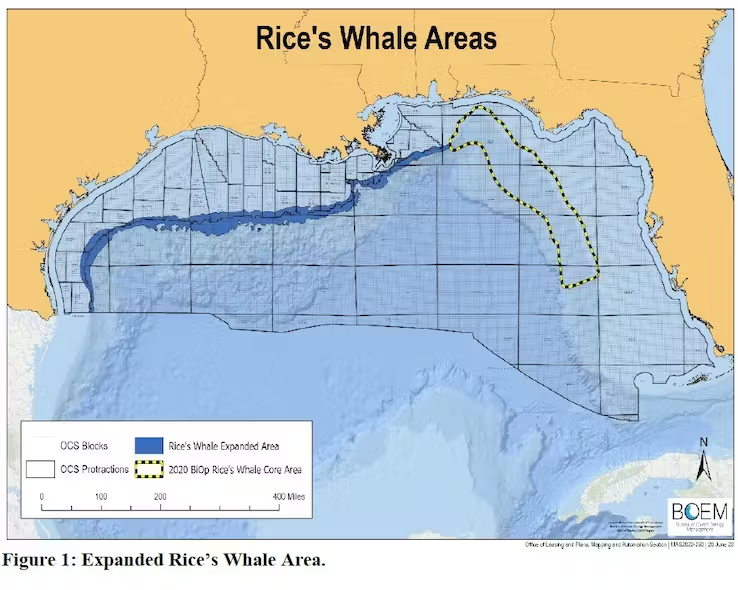
“The proposed critical habitat has been deemed, by NMFS, to have the essential physical and biological features needed for the Rice’s whale to feed, breed, and reproduce. However, direct evidence for what oceanographic features within the 100-400 m isobath band identified by NMFS are required to sustain the Rice’s whale is lacking, and the extent of those truly important features elsewhere in the GOMx is uncertain and may not reach into the central or northwestern GOMx as predicted by the habitat based density model (Garrison et al. 2023). Even though there is evidence to support the possible occurrence of Rice’s whale near the FGBNMS in the northwestern GOMx, there are no data that show this area is being used to support important life history functions such as breeding, feeding, or migrating. Additionally, the sightings and acoustic detections that have been recorded there are much less frequent than those recorded for Rice’s whale in the core habitat in the northeastern GOMx. Based on the limited data available on the use and occurrence of Rice’s whale in the central and northwestern GOMx (one acoustic study (Soldevilla et al. 2022b), one confirmed sighting (NMFS 2018a) and a few unconfirmed sightings (Rosel et al. 2021)), there is insufficient scientific evidence to determine that essential features for Rice’s whale conservation are indeed present in the central and northwestern GOMx. In fact, data on the life-history requirements of Rice’s whale even in the core habitat are still lacking and need further investigation.“
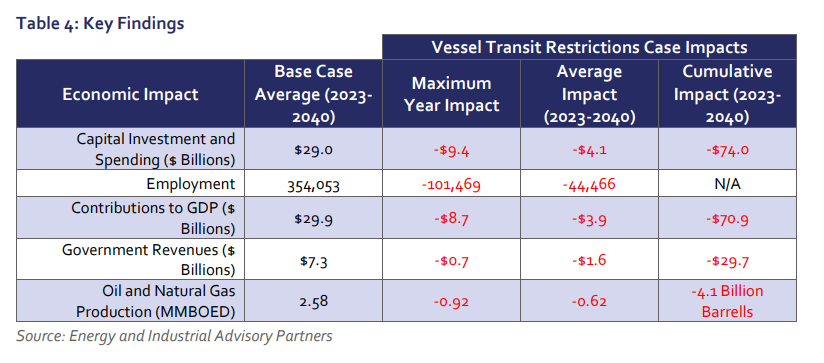
EIAP’s key findings on the estimated economic impacts from these restrictions are summarized in the table below. Those are very significant costs given the uncertainty of the whale habitat in the central and western GoM.
Separate comments submitted by the Offshore Operators Committee are also quite strong. Their letter is attached.
The Polar Pioneer was once a good rig for sub-arctic operations, but is not at all similar to the modern drilling units that are used on the deepwater Gulf of Mexico leases that now account for 93% of OCS oil production and 76% of the natural gas. With the exception of the GoM shelf, which is laudably being gleaned by independent producers, the deepwater GoM blocks are all that is left of the once robust US offshore leasing program.
Unless the picture of the scrapped drilling rig is intended to be symbolic of the current state of the leasing program, the photo choice implies inattention to significant technical details. The document does not include a single picture of a deepwater drilling unit or production facility.
The current leasing policy as articulated in both the draft and final proposed program is to phase out oil and gas production:
The long-term nature of OCS oil and gas development, such that production on a lease may not begin for a decade or more after lease issuance and can continue for decades, makes consideration of net-zero pathways relevant to the Secretary’s determinations on how the National OCS Program best meets the Nation’s energy needs.
Basing leasing decisions on highly uncertain “net-zero pathways” would seem to be a considerable stretch of the Secretary’s authority under the OCS Lands Act. A strategic shutdown of the offshore oil and gas program, which would dramatically increase energy supply and security risks going forward, should be authorized by Congress. Even the threat of such a shutdown could have major economic implications.




 Bud's Offshore Energy (BOE)