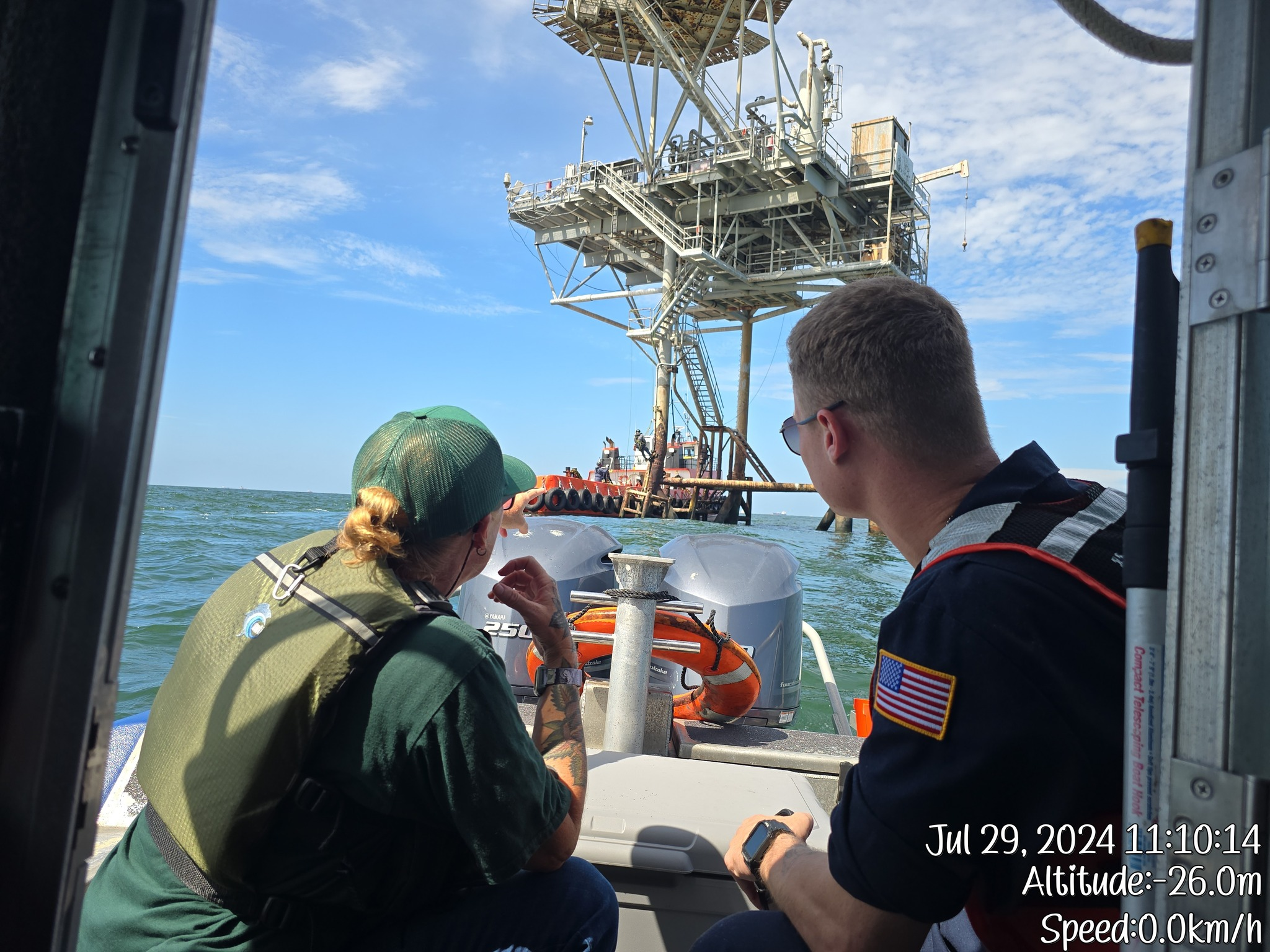
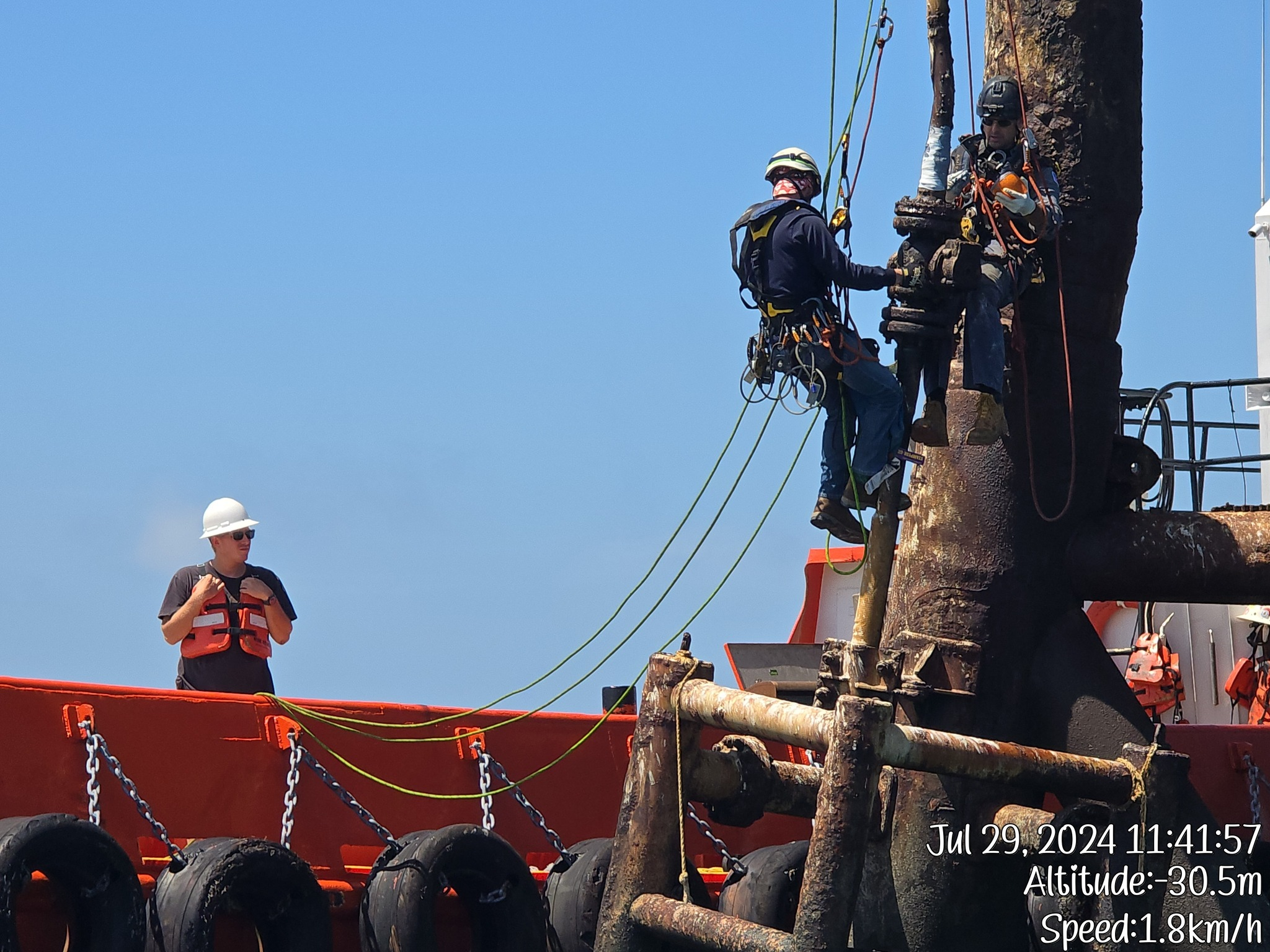
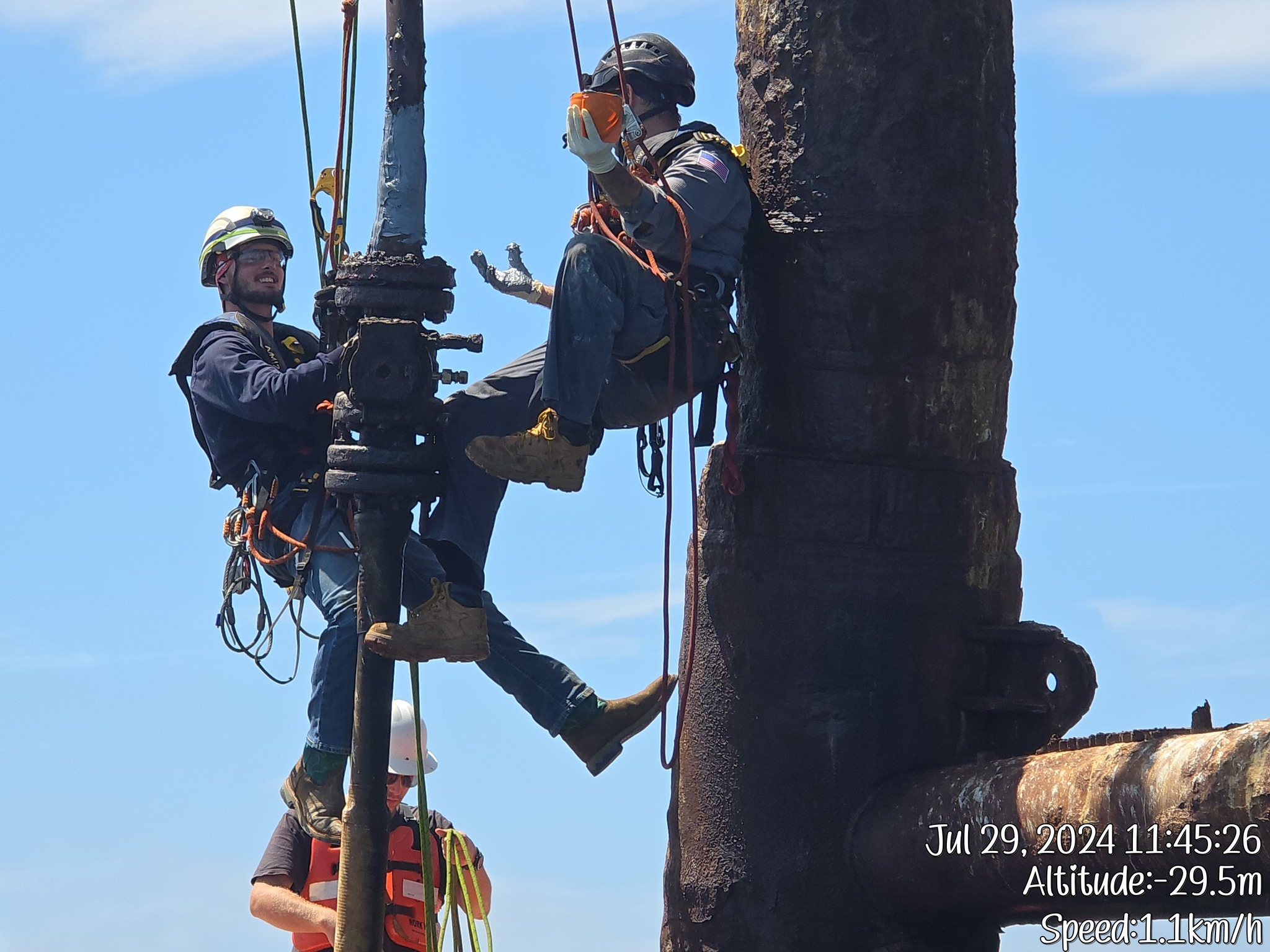
Crews from the U.S. Coast Guard, Texas General Land Office, and the Texas Railroad Commission monitored the operation. It’s unclear who the responsible party is and who funded and performed the work.
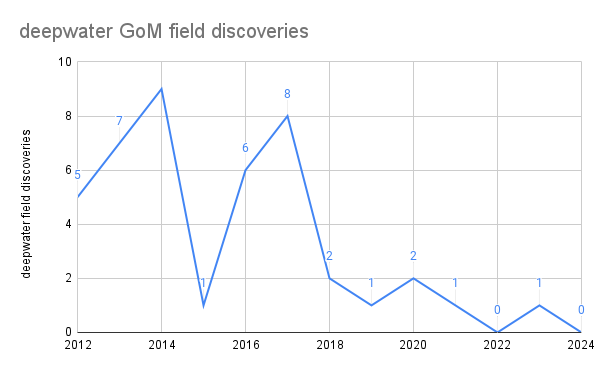
The dearth of deepwater discoveries over the past 6 years (chart below derived from BOEM data) should be a major concern to those engaged in energy policy. Technical innovation has facilitated simpler, safer, and greener deepwater development. However, most of those discoveries were made 7-15 years ago.
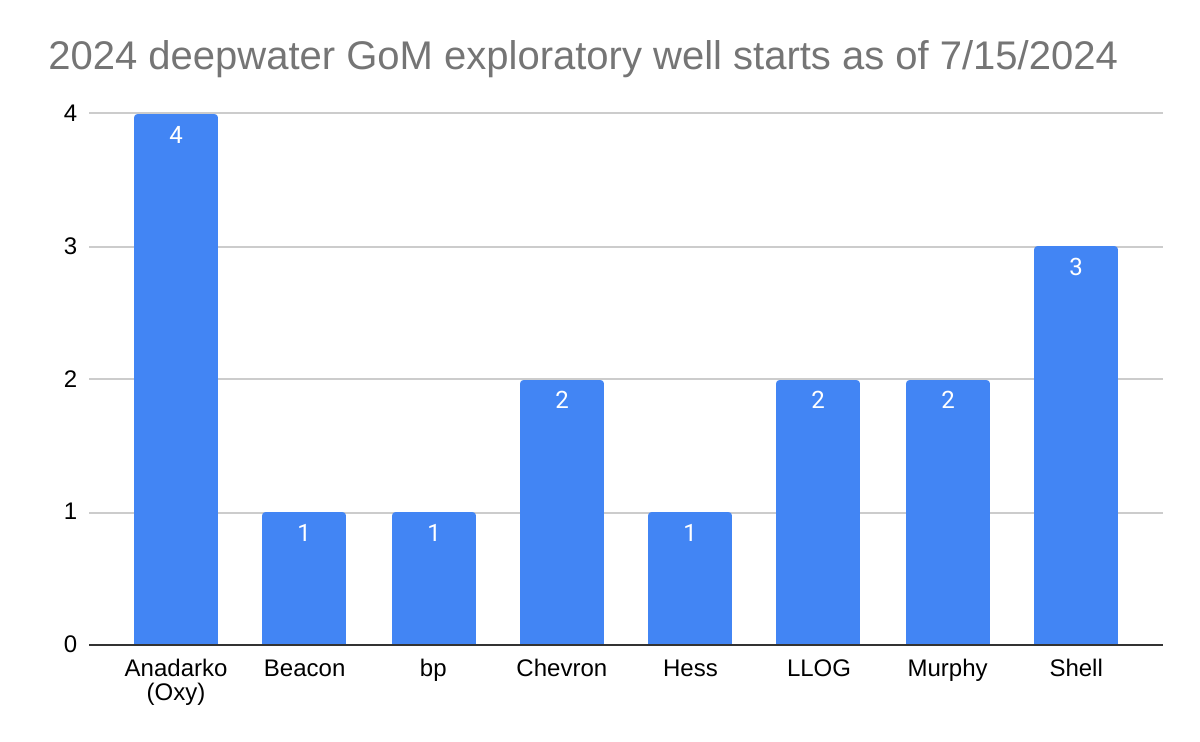
The decline in discoveries is no surprise given the decline in deepwater exploratory drilling documented by Lars Herbst in Dec. 2022. That trend continues, and the BSEE data summarized below indicate that deepwater exploratory drilling has remained at historically low levels.
Onshore oil and gas production, mostly from private lands, has responded to growing US demand, but the offshore sector could be contributing more and offers some important advantages:
The Deepwater Advantage:fewer facilities + fewer wells + high production rates + efficient power generation + advanced processing + restricted flaring + pipeline transportation = fewer environmental impacts and low GHG intensity production
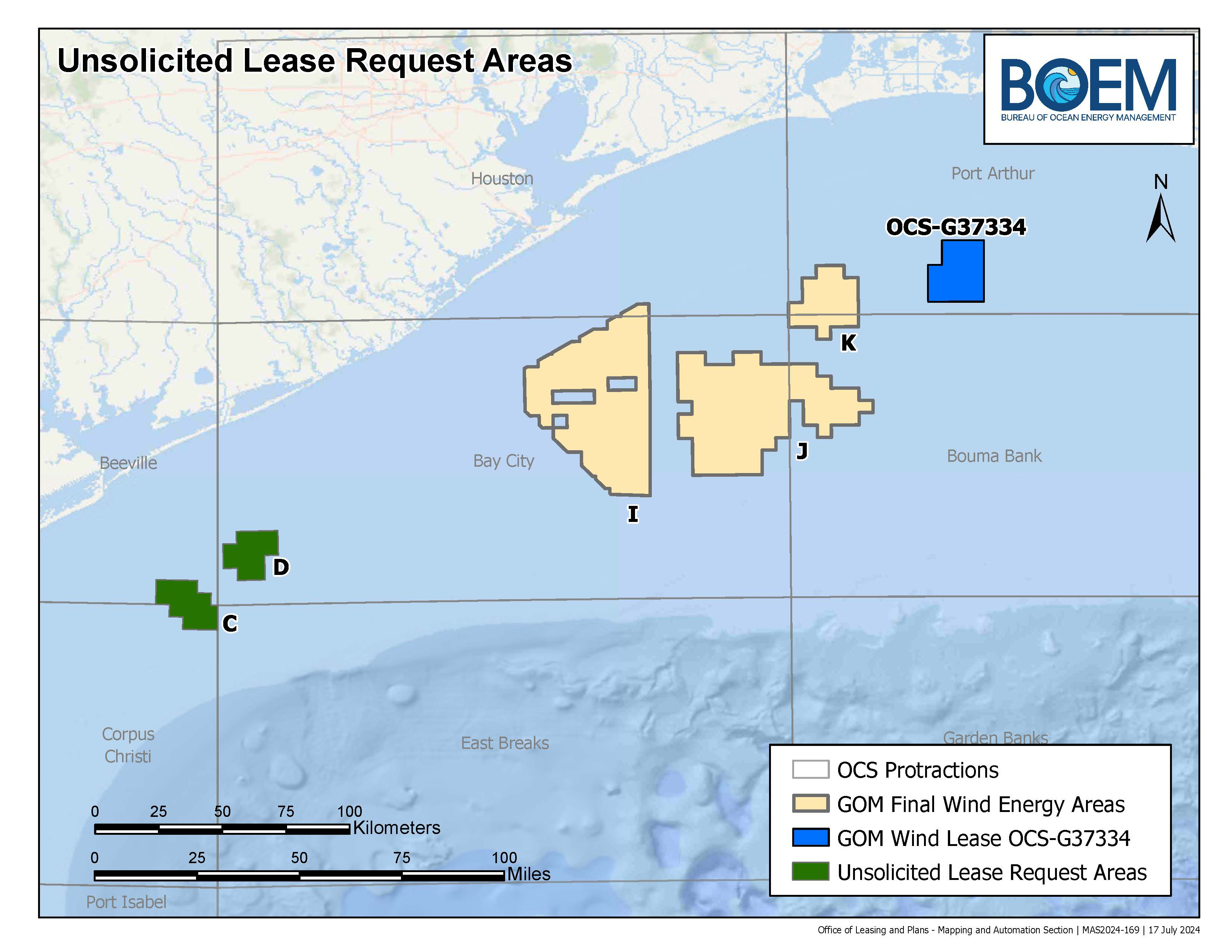
Hercate lease request – C & D. Wind areas that were considered for 2nd GoM sale – I, J, & K. Active RWE lease – blue.
GoM wind leasing update:
BOEM’s highly promoted 2023 GoM wind sale was a bust. The sole bidder, the German company RWE, acquired a single lease.
BOEM’s second GoM wind sale failed to get off the ground. Because only one company expressed interest in participating, that sale has been cancelled.
BOEM is now surveying interest in other GoM areas as a result of an unsolicited lease request from Hercate Energy.
If BOEM does not receive competing indications of interest, they may (and probably will) issue a noncompetitive lease to Hecate.
BOEM calls Hercate an “industry leader.” However, per their website, Hecate is mainly a solar energy company with only 2 wind projects. Both of those wind projects are onshore (Kentucky), and are “in development” (i.e. not yet operating). Hercate is no doubt a fine company, but have they demonstrated the technical expertise and financial strength needed for offshore wind development?
BOEM’s aggressive wind leasing policy stands in stark contrast to their current oil and gas policy. Not a single oil and gas sale will be held in 2024. Were it not for a provision in the “Inflation Reduction Act,” the last 3 GoM sales (257, 259, and 261) would probably not have occurred.
The new 5 year oil and gas leasing plan confirms that the Dept. of the Interior (DOI) has no intention of fulfilling their statutory oil and gas leasing mandate. In announcing the new 5 year plan, DOI boasted that the plan includes the fewest sales (3) of any plan in the history of the program. DOI strongly implied that the only reason those 3 sales were included was to sustain the wind program.,
When we drafted the OCSLA amendments that authorize offshore wind leasing, we envisioned complementary and synergistic programs, not a dogmatic pro-wind bias. As experts like Daniel Yergin have repeatedly warned, the notion that wind energy can eliminate the need for oil and gas is pure folly.
The Vineyard Wind turbine incident, which littered Nantucket beaches, has also tarnished the US offshore wind program. BSEE has prudently halted Vineyard Wind operations and construction pending an investigation into the blade failure.
Offshore wind development is structure rich, so public confidence in the design of turbines and support platforms is critical. BOEM lists 37 active wind leases on the US OCS. Most of these leases have not yet reached the construction phase. A hold on the approval of any Construction and Operations Plans would seem to be appropriate pending completion of the Vineyard Wind investigations.
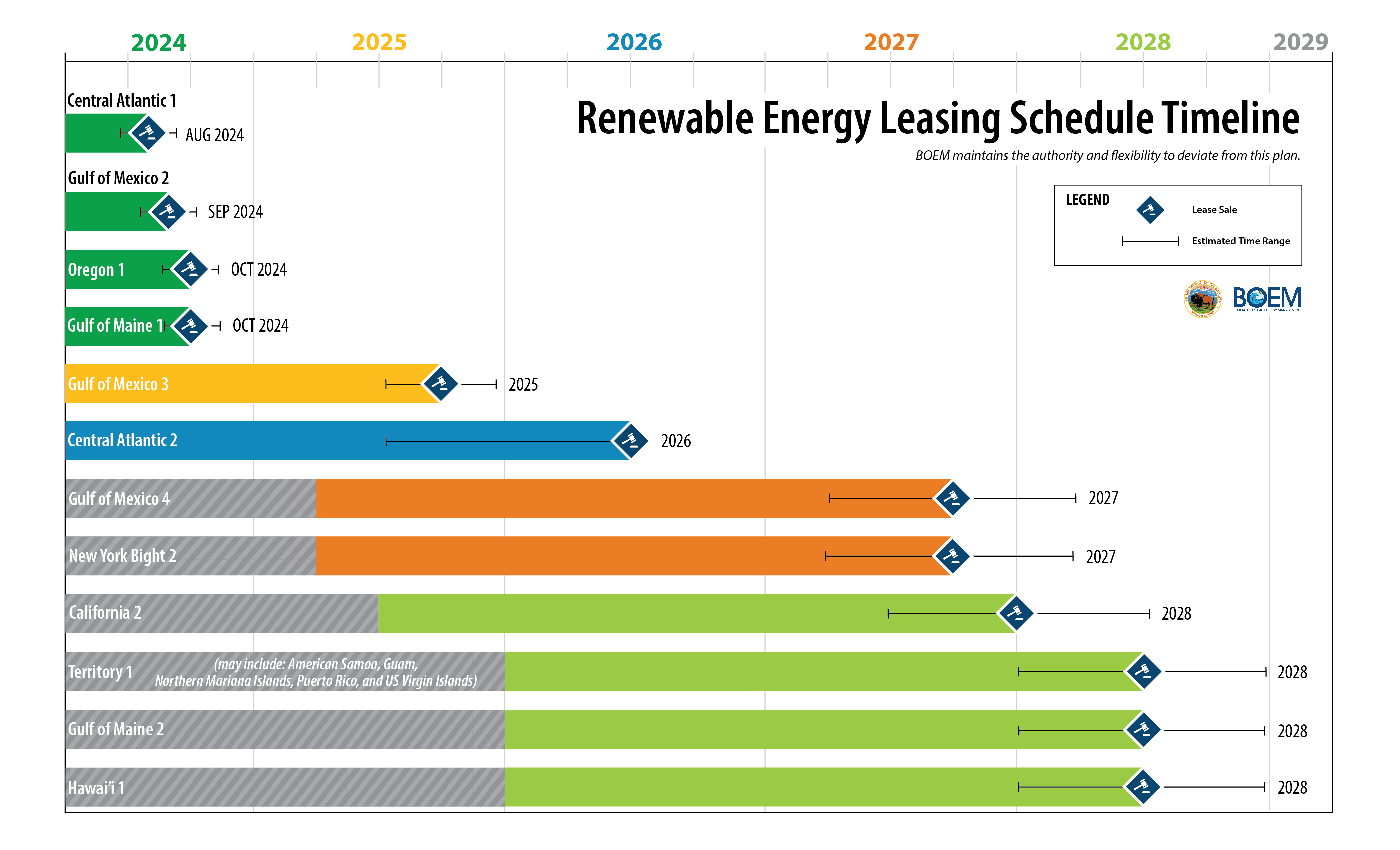
Per the leasing schedule below, BOEM intends to hold 4 wind sales during the remainder of 2024, all within a 3 month period. Only 1 sale is scheduled for each of the following 2 years. Deferring the 2024 sales until the investigations are complete would assist potential lessees by ensuring that the issues of concern were fully understood.
Unfortunately, BOEM’s failure to conduct a 2024 oil and gas lease sale has boxed in the wind program. The Inflation Reduction Act prohibits BOEM from issuing wind leases unless an oil and gas sale has been held within the previous year. Lease Sale 261 was held on 12/20/23 meaning that no wind leases may be issued after 12/20/24. BOEM has compressed the wind leasing schedule, presumably to beat the legislative deadline. It would have been better for both the oil and gas and the wind programs if at least one oil and gas sale had been held in 2024 as has been customary since the 1950s.
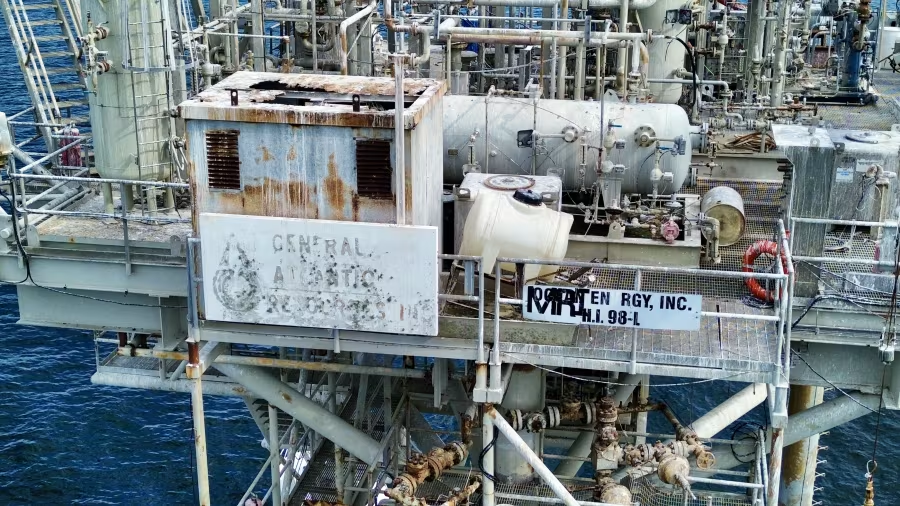
This is yet another example of the importance of proper well plugging, platform removal, and decommissioning financial assurance. It’s noteworthy that Texas is among the states suing to block BOEM’s financial assurance rule for Federal waters.A serious collaborative Federal, State, and industry effort to address decommissioning issues is long, long overdue.
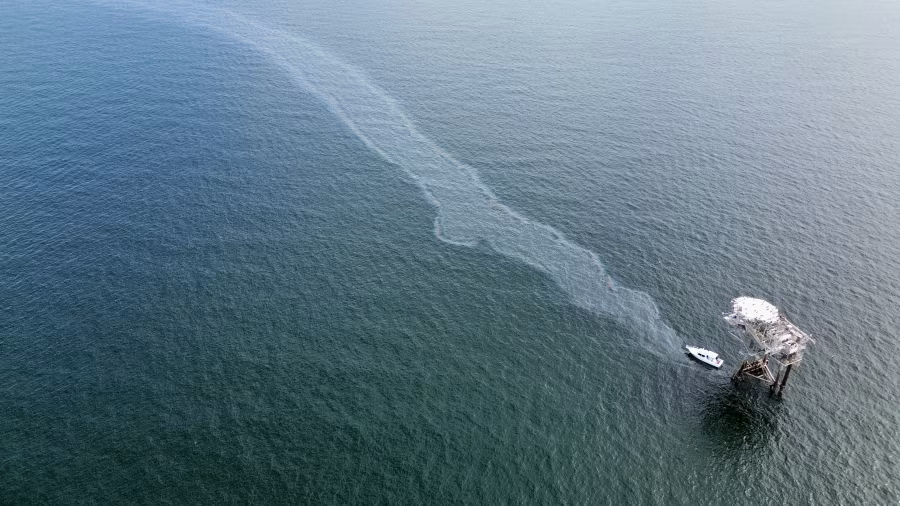
8 miles offshore Galveston County (TX State waters extend 3 marine leagues/9 nautical miles/10.35 statue miles offshore)
flowline riser leaking natural gas and condensate (badly corroded platform)
no recoverable oil
abandoned platform
additional research is needed to fully determine ownership of the leak source (???)
HIGH ISLAND BLOCK 98-L INCIDENT :
The Texas General Land Office (GLO) is sharing the following information:
On Sunday, July 14, 2024, at 8:00 pm, the Oil Spill La Porte Office Response Officer received notification of a natural gas/oil discharge off the coast of Crystal Beach, Galveston County. The spill was reported to be from a platform in High Island Block 98-L, about eight miles offshore in the Gulf of Mexico. Oil Spill personnel traveled via response boat to investigate on Monday morning and determined the discharge to be from a flowline riser leaking natural gas and condensate. Although the leak can be seen from the water, no recoverable oil was visible. The platform is abandoned, as defined by the Texas Railroad Commission, placing it within the Railroad Commission’s statutory authority for administration. The wells are not covered as part of the GLO’s current well plugging MOU with the Railroad Commission. The platform and associated wells are documented in the Oil Spill program’s abandoned well listings.
On Wednesday, July 17, La Porte office staff, with US Coast Guard and Railroad Commission personnel, inspected the platform area again. The leak is still present but has not increased. Railroad Commission staff stated that additional research is needed to fully determine ownership of the leak source.
The Coast Guard reports receiving a call from Channel 2-KPRC (NBC) in Houston regarding the leak and also seeing social media posts by a local area fishing group.
At this time: No injuries reported, No impact to commerce, No impact to wildlife.
For decades, Gulf of Mexico operators have reported facility evacuation and production curtailment data to MMS/BSEE as tropical storms or hurricanes approached. Requirements for this reporting are found in the regulations (30 CFR 250.192(a)) supplemented by NTL 20I5-G02.
Operators must submit reports by 11:00 a.m. (CT) daily throughout the period of evacuation and shut-in with the understanding that BSEE will post the compiled data by 1 pm CT. This reporting has been diligently accomplished for decades and MMS/BSEE posted the data each day, including weekends and holidays, without fail. Everyone in industry and government understood the importance of safely evacuating personnel, shutting down production, and ensuring that these hurricane data were made available to the public each day. (All of the daily updates for 2011 onward can be found here.)
On Wednesday, July 3, Shell informed the media that they had begun evacuating non-essential personnel and shutting-in production at certain facilities. Both Shell and Chevron issued general statements on the status of their operations on Thursday, July 4. Both companies no doubt submitted the required reports to BSEE, as did other companies with operations near the projected path of the storm.
BSEE failed to post any evacuation and shut-in data on any date from July 3 through today (July 8).
Beryl missed the heart of the Gulf of Mexico basin, but Shell and other companies with facilities in the more westerly areas evacuated personnel and curtailed production. BSEE’s unprecedented failure to post this information needs to be addressed before more significant storms threaten offshore personnel and production in the Gulf.
Shell evacuated non-essential personnel and shut-in production at Perdido (pictured)
Winterfell from the water surface (5400′ water depth). The field is produced with subsea wells tied back to Oxy’s Heidelberg platform, which is 13 miles away. Deepwater development is characterized by high energy density and low facility density.
Beacon Offshore Energy (BOE, but not this blog 😉) and its partners, all independent producers, have initiated production at the Winterfell project in the Green Canyon area of the Gulf of Mexico. The 3 initial wells are expected to produce 20,000 bbls of oil equivalent (again BOE 😉) per day. The Winterfell partners are:
On July 1, U.S. Federal Judge James Cain Jr. (Western District of Louisiana) issued a preliminary injunction suspending DOE’s LNG exports “pause.” The judge’s full ruling is attached.
Judge Cain: “It appears that the DOE’s decision to halt the permit approval process for entities to export LNG to non-FTA countries is completely without reason or logic and is perhaps the epiphany of ideocracy.”
Nothing subtle about that comment 😉
Despite the court order, the Administration seems intent on keeping the “pause” in place. Per White House spokesperson Angelo Fernández Hernández, “We remain committed to informing our decisions with the best available economic and environmental analysis, underpinned by sound science.” ????
Nearly 80% of current OCS gas production is from deepwater leases. This production is primarily associated (oil-well) gas that operators are rightfully required to market for resource conservation and environmental reasons. Expanding LNG marketing opportunities could thus improve the economics of deepwater development.
The other 20% of OCS gas production is largely from gas-well (non-associated) gas produced by independent companies that continue to operate in the shallower waters on the shelf. LNG sales could improve the challenging economics for these producers and increase the ultimate recovery of shelf resources.
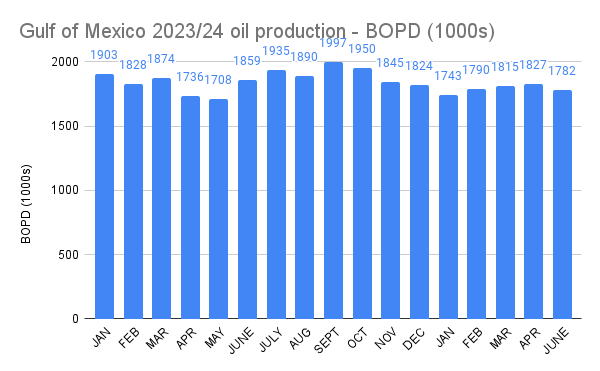
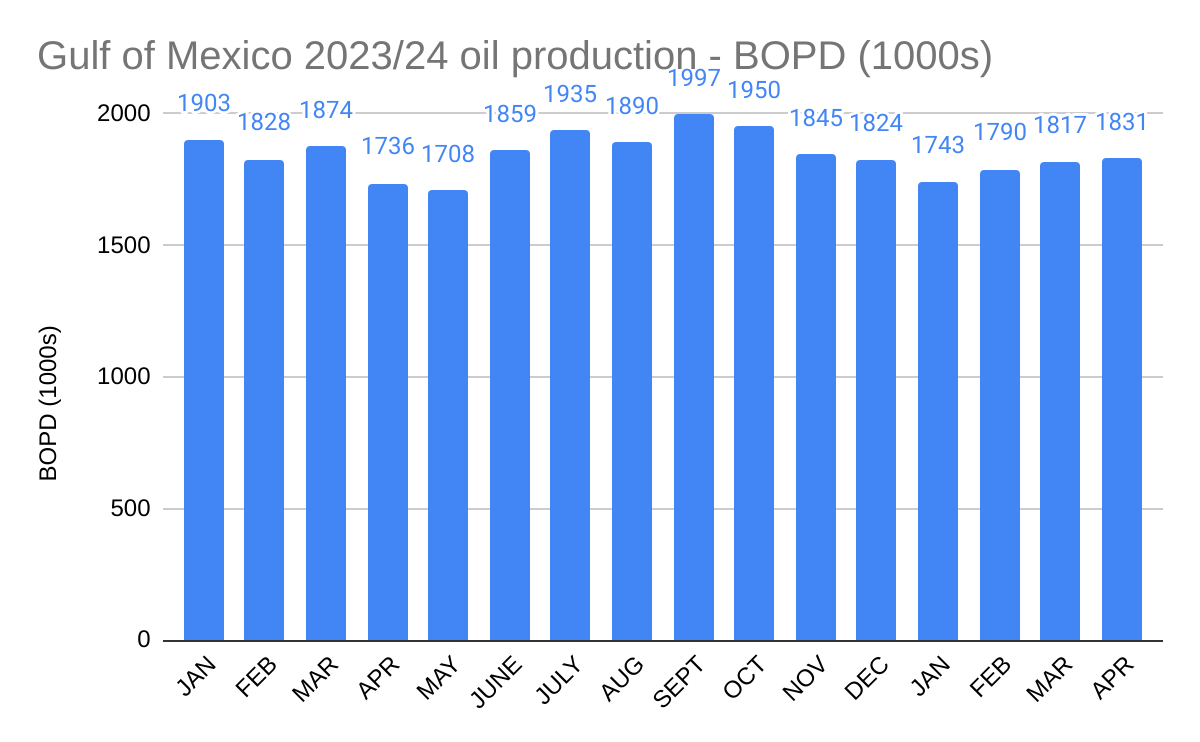
EIA has released the April oil production data. The Federal waters of the Gulf of Mexico produced 1.831 million BOPD in April, which is essentially level with corrected March production (1.817 million).
GoM production fell more than 12% from nearly 2 million BOPD in September 2023 to 1.743 million BOPD in January 2024 before climbing back to 1.8 million BOPD over the past 3 months (see chart below). What’s up?
The mysterious Main Pass Oil Gathering (MPOG) system shutdown in November 2023 no doubt contributed to the decline, but that system was reported to be fully online in April. Based on the GoM data, the MPOG shutdown may have reduced production by 50-80,000 BOPD. That would account for less than half of the GoM decline since Sept 2023.
We may learn more about the MPOG shut-in volumes when the NTSB investigation report is published. (Don’t expect a report soon. The NTSB report on the Huntington Beach pipeline spill took nearly 2 years to complete. The final NTSB report on the deadly December 2022 GoM helicopter crash has still not been issued.)
In 2022, EIA projected that additional GoM capacity would offset production declines, but would not sustain crude oil production at levels of 2.0 million BOPD. That forecast has proven to be accurate.
Bottom line: 1.8 million BOPD does in fact appear to be the current GoM production baseline. The GoM is thus significantly under-performing BOEM forecasts. This should be a concern to those who support responsible OCS production.
Carbon sequestration (i.e. subsurface disposal) is a controversial and divisive topic, and important questions regarding the costs and benefits remain. Nonetheless, the Infrastructure Bill of 2021 authorized the disposal of CO2 on the OCS, and stipulated that the Secretary of the Interior promulgate regulations for that purpose. However, that major task cannot be completed without a better understanding of the potential environmental impacts.
BOEM has announced a study (see attached pages from their new Environmental Studies Plan) to consider the potential for CO2 leakage and related environmental concerns. A few excerpts from BOEM’s summary follow:
Problem: Potential CO2 leakage from carbon sequestration (CS) project activities could occur via a number of pathways. Few studies model and/or measure CO2 leakage, transport, dispersion, attenuation, and environmental impacts in the offshore environment, and those that do exist are preliminary.
Intervention: BOEM needs more information about the dynamics, fate, transport, and potential environmental impacts of CO2 leakage under various scenarios, including worst-case, on the OCS to inform the new nationwide CS Program and to protect the environment from CO2 leakage.
Comparison: The study will model CO2 leakage under various scenarios, including worst-case scenarios, using the GOM OCS Region as a case-study and can be applied to all OCS regions. Outcome The leakage and worst-case scenario modeling will aid BOEM’s ongoing rulemaking efforts, program development and implementation, and future operational needs including NEPA analyses, lease planning, lease stipulations, consultations, plan and permit approvals, mitigation measures, risk assessment and monitoring requirements, etc. Study results will also provide direction for future studies to include field and/or laboratory analyses.
The performance period for this important study extends through 2027, so it’s hard to envision final CS regulations prior to that date. You can’t issue regulations without first assessing the potential harm that could result from their promulgation (as required by NEPA).
BOEM’s summary mentions “the anticipation of a CS lease sale in the GOM after final regulations are published.” Hopefully, this also means that BOEM will not permit improperly acquired oil and gas leases (Sales 257, 259, and 261) to be converted to CS leases.



 Bud's Offshore Energy (BOE)