Feeds:
Posts
Comments

Archive for the ‘energy policy’ Category

New PHMSA (DOT) regulation

At the behest of Congress, coastal areas and beaches are now designated as Unusually Sensitive Areas (USAs). Given that any offshore liquids pipeline has the potential to affect coastal waters or beaches, the rule would seem to require that all such pipelines be included in Integrity Management Programs, which are mandatory for pipelines that could affect USAs. (The IMP requirements would almost certainly apply to all DOT regulated offshore pipelines. Their applicability to DOI/producer pipelines is less certain. Of course, very little is clear and consistent in US offshore pipeline regulation.)

As one would expect, the recent Huntington Beach pipeline spill is among the incidents cited in the justification for this regulation. More surprisingly, the Santa Barbara well blowout was also cited. This incident occurred 53 years ago, was the result of a reckless drilling program, and had nothing to do with production operations or pipelines.

As noted in a recent BOE post, the regulatory regime for offshore pipelines is badly in need of overhaul. DOT and DOI, with inconsistent jurisdictional boundaries, regulations, and approaches, have primary responsibility and multiple regulatory entities have roles.

Lastly, PHMSA seems to have inadvertently posted a highlighted copy of the new regulation. Nothing at all scandalous (looks like someone was highlighting potential talking points), but possibly amusing to other regulation nerds. 😃

Read Full Post »

Carbon capture and storage
NPD

Several actors have approached the ministry with a desire to be allocated two specific areas for storage of CO 2 . One area in the North Sea and one in the Barents Sea were therefore announced on 10 September in accordance with the storage regulations.

By the application deadline of 9 December, the ministry had received applications from five companies. The Ministry will process the received applications and allocate area in accordance with the storage regulations during the first half of 2022.

Ministry of Petroleum and Energy, Norway

Contrast the situation in Norway with Exxon’s apparent attempt to acquire 94 Gulf of Mexico leases at Oil and Gas Lease Sale 257 solely for CCS purposes. BOEM’s Notice of Sale made no mention of CCS, and there had been no environmental or economic assessment of CCS activity.

And how much will the public pay for grand CCS ventures that (although interim measures) will take years to initiate, add new safety and environmental risks, and may never achieve their objectives? The public burden will no doubt include direct subsidies, tax credits, increased petrochemical prices, and the erosion of purchasing power associated with the resulting inflation pressures.

More on Sale 257 and the CCS bidding.

Read Full Post »

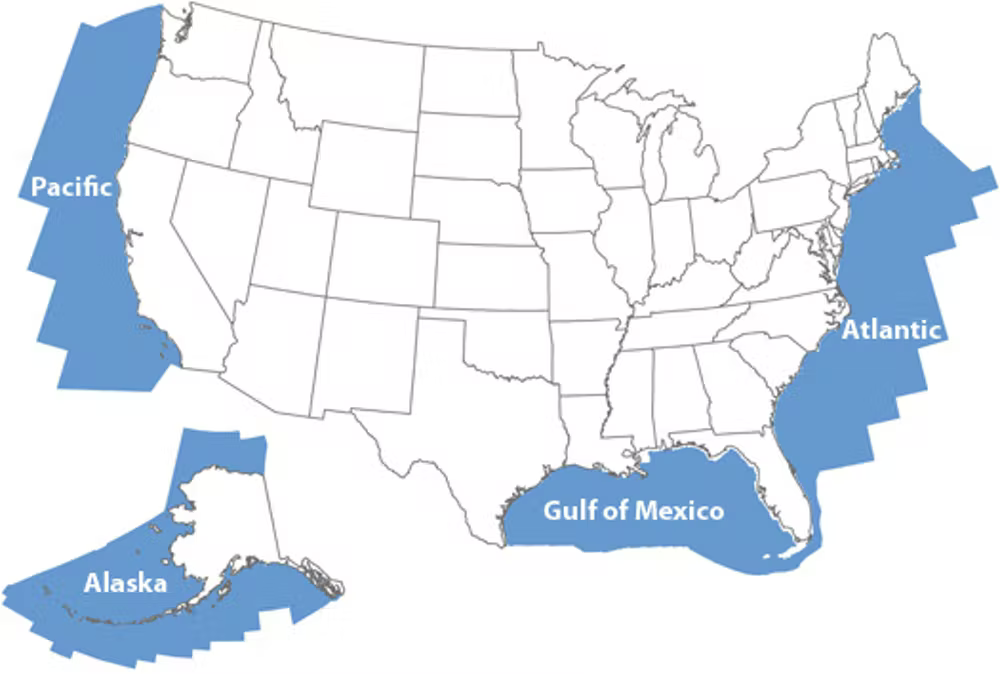
Sen. Joe Manchin III (D-W.Va.), a critical swing vote, has rejected a provision (in the “Build Back Better Bill”) that would prohibit all future drilling off the Atlantic and Pacific Coasts, as well as the eastern Gulf of Mexico, according to three people familiar with the matter

Washington Post

New oil and gas leasing is unlikely in these areas, but broad permanent bans are never a good idea.

Read Full Post »

It’s a great country! 😃

Read Full Post »

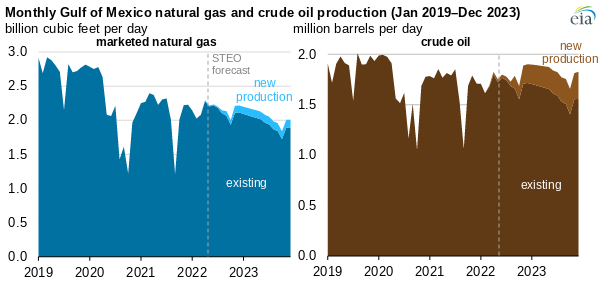
Offshore gas production (see chart below) has declined for the past 20 years and now accounts for only 4% of total US gas production, down from 20% in 2005 and 25% in the 1990s. Associated gas production (oil-well gas) has remained relatively constant owing to the strength in deepwater GoM oil production. 73% of 2020 gas production was from deepwater wells, and was mostly oil-well gas. Associated gas production surpassed nonassociated gas production (gas-well gas) in 2016 and the latter has continued to decline.

The case for natural gas has been well documented (see the EQT letter linked below). Recent natural gas advocacy has emphasized the carbon/GHG advantages given that methane (CH4) is essentially a hydrogen transporter that emits far less CO2 than other fossil fuels when burned. However, natural gas’s other important air quality advantages – low NOx. SO2, and particulate emissions – have greater local significance from a human health standpoint. Those who have ridden a bike behind a natural gas powered bus have no doubt experienced the natural gas advantage firsthand. These buses are literally a breath of fresh air!

Other environmental advantages of offshore natural gas, particularly nonassociated gas, receive less attention but are nonetheless significant. Advantages of nonassociated offshore gas include the following:

  • Fewer wells required than for shale gas
  • No risk of fresh water contamination
  • Platforms provide beneficial reef effects
  • Minimal space preemption and land disturbance relative to onshore gas production and wind/solar operations
  • Low facility density and navigation risks relative to wind operations;
  • Lower elevation and fewer view-shed, aesthetic, and aviation issues than for wind
  • Minimal avian risks relative to on- and offshore wind operations
  • Minimal spill risk relative to oil and associated gas production
  • Significantly less flaring than for oil well gas. While the overall % of US offshore gas production that is flared is low (approx. 1.0 -1.5% from 2016-2020 per EIA data), the % of gas-well gas that is flared has historically been less than 0.5%.

Low natural gas prices and competition from nimble and efficient shale operations have constrained offshore gas exploration. Ultradeep (subsurface) drilling has shown promise from a gas resource perspective but has proven to be expensive and operationally challenging. Some independent producers are still acquiring gas prone shelf tracts and that needs to be encouraged. Consideration should be given to incentives such as making nonassociated gas production royalty free. That would certainly seem preferable to subsidizing complex, expensive, and uncertain carbon disposal operations on offshore leases.

Read Full Post »

This letter from EQT CEO Toby Rice to Senator Elizabeth Warren summarizes data demonstrating the importance of shale gas in dramatically reducing US GHG emissions. A few excerpts:

In 2019, the United States emitted 970 million metric tons less than in 2005, with 525 million metric tons of that emissions reduction resulting from replacing coal with natural gas in power generation. Said another way: since 2005, in the United States, all emissions reduction efforts combined have had less impact than coal to gas switching alone.

The emissions associated with the production of natural gas are dwarfed by the emissions reduction of switching from the consumption of coal to gas.

Meanwhile, China, which produced only 3% of the world’s natural gas but the majority of the world’s coal, saw its methane emissions increase by an amount roughly equivalent to adding a second Europe to the world.

Letter from EQT to Senator Warren

Meanwhile, natural gas prices have soared to record levels in Europe and a predicted polar vortex may spike US demand. This OilPrice.com chart illustrates the remarkable divergence between US and European gas prices.

OilPrice.com

Will natural gas demand lead to a resurgence in US offshore gas-well drilling?

Read Full Post »

What, if anything, will the Judge say about the leases that are intended to be carbon sequestration sites? How can BOEM sell OCS leases for purposes that were neither announced nor environmentally assessed? What do EarthJustice and the other plaintiffs think about the sequestration bids given that the environmental community is split on CCS?

Who is going to pay the enormous cost of sequestration on the Outer Continental Shelf – platforms, wells, pipelines, processing equipment, maintenance, monitoring, decommissioning, and more? The Federal government (i.e. taxpayers) features large in this grand scheme, and will no doubt be assuming most of the economic and performance risks. And all of these costs are for disposal purposes, not for offshore energy production of any kind.

Together with the bipartisan infrastructure bill enacted in November, which included more than $12 billion in funding for carbon capture and carbon removal technologies, the Build Back Better legislation would hand fossil fuel companies nearly every item on their carbon capture wishlist.

Inside Climate News

The reality of offshore CCS is not anywhere near as simple as portrayed in the slick graphic below:

houston ccs hub
ExxonMobil

Read Full Post »

C:\Users\Owner\Pictures\Hudson Canyon Test.jpg

More than 43 years ago, natural gas was discovered in the Atlantic about 100 miles SE of Atlantic City. The prospect was unitized (Hudson Canyon Unit) and 7 additional wells were drilled over the next 3 years. 725 miles of 3-D seismic data were collected. The geology was complex and more time was needed to evaluate the data. MMS refused to extend the leases without further drilling activity. One unit partner committed to funding a confirmation well if the other companies would relinquish their interest. They would not and the leases expired in 1984. This Hudson Canyon “end game” reflected poorly on the unit partners and the regulator, and the opportunity to produce regionally significant quantities of natural gas was forever lost. Seemed petty then; seems petty now.

Read Full Post »

Dan starts by retelling the story about the North Face hypocrisy that earned the company the Colorado Oil and Gas Association’s first ever Customer Appreciation Award for being an extraordinary oil and gas customer. This award rivals the Not My Job Award as a means of recognizing extraordinary individual and organizational chutzpah. North Face refused to sell jackets to an oil industry service company because doing so would be counter to its “goals and commitments surrounding sustainability and environmental protection.” As the Colorado Oil and Gas Assoc. pointed out:

At least 90 percent of the materials in North Face jackets are made from petrochemicals derived from oil and natural gas. Moreover, many of its jackets and the materials that go into them are made in countries such as China, Vietnam, and Bangladesh, and then shipped to the United States in vessels that are powered by oil. To muddy matters further, not long before North Face rejected the request, its corporate owner had built a new hangar at a Denver airport for its corporate jets, all of which run on jet fuel. 

Yergin in The Atlantic

Yergin goes on to point out the extraordinary complexities of energy transitions particularly for developing nations:

Aissatou Sophie Gladima, the energy minister of Senegal, put it more pithily: Restricting lending for oil and gas development, she said, “is like removing the ladder and asking us to jump or fly.”

Yergin in The Atlantic

He talks about other energy transitions:

The 19th century is known as the “century of coal,” but, as the technology scholar Vaclav Smil has noted, not until the beginning of the 20th century did coal actually overtake wood as the world’s No. 1 energy source. Moreover, past energy transitions have also been “energy additions”—one source atop another. Oil, discovered in 1859, did not surpass coal as the world’s primary energy source until the 1960s, yet today the world uses almost three times as much coal as it did in the ’60s.

Yergin in The Atlantic

Read Full Post »

Despite scientific support, California’s “rigs to reefs” program has made little progress. Comments in yesterday’s LA Times article help explain why:

Fed by concerns from some environmental advocates and a skepticism about the motives of California’s billion-dollar oil industry, the Rigs to Reefs program that passed in 2010 was so complicated by political compromise that the permitting process became almost unworkable, (State Sen.) Hertzberg said.

Not a single oil company has applied in the history of the program, according to the State Lands Commission, which has jurisdiction over state waters.

LA Times

“Oil companies want a clear path to compliance,” he said. “They’re operating in many cases at a loss, but it’s cheaper to operate at a loss than it is to face millions for decommissioning.”

Gary Brown, Orange County Coastkeeper

Read Full Post »

« Newer Posts - Older Posts »