There are unconfirmed reports that Big Oil deliberately set off the volcano by setting up fracking operations nearby to shut down the famous atmospheric CO2 measuring site. /s#ClimateBrawl #ClimateCrisis #ClimateEmergency
— Gerald Kutney – 🌏🔥#ClimateBrawl🔥🌍 (@GeraldKutney) December 1, 2022
https://t.co/o4NqJb1tgE pic.twitter.com/V9au2CNQqi
Archive for the ‘climate’ Category
I thought this tweet about the Mauna Loa volcano was satire, but apparently the author is serious
Posted in climate, Uncategorized, tagged CO2, fracking, Mauna Loa on December 3, 2022| Leave a Comment »
“Deep Geothermal Is Closer Than You Think”
Posted in CCS, climate, energy, tagged gyrotron, Quaise Energy, renewable energy, ultradeep geothermal on November 17, 2022| Leave a Comment »
Update on the most promising renewable energy alternative:
Quaise has received a grant from the Department of Energy to scale up Woskov’s experiments using a larger gyrotron. With the larger machine, the team hopes to vaporize a hole 10 times the depth of Woskov’s lab experiments by the end of this year. After that, the team will vaporize a hole 10 times the depth of the previous one — what co-founder Matt Houde calls a 100-to-1 hole.
“That’s something [the DOE] is particularly interested in, because they want to address the challenges posed by material removal over those greater lengths — in other words, can we show we’re fully flushing out the rock vapors?” Houde explains. “We believe the 100-to-1 test also gives us the confidence to go out and mobilize a prototype gyrotron drilling rig in the field for the first field demonstrations.”
Rather than getting deep in the weeds of carbon capture, imagine powering those existing facilities with steam generated without carbon emissions at all.
The key is that ultradeep geothermal has the power density and scalability of fossil fuels.
2021 Flaring Intensity – 10 largest flaring nations vs. US Gulf of Mexico
Posted in climate, flaring and venting, Gulf of Mexico, Offshore Energy - General, tagged flaring, flaring intensity, Gulf of Mexico, World Bank on November 15, 2022| Leave a Comment »
Using the World Bank’s worldwide flaring data and ONRR flaring and venting data for the GoM, I compared GoM flaring intensity for 2021 with that of the World Bank’s top ten flaring nations. This is just one example of why US offshore production is a preferred and vital component of our energy mix.
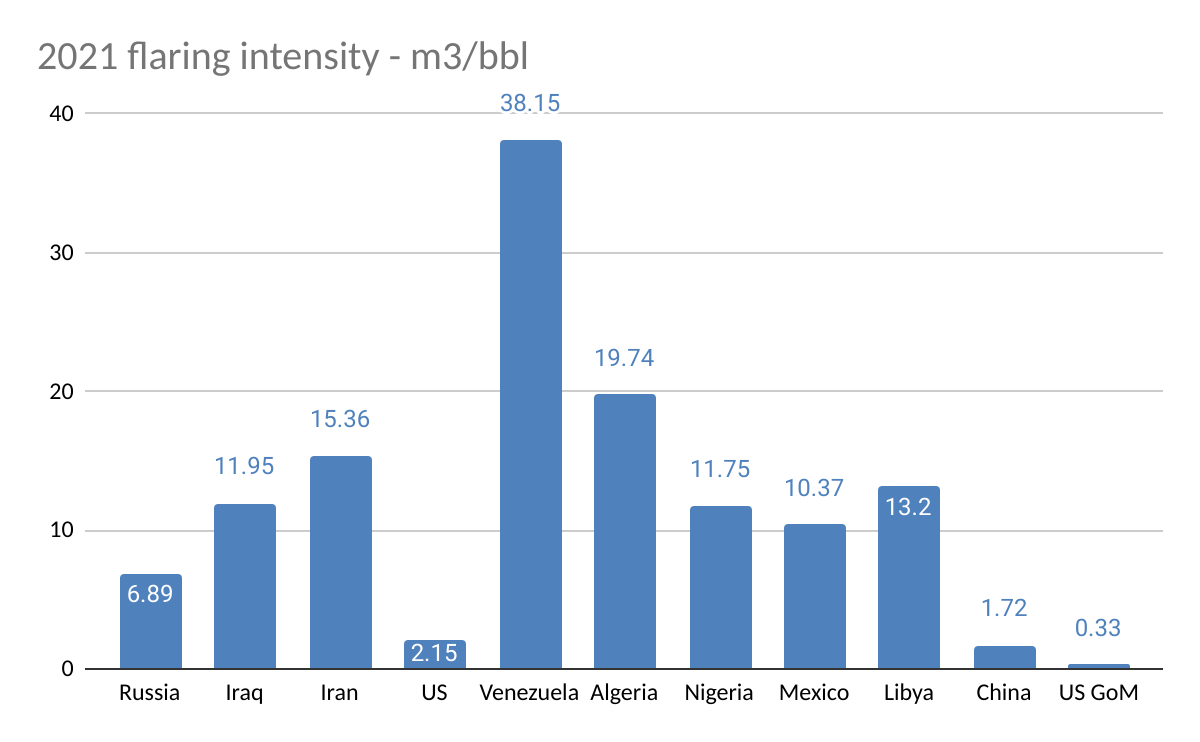
Further discussion: Kudos to the World Bank for their use of satellite data to estimate flaring volumes worldwide. Their primary performance indicator is flaring intensity (volume flared per bbl of oil produced). Absent better worldwide reporting regimes, satellite data are essential. However, there are issues with the World Bank’s system that merit further consideration:
- Satellites miss some flares and vented gas (a more significant GHG concern) is not detected
- A prior review of Gulf of Mexico data indicated that the World Bank flaring estimates are low.
- The flaring intensity indicator penalizes higher gas-oil ratio (GOR) wells. Production upsets of the same duration yield higher flaring intensity scores at higher GOR facilities.
- Associated gas is an environmentally favorable energy source that should not be discouraged. Most Gulf of Mexico gas production is now from oil wells. Efficient collection and utilization is the key.
- There will always be some production upsets that result in flaring. The objective should be to minimize the % of oil-well and gas-well gas that is flared, irrespective of the amount of oil production. See the recent GoM summary data posted here and here.
The international climate agenda does not supersede the OCS Lands Act
Posted in climate, energy policy, Offshore Energy - General, tagged 5 year leasing plan, DOI, Niklas Hohne, OCS oil and gas program on November 7, 2022| Leave a Comment »
Netherlands climate activist Niklas Hohne succinctly summarizes the “end of fossil fuels” strategy (first quote) that the US Department of the Interior seems intent on implementing in the proposed 5 Year OCS Leasing Plan (second quote). What is DOI’s legislative authority for phasing out offshore oil and gas production? It’s certainly not the OCS Lands Act which calls for the expeditious and orderly development of OCS resources. Neither the EIA nor any other reputable forecaster believes we can even reduce, let alone eliminate, oil and gas consumption in the next 20-30 years.
“The plan was not to build any new infrastructure, because everything new you build has to run for 20 or 30 years to pencil out, long past the point we want to be off fossil fuels,” Hohne said.
Niklas Hohne, founder of the New Climate Institute (Netherlands) to the Washington Post
“The long-term nature of OCS oil and gas development, such that production on a lease can continue for decades makes consideration of future climate pathways relevant to the Secretary’s determinations with respect to how the OCS leasing program best meets the Nation’s energy needs.“
5 Year Leasing Program, p.3
Total GoM gas flared/vented vs. total gas production
Posted in climate, energy policy, gas, Gulf of Mexico, Offshore Energy - General, tagged flaring, Gulf of Mexico production, natural gas, ONRR on November 4, 2022| Leave a Comment »
| Oil-Well Gas Produced (BCF) | Gas-Well Gas Produced (BCF) | total gas produced (BCF) | total gas flared or vented (BCF) | % flared or vented | |
| 2015 | 588.4 | 719.4 | 1307.8 | 10.3 | 0.8 |
| 2016 | 631.7 | 589.1 | 1220.8 | 9.7 | 0.8 |
| 2017 | 637.3 | 441.2 | 1078.5 | 9.9 | 0.9 |
| 2018 | 623.1 | 370.1 | 993.2 | 10.6 | 1.1 |
| 2019 | 670.2 | 364.1 | 1034.3 | 11.7 | 1.1 |
| 2020 | 581.4 | 224.9 | 806.3 | 10.4 | 1.3 |
| 2021 | 582.2 | 209.5 | 791.7 | 8.2 | 1 |
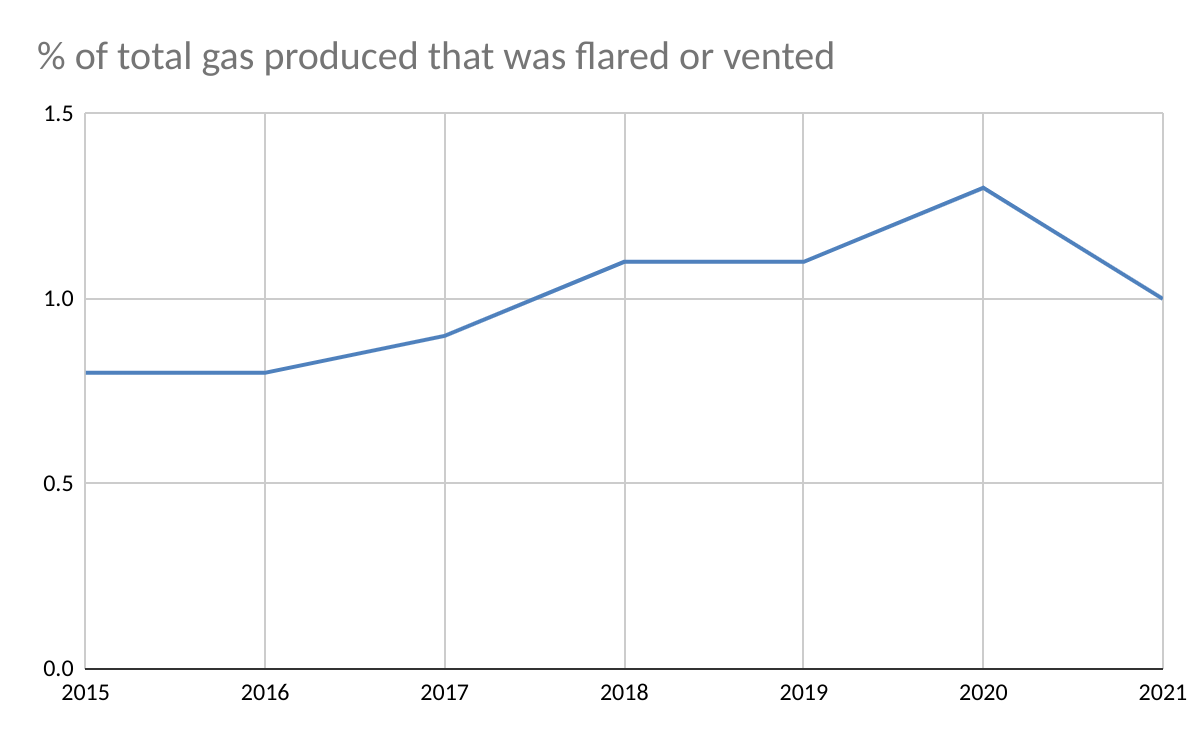
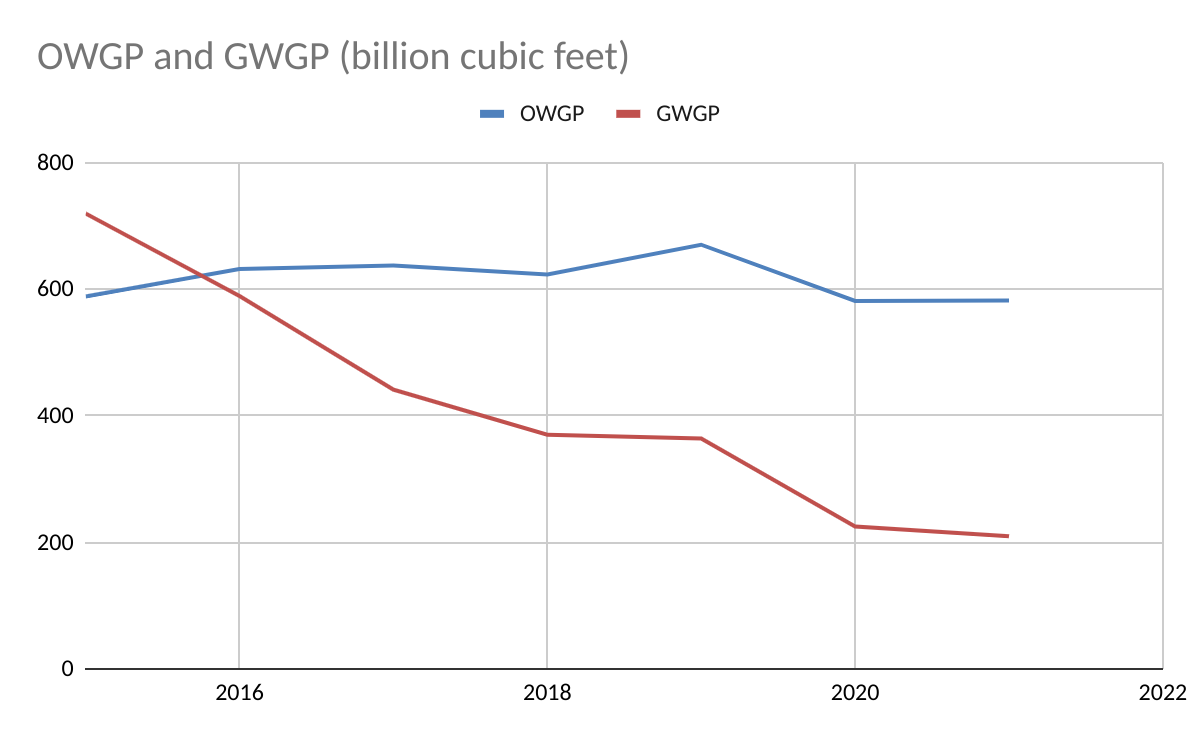
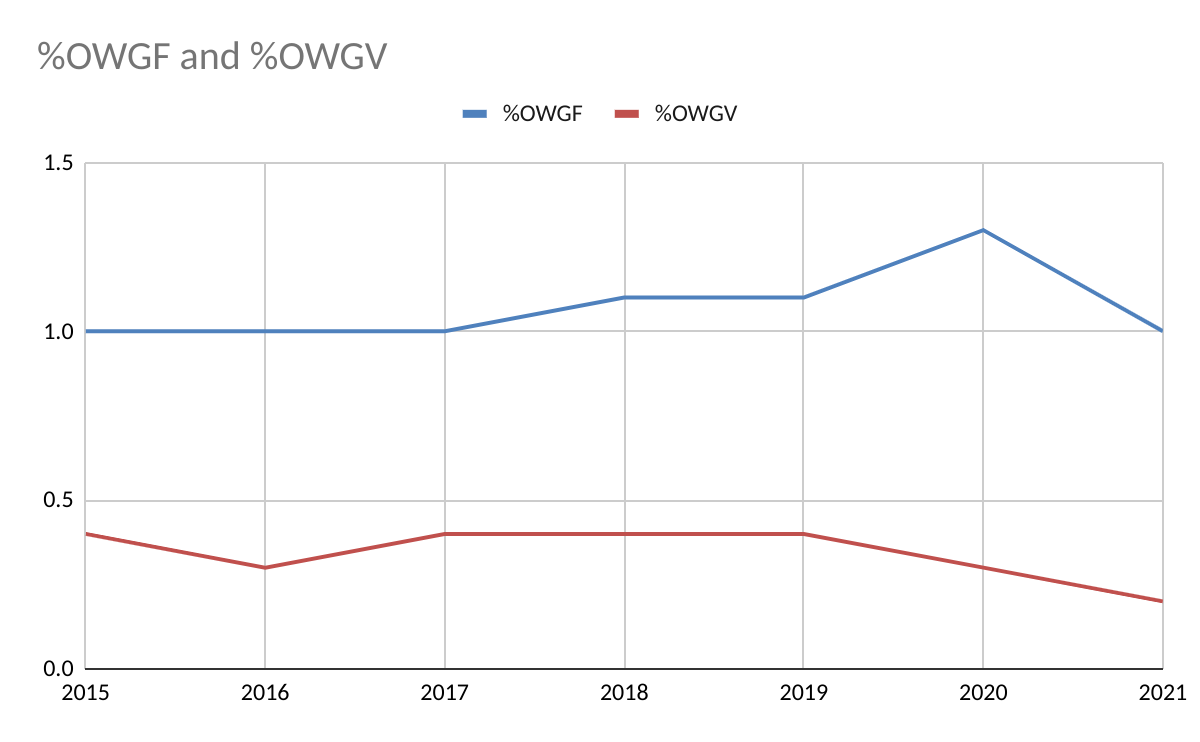
Six years of ONRR GoM flaring data summarized below
Posted in climate, energy policy, flaring and venting, gas, Gulf of Mexico, Offshore Energy - General, tagged flaring, Gulf of Mexico, natural gas production, ONRR, venting on November 3, 2022| Leave a Comment »
Gulf of Mexico flaring and venting data have been sorted for the years 2015-2021. The reporting of these data is mandatory and strictly enforced, so these ONRR numbers should be accurate.
Biggest surprise: The biggest surprise is that there were no big surprises in the data. The % of gas flared and vented were generally consistent with expectations based on familiarity with historical data.
Biggest disappointment: the continued sharp decline in nonassociated (gas-well) gas production. GoM gas well gas production exceeded 4 tcf annually in the 1990s and was still above one tcf ten years ago. Since then, GWG production has declined by 80%. Nonassociated offshore natural gas has important environmental advantages, so the decline in production should be a major concern to policy makers
Encouraging sign: The % of oil-well gas vented has ticked down over the past 2 years which is encouraging from a GHG standpoint. This is presumably because most associated gas is produced on modern deepwater facilities equipped with flare booms. An astute politician would be rushing to take credit for this achievement.😀
Unfavorable ratio: Although the volumes are low (<1 Bcf combined in 2021), more gas-well gas was vented each year than flared. This is presumably because older shelf facilities without flare booms still produce much of the natural gas.
Abbreviations:
- ONRR: Office of Natural Resources Revenue
- GoM: Federal waters of the Gulf of Mexico
- OWGP: oil-well gas production
- GWGP: gas-well gas production
- OWGF: oil-well gas flared
- OWGV: oil-well gas vented
- GWGF: gas-well gas flared
- GWGV: gas-well gas vented
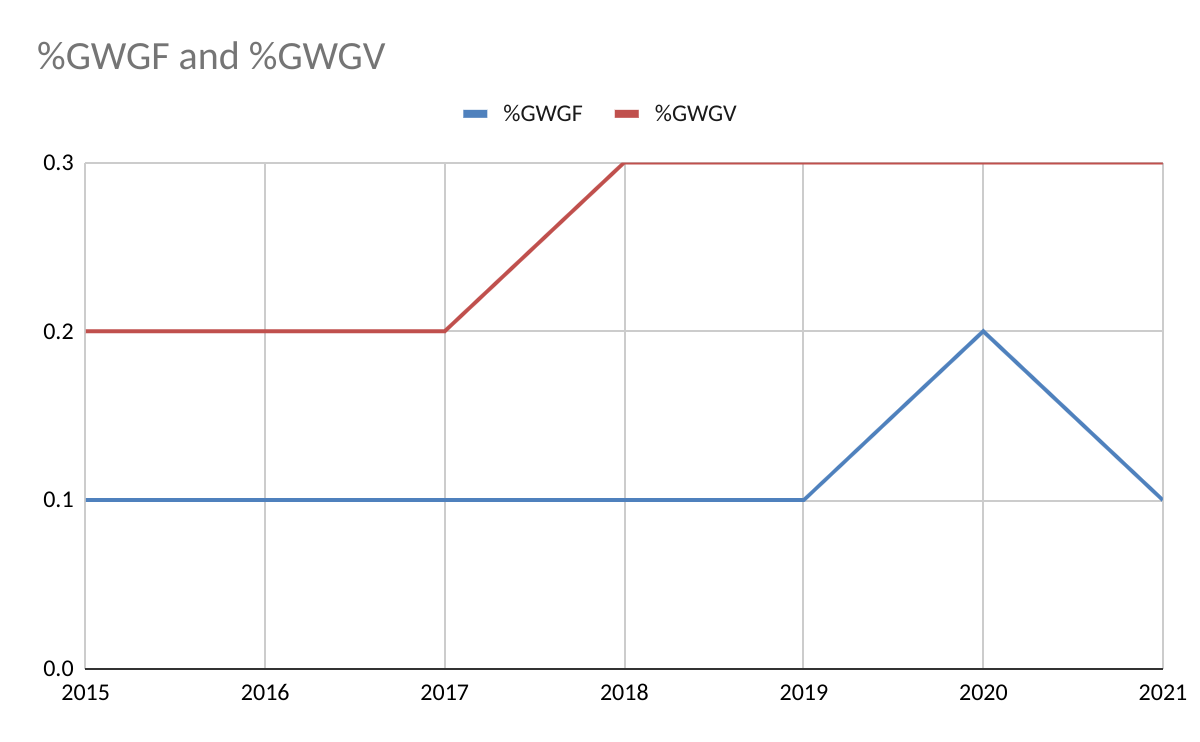
Enjoy the weekend while supporting renewable energy 😀
Posted in climate, energy, natural gas, Uncategorized, tagged Jack Daniels, Lars Herbst, RNG, TC Energy on October 28, 2022| Leave a Comment »

Advice from Lars Herbst, distinguished offshore energy leader: “Help the Energy Crisis – Drink more Jack Daniels”
Tennessee Twist:TC Energy’s $29.3 million investment in a RNG (renewable natural gas) production facility near the Jack Daniel’s Distillery will see the Canadian operator producing RNG with a carbon-intensity score that is 50% lower than traditional natural gas, saving up to 16,000 tonnes of CO2e per year, according to the company.
“This investment is our first in the production of renewable natural gas,” said Corey Hessen, TC Energy executive vice president and president, power & Energy solutions. “The production of RNG onsite at the Jack Daniel’s Distillery offers TC Energy one more opportunity to meet the challenge of growing energy needs and reducing emissions while providing customers with access to an affordable, reliable, source of energy.”
JPT
It’s a great country! 😀
While we are looking at GoM methane releases…
Posted in climate, gas, Gulf of Mexico, natural gas, Offshore Energy - General, tagged gas venting, Gulf of Mexico, methane, NASA on October 27, 2022| Leave a Comment »

NASA has identified 50+ super-emitters of methane including sites in Turkmenistan (image below) that emit an estimated 111,000 pounds per hour.
By comparison, vented Gulf of Mexico methane emissions in 2021 totaled 1953 mmcf. This converts to 82 million pounds at atmospheric pressure and 60°F. The identified Turkmenistan sources would thus release the amount of methane in a month that all Gulf of Mexico facilities vent in a year (2021).

Expect this type of behavior to continue
Posted in climate, energy policy, Offshore Energy - General, UK, Uncategorized, tagged anti-oil activism, Sunflowers, Van Gogh, Vandalism on October 17, 2022| Leave a Comment »

Two supporters of Just Stop Oil have thrown soup over Vincent Van Gogh’s Sunflowers, as actions in the capital roll into the 14th day. They are demanding that the UK government halts all new oil and gas projects.
Just Stop Oil
Why these stunts will continue in Europe and N. America:
- Minimal penalties for their behavior.
- Publicity and contributions. (Donate buttons are the main feature of JustStopOil)
- Prominent supporters and leading political figures have endorsed their message, if not their conduct.
- Weak, imbalanced educational systems, particularly with regard to energy.
Louisiana to BlackRock: We’re out!
Posted in climate, energy policy, tagged BlackRock, Jeff Landry, John Schroder, Louisiana on October 6, 2022| Leave a Comment »
Louisiana treasurer John Schroder said Wednesday he would pull $794 million of state money from BlackRock Inc. funds.
“Your blatantly anti-fossil fuel policies would destroy Louisiana’s economy,” Mr. Schroder wrote.
WSJ
Here is the pertinent guidance from Louisiana Attorney General Jeff Landry:
 Bud's Offshore Energy (BOE)