What a completely pointless exercise! £20 Billion on a Carbon Capture Storage Plan.
— Lois Perry (@LoisPerry26) March 27, 2023
I wonder which private companies and individuals are being awarded these insane contracts
I really do feel like Alice at times like these, except this is no Wonderland!
1984 more like…. pic.twitter.com/PCVTgETM1W
Archive for the ‘climate’ Category
Government money down the rathole – literally
Posted in CCS, climate, drilling, energy policy, UK, tagged carbon sequestration, CCS, UK on March 27, 2023| Leave a Comment »
Barbadian Minister Kerrie Symmonds:”Nobody is coming forward to say we are prepared to pay you to keep the natural gas and the oil in the ground.”
Posted in Barbados, climate, energy policy, tagged Barbados, Kerrie Symmonds, oil and gas on March 24, 2023| Leave a Comment »

The Minister is optimistic about the prospects for production offshore Barbados:
“I don’t want to go and give news now before it is ready to be given, but let us say the prospectivity is highly regarded,” he told a local academic forum in the Eastern Caribbean tourism paradise.
He also sends a message to “keep it in the ground” crowd.
“Let’s be frank: All of the oil producers of the world, including Canada, speak the language of climate change and putting a stop to that, which is now being done by small entities or like those of us in Barbados who are contemplating finding natural gas, but the reality is, none of them is saying ‘I will not continue to produce the oil that I produce’ or ‘I’m shutting down all my wells,’” he said. “The Americans are not going to tell you that that’s what’s going to happen in Texas. The British, for all their partnership value, will not tell you that the North Sea will not be full of Brent crude. They’re not going to do that because they intend to produce for the next 50 years. Nobody is coming forward to say we are prepared to pay you to keep the natural gas and the oil in the ground.”
Are the Netherlands Senate elections a positive sign for more rational energy policy?
Posted in climate, energy policy, Uncategorized, tagged BBB, elections, farmers, Netherlands on March 19, 2023| Leave a Comment »
The BBB or BoerBurgerBeweging (Farmer-Citizen Movement) party won 17 seats in the Senate, more than any other party.
WP: “Why Big Oil is less worried about Biden phasing out fossil fuels”
Posted in climate, energy policy, Offshore Energy - General, tagged Biden administration, fossil fuels phase out, offshore program on March 11, 2023| Leave a Comment »
HOUSTON — Oil and gas industry leaders say they’ve seen a big shift in tone from the Biden administration over the past year, helping to smooth over one of the president’s rockiest relationships.
Washington Post
Perhaps the Washington Post reporter is correct, but the “big shift in tone” is not apparent in the offshore sector. The only lease sales have been mandated by Congress, the 5 year plan is still 9 months from completion, the lease sale terms have been less than favorable, and language in the draft 5 year plan does in fact express the intent to phase out oil and gas.
Senator Manchin on the delayed 5 Year Leasing Plan
Posted in climate, energy policy, Offshore Energy - General, tagged 5 year leasing plan, DOI, OCS Lands Act, Senator Manchin on March 9, 2023| Leave a Comment »
Washington, DC — Today, U.S. Senator Joe Manchin (D-WV), Chairman of the Senate Energy and Natural Resources Committee, released the following statement on the Department of the Interior’s (DOI) unprecedented delay in releasing a five-year leasing plan.
“Monday night, the Department of the Interior made it painfully clear – again – that they are putting their radical climate agenda ahead of our nation’s energy security, and they are willing to go to great lengths to do it. The earliest that Interior will release a legally required program for 2023-2028 offshore oil and gas leasing will be the end of this year. That’s 18 months late. This is the first time in our nation’s history that we haven’t had a 5-year leasing program released before the old plan expired. Every other Administration, Democrat and Republican, has managed to follow the law in a timely fashion.
“Let me be clear – this is not optional. The Outer Continental Shelf Lands Act mandates that the Secretary of the Interior “shall prepare” this program to “best meet national energy needs.”
“What is even more terrifying is that on top of this disturbing timeline, Interior refuses to confirm if they intend to actually include any lease sales in the final plan, which is an issue I sounded the alarm about when Secretary Haaland appeared before the Senate Energy and Natural Resource Committee on May 19, 2022. I will remind the Administration that the Inflation Reduction Act also prevents them from issuing any leases for renewables, like offshore wind or onshore solar unless there are first reasonable lease sales for oil and gas that actually result in leases being awarded. And I will hold their feet to the fire on this.”
Senator Manchin
Plain English; no need for interpretation 😉
Reality check for supermajors
Posted in climate, energy, Gulf of Mexico, Offshore Energy - General, Uncategorized, tagged bp, oil and gas production, Shell on March 6, 2023| Leave a Comment »
“I am of a firm view that the world will need oil and gas for a long time to come,” (Shell Chief Executive) Sawan, who started the job on Jan. 1, told Times Radio in the U.K. on Friday. “As such, cutting oil and gas production is not healthy.”
Back in 2021, Shell predicted that its own oil production would decline every year and drop by as much as 18% by 2030. BP had a similar outlook, but CEO Bernard Looney rolled back its climate targets this year and said it will increase investment in exploration and production.
BP and Shell have trailed their U.S. peers in price to earnings ratios. Analysts have said investors interested in exposure to oil and gas have shunned them for putting more money into renewables, while investors focusing on environmental concerns haven’t rewarded them. That’s kept European energy firms trading at a discount.
Barron’s
It will never happen, but a separate company composed of BP and/or Shell upstream US assets would be very attractive to investors.
Atlantic whale deaths:Imagine the furor if there were oil and gas operations in the region
Posted in climate, energy policy, Offshore Energy - General, Offshore Wind, tagged Atlantic whale deaths, nonassociated gas, offshore oil and gas, Offshore Wind on February 20, 2023| Leave a Comment »

While it’s highly unlikely that wind turbine siting activities are responsible for the alarming number of whale deaths, some of the vociferous wind industry defenders would have been among the first to point the finger at oil and gas operations if there were any in the US Atlantic.
Some quotes from a recent USA Today article followed by BOE comments:
“It’s just a cynical disinformation campaign,” said Greenpeace’s oceans director John Hocevar. “It doesn’t seem to worry them that it’s not based in any kind of evidence.” (Comment: World class chutzpah on the part of Greenpeace, the master of disinformation.)
Gib Brogan, a campaign director with Oceana, an international ocean advocacy group, said those opposed to wind power are using a spate of whale deaths in the area as an opportunity. (Comment: Does Oceana suddenly find this type of opportunism to be shocking?)
“Groups opposed to clean energy projects spread baseless misinformation that has been debunked by scientists and experts,” said JC Sandberg, chief advocacy officer with the American Clean Power Association, a renewable energy trade group. (Comments: Use of the term “clean energy” is clever advocacy that serves to discredit other forms of energy. All energy sources have pros and cons, environmentally and otherwise. Wind and solar have significant visual, space preemption, navigation, wildlife risk, and intermittency issues, and are heavily dependent on subsidies and mandates. When all issues are considered, one could argue, as we have, that offshore gas, particularly nonassociated gas, is perhaps the environmentally preferred energy alternative.)
15 Minute Cities
Posted in climate, UK, tagged Greta on February 19, 2023| Leave a Comment »
Methane emissions: Nord Stream > offshore leasing
Posted in climate, energy policy, Gulf of Mexico, Offshore Energy - General, tagged BOEM, GHG emissions, lease sales, methane, Nord Stream, OCS oil and gas program on February 14, 2023| Leave a Comment »
The Nord Stream sabotage likely released more methane than the complete lifecycle of a GoM lease sale (upstream and downstream). Also, the Nord Stream explosions may have released more methane than is emitted by all US offshore producers in an entire year. Here are the numbers:
| Source of Methane | CH4 emissions (1000s of tons) |
| Nord Stream (probable range) | 100-400 |
| Nord Stream (maximum) | 500 |
| Nord Stream – first 48 hrs (CAMS est) | 175 |
| all US offshore production in 2020 (EPA) | 193 |
| all US on- and offshore exploration in 2020 (EPA) | 12 |
| lifecycle upstream emissions from a typical GoM lease sale (BOEM) | 118 |
| lifecycle up- and downstream emissions from a typical GoM sale (BOEM) | 151 |
Finally, remember that offshore oil and gas leasing results in a net reduction in GHG emissions.
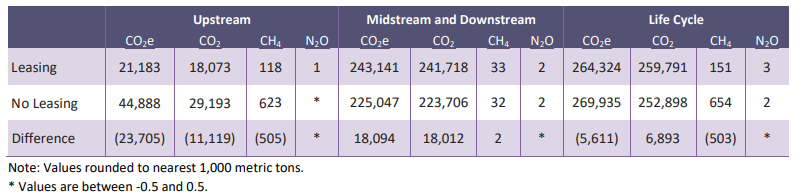
The No Leasing scenario results in roughly double the CO2e emissions for upstream activities compared to those of the Leasing scenario, given that, collectively, the substitute energy sources have higher GHG emissions per unit of production (also known as “GHG intensity”) compared to the forgone domestically produced OCS oil and natural gas of the Leasing scenario.
BOEM
Even when mid- and downstream emissions are included, leasing is preferable to no leasing. See the table below from the BOEM report:
Bottom line: we need more energy leasing and less military aggression!
Highly misleading Reuters headline about US flaring
Posted in climate, flaring and venting, Gulf of Mexico, Offshore Energy - General, tagged flaring data, flaring intensity, gas flaring, Reuters, World Bank on January 30, 2023| Leave a Comment »
This misleading headline was featured in Reuters’ “Power Up” newsletter (26 Jan 2023):

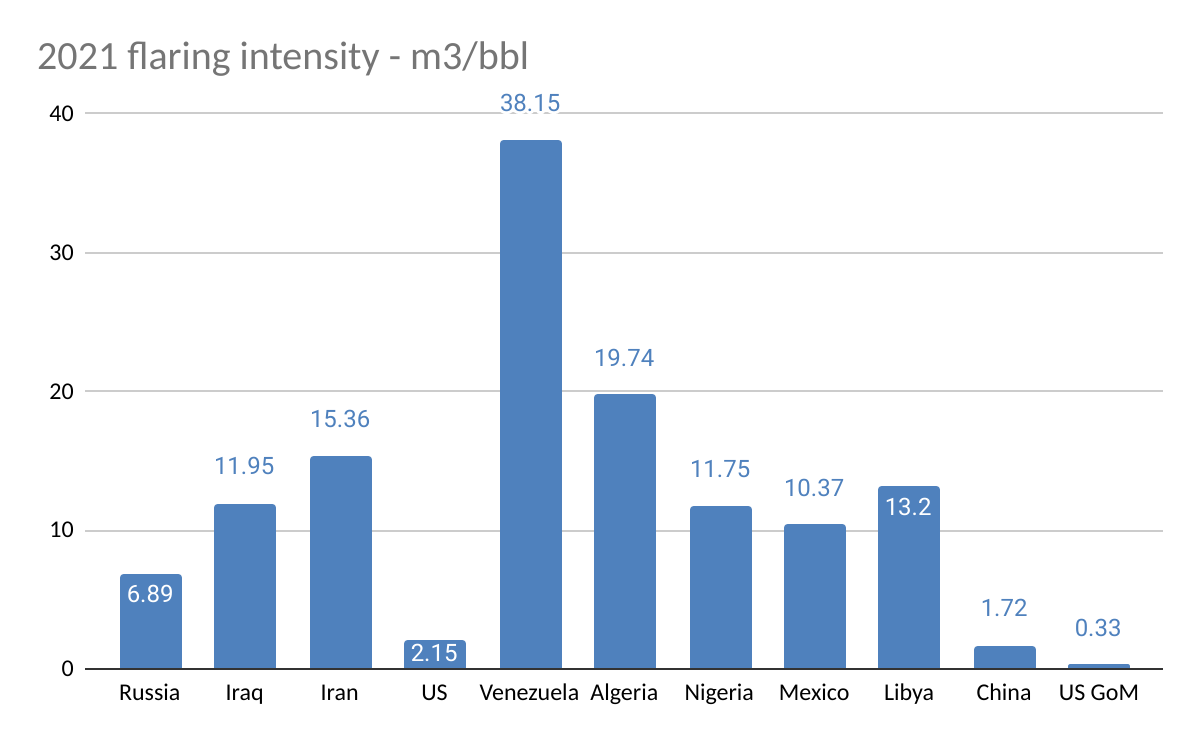
An objective flaring assessment would have also considered the volume of oil and gas produced. The World Bank uses flaring intensity (m3 flared per bbl of oil produced) to normalize their flaring data and provide perspective. The chart below is derived from World Bank flaring intensity data and Gulf of Mexico data from mandatory flaring and venting reports for the same year (2021). These normalized data sharply contradict the Reuters message.
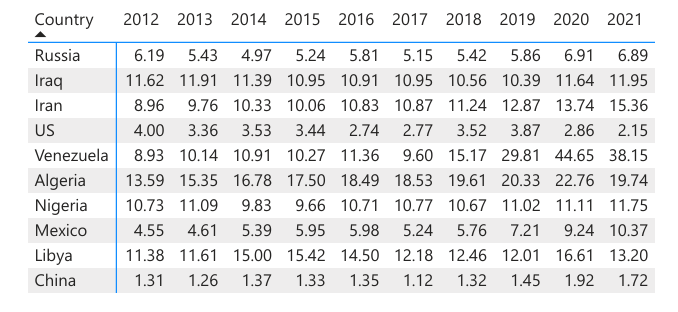
Reuters might also have noted (World Bank table below) that the US flaring intensity score declined by 46% between 2012 and 2021. Each of the other “top flaring” countries had flaring intensity increases during that period.
Finally, while I applaud the World Bank’s efforts to monitor worldwide flaring, some issues with their methodology were identified in a prior BOE post.

