Feeds:
Posts
Comments

Archive for the ‘CCS’ Category

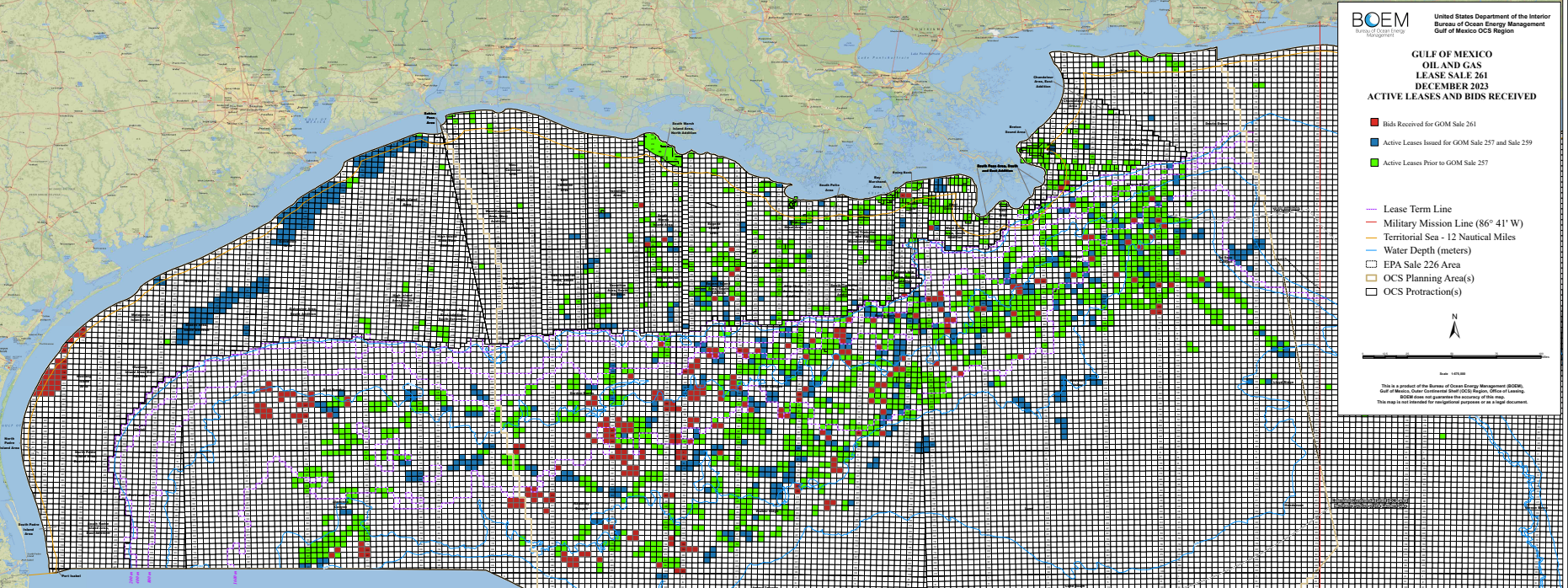
At Sale 261, Repsol was the sole bidder for 36 nearshore Texas tracts in the Mustang Island and Matagorda Island areas (red blocks at the western end of the map above). Exxon acquired 163 nearshore Texas tracts (blue in map above) at Sales 257 and 259.

Why Repsol’s carbon disposal bids should be rejected (as Exxon’s Sale 257 and 259 bids should have been):

  • Sale 261 was an oil and gas lease sale. The Notice of Sale said nothing about carbon sequestration and did not offer the opportunity to acquire leases for that purpose. Therefore, the public notice requirements in 30 CFR § 556.308 were not fulfilled.
  • Because there was no draft or final Notice of Sale for sequestration (carbon disposal) leasing, interested parties did not have the opportunity to comment on tract exclusions, stipulations, bidding parameters, rental fees, royalties, and other factors pertinent to any OCS lease sale.
  • 30 CFR § 556.308 requires publication of a lease form. No carbon sequestration lease form has been posted or published for comment.
  • Carbon sequestration operations were not considered in the environmental assessments conducted prior to this or any other OCS lease sale.
  • No evaluation criteria for carbon sequestration bids have been published.

Hopefully, the carbon sequestration regulations that are under development will preclude conversion of leases acquired at Sales 257, 259, and 261. At a minimum, these regulations should require a competitive process for converting any oil and gas leases.

The difference between the conversion of the Exxon and Repsol leases and the conversion of other existing oil and gas leases is that the Exxon and Repsol leases were acquired solely for the purpose of carbon disposal with no intention of oil and gas exploration and production. Also, they can conduct geophysical surveys on their extensive (arguably monopolistic) nearshore Texas lease holdings, which gives them an unfair competitive advantage should a carbon sequestration lease sale be held.

To their credit, Repsol bid legitimately on 9 oil and gas leases at Sale 261. Exxon did not participate in Sale 261, and their only participation in Sales 257 and 259 was for carbon disposal purposes. Prior to Sale 257, the company had not acquired an OCS lease since 2008.

Read Full Post »

ENERGYWIRE has reported that the Department of the Interior will publish the legislatively mandated carbon sequestration rule later this year. Given that even close followers of the OCS program were completely unaware of the enabling legislative provisions prior to their enactment, the proposed DOI rule will provide the first opportunity to formally comment.

Within the oil and gas industry and the environmental community, there are considerable differences of opinion about carbon sequestration in general, and more specifically, offshore sequestration. All interested parties are encouraged to submit comments on these important regulations.

Some background information on the sequestration legislation and subsequent actions:

Exxon and other companies intend to commercialize carbon sequestration, and Exxon projects an astounding $4 trillion CCS market by 2050. Such a market will of course be dependent on mandates and subsidies, and the costs will ultimately be borne by taxpayers and consumers.

Is it not a bit unsavory and hypocritical for hydrocarbon producers to capitalize on the capture and disposal of emissions associated with the consumption of their products? Perhaps companies that believe oil and gas production is harmful to society should exit the industry, rather than engage in enterprises that sustain it.

More:

Read Full Post »

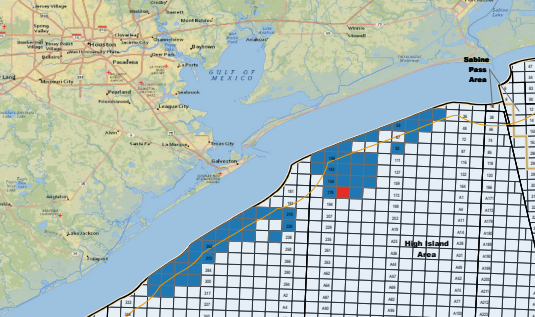
In addition to the 94 nearshore Texas leases Exxon acquired in Sale 257, the company was the sole Sale 259 bidder for all but one of 69 nearshore Texas blocks. The exception was High Island 177 (in red above). So who gets that lease?

  • the company (Exxon) that was the sole participant in a de facto CCS sale (bid of $182,750)
  • the company (Focus Exploration) that was participating in the announced oil and gas lease sale (bid of $145,177)

If Exxon is just acquiring these leases for evaluation purposes in preparation for a possible CCS sale in the future, their lease acquisitions may be okay. If they are planning on retaining these leases for actual sequestration operations, that is not okay, at least not until a competitive process has been established for awarding or reclassifying such leases. To date, no lease terms or bid evaluation procedures have been proposed for carbon sequestration leases; nor has an environmental review been conducted pursuant to NEPA.

Questions about Gulf of Mexico carbon sequestration

Read Full Post »

As anticipated, the increase in royalty and rental rates appears to have further weakened interest in leases in the shallow waters of the Gulf of Mexico continental shelf. Note the sharp declines in both the number of blocks receiving bids and the bid amounts.

lease saleblocks with bids
(excluding CCS bids)
sum of high bids
($million, excluding CCS bids)
25746$8.1
25929$4.1

Read Full Post »

Read Full Post »

  • 313 blocks receiving bids
  • 353 bids
  • 32 companies submitting bids
  • High bids totaled $263.8 million

Exxon doubled down on their strategic CCS bidding; their only bids (69 in total) again appeared to be solely for carbon sequestration purposes. As previously noted, acquiring tracts for CCS purposes is not authorized in an oil and gas sale. Arguably, these bids should be rejected.

The other super-majors, BP, Chevron, and Shell, were active participants as were many independents.

It was good to see BOEM Director Liz Klein announcing bids. This shows respect for the OCS oil and gas program.

It was also good to hear that Red Willow, a native American corporation, was again an active participant.

More to follow.

Read Full Post »

Read Full Post »

BOEM published their Sale 257 Decision Matrix on Friday (2/24/2023), and my previous speculation regarding the rejected Sale 257 high bid has proven to be partially incorrect. The rejected high bid was submitted by BP and Talos and was for Green Canyon Block 777. BOEM’s analytics assigned a Mean of the Range-of-Value (MROV) of $4.4 million to that tract, which tied for the highest MROV for any tract receiving a bid. The BP/Talos bid was $1.8 million or just 40% of BOEM’s MROV. BOEM’s tract evaluation is interesting given that the other bid on this wildcat tract (by Chevron, $1.185 million) was considerably lower than the rejected BP/Talos bid.

The Sale 257 bid that I thought might have been rejected was for lease G37261. This lease was never issued per the lease inquiry data base and the final bid recap. BHP’s bid of $3.6 million for that tract (Green Canyon Block 79) was more than 5 times BOEM’s MROV of $576,000, and was accepted per the decision matrix. Why was the lease never issued?

Both Green Canyon 79 and 777 should again be for sale in legislatively mandated Sale 259, which will be held in just a few weeks on March 29, 2023, just 2 days prior to the deadline. It will be interesting to see what the bidding on those tracts looks like.

Meanwhile, Exxon and BOEM are still mum about the 94 Sale 257 oil and gas leases that Exxon acquired for carbon sequestration purposes. Note the large patches of blue just offshore Texas on the map above. These leases were all valued by BOEM at only $144,000 each, which is equivalent to the minimum bid of $25/acre. This valuation reflects the absence of perceived value for oil and gas production purposes. Exxon bid $158,400 for each tract, $27.50/acre or 10% higher than the minimum bid. Given that (1) the Notice of Sale only provided for lease acquisition for oil and gas exploration and production purposes, and (2) it was common knowledge that these tracts were acquired for carbon sequestration, should these bids have been rejected?

Read Full Post »

Carbon-Zero US LLC of Dallas (a Cox Oil affiliate) has applied for up to $12 million in U.S. Department of Energy funds to develop a pilot sequestration hub in offshore storage fields about 20 miles from Grand Isle, according to officials from Cox Operating LLC, the Dallas operator that owns some of the storage fields.

Cox Operating LLC will “repurpose facilities and equipment” for the carbon storage project, according to a news release.

The Advocate

Should this company be authorized to repurpose Gulf of Mexico facilities for carbon sequestration?

  • Per BSEE Incident of Non-Compliance (INC) data for 2022, Cox had more component shut-in INCs (132) than any other company. Cox was second to the Fieldwood companies in the number of warning and facility shut-in INCs, and in the total number of INCs. 48% of the Cox INCs required either a component or facility shut-in.
  • Cox had an INC/facility-inspection ratio of 0.77, nearly 50% higher than the GoM average of 0.53.
  • Per the posted BSEE district investigation reports for 2022, Cox was responsible for 9 of the 30 incidents that were significant enough to require investigation. That is more than twice as many as any other company (next highest was 4).
  • The incidents included 3 serious injuries, 2 fires, a large gas leak, and oil spills of 114, 129, and 660 gallons. Per the posted reports, only one other company had an oil spill of >1 bbl. (Note: Only spills of > 1 bbl are routinely investigated by BSEE. One bbl = 42 gallons.)
  • While INCs were issued for only 3 of the 9 Cox incidents, a review of the reports suggests that INCs should have been issued for at least 4 of the other incidents.
  • Cox operates 375 platforms with installation dates as early as 1949. 134 of their platforms are > 50 years old. Only 66 were installed in the last 20 years and only 6 in the last 10 years (most recent December 2014). How will the carbon sequestration plans affect their massive decommissioning obligations?
  • Many of the Cox platforms were assigned by predecessor lessees. Those predecessors can only be held responsible for the decommissioning of facilities they installed, not for more recent wells or platforms and not for facilities that are repurposed for carbon sequestration.

Other more generic issues should be addressed before DOE awards funds for offshore sequestration projects.

Also, as noted in the discussion of Exxon’s 94 Sale 257 oil and gas leases, a competitively issued alternate use RUE is required (30 CFR § 585.1007) before sequestration operations may be conducted on an oil and gas lease.

Read Full Post »

On September 14, 2022, BOEM announced that 307 high bids from Lease Sale 257 in the Gulf of Mexico were accepted. BOEM also announced that one high bid was rejected for not providing the public with fair market value. BOEM has not identified the rejected bid.

Per BOEM’s Lease Area Block Online Query file, 306 Sale 257 leases were effective on Oct. 1, 2022. A comparison of these data with the sale results identified 2 Sale 257 leases that have not been awarded:

leaseblockhigh bidder(s)bidcomments
G37261GC 70BHP$3.6 millionlone bid; 7th highest
bid in sale
G37294GC 777BP (75%),
Talos (25%)
$1.8 million2 bids; next highest
$1.185 million

So one of these 2 bids was rejected and the other has lease not yet been awarded for some reason (or perhaps there has been a clerical/IT issue).

Which bid was rejected? I would guess it was the BHP bid even though that bid was the 7th highest bid in the entire sale. The fact that this bid was $2.5 to $3 million higher than the other 7 BHP bids (all of which were accepted) tells us that the company valued this tract highly. Perhaps BOEM, which has all of the geologic data, thought the value was even higher, which is why the bid may have been rejected.

There was another bidder (Chevron) for the BP/Talos tract, so the competition makes it less likely that the bid would have been rejected.

Ironically, the 94 carbon sequestration bids, which made something of a mockery of the lease sale, could not be rejected on fair market grounds. The bids exceeded the minimum required, and the tracts have little or no value from an oil and gas production standpoint. A competitive process would be require to repurpose these leases for carbon sequestration.

Read Full Post »

« Newer Posts - Older Posts »