Feeds:
Posts
Comments

Archive for the ‘Alaska’ Category

In the early 1990’s, Department of the Interior (DOI) and Department of Energy (DOE) leadership dabbled at re-branding the OCS Oil and Gas Program by reversing the order of the words. Clever? Perhaps by Washington public relations standards. One senior manager even changed his license plate from “OCS OIL” to “MMS GAS” (not much competition for those tags 😃). Technical staff were less enthused about this simplistic marketing gimmick that misrepresented the historical and scientific facts about oil and gas production. For many years, natural gas was a byproduct of oil production that was commonly flared. (This practice continues in some regions of the world, although to a lesser extent than in the past.)

Understandably, the Oil and Gas Journal wasn’t very impressed by the change. I saved a copy of their 1/24/1994 editorial (attached) on the subject. Per the OGJ:

We at the Journal love natural gas. But that doesn’t warrant an attempt to repeal the laws of nature and ignore the weight of tradition by renaming everything “gas and oil” this and that.

John L. Kennedy, Editor, Oil and Gas Journal, 1/24/1994)

To their credit, BOEM and BSEE web pages and announcements during recent administrations (both parties) indicate a preference for the more traditional “oil and gas.” (The DOE website largely ignores the existence of either oil or natural gas.) Surprisingly, the American Petroleum Institute (API), an industry trade organization with more than 100 years of history, is now consistently using “natural gas and oil.” This rearrangement of words is not entirely consistent with the interest of API’s members. In the offshore sector, the primary interest of API members is in finding and producing oil. if you think otherwise, look at the EIA GoM gas production data. Most of the Gulf’s declining gas production is now associated with deepwater oil production, and BSEE rightfully requires that this gas be used for fuel or transported for sale. Similarly, gas is a secondary consideration for API members exploring in Alaska given that 35 trillion cu ft of North Slope gas still awaits a pipeline.

Oil companies, and those who represent them, should be proud of their current and historical role in producing oil (and gas) for our economy, security, and way of life; and of the men and women who have toiled to locate and produce petroleum resources for the benefit of society. Are there better energy alternatives? Perhaps, but issues with these alternatives remain to be resolved, and oil and gas will continue to be important. Let’s focus on producing these resources as safely, cleanly, and reliably as possible.

Read Full Post »

Positive measures announced by President Obama during today’s radio address:

  1. Hold a Gulf of Mexico lease sale this year and two next year
  2. Extend Gulf of Mexico and Alaska leases where drilling activity was suspended after the blowout
  3. Accelerate pre-sale seismic surveys in the Mid- and South Atlantic
  4. Conduct annual lease sales in Alaska’s National Petroleum Reserve

Read Full Post »

Anchorage Daily News:

The federal Environmental Appeals Board, which is part of the EPA, reviewed the permits. It found last week that the analysis of the impact of nitrogen dioxide emissions from the ships on Alaska Native communities was too limited, and remanded the permits so that problems cited by the board could be fixed by the agency.

The closest proposed drill site is 60 miles off shore and about 80 miles from Wainwright, an Inupiat Eskimo village 710 miles northwest of Anchorage.

Read Full Post »

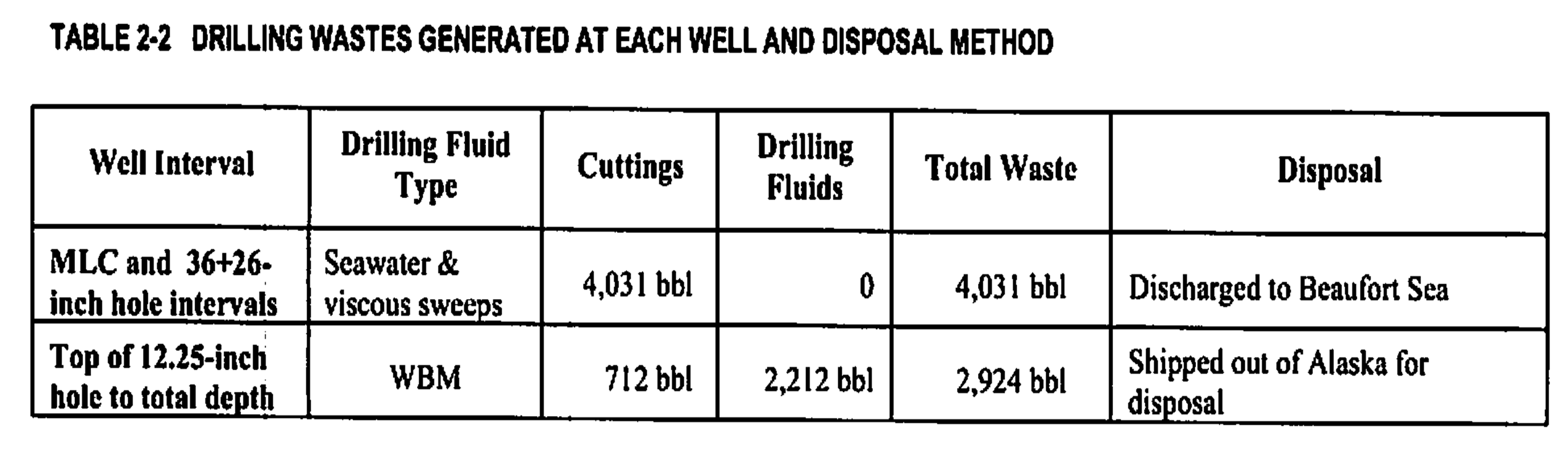
Shell’s submission to the BOEMRE provides more details on discharge plans for their Beaufort Sea exploratory drilling, and confirms that all muds and cuttings generated in drilling below the 20″ casing will be transported out of the Beaufort for disposal.  Shell also plans to transport gray water and sanitary wastes, bilge, and ballast water to approved discharge sites. This is about as close as you can get to true “zero discharge” when conducting exploratory drilling from a floating drilling unit.


Read Full Post »

Shell has agreed to transport its used drilling fluids from Beaufort Sea exploration drilling out of the Arctic if the company finally gets government permission to drill a well next summer. Alaska Journal of Commerce

I assume this includes all drilling fluids and drilled solids (cuttings) except for the spud mud and cuttings generated prior to installing the riser?  If so, I believe this will be a first for an exploratory well drilled from a floating rig in US offshore waters.

Read Full Post »

« Newer Posts