Feeds:
Posts
Comments

Archive for the ‘accidents’ Category

1. BP CEO Bob Dudley pokes media, politicians and oil industry:

A great rush to judgment by a fair number of observers before the full facts could possibly be known, even from some in our industry.

Comment: Bob Dudley is correct, but the attacks and distortions were entirely predictable.  Human responses to high-profile disasters will always be excessive, and you won’t have a lot of friends when you are a public target. Add this negative outcome to the list of more important reasons for avoiding offshore disasters – protecting workers, preventing pollution, and preserving assets.

2. PTT and Indonesia continue to battle over Montara damages.

Comment: This will be a long and interesting international battle.  I wonder if PTT has any assets in Indonesia?  I can’t really tell from their website.

Read Full Post »

Bad News from Burma

Odd Finnestad alerted me to this tragic incident reported in the Bangkok Post:

At least 14 people have been killed and 58 more injured in a fire at an oil well in central Burma, an official in the military-ruled country said Monday.

Will we ever learn the details?

Read Full Post »

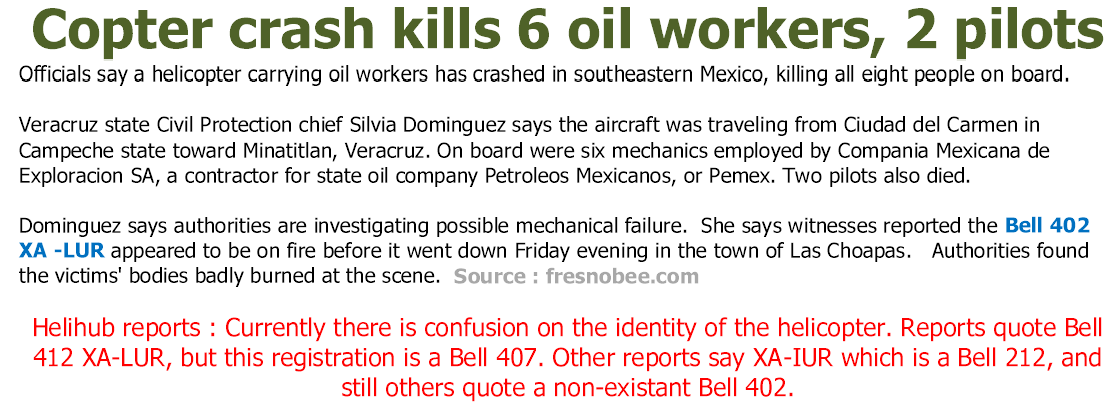
Helicopter Crash

From the Fresno Bee (18 Oct).  Click on visual to enlarge:


Read Full Post »

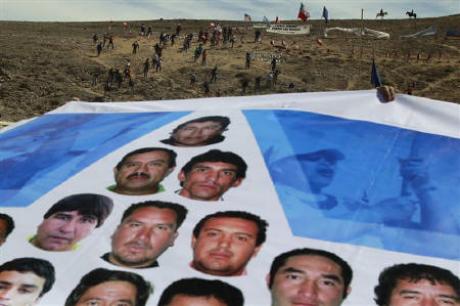
Now that Chile, with the help of the international community (including two companies from the Commonwealth of Pennsylvania where the drilling industry began), has rescued the 33 miners, can we drill into the Australian government and rescue the Montara and Varanus Island reports?

While we are at it, can we learn more about these accidents?

Let’s learn from past accidents, so we don’t need dramatic rescues in the future.

The offshore safety record will be suspect until industry and governments have credible, internationally accepted programs and policies for ensuring that accidents are independently investigated and that investigation updates and reports are released in a timely manner.

Read Full Post »

I’ve been saving  this interesting comment from the CEO of the company that drilled the successful rescue well. Now that the miners are being rescued and we can smile, I’ve pasted it below 🙂

The pressure really started to build. We’re not used to drilling for people. Andrew Schmitt, CEO, Layne Christensen Co.

Here is a little information on the rescue well:

The Layne-Geotec team worked carefully, starting with a 5-inch hole dug through 2,300 feet of the hard rock until they broke through. From there, they made another pass, this time expanding it to 12 inches. Finally, with a third pass, they increased the hole to the 26 inches needed for the rescue capsule, all the while concerned about a collapse. They finished the job in 33 days, well ahead of predictions.

Comment: In the past year, we have seen the tragic consequences of a drilling operation that went awry.  We have also seen the industry’s technical precision demonstrated in drilling the Macondo relief well and have watched drillers save lives in Chile. Regardless of how you feel about drilling, the intentions are good – to find and produce commodities that are in much demand (typically oil, gas, or freshwater) , and to make a return on your investment.  The challenge is to minimize the safety and environmental risks associated with these operations, and to do so consistently, effectively, and efficiently.

Read Full Post »

The White House said Tuesday the government will lift a moratorium on deep water oil drilling in the Gulf of Mexico “very soon” – likely this week. Washington Post

Read Full Post »

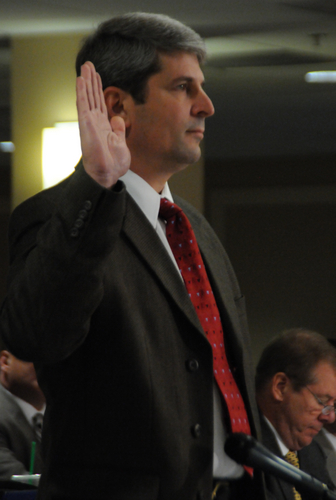
There were so many simultaneous activities — starting with the displacing of mud to the pumping of fluids overboard — it was difficult to see what was going on. John Gisclair, Sperry Sun (see Times Picayune summary of yesterday’s BOEM-Coast Guard hearing)


John Gisclair


Too much at once? Hurrying to finish the job? Cost concerns?  No one in charge? Distracted by managers visiting the rig? One or more of these human and organizational factors appears to have contributed to the blowout.

Similarly, the rigid commitment to “batching” the development wells (for efficiency reasons) seems to have been a factor contributing to the Montara blowout in the Timor Sea.  If after removing the corrosion cap on the production casing, the work on the H1 well had continued in series (i.e. casing tied-back, BOP installed, and well secured) before moving on to another well, this blowout may have been prevented.

At both Macondo and Montara, time pressures (perceived or real) may also have affected the way negative-pressure tests were conducted or assessed.  These tests should have detected the influx of hydrocarbons via the shoe track.

Read Full Post »

Safety and Environmental Management Systems

This rulemaking will incorporate in its entirety and make mandatory the AmericanPetroleum Institute’s Recommended Practice 75, Development of a Safety andEnvironmental Management Program for Offshore Operations and Facilities, with respectto operations and activities under the jurisdiction of BOEMRE. This final rule will applyto all OCS oil and gas and sulphur operations and the facilities under BOEMREjurisdiction including drilling, production, construction, well workover, well completion,well servicing, and DOI pipeline activities.

The rule will become effective on November 15, 2010.

Read Full Post »

Decision Making Within the Unified Command

The Use of Surface and Subsea Dispersants During the BP Deepwater Horizon Oil Spill

The Challenges of Oil Spill Response in the Arctic

The Amount and Fate of the Oil


Read Full Post »

Absent live streaming or television, the Times Picayune seems to be providing the best coverage of the Coast Guard – BOEM Macondo hearings in New Orleans.  While the legal sparring has attracted the most press interest, two other items in this Times Picayune article caught my attention.

Part of Keplinger and Fleytas’ duties was to monitor indicators of gas detectors and alarms from the bridge. Keplinger was busy showing visiting BP and Transocean officials a video-game-style simulator for 45 minutes to an hour before the explosions, he said, but he insisted that Fleytas was keeping him abreast of readouts of the rig’s systems.

Comment: Just as school teachers shouldn’t have been flying in the space shuttle, “tourists” shouldn’t have been visiting a complex drilling operation when the crew was in the process of setting production casing and suspending a potentially dangerous well. While the visit was well-intended, the last thing the crew needed on that night was to be distracted by a group of corporate executives.  The distraction they caused was comparable to driving on a dangerous highway while getting text messages from your boss. Visiting windows should be limited to relatively low-risk operations (e.g. when drilling ahead prior to reaching target intervals), and these windows should immediately close if complications develop.

Keplinger flashed some anger at Capt. Curt Kuchta, captain of the Deepwater Horizon rig, during his testimony. He noted that a fellow rig worker, Chris Pleasant, had to ask Kuchta three times whether to disconnect the rig from the wellhead before he got the go-ahead.

Comment: One of the benefits of drilling from a floating and dynamically positioned rig is the ability to move off location if trouble arises.  The failure to disconnect the riser and move away from the well at the first indication of flow contributed significantly to the tragic consequences.  The technical and human factors that prevented such a disconnect must be thoroughly examined.

Further comment: The absence of live streaming of these important safety hearings is inexcusable.  If a senator or governor were testifying, I expect that the cameras would be there.

Read Full Post »

« Newer Posts - Older Posts »