Feeds:
Posts
Comments

Archive for the ‘accidents’ Category

Offshore veteran JL Daeschler brought the historic destruction of the Ocean Prince to my attention.

At about 2 am on the day of the storm, the rig’s superstructure was torn off during a gale. By 7:10 am about a third of the drilling plattform had dissapared under 60 feet water.”
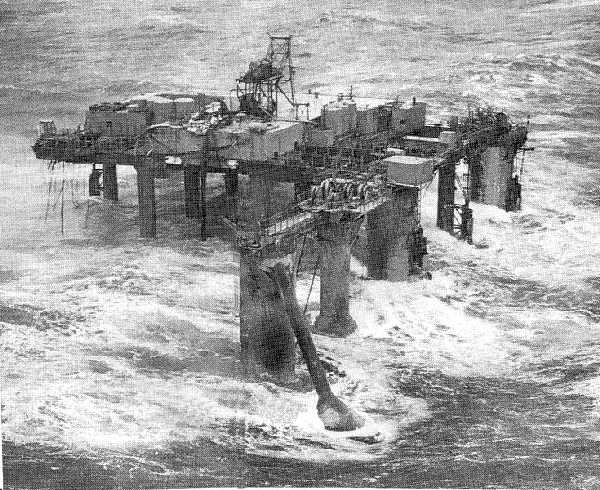
I didn’t realize that some early North Sea wells were drilled with semisubmersible rigs that were sitting on bottom, ala submersibles.

Per JL Daeschler, “the barge master on Ocean Prince was unsettled about sitting on a sandbank in the North Sea with waves as deep as the water depth, hence accelerating the scouring around the pontoon on the sea bed and distorting the forces on an unsupported hull. On a semisubmersible floating rig there is a great level of compliance between the mooring system and the forces on the leg and bracing. Worst case, you let the mooring go and drift. 

It’s noteworthy that: “During the same storm which claimed the ”Ocean Prince,” the rig’s sister ship ”Ocean Viking,” while drilling afloat, withstood winds and waves of equal force.”

The entire crew of the Ocean Prince was safely evacuated. The helicopter pilot’s last name was fitting given his bravery during the rescue!

Hero of the rescue effort was Capt. Robert Balls, 32, a former naval pilot who was alerted to remove the stranded crewmen. Within 45 minutes after he was awakened at Scarborough Hotel at 6 a.m., he was piloting a Wessex 60 helicopter across the North Sea fighting gale winds 400 feet up.”

“Captain Balls flew the copter with a minimum load of fuel in order to carry more than a full passenger load to the oil rig ”Constellation,” which was drilling about 20 miles south of the ”Ocean Prince.” On the first lift he transported 19 men. Usually, the capacity of the Wessex 60 is 16. On the second trip he took 18 crewmen. The final trip, he flew eight men directly to Scarborough.”

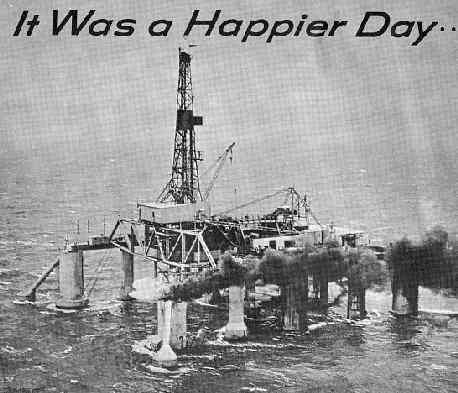
Before the storm:
Read Full Post »

Per the DOI regulatory agenda published on 7/27/2023 (excerpt below), the final BSEE well control rule was published in June. Of course, that did not happen, but the update tells us that the final rule should be published soon. The delay is probably in the internal review process which moves at the pace of continental drift 😉.

BOE comments on the proposed rule are attached here.

12. Oil and Gas and Sulfur Operations in the Outer Continental Shelf-Blowout Preventer Systems and Well Control Revisions [1014–AA52]

Abstract: This rulemaking revises the Bureau of Safety and Environmental Enforcement (BSEE) regulations published in the 2019 final rule entitled “Oil and Gas and Sulfur Operations in the Outer Continental Shelf-Blowout Preventer Systems and Well Control Revisions,” 84 FR 21908 (May 15, 2019), for drilling, workover, completion and decommissioning operations. In accordance with Executive Order (E.O.) 13990 (Protecting Public Health and the Environment and Restoring Science to Tackle the Climate Crisis) and the E.O.’s accompanying “President’s Fact Sheet: List of Agency Actions for Review,” BSEE reviewed the 2019 final rule and is updating to subpart G of 30 CFR part 250 to ensure operations are conducted safely and in an environmentally responsible manner.

Timetable:

ActionDateFR Cite
NPRM09/14/2287 FR 56354
NPRM Comment Period End11/14/22
Final Action06/00/23
Final Action Effective07/00/23

Read Full Post »

Read Full Post »

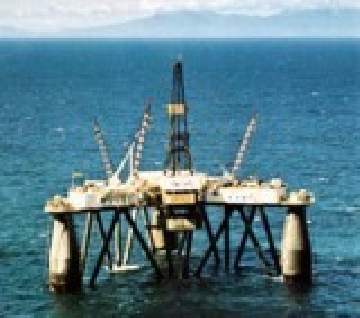
Pioneering subsea engineer, JL Daeschler, brought to my attention the little known sinking of the Sedco 135 B semisubmersible drilling rig (pictured above) while in transit from Hiroshima to Borneo in 1965. 13 workers died in this tragedy. Miraculously, a single survivor, dehydrated and floating on a wooden pallet, was found days later by a passing Japanese trawler. 

The bottle shape of the columns with the tapered top section was intended to reduce the influence of sea conditions when the rig was on the bottom. These early semisubmersibles sometimes operated in shallow water and sat on the seafloor. However, when buoyant, this type of column reduced the rig’s dynamic stability.

The 135 B tragedy resulted in stricter stability requirements by the American Bureau of Shipping (1968 ABS Rules for Building and Classing Offshore Mobile Drilling Units.)

JL informs me that the Alexander Kielland was a symmetrical pentagon design. Unfortunately, with this design, the failure of a major diagonal brace results in the complete loss of structural integrity.

Read Full Post »

The fire was triggered by an explosion on the Nohoch-A link platform of the company’s Cantarell Field, in the the Bay of Campeche. It then spread to a compression complex, where the two workers lost their lives. More than 300 people were evacuated. The fire is reported to be controlled.

Read Full Post »

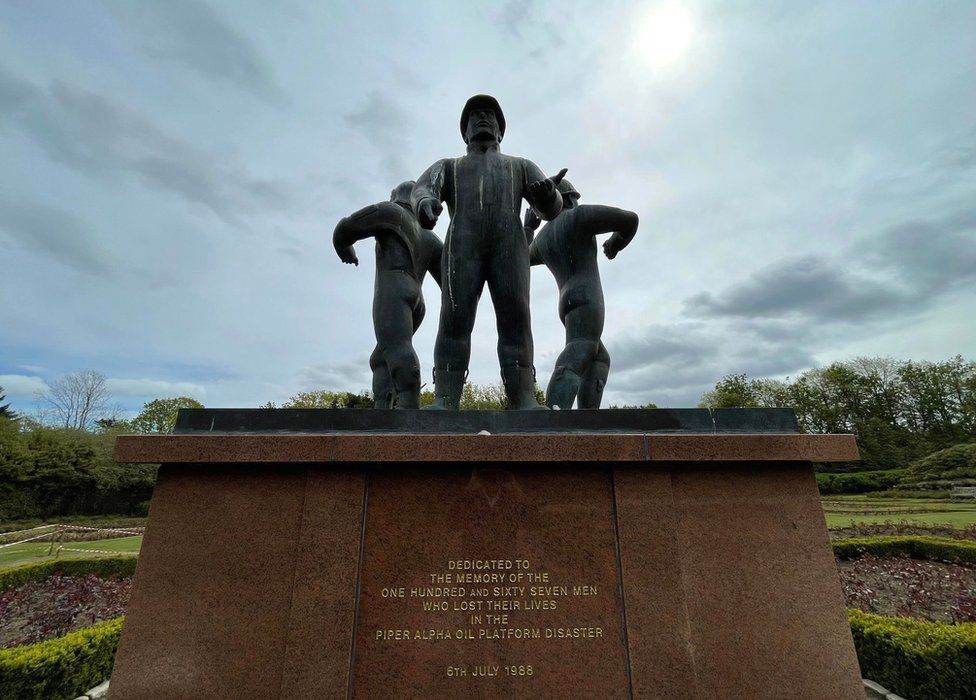
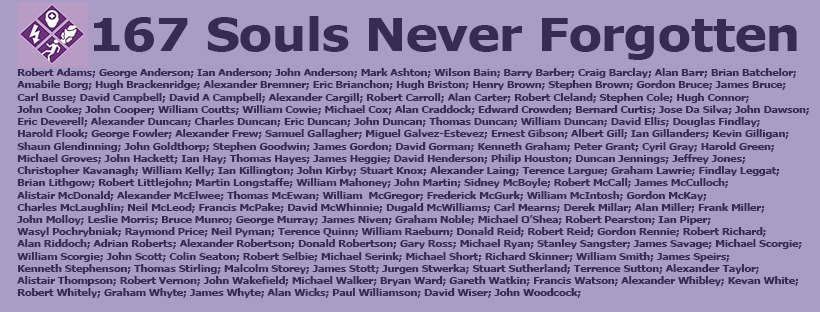
The Piper Alpha fire was the worst disaster in the history of offshore oil and gas operations and sent shock waves around the world. Eight months later another interactive pipeline-platform fire killed 7 workers at the South Pass 60 “B” facility in the Gulf of Mexico. A US Minerals Management Service task group reviewed the investigation reports for both fires and recommended regulatory changes with regard to:

  1. the identification and notification procedures for out-of-service safety devices and systems,
  2. location and protection of pipeline risers,
  3. diesel and helicopter fuel storage areas and tanks,
  4. approval of pipeline repairs, and
  5. location of ESD valves on pipelines.

Paul Schneider and I wrote a paper on the task group’s findings and that paper was published in Offshore Operations Post Piper Alpha (Institute of Marine Engineers,1991). The proposed regulations that followed summarized these findings and can be be found at this Federal Register link.

Lord Cullen’s comprehensive inquiry into the Piper Alpha tragedy challenged traditional thinking about regulation and how safety objectives could best be achieved, and was perhaps the most important report in the history of offshore oil and gas operations. Per Cullen:

Many current safety regulations are unduly restrictive because they impose solutions rather than objectives. They also are out of date in relation to technological advances. Guidance notes lend themselves to interpretations that discourage alternatives. There is a danger that compliance takes precedence over wider safety considerations and that sound innovations are discouraged.

Cullen advocated management systems that describe the safety objectives, the system by which those objectives were to be achieved, the performance standards to be met, and the means by which adherence to those standards was to be monitored. He called for safety cases that describe major hazards on an installation and provide appropriate safety measures. Per Cullen, each operator should be required in the safety case to demonstrate that the safety management systems of the company and the installation are adequate to assure that design and operation of the platform and its equipment are safe.

Links for the full Piper Alpha Inquiry: volume 1 and volume 2

Read Full Post »

David Scarborough, Island Operating Co. employee who died in the crash.

The preliminary NTSB report was posted on 1/18/2023, but the final report has still not been published. Status update:

Will the investigators consider longstanding regulatory fragmentation issues? The most recent Coast Guard – BSEE MOA for fixed platforms added to helideck regulatory uncertainty by assigning decks and fuel handling to BSEE and railings and perimeter netting to the Coast Guard.  This is the antithesis of holistic, systems-based regulation.

Read Full Post »

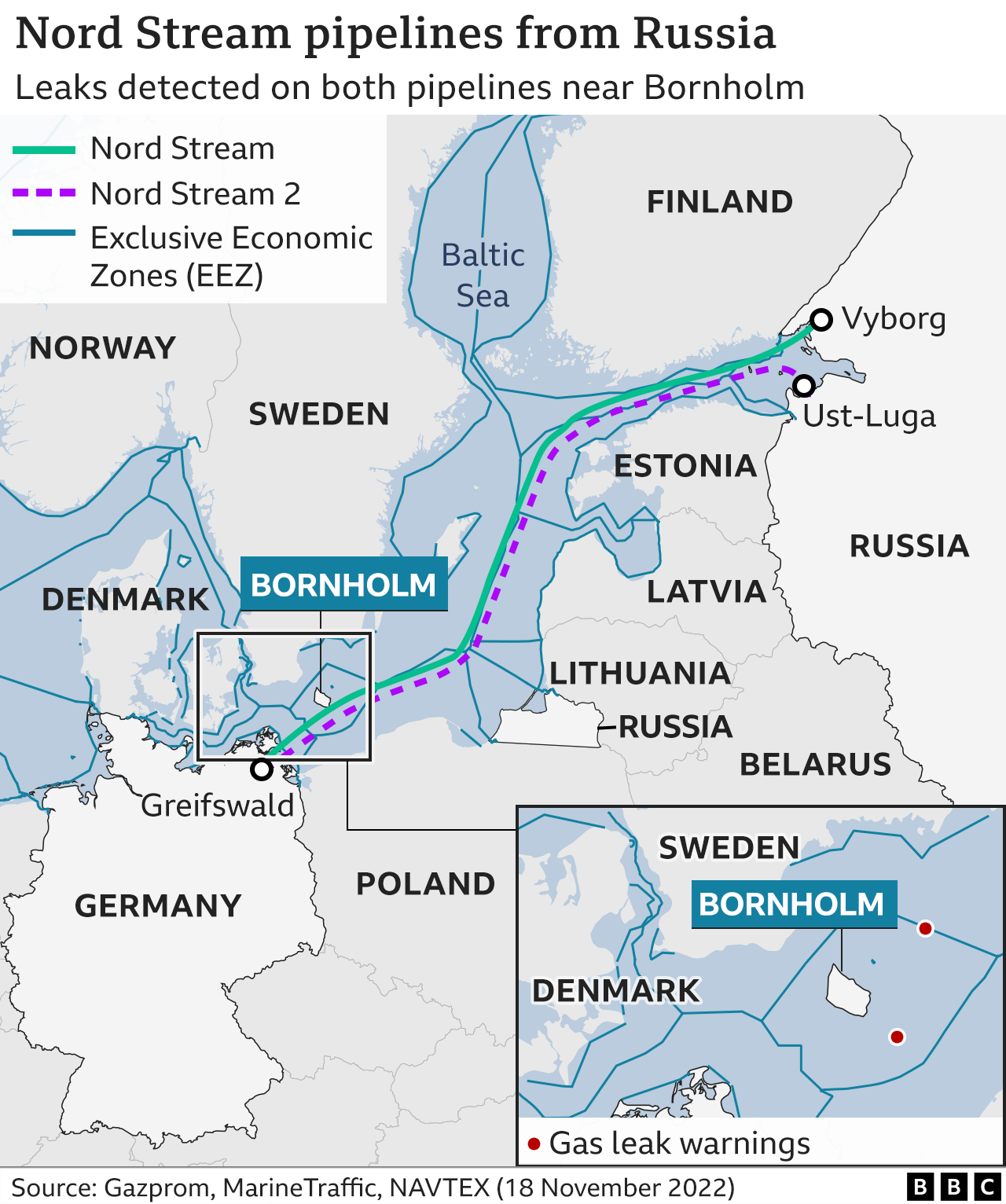
Trying to keep track:

So at this time, some theories on the culprits appear to have dropped out. Those that are still in play include various versions of the Ukrainian rental yacht narrative and the Hersh account. Hopefully, the responsible parties will be identified, but given the political stakes, this is becoming increasingly unlikely.

Read Full Post »

NOPSEMA’s June 8 safety alert implies that the June 2nd fatality at the North Rankin complex, offshore Western Australia, was the result of a crane/lifting incident. Per NOPSEMA:

A recent fatal incident involving a person working on an offshore oil and gas facility has provided a tragic reminder of the risks of work involving the rigging, manipulation and movement of loads, including people and equipment.

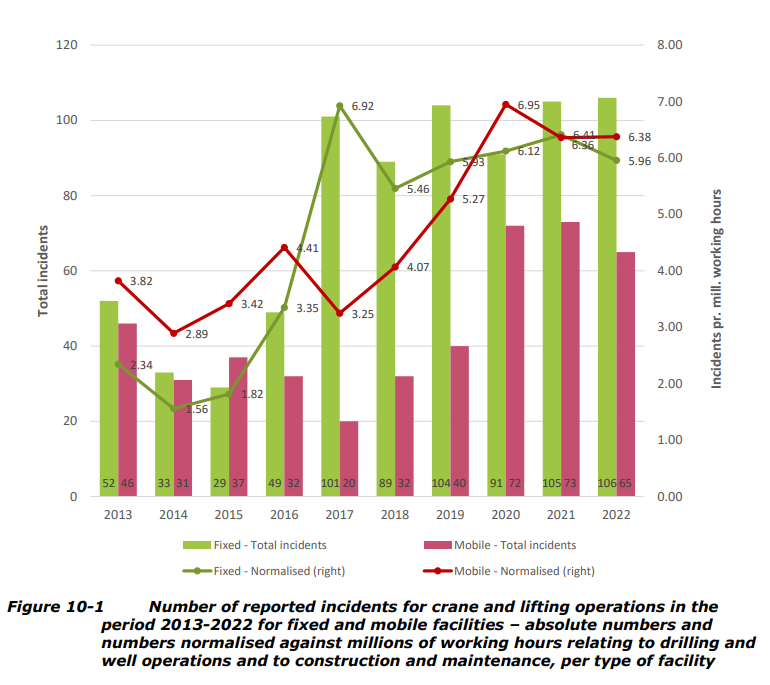
Despite the international focus on lifting operations over the past 30 years, Norwegian and US data do not suggest improved performance. PSA Norway’s “Trends in risk level on the Norwegian Continental Shelf” report shows an increase in lifting incident rates for both fixed and mobile facilities over the past 10 years (first chart below).

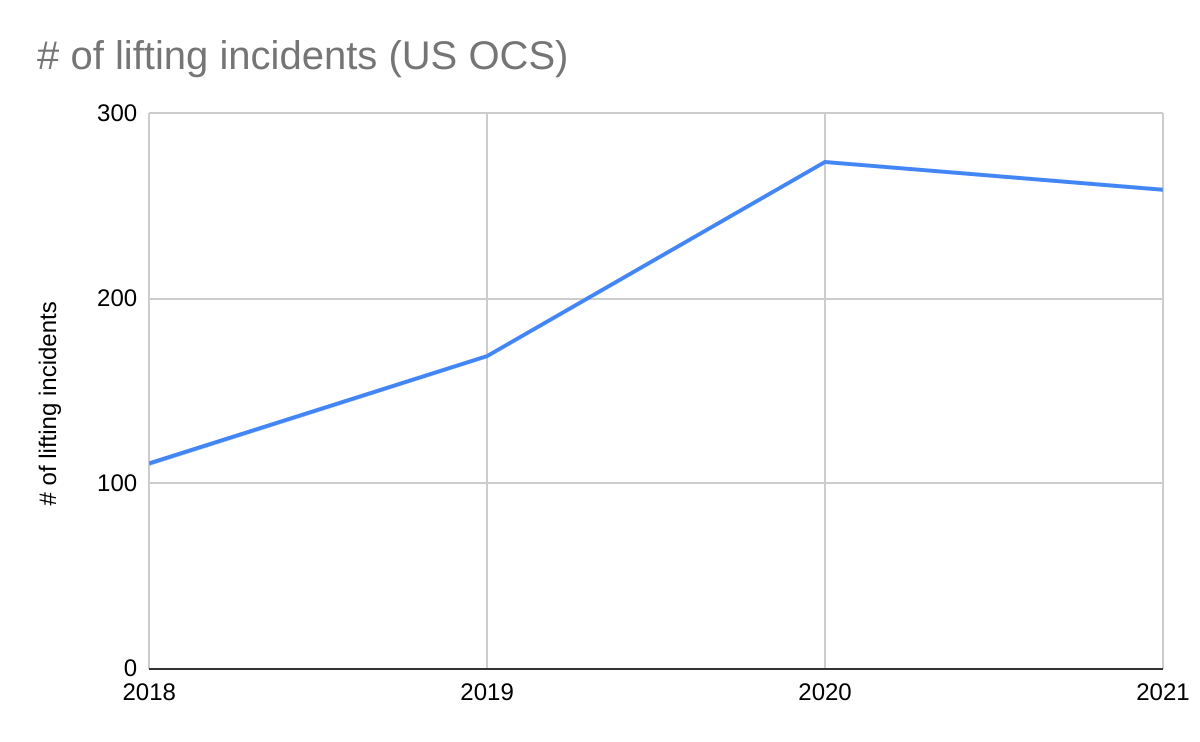
Similarly, recent lifting data from BSEE’s incident tables (summary below) and Jason Mathew’s June 2022 presentation (pages 48-63) suggest that lifting risks are not being effectively mitigated. Why are industy/regulator messages regarding hazard identification and controls not achieving the desired results? Perhaps a fresh look and renewed dialogue are needed.

Crane or personnel/material handling incident (as used in 30 CFR 250.188(a)(8)) refers to an incident involving damage to, or a failure of, the crane itself (e.g., the boom, cables, winches, ballring), other lifting apparatuses (e.g., air tuggers, chain pulls), the rigging hardware (e.g., slings, shackles, turnbuckles), or the load (e.g., striking personnel, dropping the load, damaging the load, damaging the facility) at any time during exploration, development, or production operations on the OCS. This includes all incidents of shock loading that, upon inspection, reveals damage to any part of the crane, lifting apparatus, rigging hardware, or load. Personnel handling incidents include events involving swing ropes, personnel baskets, and any other means to move personnel. Material handling incidents include any activities involving the loading and unloading of material and moving it on, off, or around an OCS facility.

Read Full Post »

All we know at this point is that a Woodside contractor died during work activities at noon today (AWST).

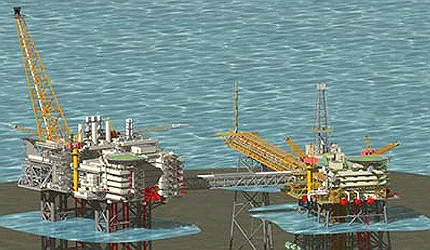
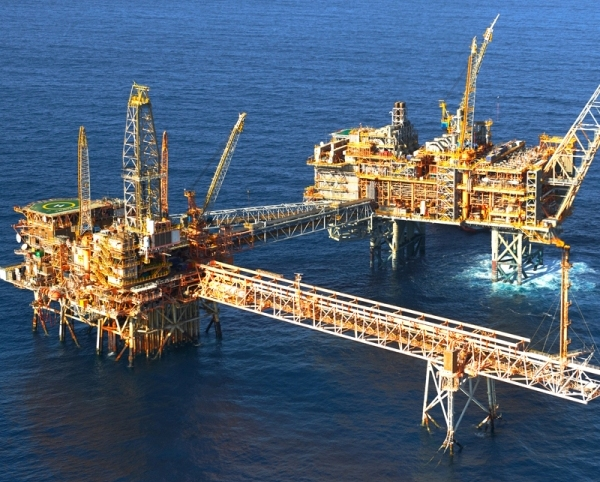
The North Rankin complex is in 135 km offshore from Dampier on the northwest coast of Australia and is in 125 m of water.

More to follow.

North Rankin complex

Read Full Post »

« Newer Posts - Older Posts »