The White House urged OPEC to boost oil production Wednesday, saying recent planned increases are insufficient as countries around the world seek to emerge from the Covid-19 pandemic.
In the early 1990’s, Department of the Interior (DOI) and Department of Energy (DOE) leadership dabbled at re-branding the OCS Oil and Gas Program by reversing the order of the words. Clever? Perhaps by Washington public relations standards. One senior manager even changed his license plate from “OCS OIL” to “MMS GAS” (not much competition for those tags 😃). Technical staff were less enthused about this simplistic marketing gimmick that misrepresented the historical and scientific facts about oil and gas production. For many years, natural gas was a byproduct of oil production that was commonly flared. (This practice continues in some regions of the world, although to a lesser extent than in the past.)
Understandably, the Oil and Gas Journal wasn’t very impressed by the change. I saved a copy of their 1/24/1994 editorial (attached) on the subject. Per the OGJ:
We at the Journal love natural gas. But that doesn’t warrant an attempt to repeal the laws of nature and ignore the weight of tradition by renaming everything “gas and oil” this and that.
John L. Kennedy, Editor, Oil and Gas Journal, 1/24/1994)
To their credit, BOEM and BSEE web pages and announcements during recent administrations (both parties) indicate a preference for the more traditional “oil and gas.” (The DOE website largely ignores the existence of either oil or natural gas.) Surprisingly, the American Petroleum Institute (API), an industry trade organization with more than 100 years of history, is now consistently using “natural gas and oil.” This rearrangement of words is not entirely consistent with the interest of API’s members. In the offshore sector, the primary interest of API members is in finding and producing oil. if you think otherwise, look at the EIA GoM gas production data. Most of the Gulf’s declining gas production is now associated with deepwater oil production, and BSEE rightfully requires that this gas be used for fuel or transported for sale. Similarly, gas is a secondary consideration for API members exploring in Alaska given that 35 trillion cu ft of North Slope gas still awaits a pipeline.
Oil companies, and those who represent them, should be proud of their current and historical role in producing oil (and gas) for our economy, security, and way of life; and of the men and women who have toiled to locate and produce petroleum resources for the benefit of society. Are there better energy alternatives? Perhaps, but issues with these alternatives remain to be resolved, and oil and gas will continue to be important. Let’s focus on producing these resources as safely, cleanly, and reliably as possible.
Jim Lane, who inspired our NMJA program many years ago, has submitted this nominee from the Texas Hill Country where he now resides. The metal stake in the picture was used to support a sapling that was planted in a county park. However, neither the employee who planted the young tree nor any of his colleagues saw fit to remove the stake. Not their job? The end result is pictured below.
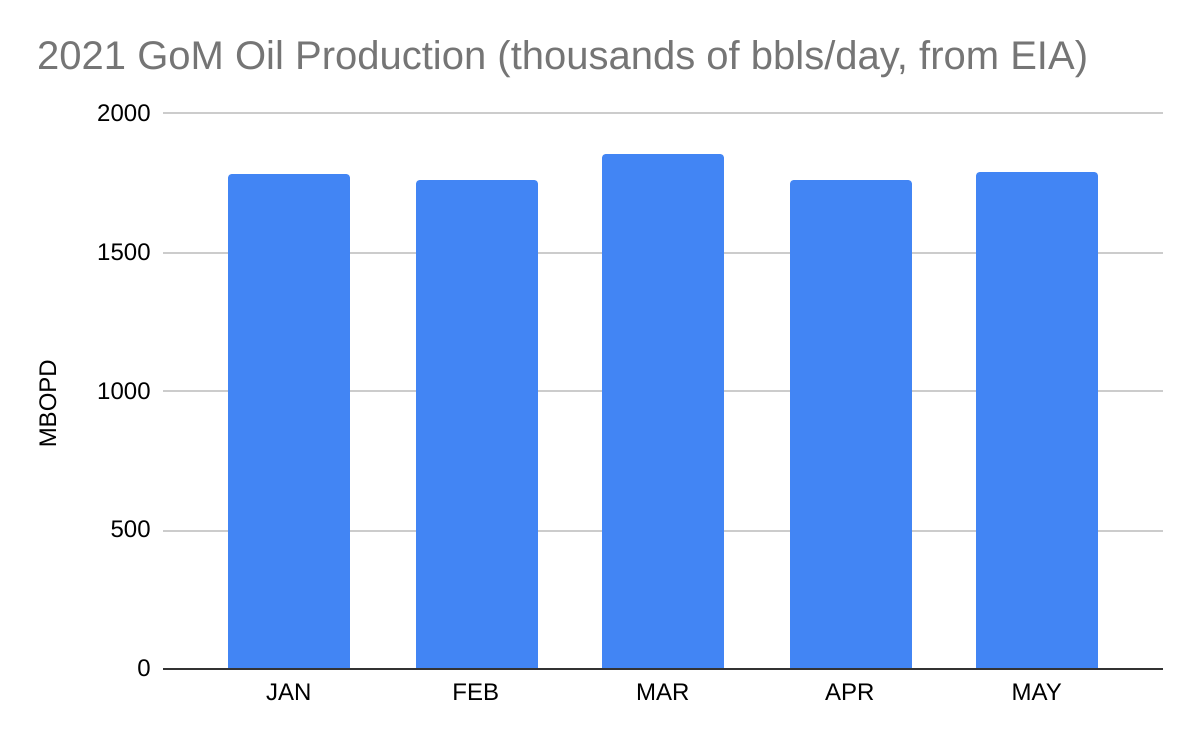
A previous BOE post estimated that current stabilized GoM oil production rates were 1.7 – 1.8 million BOPD. EIA recently announced that May production was 1.791 million BOPD, which is consistent with our estimate. Per the chart below, GoM production was essentially unchanged from the beginning of the year despite a 37% increase in the price of oil (WTI) from 1 January to 31 May. This suggests that stabilized GoM production may have peaked pending first oil from several new projects.
Key production questions:
Will new production from Mad Dog 2, Vito, PowerNap, Thunder Horse South 2, and the recently sanctioned Whale project offset high depletion rates elsewhere in the deepwater GoM?
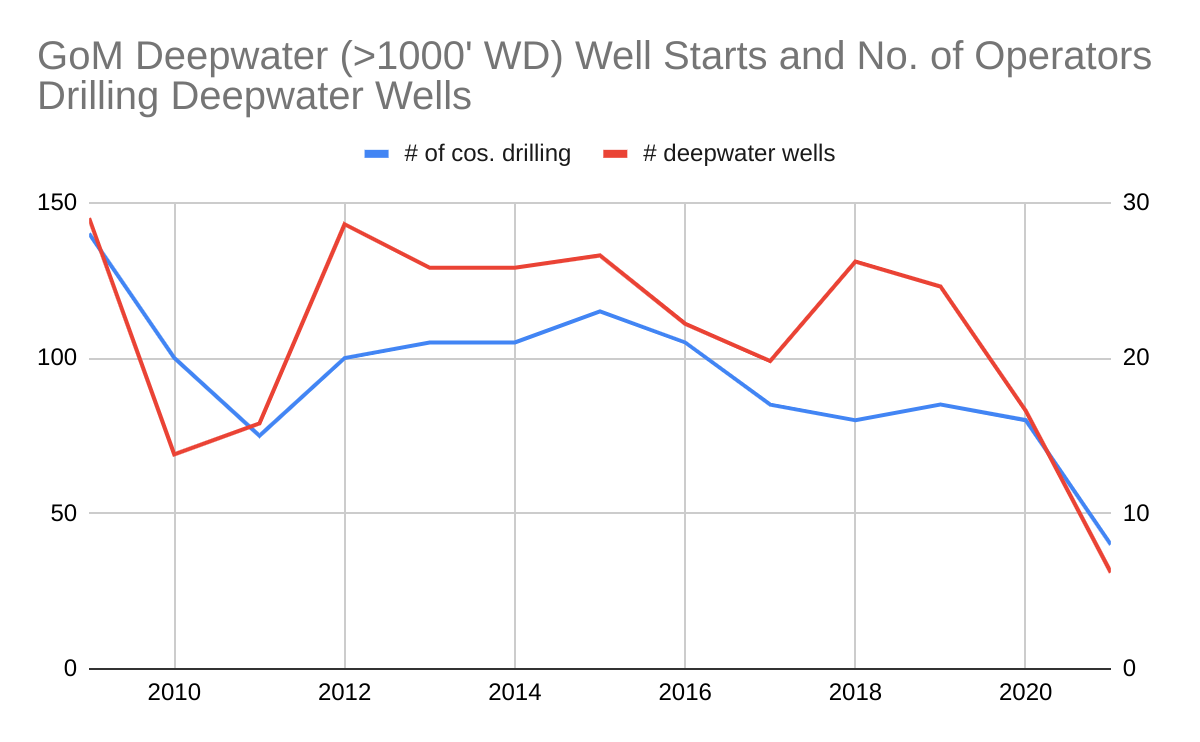
Looking further ahead, is deepwater GoM production sustainable without increased drilling activity? Per BSEE data, only 33 deepwater wells were started in 2021 YTD, just 18 of which are classified as exploratory. Drilling is thus at historic low levels. For reference, there were 477 wells started in 2001, 149 of which were exploratory. This level of activity facilitated a 30% growth in oil production, peaking at 2 million BOPD in 2019.
Regardless of one’s views on the urgency and timing of the “energy transition,” is there any doubt that oil and gas will continue to be important to our economy and security for years to come? If not, should deepwater GoM production, with its relatively low carbon intensity, be a core element of our energy strategy? To better understand the trade-offs, I suggest that BOEM’s Environmental Studies Program conduct a peer reviewed assessment of the carbon intensity of domestic and international supply alternatives. Product transportation considerations should be included in this assessment.
Continuous improvement has to be the primary objective of offshore safety leaders, and this independent blog is committed to recognizing initiatives that further reduce safety and environmental risks. Australia’s collaborative mental survey project is an interesting such initiative in its early stages. Two other important initiatives are noted below.
BSEE’s Dropped Object Risk-Based Inspection initiative: As has been the case for 50 years, most offshore fatalities and serious injuries are associated with falls or falling and moving objects/equipment. BSEE’s Dropped Objects initiative, as described in a presentation by Jason Mathews during a recent Center for Offshore Safety (COS) webinar is intended to draw further attention to and better manage these risks. In addition to BSEE’s focused inspections, the “Good Practices” being followed by some operators and contractors, as described on pages 40-50 of the presentation, are encouraging. These types of initiatives are necessary if we are to achieve the elusive “zero fatality” year on the US OCS.
IOGP process safety guidance, Report 456 v.2 : Contrary to some post-Macondo narratives, process safety and well control were always the primary focus of the US OCS regulatory program. In 1974, my boss Richard Krahl (known as “Mr. OCS” for his commitment to offshore safety) dropped a copy of the first edition of API RP 14C (Analysis, Design, Installation, and Testing of Safety Systems for Offshore Production Facilities) on my desk and told me it was an excellent document that I should read. RP 14 C and other process safety standards were incorporated into the USGS OCS Orders (regulations) in the 1970’s. For decades, the USGS and MMS were leaders in well control and production safety research and training. That said, better indicators and improved approaches to offshore facility process safety were needed, and the International Association of Oil and Gas Producers report has provided an excellent framework. Report 456 is comprehensive and technically sound, and provides excellent guidance and examples. Very well done!
In light of energy security and price considerations, rebounding oil demand, uncertainty about the long-term viability of non-conventional onshore production, and the elimination of most other offshore options, sustaining deepwater GoM production should be a high-priority U.S. policy objective. The deepwater GoM also offers significant environmental advantages in that approximately 1.6 million BOPD are produced from only 58 widely dispersed surface facilities that are well maintained, closely monitored and inspected, and distant from shore. Another advantage of US deepwater production is the low carbon intensity relative to other sources of petroleum (more on this in a later post).
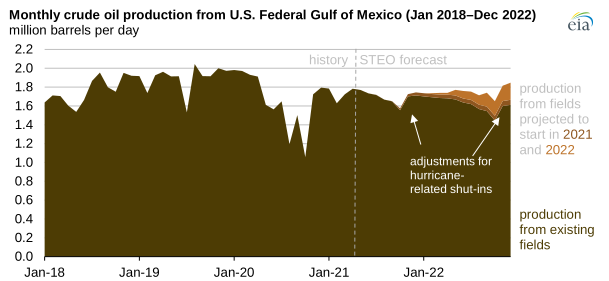
EIA (Chart 1) projects relatively stable GoM production over the next 2 years. Platt’s (Chart 2) is forecasting a slight decline in 2021 production primarily because of COVID-related delays in the initiation of production at Shell’s VIto and PowerNap and BP’s Mad Dog 2 and Thunder Horse South 2 facilities. Based on the latest available EIA data, current stabilized GoM oil production appears to be in the 1.7-1.8 million BOPD range.
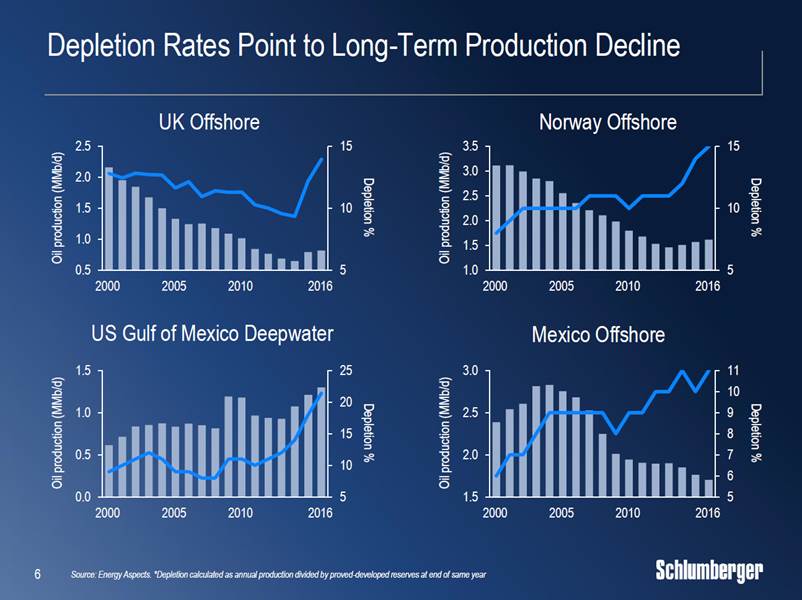
Going forward, the concern is the high rate of reserve depletion and the absence of drilling activity needed to replace reserves. Schlumberger data through 2016 (Chart 3) show depletion rates rising to above 20%, the highest (by far) of the offshore regions analyzed. I was unable to find more recent data, but unless this trend line has made a sharp turn, production declines are likely in the next 3-5 years. Further, drilling trends do not suggest the likelihood of significant reserve growth. Data from BSEE’s Borehole File (Chart 4) indicate deepwater well start activity that is comparable to the moratorium years of 2010 and 2011. Even more concerning is the absence of exploratory drilling (chart 5) and the very few operating companies that are drilling deepwater wells. Only five operators have spudded deepwater exploratory wells in 2021 YTD. One US supermajor hasn’t started a well since 2019, and another US major has essentially exited the Gulf.
Deepwater production trends are not easily reversed, so dialogue is urgently needed to assess the implications of declines in drilling, reserves, and industry interest. As the resource manager on behalf of the public, BOEM is the logical choice for initiating these discussions. BOEM’s Norwegian equivalent, the Norwegian Petroleum Directorate (NPD) demonstrates the importance of pro-active land management. The NPD has done an outstanding job of sustaining exploration activity and production consistent with Norwegian safety and environmental values, which are among the highest in the world. On their website, NPD provides ongoing updates on exploration, production, and reserve depletion parameters. Their competency and commitment to sustaining production on the Norwegian shelf is underscored in this news release, an excerpt from which is pasted below:
Exploration is of great importance for the long-term value creation on the shelf. The supply of oil and gas resources from new discoveries, as we have seen so far this year, is necessary so that activity in the petroleum industry does not fall sharply after 2030. Without new discoveries, production can fall by more than 70 percent in 2040 compared to 2020, says Torgeir Stordal, director of Technology and coexistence in the Norwegian Petroleum Directorate.
Following the Piper Alpha tragedy (1988) and the Exxon Valdez spill (1989), the Minerals Management Service, under the direction of Dr. Charles Smith, embarked on new research to address the human and organizational factors that are fundamental to offshore safety. An important 1993 report, MMS project 167, Management of Human Error in Operation of Marine Systems by Robert Bea and William Moore, observed that:
“High consequence accidents resulted from a multiplicity of compounding sequences of breakdowns in the human, organization, and system; often there are precursors or early-warning indications of the breakdowns that are not recognized or are ignored.” The human element is complex and “states” such as “fatigue, negligence, ignorance, greed, folly, wishful thinking, mischief, laziness, excessive use of drugs, bad judgement, carelessness, physical limitations, boredom, and inadequate.” Environmental factors such as weather conditions, time of day, smoke, and noise further complicate human performance.
Your unique insight on the impacts of the COVID-19 pandemic on members of the offshore workforce are vital to informing industry and the development of strategies that best support employee mental health and well-being.
BOE is looking forward to learning about the results of this survey and other efforts to better assess and understand mental health challenges facing offshore workers. The effective integration of mental health considerations into management systems is critical to safety achievement.
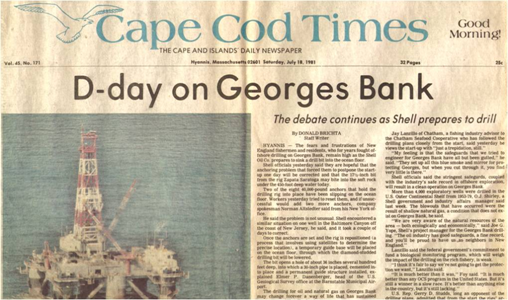
40 years ago today, drilling began on the first two exploratory wells on Georges Bank, a large seafloor feature that separates the Gulf of Maine from the Atlantic Ocean. The Cape Cod Times headline (below) attests to the drama that was unfolding 155 miles southeast of Nantucket. After years of debate, oil embargoes, gas lines, and the threat of future supply disruptions had tipped the political balance in favor of offshore leasing, and OCS Sale No. 42 (North Atlantic) was held one week before Christmas in 1979. Looking back, I find it remarkable that only 19 months elapsed between the lease sale and the initiation of drilling. During that time, bids were evaluated, exploration and spill response plans were drafted by the operating companies and reviewed by the Federal regulators and six coastal states, fisheries issues were addressed, and a comprehensive monitoring program was developed and initiated. Perhaps most impressive was the manner in which government (Federal and State), industry, and academic professionals with very different personal opinions about offshore drilling collaborated to assess and monitor impacts and mitigate risks.
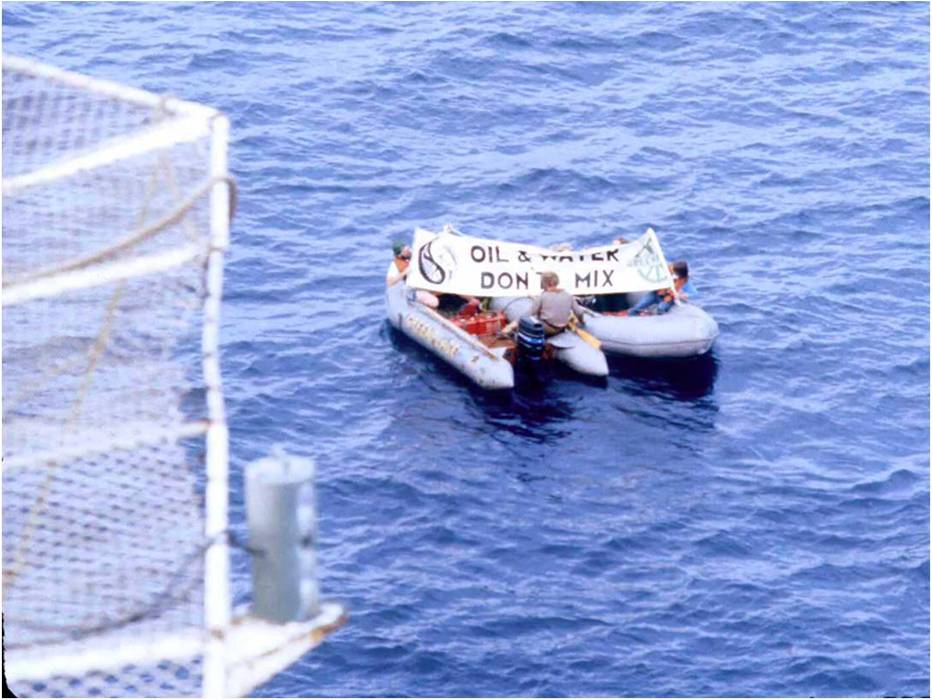
The protesters pictured above were dispatched to the Zapata Saratoga drilling rig from the Greenpeace vessel Rainbow Warrior. Given the remote location, the protest was unexpected. However, the drilling operation was not disrupted and no action was taken against the protesters. Four years later, the Rainbow Warrior was bombed by French commandos while in port in Auckland, NZ prior to planned protests against French nuclear testing in the South Pacific. Sadly, one crew member was killed during this incident.
Below is a list of the exploratory wells that were drilled on Georges Bank. In addition, two off-structure geologic test wells were drilled in 1976 and 1977. None of the wells discovered commercially significant oil and gas resources. However, gas shows led to erroneous press reports such as the article below. In 2000, the Minerals Management Service (MMS) published a summary of the geologic findings.
Operator Lease No. Block/Well Rig ___________
Water Depth (ft.)
_________
Lat/Long Miles SE Nantucket ____________
Onsite
__________
Spud
________
Offsite
_________
Well Depth (ft. ) ________
Exxon 0170 133/1 Alaskan Star
225
40°49’05” 67°56’03” 112
7/22/81
7/24/81
11/24/81
13,808
Shell 0218 410/1 410/1R Saratoga
452
40°34’24” 67°12’32” 155
7/10/81 8/8/81
7/24/81 8/10/81
8/8/81 3/31/82
875 15,043
Mobil 0200 312/1 Midland
260
40°39’27” 67°45’55” 125
11/21/81
12/8/81
6/27/82
19,652
Exxon 0153 975/1 Alaskan Star
209
41°00’24” 67°37’19” 125
11/24/81
11/25/81
3/10/82
14,313
Tenneco 0182 187/1 Alaskan Star
300
40°46’15” 67°23’19” 140
3/10/82
3/12/82
8/22/82
17,744
Shell 0210 357/1 Saratoga
265
40°36’51” 67°44’41″1 128
4/2/82
4/14/82
9/27/82
19,090
Conoco 0179 145/1 Aleutian Key
300
40°49’59” 67°17’06” 145
5/9/82
5/13/82
8/25/82
14,115
Mobil 0196 273/1 Midland
302
40°41’04” 67°30’12” 140
6/28/82
6/30/82
9/13/82
15,190
Excerpted from “Georges Bank Exploratory Drilling, 1981-1982” by EP Danenberger
Regulatory policy lessons from the Georges Bank experience:
Regulators with overlapping responsibilities function best as a joint authority, particularly at the field level. While MOUs/MOAs tend to be primarily for the purpose of protecting regulatory turf, joint authorities focus on the specific mission and how the performance objectives they can best be achieved. Capt. Barry Eldridge had the foresight to co-locate a USCG Marine Safety Detachment, headed by Bob Pond, adjacent to the USGS office at Barnstable Municipal Airport. This facilitated cooperative reviews, coordinated inspections, and joint exercises. This collaboration led to the first ever unannounced offshore response drills. Similar USCG/DOI organizational arrangements have proven effective in the Pacific and in the Gulf of Mexico, particularly for monitoring hurricane preparations and responses.
Strive to conduct regulatory functions at a single field office. USGS had the foresight to assign exploration plan review, environmental assessment, and coordination with State government responsibilities to our district office. As a result, our environmental specialists, geologists, engineers, and inspectors worked together, along with our State and Federal partners, from the initial planning to the decommissioning stages. Positive working relations were developed and everyone was informed and involved. A subsequent reorganization changed the structure of our office and led to greater control from Washington, which (unsurprisingly) was not helpful.
Transparency may be a bit of a buzzword, but it’s critical to regulatory success. Other than proprietary geologic information and well reports, we fully informed our regulatory partners about the status of activities, all incidents and near-misses, and any operational issues. Conveying news that is not-so-good, like the mooring failures that were experienced by 2 Georges Bank rigs, is part of the mission.
Those regulating the operations should be informed about and a part of the environmental monitoring programs. Our office worked closely with the Woods Hole and other scientist conducting the comprehensive Georges Bank Monitoring Program. In support of Mike Bothner, USGS Woods Hole scientist, we tracked every drilling fluid additive, and verified the materials that were available on each rig. Mike conducted a material balance on the barite and looked for chromium and other metals in sediments near the well sites. His outstanding work is summarized in this paper.
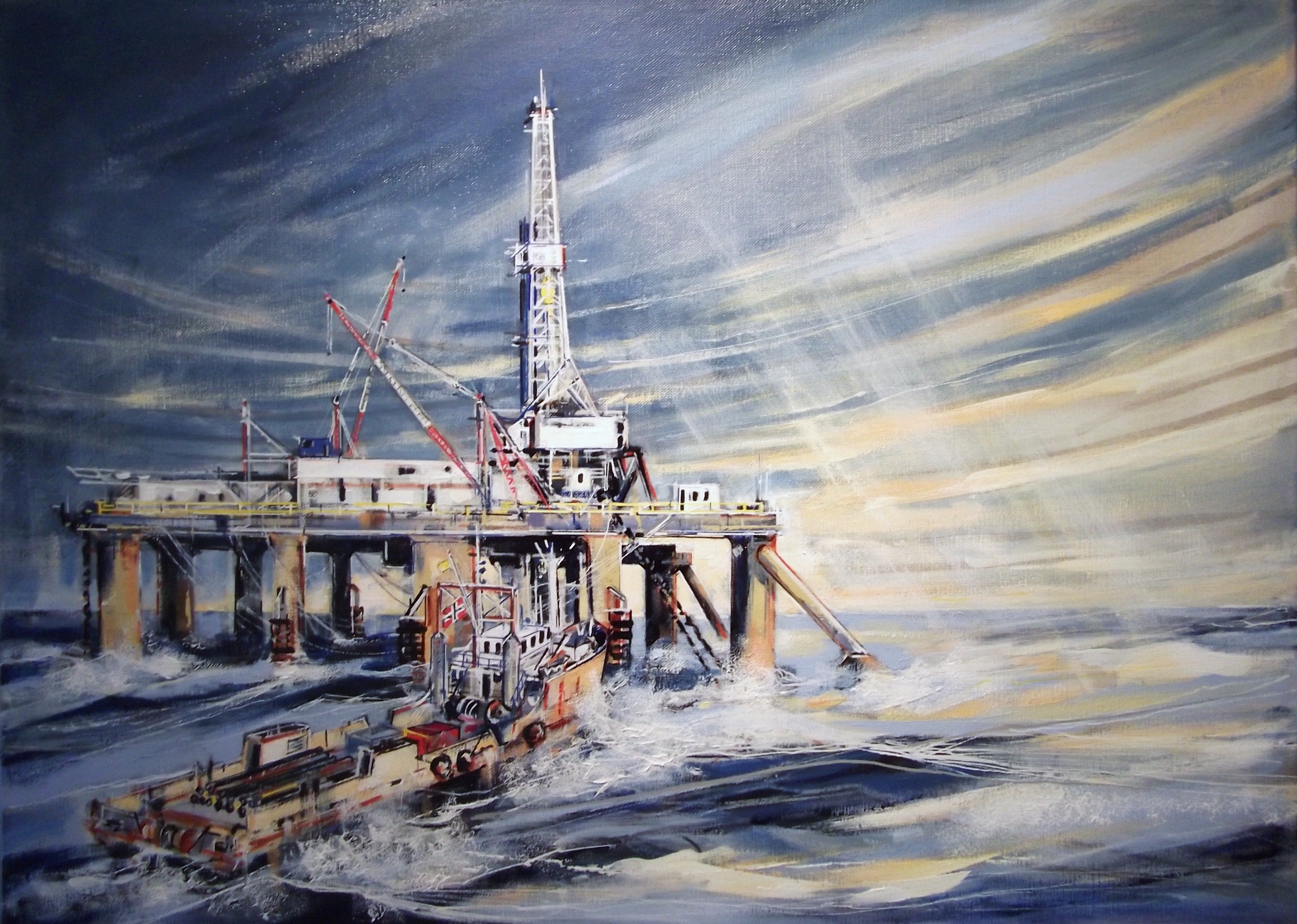
After a brief pause (only 10 years 😀), the BOE blog is set to return on 7/22/2021. In the meantime, I am sharing this outstanding painting by Jean-Louis Daeschler, a pioneering offshore engineer and a very accomplished artist. Click on the image to enlarge.
Painting by JL Daeschler. Sharing with his permission.





 Bud's Offshore Energy (BOE)