Feeds:
Posts
Comments

Archive for March, 2011

From Platts Oilgram News article by Gary Gentile:

The team examining the BOP in Louisiana conducted tests in January and February of this year that showed that with the proper amount of hydraulic fluid pressure, the rams on the BOP would close, according to Dan Tillema, an investigator with the US Chemical Safety Board.

Portions of drill pipe were found in the BOP and the pipe was cut, Tillema said—a sign that the rams did close at some point during the incident.

But Tillema cautions against making any assumptions based on the test results sofar. Some reports have suggested that rubber gaskets around the rams were worn awayby the massive flow of oil and gas gushing from the Macondo well, overcoming the BOP’s capacity. That is just one of several possibilities, Tillema said. “We haven’t made any conclusions yet,” he said.

Read Full Post »

In recent years various bodies have concluded that certain MMS offices and programs have violated ethical rules or guidelines. In the wake of the Deepwater Horizon disaster, some questioned whether ethical lapses played any role in causing the blowout. The Chief Counsel‘s team found no evidence of any such lapses.

National Commission on the BP Deepwater Horizon Oil Spill and Offshore Drilling, Chief Counsel’s Report, page 261

Read Full Post »

“The Honda Civic GX (the only NGV available to U.S. consumers and repeat winner of the ACEEE Green List) has been so successful Honda predicts it will double GX sales in the U.S. this year after doubling them in 2009. Utah, Oklahoma and California have been very successful in building out natural gas infrastructure and deploying NGVs that are refueling with natural gas.” SeekingAlpha.com

While I don’t agree with everything in this article, the numbered points are right on target. Increased use of natural gas for transportation is the best near- and intermediate-term option for reducing oil consumption and imports, air emissions, and transportation costs.

Supply does not appear to be an issue in light of the numerous domestic options including shale gas, Alaskan gas, coalbed methane, and conventional onshore and offshore gas.  Given the proximity of enormous shale gas resources to major markets, shale gas is the featured attraction. However, this is an offshore blog, and from a strictly environmental perspective, offshore gas is the preferred option.  Why?

  • No freshwater contamination issues
  • Small environmental footprint – limited facilities needs and minimal space preemption
  • No production in or near residential areas
  • Potential production near major natural gas markets. For example, there is a natural gas discovery in the Atlantic approximately 100 miles southeast of the New York City area. (Before my geologist friends get upset, I will point out that the productive reservoirs are highly complex and further exploration is necessary to determine whether this field – the former Hudson Canyon Unit – and other Atlantic prospects are commercially viable.)
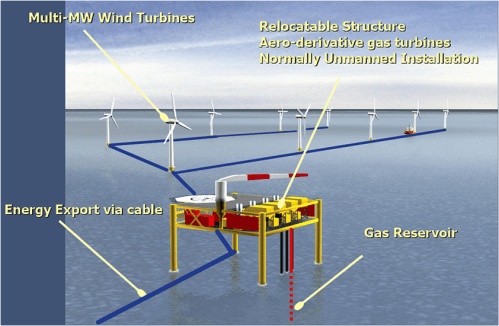
  • Potential for combining offshore gas and wind projects into offshore energy units that can ensure consistent power supply. (See slide below from a presentation by George Hagerman, Virginia Tech Advanced Research Institute)
Read Full Post »
The Petroleum Safety Authority Norway (PSA) has initiated an investigation following an incident in connection with a lifting operation on the Gullfaks A facility on 28 February 2011.

See the full PSA announcement

Comment: PSA is applauded for their transparency in reporting accidents. When every regulator, operator, and contractor routinely posts accident information on their home page, we will have made a major step forward in collectively improving the safety culture and preventing future incidents.

Read Full Post »

From PSA’s recent Safety Forum:

Over the last few years, there have been a great number of incidents in the industry related to loss of position, including dynamic positioning. A project has been started under the direction of the rig industry and the Norwegian Shipowners’ Association in order to reduce the number of serious anchoring incidents on the Norwegian shelf.

The project, which is being led by an Anchoring forum, has an ambition of a 75 percent reduction in serious anchoring incidents on the Norwegian shelf by 2010, compared with 2006. A status report will be given regarding goal achievement at the next Safety Forum meeting.

Given the US experience with hurricane mooring issues, the recent Gryphon Alpha incident, and other station keeping failures around the world, this is an excellent opportunity for international cooperation.

Read Full Post »

Rep. Tim Murphy’s (R-Pa.) bill states that companies with drilling permits approved before early May 2010 can proceed with exploration or production “without further review” by the Interior Department, and “without further review or delay” under various environmental laws. The Hill.com

Read Full Post »

GAO’s report entitled “Opportunities to Reduce Potential Duplication in Government Programs, Save Tax Dollars, and Enhance Revenue” has just been released. The report identifies $billions in potential savings that could be realized by reducing program duplication.

Comments:

  1. Not only could taxpayer dollars be saved by reducing overlap and duplication, but greater efficiencies and safety benefits would be achieved.  As BOE has frequently noted, a single agency should be responsible and accountable for safety and pollution prevention at offshore facilities. For regulators, “overlap means underlap.” Important issues are sure to be overlooked, misunderstood, or confused. Jurisdictional redundancy inevitably results in unnecessary complexity, and regulatory and industry personnel are required to spend too much time resolving and coordinating administrative and procedural matters.  This time would be better spent focusing on mission critical safety issues.
  2. Much of the duplication among agencies is the result of the overlapping responsibilities of congressional committees, complex and poorly crafted legislation, and insufficient emphasis on function-based management.
  3. Program savings achieved by one government unit are immediately absorbed by another, discouraging cost-effective management practices. Senior and mid-level Federal managers should be able to transfer savings directly to a debt reduction fund that cannot be used for any other purpose. Federal managers should receive positive recognition for savings and efficiency, not criticism or immediate budget reductions.

Read Full Post »

From Platts Oilgram News:

The well had previously been drilled to a depth of 13,585 feet at the time of the moratorium, Noble said. Drilling is expected to resume in late March, targeting total drilling depth of about 19,000 feet, Noble said. Results are expected by the end of May. Noble said it will use the Ensco 8501 rig for the project.

Ensco 8501

Read Full Post »

Charlie Sheen, currently unemployed, is being recruited to direct BOE’s Not My Job Awards program.

Charlie has repeatedly demonstrated habits and personality traits that make him uniquely qualified to serve as our Not My Job Awards program director. He is a hero to Not My Jobbers worldwide and would elevate that program to the next level. BOE Management

Read Full Post »

Secretary Salazar will appear before the Senate Energy and Natural Resources Committee on Wednesday (2 March) at 10:00 am ET and the House Natural Resources on Thursday (3 March) at 10:00 am ET. Expect deepwater drilling and other offshore energy questions.  Both hearings will be streamed live at the respective websites.

Read Full Post »

« Newer Posts