Feeds:
Posts
Comments

Archive for January, 2011

Jokes about national disasters are not very funny to most of us, so I think Dave Barry’s flip comments about the blowout were ill advised. Perhaps Dave, like many others, never noticed or has forgotten that the blowout killed eleven workers. Despite the continuous coverage of oil flowing into the Gulf, this reality show wasn’t for amusement purposes.

That said, one comment in Dave’s review did make me smile.  This line has been recycled for years in various forms, but always draws a reaction:

Meanwhile, Congress holds televised hearings that establish, beyond any reasonable doubt, that Congress is very upset about, and totally opposed to, large oil spills.

Read Full Post »

In the Wall Street Journal, Rex Tillerson says that the Macondo blowout was not caused by systemic problems within the industry:

The explosion aboard the Deepwater Horizon rig, resulting in the massive oil spill in the Gulf of Mexico, was caused by its operators’ decisions and not by general problems in the oil industry, Exxon Mobil Corp. Chief Executive Rex Tillerson said Thursday.

But then seems to contradict that statement:

“It’s really up to the industry” to make sure regulation is strong and disasters like these don’t happen again, he said.

So, isn’t the second quote acknowledging a systemic problem?

Read Full Post »

Wall Street Journal

The conclusions of the presidential commission’s inquiry into the causes of the Deepwater Horizon accident published Thursday make it increasingly likely that BP will not be found grossly negligent and will avoid the harshest financial penalties for the Gulf of Mexico oil spill.

Pre-trial orders

Siding with arguments by the Plaintiffs, Judge Barbier concluded that the depositions should go forward in New Orleans, rather than in Houston as preferred by BP.

BP vs. TO vs. Halliburton (quotes from New York Times article)

In a statement on Wednesday, BP noted that the commission had found fault with a number of companies, not only BP, the main owner of the well.

Halliburton said in a statement that it had acted at BP’s direction in preparing and injecting cement into the well. It said tests the panel identified as indicating problems with its cement formula were preliminary and did not contribute to the disaster. Halliburton also criticized the commission for what it called selective omissions of exculpatory material it gave to the panel’s staff.

A spokesman for Transocean said that BP, not Transocean, made the major decisions in the hours before the blowout. “Based on the limited information made available to them, the Transocean crew took appropriate actions to gain control of the well,” the spokesman said. “They were well trained and considered to be among the best in the business.”

Read Full Post »

Link to the full report

What?

The blowout in the Gulf of Mexico could have been prevented if the last-line of defence—the blind shear ram on the blowout preventer, located at the well head on the ocean floor—had activated and crushed the drill pipe. Given the importance of this equipment, and the evident dangers of relying on a single device, we urge the HSE to consider prescribing specifically that blowout preventers on the UK Continental Shelf should have two blind shear rams.

Comments:

  1. The UK government should NOT be commenting on the BOP failure until the US government has completed its forensic testing and investigation.
  2. The Committee has apparently not paid any attention to the testimony on the BOP issues or the other BOP information that has surfaced.  Have they not seen the comments from BP and Transocean or the videos shot on the Q4000?
  3. Would it have been appropriate for the US government to publish a report on Piper Alpha before Lord Cullen had completed his review?

Read Full Post »

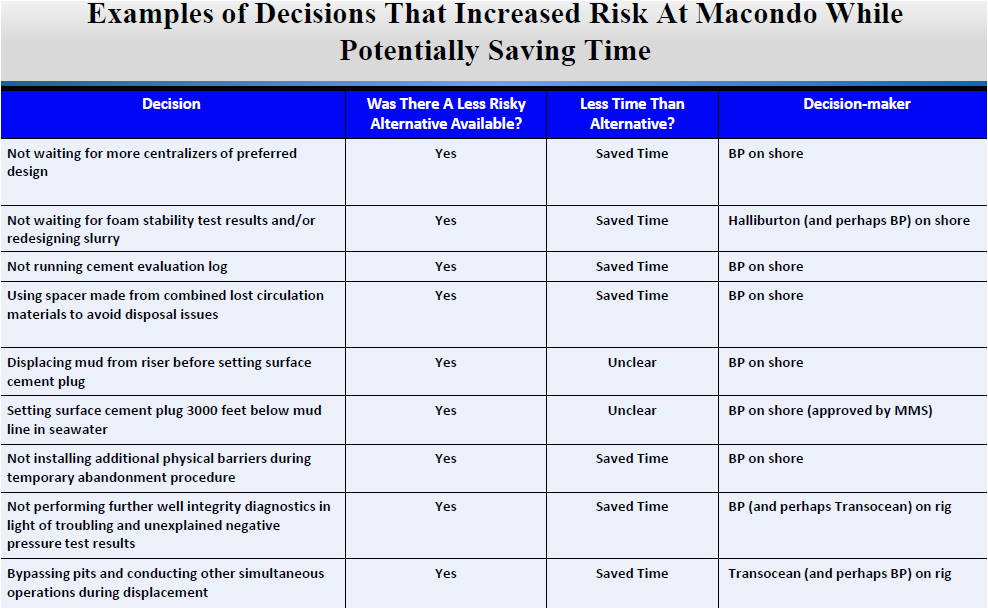
click on table to enlarge

Click for the chapter on the causes of the blowout

Read Full Post »

The UK Energy and Climate Change Committee has released its report entitled “UK Deepwater Drilling – Implications of the Gulf of Mexico oil spill.” We’ll post the report as we get a link.

Here’s the gist:

A moratorium on oil drilling in deep waters off Britain would undermine the country’s energy security, according to a report by lawmakers published on Thursday in response to the BP spill disaster last year.

Read Full Post »

Well, well. In early March, Cuba will commence with deep water drilling under contract with Repsol and Statoil ASA, using an older rig that was recently rehabbed by the Chinese. Reports indicate that it has fewer safety features than the BP’s infamous Deepwater Horizon. The site is located a scant sixty miles southeast of Key West, Florida. Benzinga.com

There are some  errors and unsupported opinions in this article, so I would take the March spud date with a grain of salt.  As confirmed by Rigzone, the Saipem Scarabeo 9 is a new rig, not a rebuild. It was built in China and commissioned in Singapore. The inflammatory comment about the rig having fewer safety features than the Deepwater Horizon is also without substance. Everything about the Scarabeo 9 appears to be state-of-the-art.

While a projected 2011 spud date has been reported and appears likely, Cuba’s deepwater drilling program has been marked by repeated delays. BOE has seen no confirmation that the rig has arrived or is en route to Cuba. We would appreciate any updates that others might be able to provide.

Read Full Post »

The updated Norwegian health, safety, and environmental regulations, effective 1 January 2011, are now available online. This includes applicable regulations that other Norwegian authorities (in addition to PSA) oversee.

Read Full Post »

Associated Press story forwarded by Cheryl Anderson:

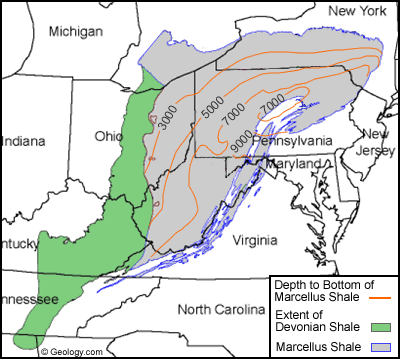
In the two years since the frenzy of activity began in the vast underground rock formation known as the Marcellus Shale, Pennsylvania has been the only state allowing waterways to serve as the primary disposal place for the huge amounts of wastewater produced by a drilling technique called hydraulic fracturing, or fracking.

State regulators, initially caught flat-footed, tightened the rules this year for any new water treatment plants but allowed any existing operations to continue discharging water into rivers.

Pennsylvania shale gas producers seem to be getting the message, but the industry is once again in a reactive mode. Where was the leadership during the critical first two years?  Why were new regulations needed to address the obvious?

Records verifying industry claims of a major dropoff in wastewater discharges to rivers will not be available until midwinter, but John Hanger, secretary of Pennsylvania’s Department of Environmental Protection, said he believed that the amount of drilling wastewater being recycled is now about 70 percent — an achievement he credits to tighter state regulation pushing the industry to change its ways.

“The new rules, so far, appear to be working,” he said. “If our rules were not changed … we would have all of it being dumped in the environment, because it is the lowest cost option,” Hanger said.

That last sentence must be painful reading for industry’s true safety and environmental leaders. The Marcellus Coalition, and the rest of us, need to remember this message:

We’re all in this together. We’re all only as good as whoever had a mistake this morning.

Read Full Post »
Anchorage Daily News:

The federal Environmental Appeals Board, which is part of the EPA, reviewed the permits. It found last week that the analysis of the impact of nitrogen dioxide emissions from the ships on Alaska Native communities was too limited, and remanded the permits so that problems cited by the board could be fixed by the agency.

The closest proposed drill site is 60 miles off shore and about 80 miles from Wainwright, an Inupiat Eskimo village 710 miles northwest of Anchorage.

Read Full Post »

« Newer Posts - Older Posts »