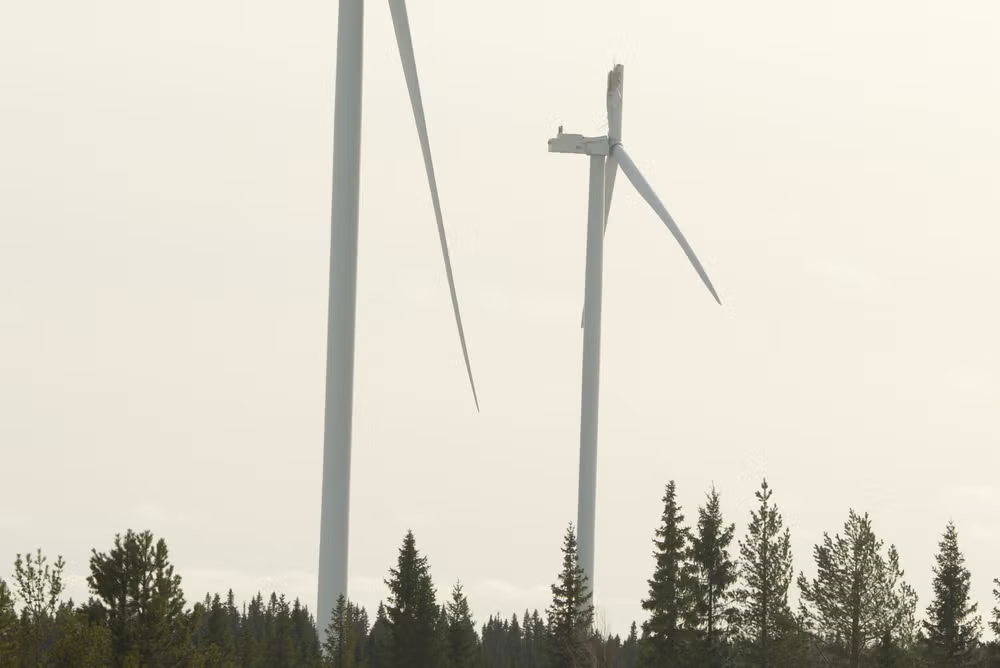
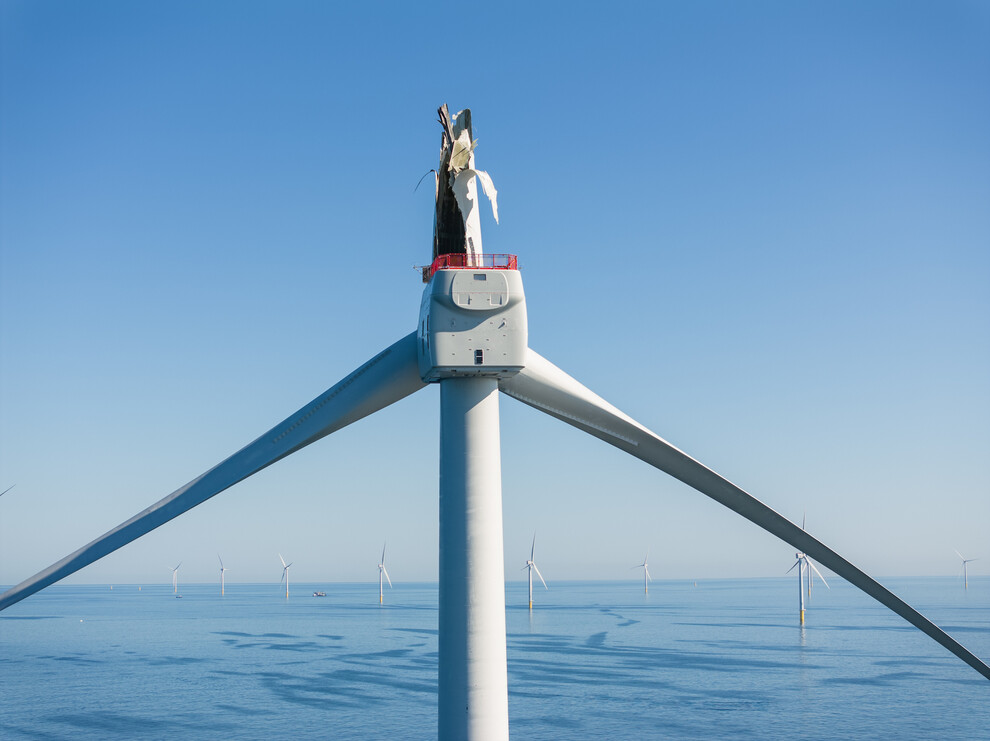
Broken blade at GE wind turbine at Björkvattnet wind farm in Sweden. Alexander Pohl photo posted at Recharge Per Recharge: The first blade break at the wind farm was probably caused by a manufacturing defect, and the second was damaged during installation. According to regional newspaper Jämtlandstidning, local residents were complaining about not getting sufficient information about the third such incident.
“We don’t know what’s happening because we’re not told anything,” Terese Björk, who witnessed the broken blade on Friday, told the newspaper.
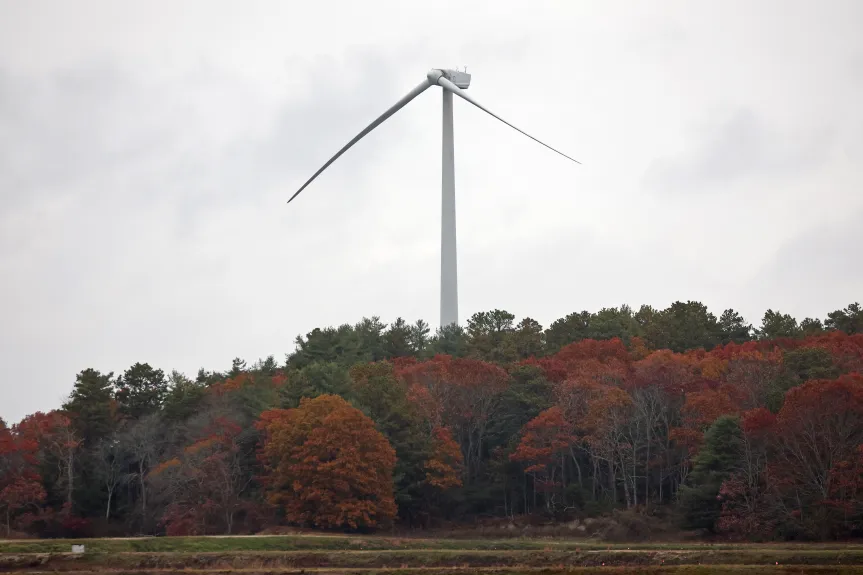
Plymouth MA wind turbine that lost a blade. (Stuart Cahill/Boston Herald)
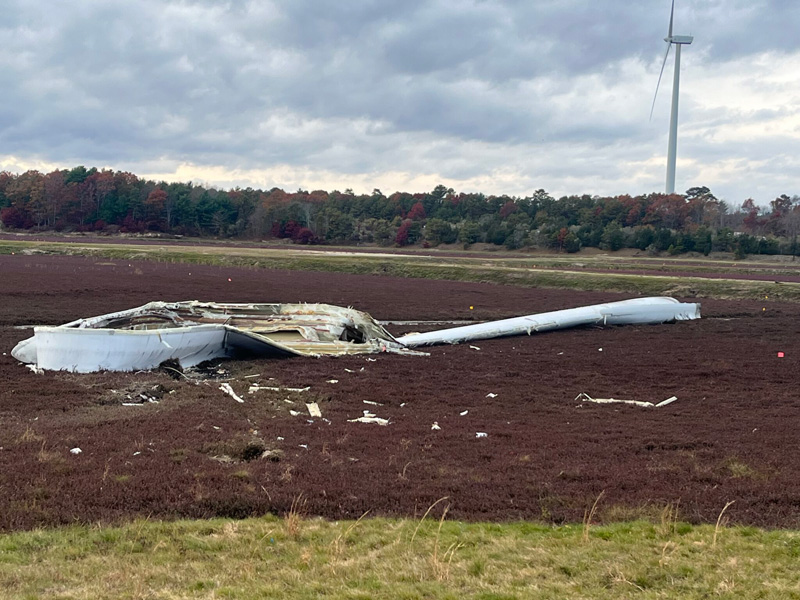
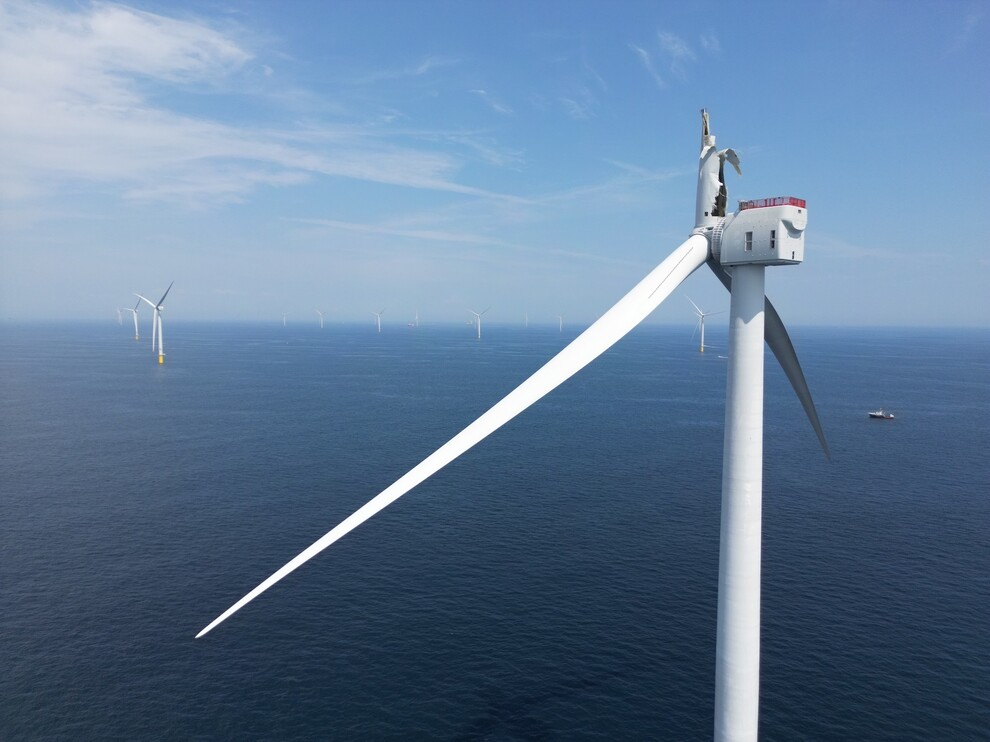
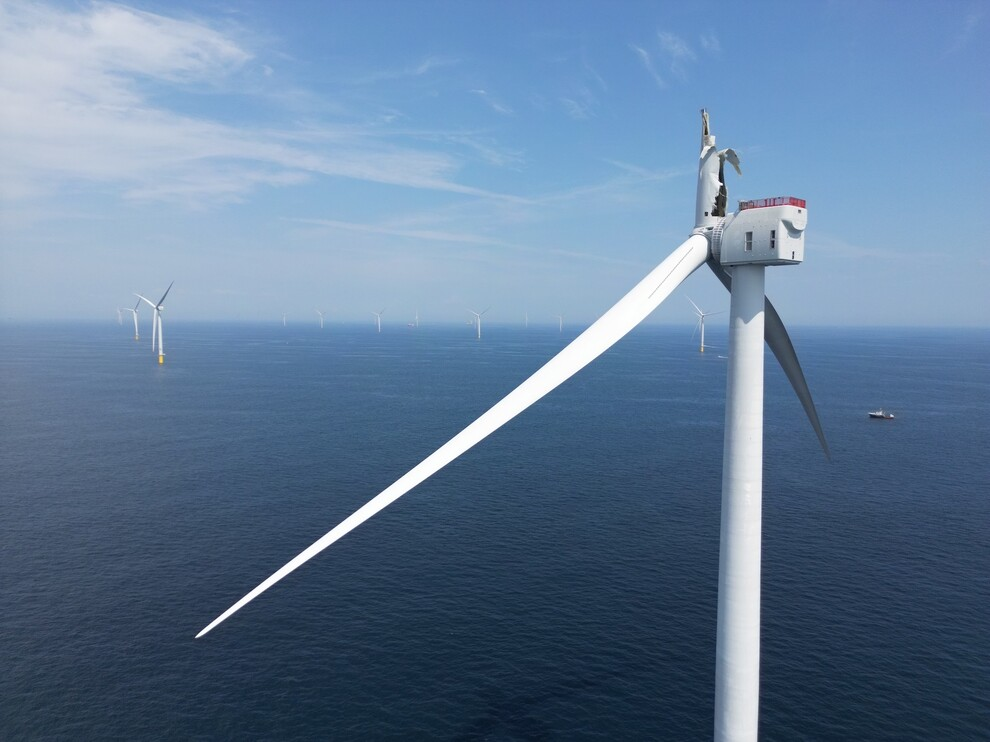
Friday’s turbine blade failure in Plymouth MA is perhaps getting added attention given its proximity to the 7/13/2024 Vineyard Wind blade failure offshore Nantucket. The Plymouth blade landed in a nearby cranberry bog (video and picture below).
Per the MV Times, the turbines for the Plymouth project were manufactured by Gamesa, which is now part of Siemens Gamesa. Both the South Fork Wind and Revolution Wind projects off the coast of the Martha’s Vineyard are being developed by Ørsted using turbines from Siemens Gamesa. Coastal Virginia Offshore Wind, the largest offshore wind project in the United States, is also being developed with Siemens Gamesa turbines. This is not to imply a higher degree of risk for those turbines. Vineyard Wind, where the only US offshore failure has occurred to date, is using GE Vernova turbines.
Unfortunately, turbine blade failures are much too common. Last October, Lars Herbst reported, based on a Wind Power article, that “with an estimated 700,000 blades in operation globally, there are, on average, 3,800incidents of blade failure each year.” Lars noted that the annual blade failure rate of about 0.5% translates to 1.5% of all operating wind turbines experiencing a blade failure every year, a remarkably high failure frequency.
Scotland Against Spin data indicate that blade failure is the second most common accident type in the wind industry, and the most common cause of accidents at operational wind turbine sites. SAS reports further that pieces of blade are documented as travelling up to one mile, and have gone through the roofs and walls of nearby buildings.
Lastly, we are still awaiting BSEE’s report on the Vineyard Wind failures so we can better understand what happened and why.
Updatedincident tables for OCS oil and gas operations. The most recent data are nearly 2 years old. The public has a right to timely information on the type of incidents that are occurring, the operating companies, and the resulting casualties, pollution, and property damage.
A summary of incidents associated with the OCS wind program. From press reports, we know about the fatality during Empire Wind construction. What other incidents have occurred to date?
Nantucket Current:Nantucket officials and attorneys will hold a press conference next Tuesday, July 29th, at 9:30 a.m. regarding “Vineyard Wind’s failure to meet its legal and public commitments to the community.”
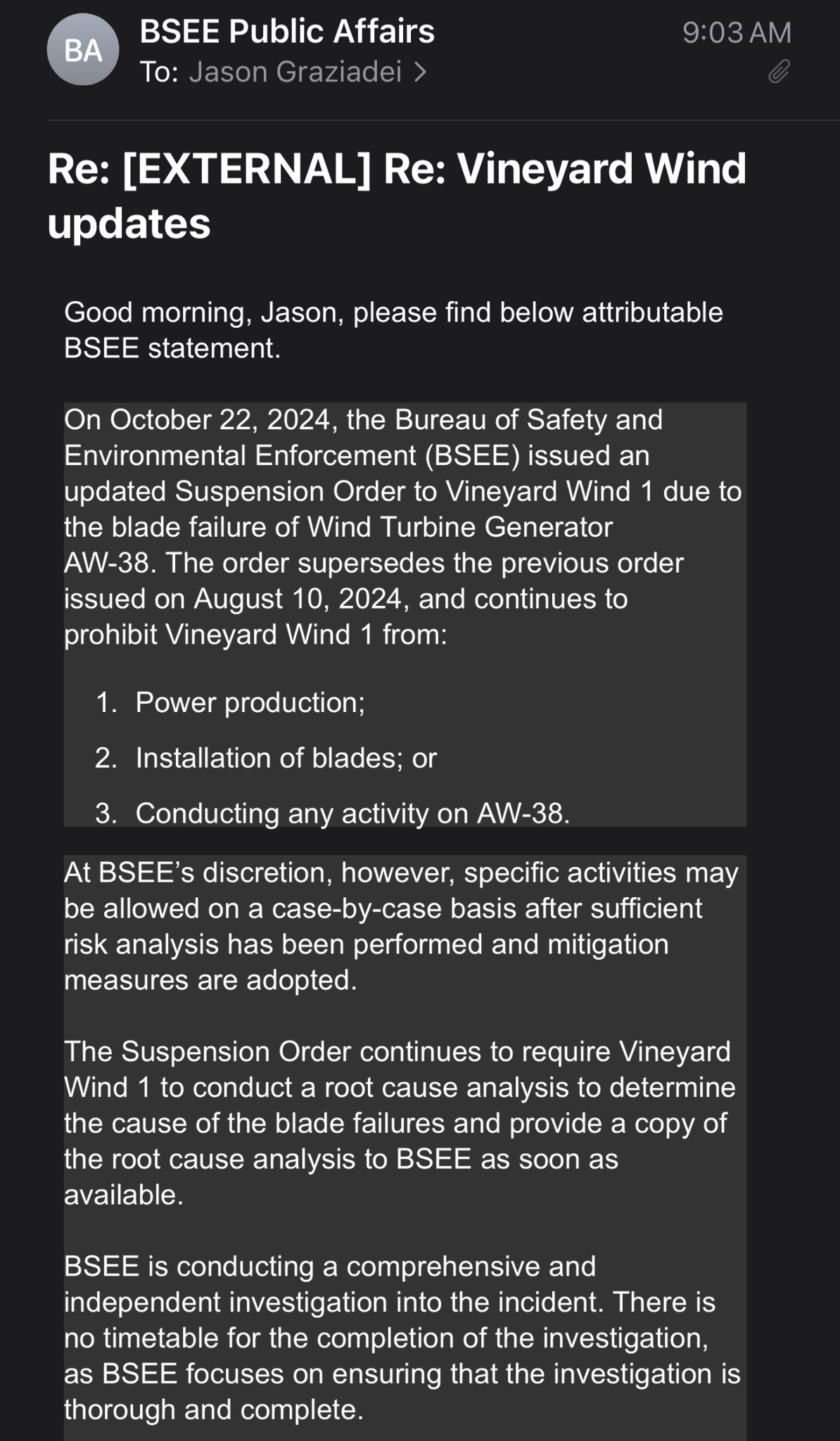
“BSEE’s comprehensive and independent investigation is ongoing,” an agency spokesperson wrote in an email to the Current on Tuesday. “There is no timetable for the completion of the investigation, as BSEE focuses on ensuring that the investigation is thorough and complete.”
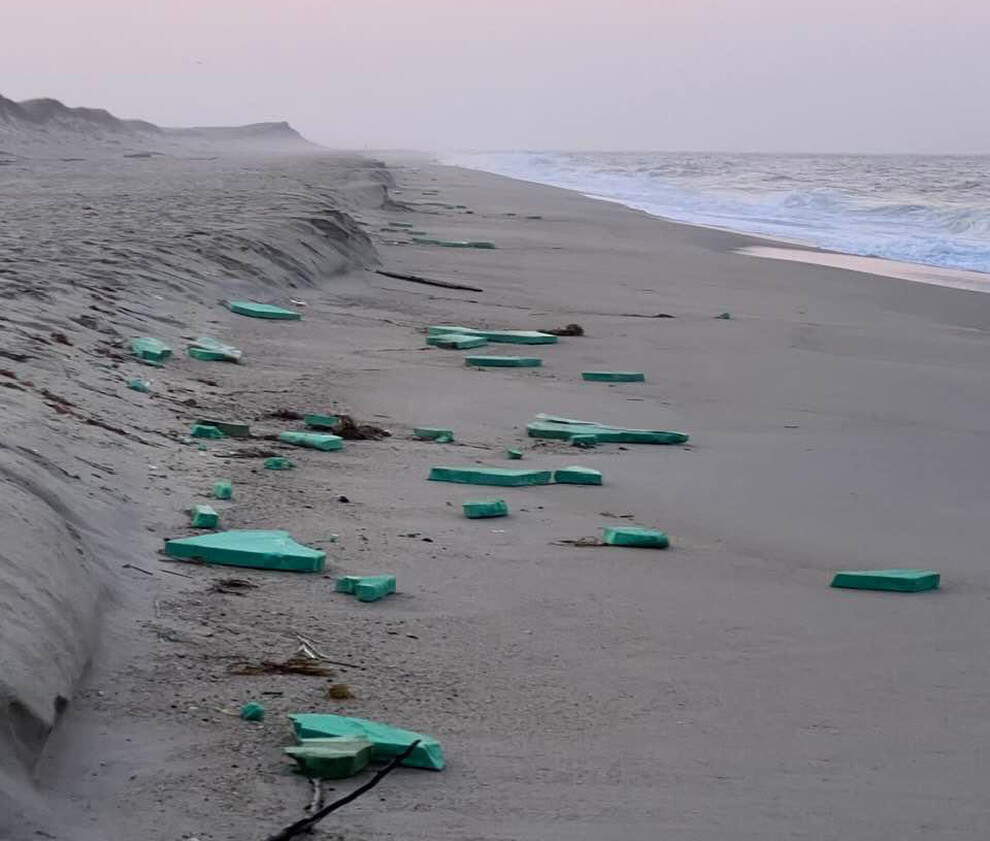
Debris from the failed Vineyard Wind blade littering the south shore of Nantucket in July 2024. Nantucket Current photo.
Nantucket reached a settlement agreement (attached) with turbine manufacturer GE Vernova (GEV), praising that company while criticizing Vineyard Wind (VW), the lessee and operator:
“The Town of Nantucket commends GE Vernova for its leadership in reaching this agreement. By contrast, the Town has found Vineyard Wind wanting in terms of its leadership, accountability, transparency, and stewardship in the aftermath of the blade failure and determined that it would not accept Vineyard Wind as a signatory to the settlement,”the town stated Friday morning.
Comments:
For a relatively modest sum ($10.5 million) paid by the contractor (GEV), the agreement further limits the Town’s ability to hold Vineyard Wind, the lessee and operating company, accountable. See sections 4, 5(a), and 9 of the agreement.
The Town’s ability to challenge the project was already compromised by their unpopular “Good Neighbor Agreement.”
What ever happened to operator responsibility? This fundamental tenet of the OCS oil and gas program also applies to offshore wind. Vineyard Wind should be the party that is fully accountable for the damages associated with their project. VW can seek compensation from GEV, but VW is the accountable party.
Can you imagine if BP had attempted to stay on the sidelines while Transocean and other contractors settled claims associated with the Macondo blowout? Unthinkable!
Nantucket should have insisted on VW’s participation, rather than excluding them.
What does the lessor, the Federal govt, have to say about damage compensation? Are civil penalties forthcoming? When will we finally see the BSEE investigation report!
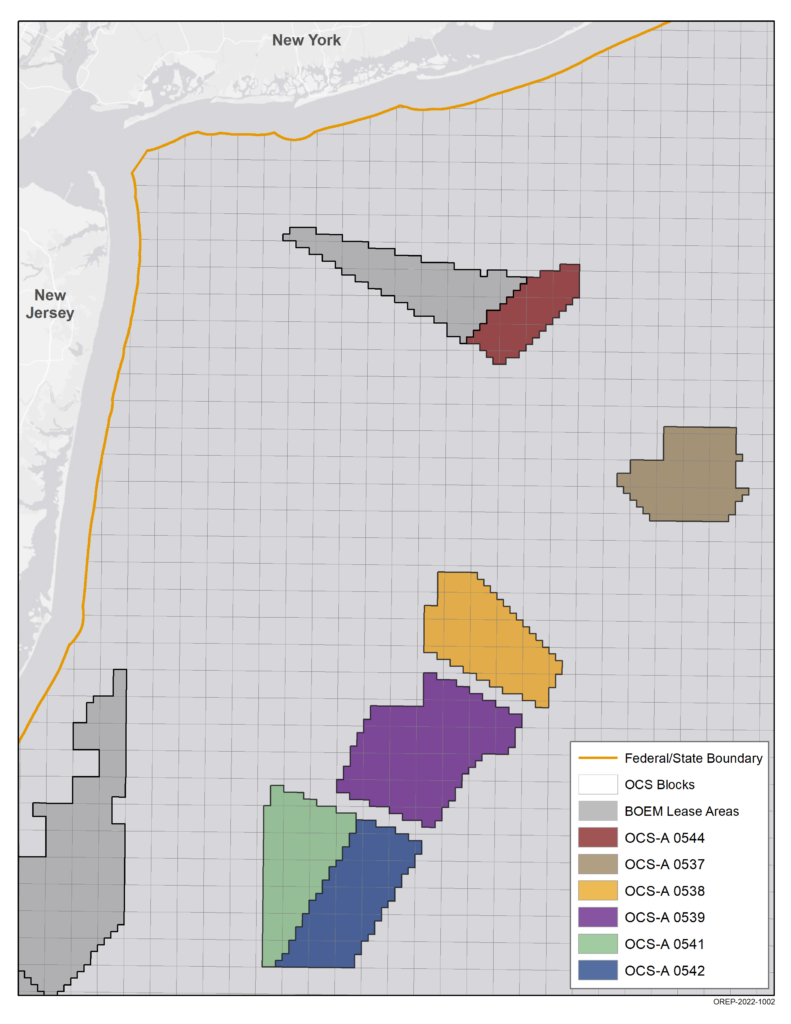
Bidding at the February 2022 Atlantic (NY/NJ) wind saleseemed incomprehensible given the economic and political uncertainties associated with offshore wind development.The 6 leases garnered bids ranging from $285 million to an astounding $1.1 billion, with total high bids of $4.37 billion! The Administration’s victory message correctly boasted that this was the “nation’s highest grossing competitive energy lease sale in history.”
The intense bidding was driven by the lure of subsidies, guaranteed power sales, unprecedented Federal and State promotion, peak climate activism, inattention to mounting public opposition, and irrational expectations regarding the role of offshore wind in powering the regional economy.
The table below summarizes the sale results and the current status for the 6 leasesissued following the 2/2022 sale. One lease has been essentially terminated by the partners and the State. The other leases are in holding patterns in the planning phases.
high bidder
lease #
acres
bid ($millions)
status
Bluepoint Wind (EDP, ENGIE, Global Infrastructure Partners)
The first US commercial offshore project, Vineyard Wind, has proven to be a major step backward for the wind industry. After being granted questionable financial and quality assurance waivers to reduce costs and “allow Vineyard Wind to adhere to its construction schedule,” the July 2024 turbine blade failure and subsequent lightning strike have raised new questions about the technology, industry, and regulatory regime. The report on the blade failure, which should arguably be a precursor to the resumption of Atlantic wind development, has yet to be released.
The one shining light, relatively speaking, for Atlantic wind development, has been Coastal Virginia Offshore Wind. That large project is on track to be completed at the end of 2026. Although the cost has risen about nine per cent, to $10.7 billion, that increase is understandable given the higher than anticipated costs for upgrading the onshore network.
LM/GE Vernova turbine blade plant. Photo credited by the New Bedford Light to Jean-Philippe Thibault/Journal Gaspésie Nouvelles.
On Oct. 24, Radio Gaspesie reported serious data falsification allegations related to the manufacturing GE Vernova turbine blades at their Gaspé, Quebec facility. GE Vernova’s delay in commenting on those charges is surprising given their economic and legal implications in both Canada and the US.
GE Vernova has informed the New Bedford Light that they have taken corrective actions at their blade facility in Gaspé after an extensive internal review of their blade manufacturing and quality assurance program. However, they have yet to comment on the data falsification allegations.
Actions speak louder than words, and the Light reports that GE Vernova laid off nine managers and suspended 11 unionized floor workers at the Gaspé factory. A representative for the union informed the Light that the production manager has been dismissed and the general manager has resigned.
Neither Vineyard Wind nor BSEE, the Federal safety regulator for the Vineyard Wind project, has commented on the matter. BSEE’s investigation of the blade failure is still pending and has seemingly gotten more complicated as a result of the manufacturing issues.
In addition to legal proceedings in Quebec, GE Vernova and Vineyard Wind are subject to possible civil and criminal penalties in the US. Civil penalties, which are administered by BSEE, seem likely given the extensive pollution from turbine blade fragments.
Criminal penalties, which are possible if the data falsification charges are proven true, are imposed by the Dept. of Justice. The applicable criminal penalties statute is pasted below.
Any person who knowingly and willfully (1) violates any provision of this subchapter, any term of a lease, license, or permit issued pursuant to this subchapter, or any regulation or order issued under the authority of this subchapter designed to protect health, safety, or the environment or conserve natural resources, (2) makes any false statement, representation, or certification in any application, record, report, or other document filed or required to be maintained under this subchapter, (3) falsifies, tampers with, or renders inaccurate any monitoring device or method of record required to be maintained under this subchapter, or (4) reveals any data or information required to be kept confidential by this subchapter shall, upon conviction, be punished by a fine of not more than $100,000, or by imprisonment for not more than ten years, or both. Each day that a violation under clause (1) of this subsection continues, or each day that any monitoring device or data recorder remains inoperative or inaccurate because of any activity described in clause (3) of this subsection, shall constitute a separate violation.
See the translated excerpts below from a Radio Gaspesie report. This is a massive scandal if true.
“Yesterday, the vice-president of global operations at GE Vernova reportedly addressed all employees at the Gaspé plant to provide an update on the situation.
The investigation, led by GE Vernova’s lawyers, reportedly revealed that employees were asked by senior company executives to falsify quality control data. Data associated with a well-made blade was then associated with poorly made blades. Our sources indicate that this is a widespread practice in the industry.
The senior management of the Gaspé plant also allegedly implemented a points system that encouraged employees to skip verification steps, thus prioritizing production quantity over quality.
Our sources say the points system allegedly involved tight management oversight that bordered on intimidation of employees.
The oversized 107m blades that were produced in Gaspé for the construction of marine parks are said to be affected. The integrity of the entire production of the longest blades in America is currently being called into question.“
BSEE: Vineyard Wind is still prohibited from installing blades, producing power or conducting any activity on the damaged A-38 turbine.
GE: We are “really now getting to a point of shifting back to execution out at sea.” (Not at all what BSEE said.)
BSEE: BSEE may permit other specific activities after a risk analysis has been performed and mitigations adopted.
GE: We were “granted approval to return to installing new blades on turbines at the project once stringent safety and operational conditions are met.” (Positive spin of the BSEE statement implying that approval is assured.)
BSEE:Root cause analysis of the blade failure has not yet been provided to BSEE.
GE: “We have finalized root cause analysis and confirm the blade at issue at Vineyard Wind was caused by a manufacturing deviation from our factory in Canada.” (Then why doesn’t BSEE have the analysis? Is the Canadian plant being scapegoated?)
BSEE:No timetable for completion of BSEE investigation (This could present a dilemma for BSEE. How do you allow the resumption of blade installation and power generation before the investigation has been completed? Will the report be held until the Harris or Trump administration gives the go-ahead?)
BREAKING: Vineyard Wind and GE Vernova will be removing “some blades” from the wind farm following inspections and re-examination of ultrasound images, along with physical inspections of blades with “crawler” drones.

 Bud's Offshore Energy (BOE)