Feeds:
Posts
Comments

Posts Tagged ‘Sale 257’

Unsurprisingly, the carbon capture and sequestration (CCS) hype is fading fast. No other carbon strategy is so strongly opposed by both climate change activists and skeptics.

Support for CCS seems to be limited to those seeking to profit from subsidies, mandates, and disposal fees. In 2022, Exxon projected a $4 trillion CCS market by 2050. Pipe dream?

“Highlights” of the Gulf of America OCS carbon disposal era:

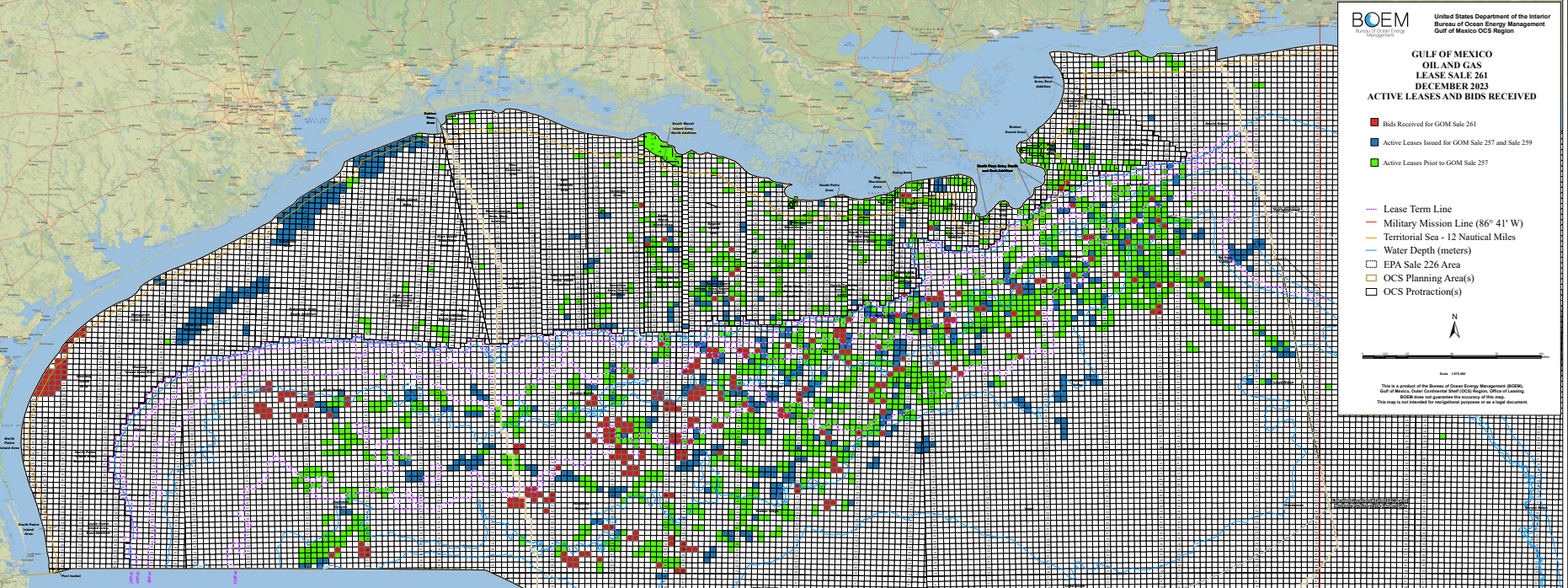
Gulf of America lease map: 199 oil and gas leases were wrongfully acquired for carbon disposal purposes. At Sale 261, Repsol acquired 36 nearshore Texas tracts in the Mustang Island and Matagorda Island areas (red blocks at the western end of the map above). Exxon had acquired 163 nearshore Texas tracts (blue in map above) at Sales 257 (94) and 259 (69).

Even those of us who are supporters of responsible offshore oil and gas production find it a bit unsavory that some companies are looking to cash in on (and virtue signal about) carbon collection and disposal at the public’s expense. Perhaps companies that believe oil and gas consumption is harmful to society should be seeking to reduce production rather than engaging in enterprises intended to sustain it.
Read Full Post »

A post from last March discussed the high and seemingly unfair royalty and rental rates for new leases in the shallow waters of the Gulf of Mexico shelf. A 50% increase in the shelf royalty rate for lease sales 259 and 261 combined with rather punitive rental rates have likely contributed to the sharp decline in bidding for shelf lease blocks (see table below).

This decline in shelf bidding is unfortunate because the smaller companies that operate in the shallow waters of the Gulf are critical to sustaining the production infrastructure. These companies are also significant producers of environmentally favorable nonassociated (gas-well) natural gas.

lease saleshelf blocks with bids
(excluding CCS bids)
sum of high shelf bids
($million, excluding CCS bids)
25746$8.1
25929$4.1
26113$1.7
The royalty rate for shelf production jumped 50% from sale 257 to sales 259 and 261

BOEM has completed their evaluation of the Sale 261 shelf bids (see below). Each of these blocks received only a single bid, and every bid was accepted. Ironically, the invalid CCS bids for blocks that have no oil and gas value, were the first to be accepted. This was also the case for Sales 257 and 259.

(1) All of the Repsol bids were $32.50/ac. Total bids varied by block size, but were $187,200 for the 5760 acre blocks.
  • Seek a legislative fix to the Inflation Reduction Act😉 provision that established a 1/6 royalty rate floor for all OCS leases (formerly the royalty rate was 1/8 for leases on the shelf).
  • In the interim, administratively lower the royalty for shelf leases to 1/6 (from 18 3/4%).
  • Reconsider the rental rate scheme for shelf leases.
  • For future oil and gas lease sales, accept all high bids that exceed the specified minimum bid (currently $25/ac for the shelf). The Gulf of Mexico shelf has been extensively explored and developed for 70 years. While prospects remain, they are generally marginal as evidenced by the recent lease sale results. Fair market value is what any company is willing to bid (above the specified minimum).
  • Focus on assuring that lease purchasers are technically qualified to minimize safety risks, and that financial assurance for decommissioning (for new and existing leases owned by the high bidder) has been fully addressed.

Read Full Post »

BOEM’s five year plan presented one of the few recent opportunities to “vote” solely on the issue of offshore oil and gas leasing. Advocates facilitated the voting process by providing form letters for and against leasing. Both opponents and supporters are quite good at these campaigns, so neither side had a significant organizational advantage.

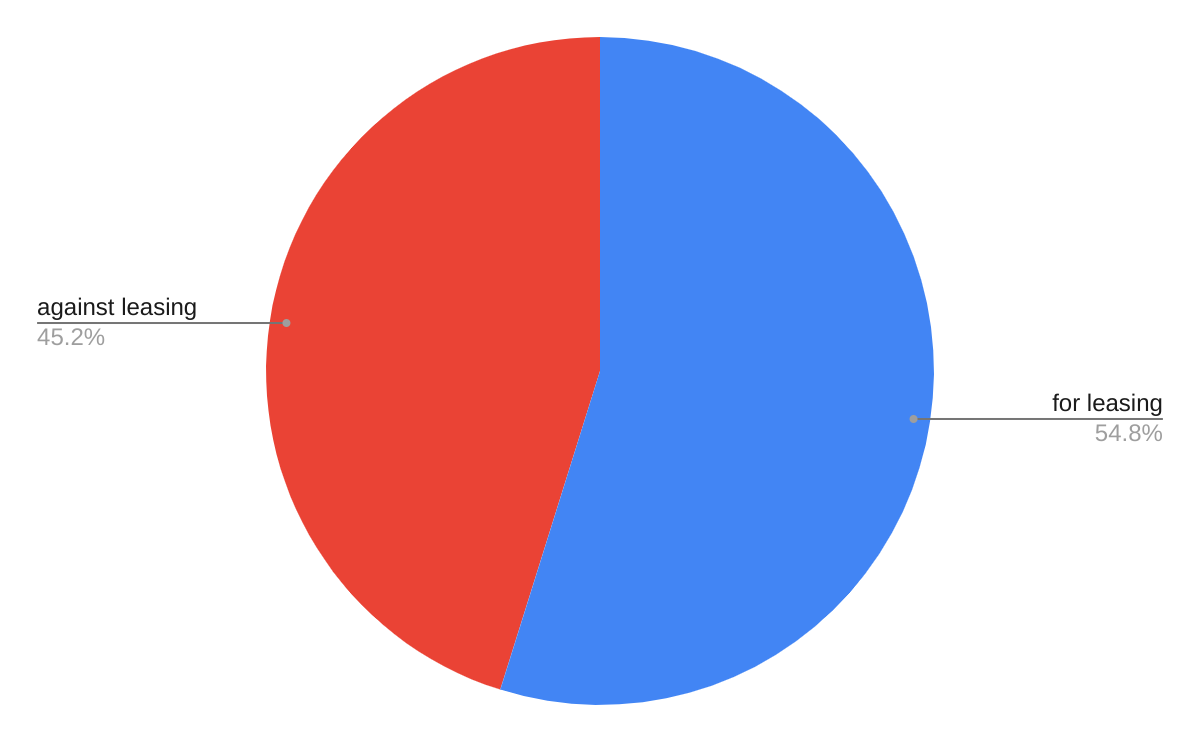
BOEM summarized (Table A-11 of the plan) the public comments, and I tabulated the 748,719 letters on the attached spreadsheet. The number of letters supporting oil and gas lease sales exceeded those opposed by 72,383 or 21.4%. The supporters campaign also had more breadth in that there were 49 separate campaigns vs. 45 for leasing opponents.

The NRDC demonstrated their organizational clout with the largest single campaign (107,355 letters). Denise Neal, a name that is unfamiliar to me, impressively organized the largest proponent campaign (61,122 letters).

Summary:

  • letters supporting offshore oil and gas leasing: 410,551
  • letters opposing offshore oil and gas leasing: 338,168
  • letter campaigns supporting leasing: 49
  • letter campaigns opposing leasing: 45
  • largest campaign: NRDC – 107,355 letters in opposition (32% of all such letters)
  • largest pro-leasing campaign: Denise Neal – 61,122 letters in support (15% of all letters in support)

Reasons for and against leasing per BOEM Table A-11:

Reasons for supporting lease salesReasons for opposing lease sales
reduce energy costs, farming costs, prices of gasoline and other goodsclimate
jobsenvironmental justice, local communities
energy independencefisheries
intl competitivenessmarine environment
national securitymarine mammals
GoM production is lower in carbon intensity, higher US environmental stds.fossil fuel dependency, unnecessary to meet energy needs, oppose new fossil fuel investments, leasing “would not reduce gas prices”
domestic oil and gas preferable during transitionoil spill risks
help improve supply chainair pollution
help address inflationstockpiling ocean space, energy price gouging

Interesting contradiction: Opponents of Sale 257 argued in Federal Court that BOEM failed to consider the positive GHG effect that higher prices (the logical result of lower production) would have as a result of reduced demand. The judge agreed with that argument and vacated the sale. Some of the same groups have now commented (per the BOEM summary) that additional leasing “would not reduce gas prices.”

Read Full Post »

Senator Manchin and the Alaska delegation criticized the DOI decision memo for Sale 258. The memo implied that the highest allowable royalty rate was chosen to minimize bidder interest and limit future production. Unfortunately, the “Inflation Reduction Act,” which mandated these lease sales, was not particularly helpful in creating interest in the less attractive OCS tracts like those in the Cook Inlet and the shallower waters of the Gulf of Mexico.

Sec. 50261 of the IRA raised the minimum allowable royalty rate from 12 1/2% to 16 2/3%, while capping the maximum rate at 18 3/4%. This provision favors deepwater operators, typically majors and large independents, whose royalty rates were capped at 18 3/4%, the same rate as for previous OCS sales.

Conversely, the IRA royalty provisions penalize the smaller companies and gleaners who are critical to sustaining shallow water (shelf) operations, including environmentally favorable nonassociated (gas-well) natural gas production, by raising the minimum royalty rate to 16 2/3%. DOI exacerbated IRA’s impact by electing to charge the highest allowable royalty rate for Cook Inlet and GoM shelf leases. The net result was a 50% royalty rate increase from prior sales (12.5 to 18.75%).

The table below illustrates the royalty rate implications of the IRA language and the DOI decisions.

AreaSaleDate% royalty: <200m water depth% royalty: >200m water depth
Cook Inlet2446/21/201712.512.5
GoM25611/18/202012.518.75
GoM25711/17/202112.518.75
Cook Inlet25812/30/202218.7518.75
GoM2593/29/202318.7518.75

Notes:

  • The base primary term for GoM shelf leases is only 5 years vs. 10 years for leases in .>800 m of water.
  • In lease year 8 and beyond the rental rates are nearly double for shelf leases vs. deepwater leases ($40/ac vs. $22/ac).
  • While deepwater development typically requires more time, the higher rental penalty for delayed shelf production (which must be approved by BSEE) is not warranted. $40/acre or $240,000 per year (plus inspection and permitting fees) is a high cost for a marginal shelf lease.
  • Cook Inlet Sale 244 drew 14 high bids totaling more than $3 million. Sale 258 drew only 1 bid of $64,000. While many factors influence lease sale participation, the 50% increase in royalty rate certainly made the Cook Inlet leases less attractive.
  • Other than the increased royalty rate, the terms for both Cook Inlet sales were essentially the same. The primary lease term was 10 years and the minimum bonus bid was $25/hectare for both sales. The rental rate was increased by only $3/hectare ($13 to $16).

Read Full Post »

Carbon-Zero US LLC of Dallas (a Cox Oil affiliate) has applied for up to $12 million in U.S. Department of Energy funds to develop a pilot sequestration hub in offshore storage fields about 20 miles from Grand Isle, according to officials from Cox Operating LLC, the Dallas operator that owns some of the storage fields.

Cox Operating LLC will “repurpose facilities and equipment” for the carbon storage project, according to a news release.

The Advocate

Should this company be authorized to repurpose Gulf of Mexico facilities for carbon sequestration?

  • Per BSEE Incident of Non-Compliance (INC) data for 2022, Cox had more component shut-in INCs (132) than any other company. Cox was second to the Fieldwood companies in the number of warning and facility shut-in INCs, and in the total number of INCs. 48% of the Cox INCs required either a component or facility shut-in.
  • Cox had an INC/facility-inspection ratio of 0.77, nearly 50% higher than the GoM average of 0.53.
  • Per the posted BSEE district investigation reports for 2022, Cox was responsible for 9 of the 30 incidents that were significant enough to require investigation. That is more than twice as many as any other company (next highest was 4).
  • The incidents included 3 serious injuries, 2 fires, a large gas leak, and oil spills of 114, 129, and 660 gallons. Per the posted reports, only one other company had an oil spill of >1 bbl. (Note: Only spills of > 1 bbl are routinely investigated by BSEE. One bbl = 42 gallons.)
  • While INCs were issued for only 3 of the 9 Cox incidents, a review of the reports suggests that INCs should have been issued for at least 4 of the other incidents.
  • Cox operates 375 platforms with installation dates as early as 1949. 134 of their platforms are > 50 years old. Only 66 were installed in the last 20 years and only 6 in the last 10 years (most recent December 2014). How will the carbon sequestration plans affect their massive decommissioning obligations?
  • Many of the Cox platforms were assigned by predecessor lessees. Those predecessors can only be held responsible for the decommissioning of facilities they installed, not for more recent wells or platforms and not for facilities that are repurposed for carbon sequestration.

Other more generic issues should be addressed before DOE awards funds for offshore sequestration projects.

Also, as noted in the discussion of Exxon’s 94 Sale 257 oil and gas leases, a competitively issued alternate use RUE is required (30 CFR § 585.1007) before sequestration operations may be conducted on an oil and gas lease.

Read Full Post »

Offshore

Per BOEM’s leasing data base, all 94 of the Sale 257 “carbon sequestration leases” (blue) were issued with an effective date of 10/1/2022. However, Sale 257 was an oil and gas sale, and the leases do not convey carbon sequestration rights. Each lease will expire in 5 years absent oil and gas production or ongoing drilling operations.

These oil and gas leases may not be repurposed for sequestration or other purposes unless an alternate use RUE is issued competitively in accordance with 30 CFR § 585.1007.

So what’s next for these 94 leases, 31% of the entire sale?

Read Full Post »

Here is a link to the entire bill. Good weekend reading for energy policy nerds. 😀

The energy sections begin on page 232 and continue until the end (page 725!). Some highlights from an offshore energy perspective (more important items in bold):

  • p. 429 – Tax credit eligibility for offshore wind energy components including blades, nacelles, foundations, and towers.
  • p. 447 – Credits for CCS equipment
  • p. 460 – For offshore wind facilities, this section specifies the % of the total costs that must be expended in the US for the facility to qualify as being manufactured in the US. That % rises gradually to 55% after 12/31/2027.
  • p. 518 – Eligibility of CCS for credits
  • p. 615 – $100 million for offshore wind electricity transmission planning, modelling, and analysis. (Seems like a lot for planning and analysis.)
  • p. 621 – $10 million for oversight by DOE Inspector General. (Those folks will have their hands full!)
  • p. 628 – Authorizes wind leasing in the EGOM and South Atlantic areas withdrawn from all leasing at the end of the Trump administration.
  • p. 631 – Authorizes offshore wind leasing adjacent to US territories. (Should be interesting!)
  • p. 632 – Codifies increase in offshore royalty rates: range of 16 2/3% – 18 3/4% for 10 years; not less than 16 2/3 % thereafter
  • p. 640 – The provision requiring that royalty be paid on flared/vented gas could be problematic. The exceptions are not consistent with those currently in the regulations, and would be difficult for BSEE/ONRR to manage. The proposed legislation (exception 1) exempts “gas vented or flared for not longer than 48 hours in an emergency situation that poses a danger to human health, safety, or the environment.” However, current BSEE regulations allow limited (48 hours cumulative) flaring for certain operations (e.g. during the unloading or cleaning of a well, drill-stem testing, production testing, and other well-evaluation testing). This flaring is essential but not normally an emergency situation. Requiring royalty payments for such essential, but not emergency, flaring would be unreasonable and inconsistent with the intent of this provision (minimize unnecessary flaring and venting).
  • p. 641 – Per our previous post, this section reinstates Lease Sale 257 (GoM) and requires that the scheduled 2022 lease sales 258 (GoM) and 259 (Cook Inlet) be held by 12/31/2022. Lease Sale 261 (GoM) must be held by 9/30/2023. Saddle up!

Read Full Post »

“The two-well subsea development is producing, in combination, approximately 16,000 barrels of oil per day and 13 million cubic feet of gas per day via a 14-mile subsea tieback to the EnVen-operated Lobster platform in EW 873. First production was achieved less than three years after the initial exploratory discovery well was drilled.” 

LLOG

The project owners (below) are all independent producers and private equity firms. Houston Energy, LLOG, Red Willow, EnVen, and Beacon were also among the high bidders in Lease Sale 257, which was vacated by a questionable court decision that the Federal government chose not to appeal.

The companies responsible for these important projects (see “simpler, safer, greener”) that have or will soon initiate production were also active bidders at Lease Sale 257. The absence of leasing has thus seriously handicapped the companies most responsible for the production surge to over 2 million BOPD in 2019 and for sustaining the current Gulf production rate of 1.7 million BOPD.

Read Full Post »

In light of the ongoing litigation regarding the Department of the Interior’s “leasing pause,” DOI’s Record of Decision for Sale 257 is most encouraging. The viewpoints expressed in the two quotes below are fundamental to the future of the OCS Oil and Gas Program. Hopefully, all parties can put aside their differences and build upon these consensus views.

While offshore exploration and development cannot be made risk free, OCS oil- and gas-related activities can be conducted safely and responsibly with strong regulatory oversight and appropriate measures to protect human safety and the environment.

ROD, p. 5

The decision to hold Lease Sale 257 recognizes the role that GOM oil and gas resources play in addressing the Nation’s demand for domestic energy sources and fosters economic benefits, including employment, labor income, and tax revenues, which are highest in Gulf Coast States and also distributed widely across the United States. Revenues from offshore oil and gas lease sales support national conservation programs and coastal resiliency for applicable coastal states and political subdivisions under the Gulf of Mexico Energy Security Act of 2006.

ROD, p. 7

Read Full Post »