
Former President Bill Clinton said Friday that delays in offshore oil and gas drilling permits are “ridiculous” at a time when the economy is still rebuilding, according to attendees at the IHS CERAWeek conference. Politico.com
Posts Tagged ‘offshore oil’
Bill “Drill Baby” Clinton
Posted in drilling, energy, Offshore Energy - General, tagged Bill Clinton, drilling, Gulf of Mexico, IHS CERA, offshore oil on March 13, 2011| 1 Comment »
“No spill response improvements since Valdez.” WRONG!
Posted in accidents, tagged accidents, blowouts, Gulf of Mexico, macondo, MMS, offshore oil, ohmsett, oil spill, Valdez on March 5, 2011| Leave a Comment »
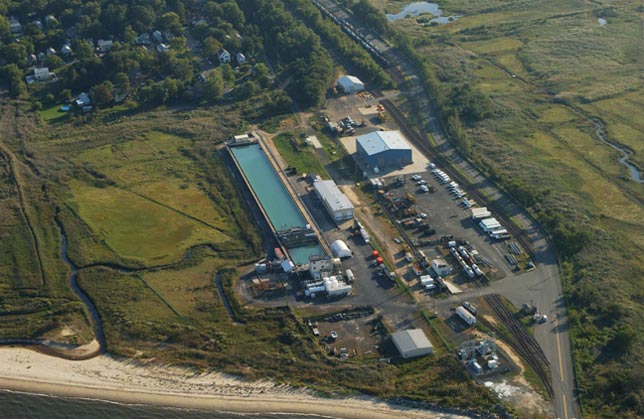
Ohmsett
The seemingly endless crowing about the absence of improvements in spill response capabilities is a story by itself. This topic warrants a full discussion when time permits, but for now I’ll offer a few comments and observations:
- The Macondo offshore spill response was unprecedented and impressive, and the lessons learned will be applied to improve spill response preparedness around the world.
- Those who claim that there has been no progress in spill preparedness either have no real interest in spill response or have not been paying attention.
- Even in the lean years following the Valdez oil spill research surge, the much-maligned MMS continued to conduct important burning, dispersant, remote sensing, and mechanical cleanup studies, while upgrading and expanding the use of the nation’s major oil spill response test facility – Ohmsett (pictured above). This research was effectively applied during the Macondo spill and smaller, less publicized incidents. Click here for a nice summary of the program and here for the very extensive list of projects and links to the reports. Domestic and international partnerships, most notably with Norway and Canada, helped sustain this important research.
- Despite periodic attempts to reprogram Ohmsett funding, MMS was able to continue to support this outstanding research facility. Learn more about Ohmsett.
- During the blowout, the networks featured the snake oil salesmen and hucksters who peddle super-sorbents and oil-consuming substances during every major spill. That time should have been given to response experts and serious oil spill researchers.
- Former industry executives with no real spill response experience trumpeted, without any documentation, claims of extraordinary recovery rates elsewhere (usually in places where no one gets to watch). Their favorite concept, supertanker response systems, received a lot of air time until the “Whale” tanker-skimmer flopped as predicted.
- You would think that Kevin Costner’s very good separator (tested at Ohmsett in 1999!) was the only advance in response technology. Perhaps more movie and TV stars should get involved with spill response. Charlie (Oil) Sheen would no doubt attract interest to the cause. 🙂
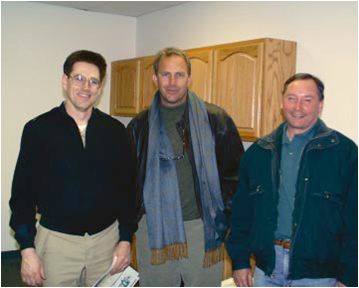
NWS Earle Executive Officer Claudill, Kevin Costner, and Ohmsett Manager Bill Schmidt (1999 photo at Ohmsett)
Interesting Platts Update on DWH BOP Testing
Posted in accidents, well control incidents, tagged accidents, blowouts, BOP, chemical safety board, Deepwater Horizon, drilling, Gulf of Mexico, macondo, offshore oil, safety, well control on March 3, 2011| 2 Comments »
From Platts Oilgram News article by Gary Gentile:
The team examining the BOP in Louisiana conducted tests in January and February of this year that showed that with the proper amount of hydraulic fluid pressure, the rams on the BOP would close, according to Dan Tillema, an investigator with the US Chemical Safety Board.
Portions of drill pipe were found in the BOP and the pipe was cut, Tillema said—a sign that the rams did close at some point during the incident.
But Tillema cautions against making any assumptions based on the test results sofar. Some reports have suggested that rubber gaskets around the rams were worn awayby the massive flow of oil and gas gushing from the Macondo well, overcoming the BOP’s capacity. That is just one of several possibilities, Tillema said. “We haven’t made any conclusions yet,” he said.
Partial recovery of the Deepwater Horizon? BOP testing about to conclude?
Posted in accidents, well control incidents, tagged accidents, blowouts, BOP, Deepwater Horizon, Gulf of Mexico, macondo, offshore oil, transocean, well control on February 28, 2011| Leave a Comment »
Transocean Ltd., the world’s largest offshore oil driller, may attempt to recover some or all of the Deepwater Horizon rig that exploded and sank during last year’s Macondo well disaster. Bloomberg
U.S. Attorney Steve Overholt told District Judge Carl Barbier that testing of the failed blowout preventor (BOP) that led to the Deepwater Horizon oilrig explosion should be done by the end of this week. Louisiana Record
Capping stacks and containment systems are important, but well integrity is critical
Posted in accidents, Uncategorized, well control incidents, tagged accidents, blowouts, capping and containment, drilling, Gulf of Mexico, Helix, macondo, Marine Well Containment Company, Montara, offshore oil, oil spill, well control on February 28, 2011| 2 Comments »

Good Nola.com article on the well containment systems
Comments on well capping and containment:
- Capping and containment systems, while important and necessary, are for blowout response, not blowout prevention. Their use, successful or otherwise, would only occur after a series of unacceptable failures.
- Having two capping and containment consortia in the Gulf of Mexico (and none anywhere else in the world) does not seem to be very cost effective or efficient.
- What are the plans for subsea capping and containment systems elsewhere?
- A capping/containment capability would not have saved a single life on the Deepwater Horizon. Verified barriers must be in place to prevent flow from the well bore.
- The well responsible for our other major drilling blowout spill (Santa Barbara – 1969), was capped at the surface by closing the blind ram on the BOP shortly after flow began. However, capping doesn’t work if you don’t have a competent well bore. The well flowed through numerous channels back to the seafloor.
- Capping subsea wells is safer than capping surface wells.
- Capping the Montara blowout (2009) in only 80m of water was neither safe nor technically feasible because of the way the well was suspended. Despite the complete absence of a capping option at Montara, the capping of surface wells has received little attention.
- The more critical, but less publicized, post-Macondo initiatives pertain to well design, construction, and verification. In that regard, important new standards, including the Well Construction Interface Document, are scheduled to be completed soon. That work must not be delayed.
- While capping stacks and containment systems will only be used in the event of a series of major failures, design and construction procedures are critical every time a well is drilled. The importance of the initial design decisions continues into the production phase and beyond, even after the well has been plugged and abandoned.
BOP Hearings in Early April?
Posted in accidents, well control incidents, tagged accidents, blowouts, Deepwater Horizon, Gulf of Mexico, macondo, offshore oil, oil spill, safety, well control on February 26, 2011| Leave a Comment »
These hearings should be interesting:
The JIT expects to hold another set of public hearings the week of April 4 to focus specifically on the BOP and findings from the forensic examination. BOEMRE and the USCG expect to issue a joint release regarding the investigation by mid-April.
Transocean Report
Posted in accidents, well control incidents, tagged accidents, blowouts, drilling, Gulf of Mexico, macondo, offshore oil, oil spill, safety, transocean, well control on February 24, 2011| Leave a Comment »
“Our internal investigation into the events of that tragedy is nearing completion,” Newman told investors during a conference call to discuss Transocean’s fourth-quarter earnings. “In light of continuing delays and obtaining information on the third-party testing of the Horizon’s (blowout preventer), we expect to release findings in the next month or two.” Fox Business
Russia:”Can’t Happen Here”
Posted in accidents, tagged accidents, arctic, blowouts, Can't Happen Here Award, Deepwater Horizon, Gulf of Mexico, offshore oil, Russia, safety, well control on February 24, 2011| Leave a Comment »

No deepwater horizons in Russian arctic:
Developed by SevMash, the first Barents Sea oil rig will be a steel table the size of a football pitch and capable of withstanding temperatures of down to minus 50 Celsius. The whole point of it is that standing on the seabed, it will allow drilling and pumping the way they are done of firm land. This is a very far cry from the Deepwater Horizon. That platform was semi-submersed, positioned dynamically and designed to pump oil from beneath a mile of sea. When the oil gushed, the spill proved almost unstoppable. The Barents Sea platform will employ a very different production technology, which involves the use of powerful pumps. Chief Technology Officer of the Gazpromneft Shelf company Dr Alexander Kisser
Comment:
- Don’t demonize deepwater production to promote the arctic (or vice versa). The world needs responsible production from both.
- “Can’t happen here (or to me)” talk impresses no one. Explain how a disasters can happen to you and what you are doing to prevent them.
- Identify the special risks at your site and how they will be mitigated. Don’t tell us why the arctic isn’t the Gulf of Mexico.
- Perhaps we should present Can’t Happen Here awards as part of the Not My Job awards program.
PSA reviewing Macondo
Posted in accidents, well control incidents, tagged accidents, blowouts, Deepwater Horizon, drilling, macondo, Norway, offshore oil, PSA on February 20, 2011| Leave a Comment »

The PSA established a project team on 7 May 2010 with some 20 members drawn from relevant disciplines to follow up the Deepwater Horizon disaster.
Its overall goal is to systematise and assess experience and investigations in the wake of this incident, so that appropriate lessons can contribute to learning and improvement on the NCS.
The project will identify areas where enhancements can be made to the requirements in Norway’s regulations and/or other types of measures related to Norwegian petroleum operations. PSA.no
Lucky Australia? Lucky PTTEP?
Posted in accidents, well control incidents, tagged accidents, Australia, blowouts, drilling, macondo, Montara, offshore oil, well control on February 17, 2011| Leave a Comment »
Anthea Pitt, Executive Editor of the Petroleum Economist and a native Australian, recently wrote about her country and its historical dependence on natural resources:
Australia is well aware it relies on primary industries for its wealth. In the 19th century, the country proudly “rode on the sheep’s back”. More recently, iron ore, coal, bauxite and gold helped keep the worst of the sub-prime crisis at bay. Soon, a slew of large hydrocarbon developments off the country’s remote northwest coast will come on line, another rich seam flowing into Australia’s resources revenue stream.
The blowout at Montara was well-earned, and Australian and PTTEP were lucky even during a massive disaster. No one was injured, the well was at a remote location, and international attention was soon diverted to the spectacle of Macondo.
Evidence given to the inquiry showed exactly how fortunate Australia had been. It emerged that wells drilled at Montara failed to meet PTTEP AA’s internal well-construction standards, let alone satisfy regulatory requirements. The H-1 well, which had been suspended as a future producer during batch drilling operations, was open to surface for around a week before it blew out. Its downhole cementing job was flawed; there were no mechanical barriers in place. The rig’s blowout preventer was over another well at the time of the incident.
Although PTTEP has been given a pass by Australian Resources Minister Ferguson, the lessons of Montara must not be ignored. Deepwater drilling is not the problem; Montara was in 80m of water. Poor planning and execution are the problem, whether the well is in the Timor Sea, the Gulf of Mexico, the arctic, the North Sea or anywhere else in the world.
 Bud's Offshore Energy (BOE)