14.07.2011 | On Wednesday 13 July, a fire broke out in the compressor area of Valhall PCP. Today the Petroleum Safety Authority Norway (PSA) will send two representatives to Valhall to investigate the incident.
The fire, which was reported to the authorities yesterday afternoon, started at around 4.40 p.m. A standby vessel was deployed to put out the fire and at 6.45 p.m. it was confirmed that the fire had been extinguished. All personnel were evacuated and there were no injuries.
Posts Tagged ‘Norway’
PSA Announcement on Valhall Fire
Posted in accidents, tagged accidents, compressor, fire, Norway, offshore oil and gas, PSA, safety, Valhall on July 15, 2011| Leave a Comment »
Fire suspends operations at Valhall production facility offshore Norway
Posted in accidents, Norway, tagged fire, North Sea, Norway, offshore oil, production, Valhall on July 14, 2011| Leave a Comment »
A fire at BP’s Valhall oil platform off Norway in the southern part of the North Sea forced the UK supermajor to halt production and evacuate the facility today.

Valhall Complex (www.mfox.nl)
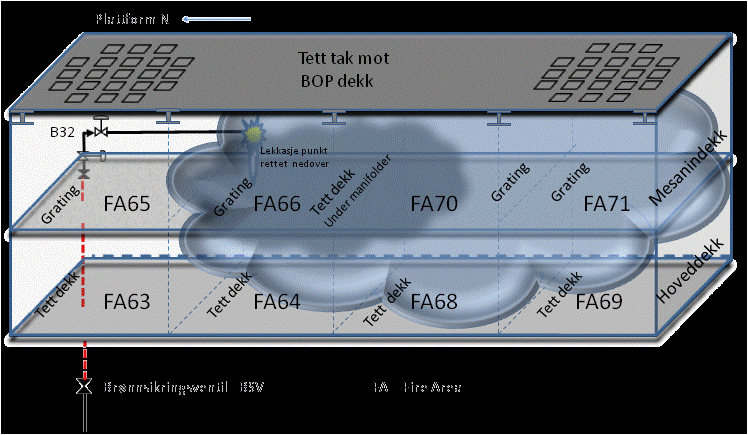
Visund gas leak investigation
Posted in accidents, tagged accidents, gas lieak, Norway, offshore, PSA, safety, Visund on July 11, 2011| 1 Comment »
If someone had asked me a few years ago what the highest risk offshore system was, I certainly would not have said a fully cased well in the process of being suspended. Yet that was the scenario for both of the recent mega-incidents, Montara and Macondo.
I would have instead suggested that dynamic production risers were the highest risk offshore system. The combination of relatively new technology, movement, fatigue potential, exposure in the splash zone, and continuous hydrocarbon flow poses risks that must be carefully managed. That is why investigations of incidents like the Visund gas leak are so important. In that regard, PSA does an excellent job and prominently posts all of their reports so that we all may benefit. I recommend that you take a look at this one.
In connection with the planned shutdown on Visund on 9 April 2011, a hydrocarbon leak occurred from well A21’s 6” flexible riser UK-18-0009. The Petroleum Safety Authority Norway (PSA) has carried out an investigation of certain aspects of the incident.
We have identified three nonconformities within the areas of establishment and follow-up of preconditions for safe operation of dynamic risers, training and expertise and governing documentation.
PSA releases summary of Deepwater Horizon review
Posted in accidents, Norway, well control incidents, tagged accidents, blowouts, BOP, Deepwater Horizon, drilling, macondo, Montara, Norway, offshore drilling, offshore oil, PSA, safety, well control on June 11, 2011| Leave a Comment »
From the standpoint of post-Macondo safety and regulatory issues, this concise summary is the most comprehensive and useful report that I have read since the blowout.
I have pasted (below) comments about information management – one of the many important topics considered in the report – and hope you take time to read the entire summary. It is only 12 pages.
Conducting a critical review of the information used to manage major accident risk is one of the measures relevant for the companies. This work could include an assessment of
the relevance, reliability and modernity of the indicators used to follow up risk trends
inappropriate use of indicators, incentives and reward systems
the need for better indicators and other information about the business which can be used to secure an early warning about a weakening in safety-critical barrier elements.
The PSA is of the opinion that the quality of information applied in managing major accident risk is also a question of what overview the players have of their own business, and thereby a question of the players’ own control. The PSA assumes that managing major accident risk cannot be outsourced. In light of the DwH accident, it could be relevant for the companies to review the processes intended to provide the necessary information about the business, assess in part how these processes support a culture of accountability and how various management and audit functions, third-party verifications and so forth contribute in this connection.
IADC Comments on Volume 1 (Coast Guard) of the Joint Investigation Team’s Deepwater Horizon Report
Posted in accidents, Offshore Energy - General, Regulation, tagged accidents, Coast Guard, Deepwater Horizon, IADC, macondo, Montara, Norway, offshore drilling, Regulation, safety on June 2, 2011| 2 Comments »
Like the National Commission on the BP Deepwater Horizon Oil Spill and Offshore Drilling, the Montara Commission of Inquiry, the Norwegian government, and leading safety and regulatory authorities around the world, the IADC recognizes the risks associated with complex, multi-agency regulatory regimes. A single authority should be responsible and accountable for safety and pollution prevention at offshore facilities, and should draw on the expertise of other agencies and organizations as necessary to achieve performance objectives.
The safety and environmental risks associated with fragmented or compartmentalized regulation include gaps, overlap, confusion, inconsistencies, and conflicting standards. Industry and governmental personnel spend too much time coordinating with multiple parties and not enough time managing safety and environmental risks.
Link to IADC comments. Key quotes:
IADC continues to be concerned by seemingly duplicative regulatory requirements imposed by the Coast Guard and BOEMRE, particularly where the agencies appear to have divergent views regarding the placement of regulatory responsibility.
One cannot holistically address safety when faced with the unyielding and overlapping demands of multiple narrowly-focused regulatory agencies.
PSA issues report on lifting incident at Gullfaks A
Posted in accidents, tagged accidents, cranes, Gullfaks A, lifting incident, Norway, PSA, safety on May 18, 2011| Leave a Comment »
PSA release and link to report:
The direct cause of the incident was that the container being lifted began swinging too much and got caught up in another container. A deck worker standing in an unsecured area was struck and injured.
This incident could potentially have killed the person concerned. Substantial material damage could also have been caused.
Syttende Mai 2011
Posted in Norway, Uncategorized, tagged Norway, Syttende Mai on May 17, 2011| Leave a Comment »
This is the second Syttende Mai for the BOE blog. Best wishes to our many Norwegian friends on their National Day, which celebrates the signing of their Constitution on May 17, 1814.
Gullfaks B report (English) now posted
Posted in accidents, Norway, tagged accidents, gas release, Gulfaks B, lifting incident, Njord A, Norway, offshore oil, PSA on May 12, 2011| Leave a Comment »
PSA has posted the Gullfaks B gas release report in English. Also posted is the report on a lifting incident at Njord A. The reports are comprehensive and timely.
The gas leak occurred during leak testing after maintenance work on a production well. The gas derived from a volume trapped between the downhole safety valve and the Xmas tree. It proved impossible to operate the emergency shutdown valves on the well. The leak lasted about an hour, with an initial rate of 1.3 kilograms of gas per second. The volume of gas released is estimated at about 800 kilograms.
No people were injured in the incident, but the leak created a serious position on the installation.
Interesting UK Safety Items
Posted in accidents, Norway, Offshore Energy - General, Regulation, UK, tagged accidents, gas leaks, HSE, Norway, safety, UK on May 10, 2011| Leave a Comment »
The HSE has told Shell to submit a revised safety case for the Brent Charlie platform after gas was detected on its topsides following leaks on 12 January this year and 27 September 2010, Upstream can reveal.
Shell, which took the decision itself to close the platform after the January incident, has been battling for some time to resolve technically complex issues related to the venting of gas from inside one the platform’s huge concrete legs — Column 1 (C1) — and dispersing it effectively away from the platform.
The operator now expects the ageing Brent field to remain shut down for several more months.
PSA adds substantial value at a relatively low cost
Posted in Norway, Regulation, tagged North Sea, Norway, offshore, Regulation, safety on May 6, 2011| Leave a Comment »
Surprisingly, the post-Macondo discussion about regulatory approaches has been largely devoid of value and cost-benefit assessments. While PSA has been praised for Norway’s outstanding offshore safety record, little attention has been paid to their relatively low regulatory costs.
According to data in the 2010 Annual Report, PSA has 161 employees, and had total operating expenses of NOK 202,762,689 ($US 38.1 million) for 2010. These modest cost and staffing numbers are particularly impressive when the magnitude and complexity of Norwegian offshore operations are considered. In March 2011, Norwegian oil production averaged 2.017 million barrels per day (no. 2 offshore oil producer slightly behind Brazil) and gas production averaged 11.6 billion cubic feet per day (world offshore leader). PSA is also responsible for onshore processing facilities.
PSA’s costs are relatively modest for the same reason that their regulatory program is successful. They hold companies responsible for managing their operations and conducting inspections. They don’t approve every detail of every operation, but focus on ensuring that the company management systems are effectively implemented. They identify risks and insist that industry address them. As Magne Ognedal said in his interview with BOE:
Our regulatory philosophy is indeed firmly based on the legislated expectation that those who conduct petroleum activities are responsible for complying with the requirements of our acts and regulations. Furthermore, our regulations require that they employ a management system that systematically probes and ensures such compliance at any time. The approach to achieving this should be risk-based. So, ensuring compliance with rules and regulations is the operator’s job – not ours.