Feeds:
Posts
Comments

Posts Tagged ‘Gulf of Mexico’

At Sale 261, Repsol was the sole bidder for 36 nearshore Texas tracts in the Mustang Island and Matagorda Island areas (red blocks at the western end of the map above). Exxon acquired 163 nearshore Texas tracts (blue in map above) at Sales 257 (94) and 259 (69).
  • The 199 oil and gas leases that were wrongfully acquired for carbon disposal purposes remain idle with the government collecting rental payments at the rate of $10/acre/yr ($7 for Sale 257 leases). Collectively, this amounts to approximately $10 million/yr.
  • Presumably, the lessees cannot claim CCS tax credits for their bonus and rental payments.
  • The primary term for these leases is only 5 years, and the clock is ticking. The 94 oil and gas leases acquired by Exxon at Sale 257 for carbon disposal purposes are approaching the end of their second year. They would be almost a year older if litigation hadn’t delayed the issuance of Sale 257 leases (break for Exxon?).
  • No exploration plans have been filed for any of these leases. Presumably Exxon and Repsol do not intend to drill any wells unless the leases are converted to authorize carbon disposal.
  • The “Infrastructure Bill,” signed 2 days before Sale 257, required the Secretary of the Interior to promulgate regulations not later than one year after the date of enactment (11/15/2021). That deadline has long passed.
  • The delay in the regulations is understandable given the complex lease management, operational, and environmental issues.
  • Like the practices and operations they are intended to enable, the regulations are certain to be divisive. Neither the offshore industry nor the environmental community are of one mind on these issues, particularly with regard to the acquisition of oil and gas leases for carbon disposal purposes.
  • Energy Intelligence suggests that final carbon disposal regulations will be promulgated this year. This is highly unlikely, given that a proposed rule must first be published for public comment.
  • Interior could seek to demonstrate “good cause” for a direct final or interim final rule. However, such an attempt at corner-cutting is unlikely, especially given the controversy associated with carbon disposal.
  • Publication of a proposed rule prior to the election is unlikely – too controversial.
  • Presumably, the regulations will establish a competitive process for the conversion of any oil and gas leases.
  • The leases that were wrongfully acquired at Sales 257, 259, and 261 should not be extended for any period of time, even if their expiration date approaches before a competitive process is established.

Closing comment: “Sequestration” is a euphemism that is being incorrectly applied to soften the reality of disposing carbon beneath the Gulf of Mexico. Sequestration implies storage for later use and that is clearly not the intent. Because carbon disposal is arguably dumping, a special exemption from the Marine Protection, Research, and Sanctuaries (Ocean Dumping) Act of 1972 had to be added to the Infrastructure Bill.

Read Full Post »

After the announcement of further restrictions on resource development in the National Petroleum Reserve of Alaska (NPR-A), Senator Sullivan (AK) called on the administration to stop sanctioning Alaska and to instead restore sanctions on Iran

The US OCS is being similarly sanctioned by its own government. The 5 year OCS “leasing plan” not only excludes all areas except the Gulf of Mexico, but authorizes a maximum of only 3 sales, the fewest ever for a 5 year program. The number of sales may well have been zero were it not for the requirement to hold an oil and gas sale during the year prior to the issuance of a lease for wind development.

2024–2029 Proposed Final Program Lease Sale Schedule
CountSale NumberSale YearOCS Region and Program Area
12622025Gulf of Mexico:  GOM Program Area
22632027Gulf of Mexico:  GOM Program Area
32642029Gulf of Mexico:  GOM Program Area
Most limited 5 year leasing program in history

Read Full Post »

14 of the high bids at Gulf of Mexico Lease Sale 259 were rejected. Did those tracts receive bids at sale 261? What was the net gain or loss of revenue? See the summary bullets and table below

  • 6 of the 14 tracts received no bids whatsoever
  • 5 of the 14 tracts received higher bids that were accepted.
  • 2 tracts received substantially higher bids that were again rejected
  • 1 tract received a lower bid that was accepted
  • net bonus revenue gain to the govt from the bid rejections (pending re-offering at future sales): $1,032,877
  • net bonus revenue gain = 0.27% of the total high bids at sale 261
  • net loss in future rental and royalty payments: ????

For a net bonus revenue gain to date of only 1/4 of one per cent, 8 of the 14 sale 259 tracts with rejected high bids remain closed to exploration. The timing of any future sales is very much in doubt given the minimalist 5 year leasing plan and the associated legal challenges.

Current bid evaluation practices only make sense if regular lease sales are held on a predictable schedule, as has historically been the case.

Meanwhile, 100% of the improper CCS bids (199/199) were accepted at the last 3 oil and gas lease sales.

area and blockSale 259 rejected high bid – companySale 261 high bidbid acceptedgovt gain (loss*)
DC 6222,101,836 – Shell615,628 – Shellyes(1,486,208)
GC 173307,107 – Woodsideno bidNA(307,107)
GC 5471,783,498 – Chevronno bidNA(1,783,498)
GC 5911,291,993 – Chevronno bidNA(1,291,993)
GC 642605,505 – Anadarkono bidNA(605,505)
GC 777583,103 – bpno bidNA(583,103)
AT 51,551,130 – Anadarko5,215,628 – Shellyes3,664,498
AT 133607,107 – Woodsideno bidNA(607,107)
KC 745707,777 – Beacon2,422,222 – Beaconno(2,422,222)
KC 789707,777 – Beacon2,143,299 – Beaconno(2,143,299)
WR 794724,744 – Beacon1,487,624 – Beaconyes762,880
WR 795774,242 – Beacon5,301,107 – Woodsideyes4,526,865
WR 796774,242 – Beacon3,310,107 – Woodsideyes2,535,865
WR 750724,744 – Beacon1,498,555 – Beaconyes773,811
total govt. gain1,032,877
*Loss based on rejected sale 261 high bid. If no sale 261 bid, loss based on sale 259 high bid. These tracts could receive bids at a future sale.

Read Full Post »

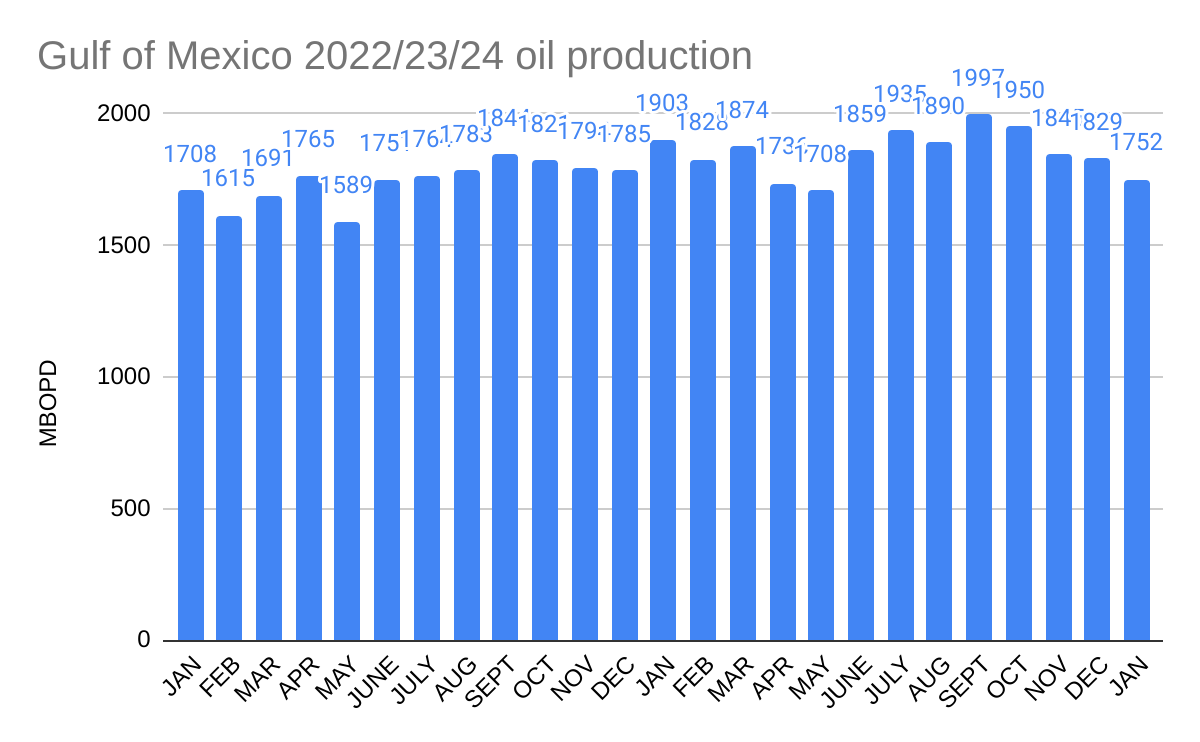
Average GoM oil production from Nov. to Jan. was more than 130,000 BOPD below the July to Oct. average. Production in Jan. 2024 was 245,000 BOPD lower than Sept. 2023 production. (See the table and chart below.)

The production shut-ins associated with the mysterious November sheen in the Main Pass area were no doubt a contributing factor to the decline, but the magnitude and duration of those shut-ins has not been disclosed. The source of the sheen has apparently still not been determined, nor has any information been provided on the status of the Federal investigation. The absence of transparency is disappointing.

production monthGoM oil production (BOPD, 1000’s)
Jan. 20241752
Dec. 20231829
Nov. 20231845
Oct. 20231950
Sept 20231997
Aug. 20231890
July 20231935
EIA data

Read Full Post »

Swimming upstream against the Federal policy current, Gulf of Mexico drilling is demonstrating impressive forward progress. Baker Hughes reports 22 active GoM rigs on 3/15/2024, an increase of 3 from the previous week.

Glancing at the charts, this appears to be the highest GoM rig count since Nov. 2019, and is double the recent low of 11 in 2022.

It’s unclear whether Baker Hughes is including the CCS drilling operation offshore Texas. If so, the actual oil and gas rig count is 21 rather than 22.

Baker Hughes also reports 1 active rig offshore California (decommissioning?) and 1 active rig offshore Alaska (Endicott or Northstar?)

Per Baker Hughes, no rigs are currently active offshore Canada.

Read Full Post »

Jerry Boelte, LLOG founder and offshore energy leader, passed away last month in a single vehicle accident. Boelte, a New Orleans native and LSU petroleum engineering grad, turned LLOG into a major deepwater player in the Gulf of Mexico.

In 2023, LLOG was the 6th biggest oil producer in the Gulf of Mexico trailing only Shell, bp, Anadarko, Chevron, and Murphy. As a natural gas producer, LLOG ranked fifth ahead of major GoM operators like Chevron and Hess.

Boelte built LLOG into a company with a strong commitment to safety and environmental protection. In that regard, the company achieved BOE Honor Roll status in 2023 and 2022.

LLOG’s ‘Who Dat’ floating production system in 3100′ of water in Mississippi Canyon Block 547 has produced more than 100 million bbls of oil equivalent. More on ‘Who Dat.’

Read Full Post »

from EIA data

Reports in Nov. indicated that ~60,000 bopd were shut-in as a result of the presumed Main Pass Oil Gathering system pipeline leak. The Coast Guard subsequently reported that other pipelines in the area were shut-in as the search for a leak continued. The bulk of the Nov./Dec. production decline of ~80,000 bopd (from Oct. levels) was probably attributable to those pipeline system shut-ins.

Read Full Post »

Energy experts like Dan Yergin have a different, and far more credible view. Yergin explains that energy transitions don’t happen on command, noting that the world uses almost three times as much coal today as in the 1960’s when oil finally surpassed coal as the world’s primary energy source.

Oxy CEO Vicki Hollub’s recent remarks should serve as a reality check for the 5 Year Plan authors and their counterparts elsewhere in western governments. More oil and gas exploration and production are needed, not less. Leading Oxy investor Warren Buffet agrees.

Crude reserves are being found and developed at a much slower pace than they’ve been in the past. Specifically, she said the world has only newly identified less than half the amount of crude it’s consumed over the course of the past 10 years. Given the current trends, this means demand will exceed supply before the end of 2025.

Oxy CEO Vicki Hollub per the Motley Fool

Recent trends in the Gulf of Mexico, where Hollub’s Anadarko unit is one of the more active and successful operators, reflect Hollub’s concern. Note below the sharp decline in discoveries, as determined by BOEM, over the past 20 years. Effective development of older discoveries and improved resource recovery practices are sustaining GoM production, but declines are inevitable without consistent leasing and increased exploration.

Read Full Post »

  • Must average <0.3 incidents of noncompliance (INCs) per facility-inspection.
  • Must average <0.1 INCs per inspection-type. (Note that each facility-inspection may include multiple types of inspections (e.g. production, pipeline, pollution, Coast Guard, site security, etc). On average, each facility-inspection included 3.3 types of inspections in 2023. Here is a list of the types of inspections that may be performed.
  • Must operate at least 3 production platforms and have drilled at least one well (i.e. you need operational activity to demonstrate compliance and safety achievement).
  • May not have a disqualifying event (e.g. fatal or life-threatening incident, significant fire, major oil spill). Due to the extreme lag in updates to BSEE’s incident tables, district investigations and media reports are used to make this determination.

Read Full Post »

With Sept. production revised down slightly, there have been no 2 million bopd months for 4 years (since Nov. 2019).

Read Full Post »

« Newer Posts - Older Posts »