Feeds:
Posts
Comments

Posts Tagged ‘drilling’

The UK Energy and Climate Change Committee has released its report entitled “UK Deepwater Drilling – Implications of the Gulf of Mexico oil spill.” We’ll post the report as we get a link.

Here’s the gist:

A moratorium on oil drilling in deep waters off Britain would undermine the country’s energy security, according to a report by lawmakers published on Thursday in response to the BP spill disaster last year.

Read Full Post »

Well, well. In early March, Cuba will commence with deep water drilling under contract with Repsol and Statoil ASA, using an older rig that was recently rehabbed by the Chinese. Reports indicate that it has fewer safety features than the BP’s infamous Deepwater Horizon. The site is located a scant sixty miles southeast of Key West, Florida. Benzinga.com

There are some  errors and unsupported opinions in this article, so I would take the March spud date with a grain of salt.  As confirmed by Rigzone, the Saipem Scarabeo 9 is a new rig, not a rebuild. It was built in China and commissioned in Singapore. The inflammatory comment about the rig having fewer safety features than the Deepwater Horizon is also without substance. Everything about the Scarabeo 9 appears to be state-of-the-art.

While a projected 2011 spud date has been reported and appears likely, Cuba’s deepwater drilling program has been marked by repeated delays. BOE has seen no confirmation that the rig has arrived or is en route to Cuba. We would appreciate any updates that others might be able to provide.

Read Full Post »

Anchorage Daily News:

The federal Environmental Appeals Board, which is part of the EPA, reviewed the permits. It found last week that the analysis of the impact of nitrogen dioxide emissions from the ships on Alaska Native communities was too limited, and remanded the permits so that problems cited by the board could be fixed by the agency.

The closest proposed drill site is 60 miles off shore and about 80 miles from Wainwright, an Inupiat Eskimo village 710 miles northwest of Anchorage.

Read Full Post »

Encouraging and prudent decision:

The Bureau of Ocean Energy Management, Regulation and Enforcement (BOEMRE) today notified 13 companies whose deepwater drilling activities were suspended by last year’s deepwater drilling moratorium that they may be able to resume those previously-approved activities without the need to submit revised exploration or development plans for supplemental National Environmental Policy Act (NEPA) reviews. Before resuming those activities without additional NEPA review, however, the companies must comply with BOEMRE’s new policies and regulations.

The resumption of operations on suspended wells was the major concern of some operators and had the potential to delay anticipated new production.

Read Full Post »

Wall Street Journal on on Gulf delays

The Energy Information Administration, the research arm of the Department of Energy, last month predicted that domestic offshore oil production will fall 13% this year from 2010 due to the moratorium and the slow return to drilling; a year ago, the agency predicted offshore production would rise 6% in 2011. The difference: a loss of about 220,000 barrels of oil a day.

UK moves ahead with deepwater drilling

MPs have ruled out a moratorium on deep water drilling in the North Sea, despite concerns it could lead to a disaster worse than BP’s oil spill in the Gulf of Mexico last year.

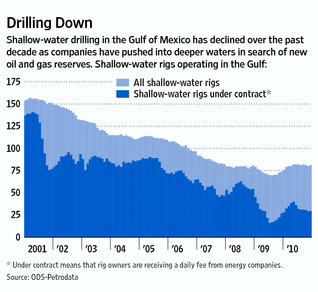
Shallow water struggle (Wall Street Journal)

From bad to worse for shelf operations:

“We were on our knees when Macondo hit,” said Jim Noe, senior vice president and general counsel for Hercules.

Read Full Post »

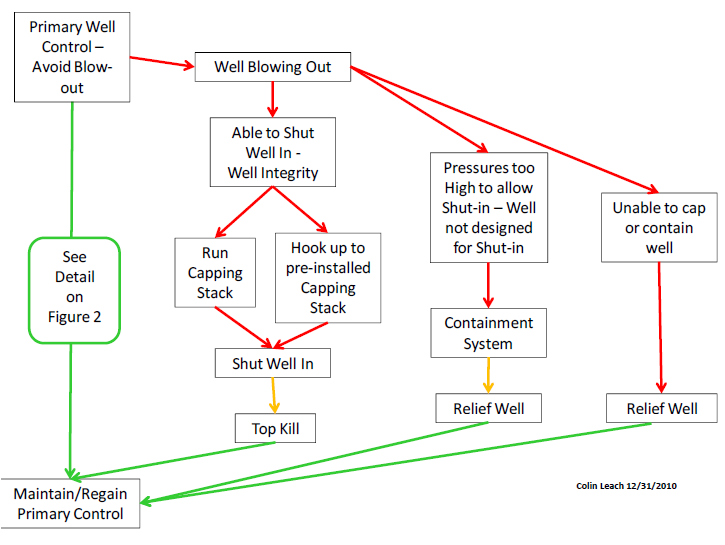
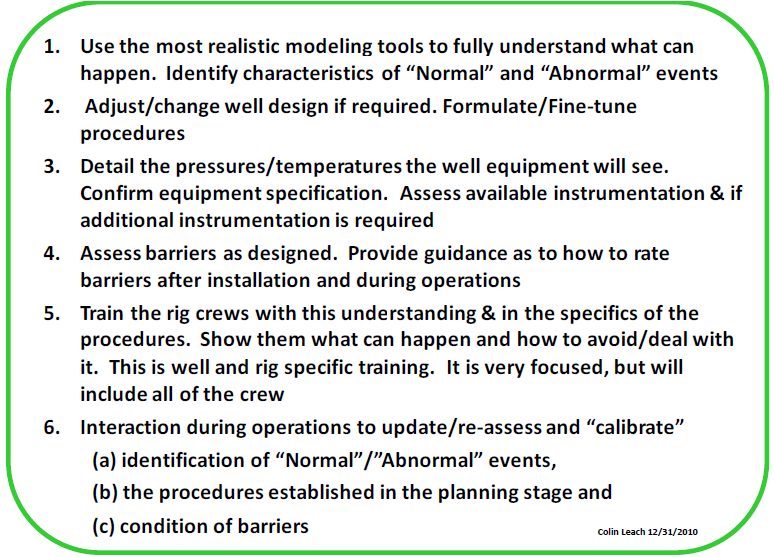
Colin Leach has provided a nice overview of the loss of well control scenarios for a deepwater well (Figure 1), and a concise, but comprehensive, summary of the critical elements of a well control program (Figure 2).   Click on either figure to enlarge.

We appreciate Colin’s continued leadership and initiative on well control issues.

Figure 1: Well Control Activities in Deep Water

Figure 2: Activities Focused on Maintaining Primary Well Control

Read Full Post »

Good article on the oil and gas industry safety institute proposal.

Read Full Post »

A colleague sent a link to a Marathon Oil Company Macondo presentation that was posted by the Houston Chronicle. The presentation was intended for internal training and discussion purposes.

Firstly, I applaud Marathon for ensuring that the blowout is studied and debated within the company. Hopefully, they did the same thing for Montara, have a good internal system for studying accidents throughout the industry, and thoroughly investigate all of Marathon’s incidents and near misses.

I thought Marathon’s comments about safety culture were particularly interesting, including these on slide 58:

Although harder to define and measure, and even more difficult to regulate, we pointed to our culture as the single most important differentiating attribute when comparing us to BP.

In a recent meeting with an individual who has numerous dealings with BP, he observed that regardless of the purpose of the gathering (planning session to morning rig call), it is almost impossible to determine who is ultimately responsible and accountable for the operation being discussed. Evidence of this exists in the very report this presentation was derived from.
I wonder what convinces Marathon that their safety culture is superior. The above anecdote, while interesting, doesn’t tell us much. Prior to Macondo (and perhaps even after the blowout), I’ll bet most BP employees thought that they had a strong safety culture. Ditto for Transocean. Does Marathon have any better evidence demonstrating the strength of their safety culture? If not, what makes them so confident? Does Marathon have a process for assessing and monitoring the attitude and commitment of their employees? Have they conducted regular internal surveys to gauge safety culture? My sense is that they have not. If they had, they could make their case without the very subjective comparison with BP.

Read Full Post »
In addition to suing for damages, the Justice Department is seeking civil penalties.  The amount has not been specified.

In the complaint, the United States alleges violations of federal safety and operational regulations, including:

  • Failure to take necessary precautions to secure the Macondo Well prior to the April 20th explosion;
  • Failure to utilize the safest drilling technology to monitor the well’s condition;
  • Failure to maintain continuous surveillance of the well; and
  • Failure to utilize and maintain equipment and materials that were available and necessary to ensure the safety and protection of personnel, property, natural resources, and the environment.

Read Full Post »

Agenda

Live Webcast

Read Full Post »

« Newer Posts - Older Posts »