Feeds:
Posts
Comments

Posts Tagged ‘drilling’

Absent live streaming or television, the Times Picayune seems to be providing the best coverage of the Coast Guard – BOEM Macondo hearings in New Orleans.  While the legal sparring has attracted the most press interest, two other items in this Times Picayune article caught my attention.

Part of Keplinger and Fleytas’ duties was to monitor indicators of gas detectors and alarms from the bridge. Keplinger was busy showing visiting BP and Transocean officials a video-game-style simulator for 45 minutes to an hour before the explosions, he said, but he insisted that Fleytas was keeping him abreast of readouts of the rig’s systems.

Comment: Just as school teachers shouldn’t have been flying in the space shuttle, “tourists” shouldn’t have been visiting a complex drilling operation when the crew was in the process of setting production casing and suspending a potentially dangerous well. While the visit was well-intended, the last thing the crew needed on that night was to be distracted by a group of corporate executives.  The distraction they caused was comparable to driving on a dangerous highway while getting text messages from your boss. Visiting windows should be limited to relatively low-risk operations (e.g. when drilling ahead prior to reaching target intervals), and these windows should immediately close if complications develop.

Keplinger flashed some anger at Capt. Curt Kuchta, captain of the Deepwater Horizon rig, during his testimony. He noted that a fellow rig worker, Chris Pleasant, had to ask Kuchta three times whether to disconnect the rig from the wellhead before he got the go-ahead.

Comment: One of the benefits of drilling from a floating and dynamically positioned rig is the ability to move off location if trouble arises.  The failure to disconnect the riser and move away from the well at the first indication of flow contributed significantly to the tragic consequences.  The technical and human factors that prevented such a disconnect must be thoroughly examined.

Further comment: The absence of live streaming of these important safety hearings is inexcusable.  If a senator or governor were testifying, I expect that the cameras would be there.
Read Full Post »

  • C-SPAN has opted not to cover this weeks BOEMRE – Coast Guard Macondo hearings.  Instead, they are presenting recordings of political rallies, assorted senatorial and gubernatorial candidate debates, and similar fare.  In other words, all three channels will be dedicated to the usual political posturing that already receives non-stop national coverage, and the investigation into one of the more significant accidents in US history will be ignored.
  • Why does it take 3 weeks to post the transcripts of these hearings? The Australians posted each Montara transcript within hours after the day’s session ended.

Read Full Post »

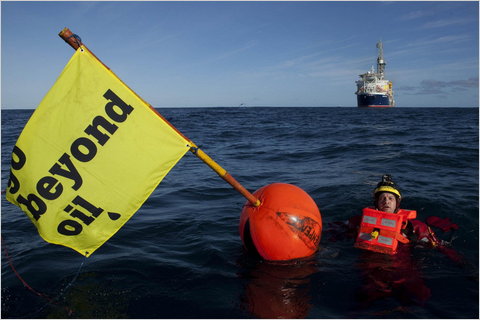
Greenpeace Photo

Despite protests, the UK has approved Chevron’s exploratory well in 1640′ of water west of the Shetland Islands.

It was a choice between producing oil and gas here in U.K. waters, where we have one of the most robust safety and regulatory regimes in the world, with all the economic benefits that will bring, or paying to import oil and gas from elsewhere. UK Department of Energy and Climate Change statement

It’s pretty hard to argue with that logic.

Read Full Post »

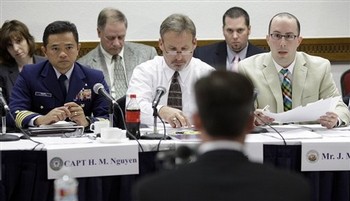
Capt. Hung Nguyen, David Dykes, and Jason Mathews question the witness. Sylvia Murphy and Kirk Malstrom monitor attentively from the 2nd row.

The panel that is most closely investigating the technical and operational aspects of the Macondo blowout reconvenes on Monday morning at 0800 CT in New Orleans.

I would assume that one of the CSpan stations will be covering the hearings, but their broadcast schedule for next week has not yet been posted.

Read Full Post »

Scarabeo 9

According to the Miami Herald an Italian rig, the Scarabeo 9, will drill the long-awaited exploratory well offshore Cuba.  The article indicates that the new-build rig is expected to arrive in Cuba late this year.

Per Oil and Gas Interntional:

The Scarabeo 9 embodies the latest technology for deepwater drilling operations and is capable of drilling in waters 3,600 meters in depth. Expectations are it will mobilize to Cuban waters during the second or third quarter of 2011 and commence drilling during the third or fourth quarter. (note: the Miami Herald article projects an earlier arrival). Repsol holds the six blocks in the Cuban sector of the Gulf of Mexico in a production-sharing agreement with Union Cubapetroleo (Cupet), the Cuban national oil company. The concession encompasses Blocks N25, N26, N27, N28, N29, and N36, a combined area of some 10,200 sq km along the island’s northwest coast. Repsol is the operator of the six blocks with 40% interest in partnership with Statoil, holding 30% and Oil and Natural Gas Corporation (ONGC) with the remaining 30%.

Read Full Post »

Today, BOEM released fact sheets describing the Drilling Safety and Safety and Environmental Management (SEMS) rules. The complete documents will be available for review as soon as they are published in the Federal Register.

Based on the fact sheet, the Drilling Safety Rule does not appear to include any significant surprises.  The rule seems to be generally consistent with the recommendations in Secretary Salazar’s 27 May Safety Measures Report to the President (the “30-Day Report”).  This is an Interim Final Rule that will be effective upon publication.

According to the fact sheet, the SEMS Rule will incorporate all elements of API RP 75 into BOEM regulations.  This is an improvement, in my opinion, from the proposed rule which incorporated only 4 elements of RP 75.  The effective date for this rule is not indicated in the fact sheet.

Read Full Post »

As previously posted (July 27, 2010), deep water had little to do with the well integrity problems and other contributing factors leading to the Macondo blowout. The Bly (BP) report further confirms this position.

Of the eight key findings in the Bly report (listed below), only number 4 could be considered to be more of a deepwater issue.  The BOP failures may also have been influenced by deepwater factors.  However, as previously noted, surface BOPs have a much higher failure rate than subsea stacks.

While the Montara blowout was in relatively shallow water, slight variations of findings 1 through 4 were the primary causes of that accident.

BP findings:

  1. The annulus cement barrier did not isolate the hydrocarbons.
  2. The shoe track barriers did not isolate the hydrocarbons.
  3. The negative-pressure test was accepted although well integrity had not been established.
  4. Influx was not recognized until hydrocarbons were in the riser.
  5. Well control response actions failed to regain control of the well.
  6. Diversion to the mud gas separator resulted in gas venting onto the rig.
  7. The fire and gas system did not prevent hydrocarbon ignition.
  8. The BOP emergency mode did not seal the well.

Read Full Post »

Secretary Salazar, Deputy Secretary Hayes, and BOEMRE Director Bromwich testified at today’s National Commission hearings. Director Bromwich made several important announcements and comments of interest to BOE readers:

  1. He has completed his public meetings and will submit his report to the Secretary by the end of the week, approximately two months ahead of schedule.  Does this point to an early end to the drilling moratorium?
  2. Two significant interim final rules will also be issued by the end of the week.  These rules will address well integrity,  BOP performance, and other issues raised in the 30-day report submitted to the President at the end of May.
  3. New drilling will not be authorized until operators and contractors can demonstrate compliance with the new rules.
  4. BOEMRE resources will be reallocated to assist with the workload associated with the resumption of drilling.

Chairman Reilly expressed concerns about the leasing and regulatory functions reporting to the same Assistant Secretary under the new organizational structure.  He also drew attention to the regulatory regimes in Norway, the UK, and elsewhere, and the importance of studying those programs.

Secretary Salazar’s goal is for the US offshore oil and gas program to serve as the “gold standard” for safe and clean operations around the world.

Read Full Post »

Monday’s hearings will be broadcast on CSpan 2 beginning at 0900 ET. Admiral Allen will be the first witness and will address decision-making within the Unified Command.  Given the number of high profile witnesses and the limited time allotted to each witness,  in-depth questioning would seem to be unlikely.  Will this be a day of short speeches?

Read Full Post »

From the Huffington Post:

Oil-producing countries on Thursday rejected a German proposal for a moratorium on deep-water drilling in the Northeast Atlantic that reflected environmental concerns after the BP Gulf of Mexico oil spill.

So Germany, which has essentially no offshore oil and gas production in its sliver of the North Sea, proposed a ban on deepwater drilling at an OSPAR meeting in Bergen, Norway?  Does the word chutzpah come to mind?  The equivalent might be a Norwegian proposal to ban the manufacturer of luxury cars at a meeting in Stuttgart!

The German proposal also called for making sure that offshore operations meet the highest safety standards and demanded an analysis of whether the circumstances that led to the Deepwater Horizon accident could also occur in the Northeast Atlantic.

Now there is some original thinking.  No one has ever suggested that before! (sarcasm intended)  Don’t you think Norway, the UK, Denmark, the Netherlands, and other countries that actually produce oil and gas might be looking into these issues?  I can assure you that they are, but that they are doing so quietly and professionally without the type of “grandstanding” demonstrated by Germany at the OSPAR meeting in Bergen.

Representatives from Germany and other nations with concerns about the safety of offshore oil and gas operations are encouraged to join us in Vancouver next month for serious discussions about the regulatory practices, technology, and management systems that minimize safety risks.

Read Full Post »

« Newer Posts - Older Posts »