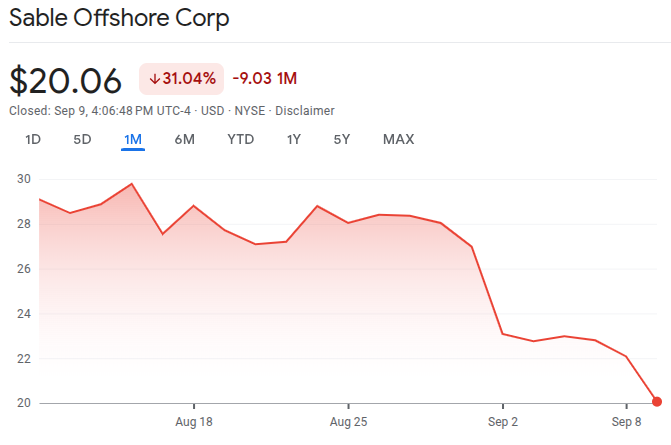
Sables’ share price sank on Tuesday following reports from Bloomberg and others that Governor Newsom is proposing new restrictions on California’s offshore oil industry. With Sable Offshore as a primary target, stricter requirements for restarting inactive intrastate oil pipelines would be imposed. •
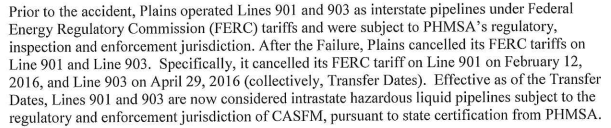
This could trigger yet another legal battle or increase the complexity of those that are ongoing. The onshore pipeline, now owned by Sable Offshore, was originally classified as an interstate pipeline under Federal jurisdiction. However, following the 2015 Refugio oil spill, it was reclassified as an intrastate pipeline via a 2016 letter of understanding signed by representatives of the Federal Office of Pipeline Safety (DOT-PHMSA) and the Office of the State Fire Marshal (pertinent text pasted below).
Given that the Sable pipeline will carry OCS production, it would seem to fundamentally be an interstate line (Federal jurisdiction), as it was when owned by Plains. Could DOT reverse the 2016 letter agreement? That is conjecture for the attorneys and courts to consider.
Meanwhile, below is an upbeat Sable video on the pipeline!
In addition to the penalty and reimbursement elements of the plea agreement, there are two Amplify commitments that may be of particular interest to BOE readers:
New leak detection system for the pipeline: More information on the leak detection improvements for this low pressure oil pipeline would be helpful.
Notification to regulators of all leak detection alarms:
Which regulators? DOT? BSEE? State? All?
Real time reporting or periodic compilations? With real time reporting for every alarm, the distinction between the pipeline operator and regulator(s) would be blurred and new organizational and competence risks would be added. The probability of communications errors and delayed decisions would increase, and the operator would no longer be accountable for bad decisions.
Also, given that the investigating agencies have still not issued their report on the October 2021 spill and no action has yet been taken against the shipping companies that caused the pipeline rupture, the congratulatory Coast Guard, EPA, FBI, and DOT quotes in the announcement seem rather premature and self-serving.
This WSJ report, if accurate, reflects the mindset that you can increase oil production on demand when absolutely necessary, and avoid committing to longer term oil and gas supplies. The goal of such thinking is to address supply crises without alienating the uncompromising climate ultras. You suspend lease sales, deny new pipelines, and demonize oil and gas and the people who produce it. When supplies tighten and prices spike, you tap the strategic reserve, appeal to OPEC, talk to Venezuela and Iran, and ask Canada to ship more oil in rail cars or trucks (but no new pipelines please!). .
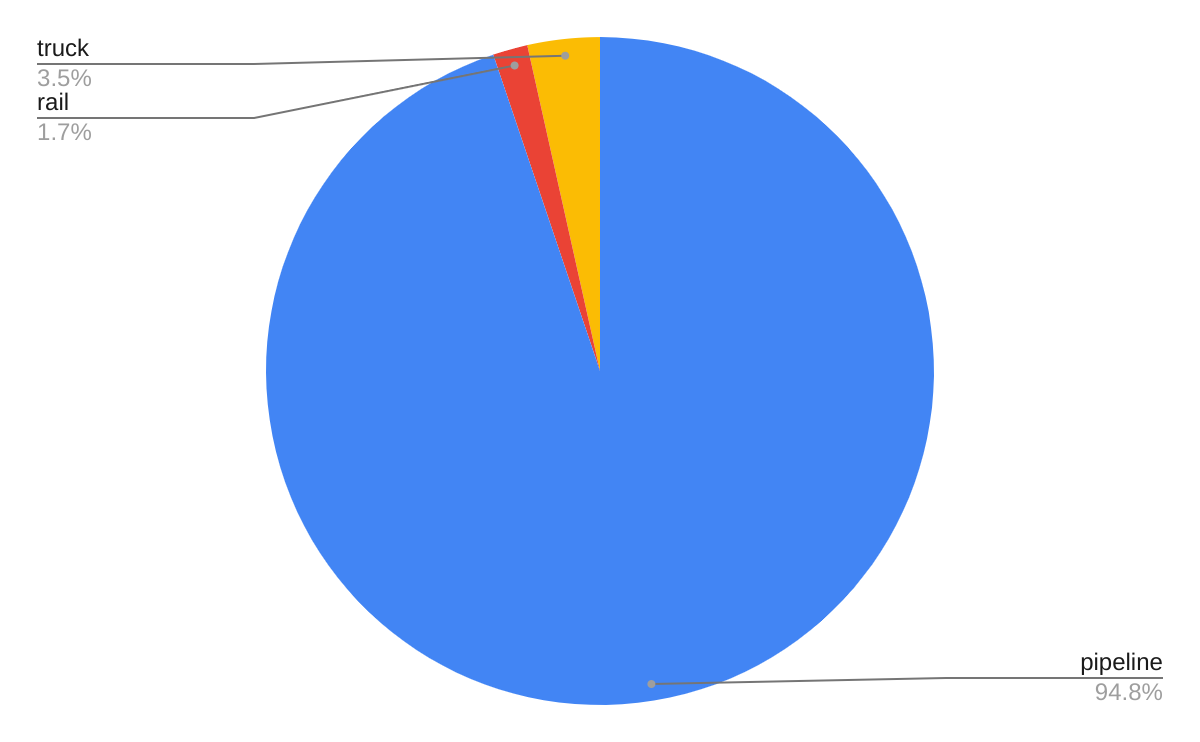
Below is a pie chart constructed using data from a 2018 DOT report to Congress. For logistical and economic reasons, pipelines are overwhelmingly the crude oil transport method of choice. Rail cars and trucks are called on where there are no pipeline options.
Looking at the systems, one would assume that pipelines have safety and environmental advantages. Loading and unloading hundreds of tanks would seem to be inviting spills, although most would presumably be small. The DOT data bear this out. On a volume transported basis, spill incidents occurred nearly 15 times more frequently for rail cars and trucks than they did for pipelines.
For pipeline(s), an incident occurred approximately once every 720 million gallons of crude oil shipped. For rail, an incident occurred approximately once every 50 million gallons of crude oil shipped. For truck(s), an incident occurred approximately once every 55 million gallons of crude oil shipped.
Looking at the percentage spilled, pipelines also had a significant (7.6 times) advantage over rail, but only a slight advantage over trucks.
Volume of Crude Oil Shipped and Spilled by Pipeline, Rail, and Truck, 2007-2016
Pipeline
volume shipped (k gal)
1,298,630,088
volume spilled (k gal)
13,161
% spilled
0.0010%
Rail
volume shipped (k gal)
23,052,960
volume spilled (k gal)
1,751
% spilled
0.0076%
Truck
volume shipped (k gal)
47,894,868
volume spilled (k gal)
521
% spilled
0.0011%
Because fatalities or hospitalizations were extremely rare, DOT chose not to normalize those data. There were a total of 3 fatalities associated with both pipeline and truck shipments. While no fatalities were associated with rail shipments, DOT noted that 47 deaths resulted from a crude oil derailment in Lac Megantic, Quebec in 2013. BOE further reminds readers that this train was transporting Bakken crude from North Dakota to a refinery in St. John, New Brunswick.
The bottom line is that you have to plan ahead to satisfy future supply needs. This is particularly true for the offshore sector where the lead times are longer, but the production volumes relative to the number of wells and facilities are higher (a good thing). The need for oil and gas is not going away, nor are threats to energy security. There are plenty of people in the U.S. Department of the Interior who understand this. Empower them to safely expedite leasing, exploration, and development!
The evidence to date indicates that the leak was detected by visual observation of the oil slick. There are some reports that the slick and associated smell were evident on Friday night (10/1). The pipeline operator Amplify issued a statement advising that they first observed an oil sheen on Saturday morning (10/2), which is when the response was initiated. Nothing in Amplify’s statement suggests that a drop in pipeline pressure or a reduction in the flow rate at the onshore terminal was observed.
So, what do the regulations require with regard to leak detection? It depends whether the pipeline is regulated by the Department of Transportation (DOT) or the Department of the Interior (DOI/BSEE). This is how DOI authority is delineated:
DOI pipelines include: (1) Producer-operated pipelines extending upstream (generally seaward) from each point on the OCS at which operating responsibility transfers from a producing operator to a transporting operator; (2) Producer-operated pipelines extending upstream (generally seaward) of the last valve (including associated safety equipment) on the last production facility on the OCS that do not connect to a transporter-operated pipeline on the OCS before crossing into State waters; (3) Producer-operated pipelines connecting production facilities on the OCS; (4) Transporter-operated pipelines that DOI and DOT have agreed are to be regulated as DOI pipelines; and (5) All OCS pipelines not subject to regulation under 49 CFR parts 192 and 195.
Unless provision (4) applies, the Elly to shore pipeline is either a producer or transporter-operated pipeline (depending on how the Amplify’s San Pedro Bay Pipeline Co. is classified) that falls under DOT jurisdiction. DOT leak detection requirements (49 CFR 195.134) are new as of 10/1/2019 and do not take effect until 10/1/2024. Unless DOI or similar leak detection requirements are being applied (by agreement, condition of approval, or some other administrative means), there are no such requirements for this pipeline.
Assuming the protection specified below for DOI pipelines is being required, why wasn’t the leak detected and production shut-in. This will be determined during the investigation, but the most probable explanation is that the pressure sensor was set too low, perhaps because the pipeline’s operating range is broad. With regard to a volumetric comparison system (250.1004 (5)), I don’t get the sense that such a capability was in place. If it was, the operator should be able to provide a good estimate of the amount of oil that was spilled (i.e. Elly output – onshore input – any oil recovered from the line after the leak was detected).
§ 250.1004 Safety equipment requirements for DOI pipelines.
(3) Departing pipelines receiving production from production facilities shall be protected by high- and low-pressure sensors (PSHL) to directly or indirectly shut in all production facilities. The PSHL shall be set not to exceed 15 percent above and below the normal operating pressure range. However, high pilots shall not be set above the pipeline’s MAOP.
(5) The Regional Supervisor may require that oil pipelines be equipped with a metering system to provide a continuous volumetric comparison between the input to the line at the structure(s) and the deliveries onshore. The system shall include an alarm system and shall be of adequate sensitivity to detect variations between input and discharge volumes. In lieu of the foregoing, a system capable of detecting leaks in the pipeline may be substituted with the approval of the Regional Supervisor.
One would hope that this major spill will lead to an independent review of the regulatory regime for offshore pipelines. Consideration should be given to designating a single regulator that is responsible and accountable for offshore pipeline safety (a joint authority approach might also merit consideration) and developing a single set of clear and consistent regulations.
 Bud's Offshore Energy (BOE)