Noble’s acquisition of Diamond Offshore will unite two safety management pioneers and long-time offshore safety leaders. The press release stresses the importance of their “culture commonality around safety, operational excellence and service posture,” and their “shared commitment to these foundational principles is expected to be a driving force toward a successful and seamless integration.” While such statements are common in corporate merger announcements, Noble and Diamond “walked-the-walk” for decades, so their statement is more than corporate lip service.
The active rig count in the GoM in 2001 was 148 (AL-4, LA-119, TX-25), which is >8 times the current Baker Hughes rig count of 18. The 2001 rig count was not a one year blip; the number of rigs active in the GoM exceeded 100 for the ten year period from 1994-2003.
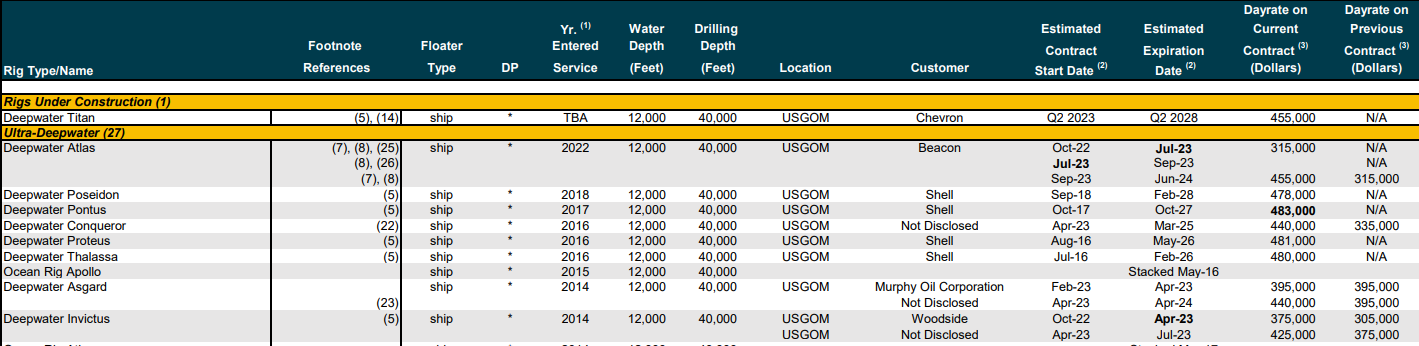
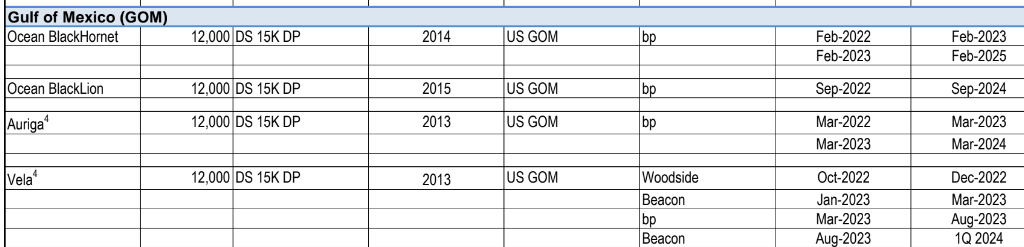
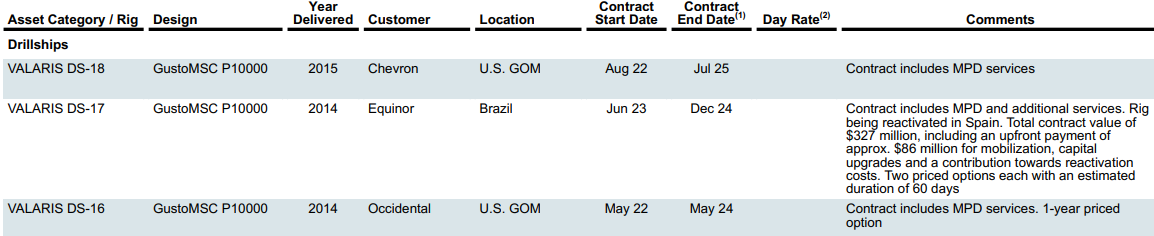
While the current rig count is anemic by comparison, the capabilities of the fleet are anything but. Below is a list derived from drilling contractor status reports of deepwater rigs now operating in the Gulf.
All of these rigs are dynamically positioned and are capable of drilling in 12,000′ of water. They have dual derricks and 15,000 psi rated BOP rams (one has a 20,000 psi stack, and another can be upgraded to 20,000 psi). The annular preventers are rated at 10,000 psi. All have impressive storage and hook load capacities, the latest tubular handling equipment, advanced control systems, and efficient power generation.
Note that most of the rigs fly the flag of the Marshall Islands. This “flag of convenience” registration is preferred for reasons related to taxation and operational freedom. For the record, the fact that the Deepwater Horizon was registered in the Marshall Islands had little to do with the Macondo blowout. The DWH was subject to all Coast Guard and MMS regulations under the OCS Lands Act.
The main cause of the Macondo blowout was the poorly planned and executed well suspension operation. Certain equipment capability, maintenance, and employee training issues were contributing factors. However, with that said, the Marshall Islands report on the blowout candidly acknowledges that “the complexity of and interdependence between the drilling and marine systems and personnel suggests a need for increased communication and coordination between the flag State and coastal State drilling regulators.” Hopefully, that coordination is being achieved and the risks associated with the fragmented regulationof mobile drilling units are being effectively managed.
Contractor
Rig
Operator
Est. end date
Flag
Transocean
Deepwater Titan
Chevron
3/2028
Marshall Islands
Transocean
Deepwater Atlas
Beacon
4/2025
Marshall Islands
Transocean
Deepwater Poseidon
Shell
4/2028
Marshall Islands
Transocean
Deepwater Pontus
Shell
10/2027
Marshall Islands
Transocean
Deepwater Conqueror
Chevron
3/2025
Marshall Islands
Transocean
Deepwater Proteus
Shell
5/2026
Marshall Islands
Transocean
Deepwater Thalassa
Shell
2/2026
Marshall Islands
Transocean
Deepwater Asgard
Hess
4/2024
Marshall Islands
Stena
Evolution
Shell
4/2029
Marshall Islands
Noble
Stanley Lafosse
???
11/2024
Liberia
Noble
Valiant
LLOG
2/2025
Marshall Islands
Noble
Globetrotter I
Shell
5/2024
Liberia
Noble
Globetrotter II
Shell
5/2024
Liberia
Valaris
DS-18
Chevron
8/2025
Marshall Islands
Valaris
DS-16
Oxy
6/2026
Marshall Islands
Diamond Offshore
BlackHawk
Oxy
10/2024
Marshall Islands
Diamond Offshore
BlackHornet
bp
3/2027
Marshall Islands
Diamond Offshore
BlackLion
bp
9/2026
Marshall Islands
Short video about the Stena Evolution, the newest entry to the Gulf of Mexico fleet:
Based on drilling contractor rig activity reports, the table below lists 19 deepwater MODUs under or soon to begin contracts in the GoM. (Further details are pasted at the end of this post.) Per the Valeris report, platform rigs are operating on bp’s Thunder Horse and Mad Dog platforms. Per the BSEE borehole file, Arena and Cantium continue to drill development wells on the GoM shelf.






 Bud's Offshore Energy (BOE)