Feeds:
Posts
Comments

Posts Tagged ‘Deepwater Horizon’

This week I’ll be posting background information, new details, and personal opinions about the April 20, 2010 Macondo tragedy. As a prelude, I wanted to share this touching tribute to the 11 men who died on the Deepwater Horizon. These American heroes gave their lives exploring for energy to power our economy. The video is introduced by singer Trace Atkins, a former Gulf of Mexico rig worker.

Read Full Post »

Phil Rae piece in Fuel Fix

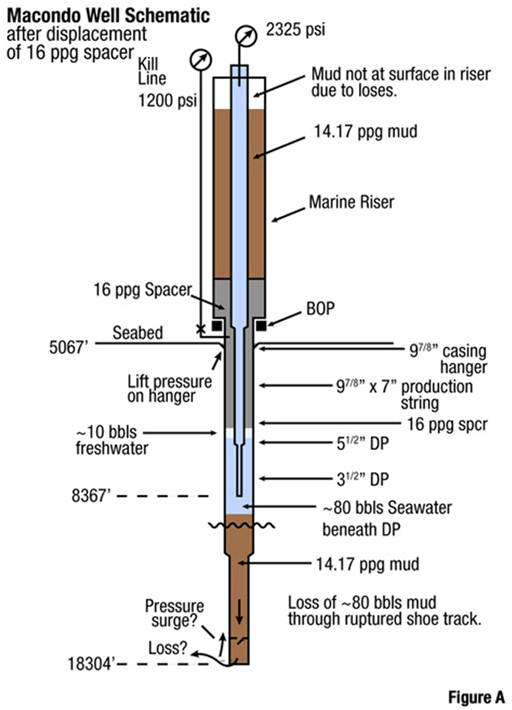
  1. The well clearly had losses through the shoe during the initial displacement of the heavy spacer with seawater, immediately prior to the negative test.
  2. Allowing for, and accepting, losses of ~80 bbls during spacer displacement, explains ALL pressure and flow anomalies without the need to create or invoke undocumented and unsubstantiated valve closures or manipulations that contradict witness testimony of events. It also eliminates the need to adopt unrealistically-low pump efficiencies for the rig pumps, hypothetical washed-out tubing and ridiculously high viscosities for the drilling mud, in an effort to fit questionable computer models.
  3. Despite extensive examination by investigators and the publication of several reports, the fact that the well experienced losses, making it even more severely underbalanced than was planned, has been given little credence or has received little or no attention, despite several clear indications that this was the case. While this statement regarding losses may be self-evident, its significance on the outcome at Macondo merits closer examination since it explains many previous, apparently-contradictory aspects of the disaster.
  4. Under-displacement of heavyweight spacer, as a result of losses during displacement, caused U-tubing and partial evacuation of the kill line, the lower end of which was later refilled with heavyweight spacer, driven by pressure and flow from the formation. The vacuum, initially, and subsequent invasion of heavy fluid rendered the kill line useless for monitoring the well since the line was effectively blind to pressure changes in the well.
  5. While initial flow into the well was through the shoe, pressure above the casing hanger seal during the negative test was reduced to levels that could have allowed the casing to lift, compromising the seal and possibly also allowing flow from the external annulus.
  6. The well encountered further losses during the second displacement (to displace the riser), after completion of the negative test. These losses, which were perhaps as much as 200 bbls, effectively replaced heavy mud with sea water in the casing below the drill pipe. This further underbalanced the well to the point that it was being kept under control only by pumping friction pressure. As the pump rate was reduced prior to shut down for the sheen test, effectively reducing system backpressure, the now severely underbalanced well began to flow.

Read Full Post »


oil-eating bacteria

Woods Hole Oceanographic Institute scientists have published important new findings on the rapid bacterial degradation of the Macondo spill.

They found that bacterial microbes inside the slick degraded the oil at a rate five times faster than microbes outside the slick—accounting in large part for the disappearance of the slick some three weeks after Deepwater Horizon’s Macondo well was shut off.


Read Full Post »

Dauphin Island tarballs, May 2011

Cheryl’s update after reviewing the latest reports:

  • There is a USCG unified command specific to BP spill residue after storms.
  • The tarballs are not considered toxic, just an unattractive nuisance.
  • Tarball cleanup on Dauphin Island was halted on May 1 to protect nesting birds.
  • BP estimates a total Macondo spill volume of about 4 million bbl as opposed to the government estimate of 4.9 million bbl.
  • BP estimates that 850,000 barrels were captured, burned or skimmed off the water.
  • 1,260 people remain employed in spill cleanup as of [July 14, 2011], down from a peak of 48,200 a year ago

Articles of interest:

Alabama.com

WALA New Orleans

Bloomberg Business Week 

Read Full Post »

Very interesting findings for those interested in the fate of spilled oil:

The deep sea entrainment of water-soluble hydrocarbons has far-reaching implications for deep water oil spills. Our results demonstrate that most of the C1-C3 hydrocarbons and a significant fraction of water-soluble aromatic compounds were retained in the deep water column, whereas relatively insoluble petroleum components were predominantly transported to the sea surface or deposited on the seafloor, although the relative proportions are not known.

The resulting apportionments of hydrocarbon transfers to the water column and atmosphere are therefore very different for a deep water oil spill versus a sea-surface oil spill. During seasurface oil spills, highly water-soluble components such as BTEX, C3-benzenes, and naphthalene quickly volatilize and are rapidly lost to the atmosphere within hours to days, thereby limiting the extent of aqueous dissolution into the water column. In the case of the Deepwater Horizon oil spill, however, gas and oil experienced a significant residence time in the water column with no opportunity for the release of volatile species to the atmosphere. Hence, water-soluble petroleum compounds dissolved into the water column to a much greater extent than is typically observed for surface spills.

Read Full Post »

Links

Animation of Transocean’s BOP analysis

Transocean’s BOP Defense:

Forensic evidence from independent post-incident testing by Det Norske Veritas (DNV) and evaluation by the Transocean investigation team confirm that the Deepwater Horizon BOP was properly maintained and did operate as designed. However, it was overcome by conditions created by the extreme dynamic flow, the force of which pushed the drill pipe upward, washed or eroded the drill pipe and other rubber and metal elements, and forced the drill pipe to bow within the BOP. This prevented the BOP from completely shearing the drill pipe and sealing the well.

In other words, Transocean contends that properly maintained BOPE was not up to the task of shutting-in and securing a high-rate well. If true, this finding has significant implications for the offshore industry.  I’m looking forward to reading the government’s findings on the BOP failure when the Joint Investigation Team report is issued next month.


Read Full Post »

BP settled Macondo litigation with Weatherford, manufacturer of the float equipment equipment used in the Macondo well. The failure of this equipment was a key contributing factor in the Macondo blowout. Under the agreement, Weatherford will pay BP $75 million.  This money will be applied to the $20 billion Macondo trust fund.

Weatherford is the first of BP’s contractors to formally agree with BP that the entire industry can and should learn from the Deepwater Horizon incident. Accordingly, Weatherford has committed to working with BP to take actions to improve processes and procedures, managerial systems, and safety and best practices in offshore drilling operations. BP and Weatherford will encourage other companies in the drilling industry to join them in this improvement and reform effort.

Comments:

  1. $75 million seems like a rather modest payment by Weatherford given the magnitude of Macondo damage costs. BP will “indemnify Weatherford for compensatory claims resulting from the accident.”  Presumably, Weatherford’s sales agreements provide good legal protection.
  2. One of the root causes of the Montara blowout was also a float collar failure. That float collar was also supplied by Weatherford.  I’m surprised that this common cause and supplier have received almost no attention. Of course, no one has paid much attention to Montara, either before or after Macondo. Had more attention been paid to the Montara inquiry, Macondo might have been avoided.  (Note that most of the post-Macondo commentary still implies that deep water is the threat even though Montara was in 80 m of water and the root causes of Macondo were not water depth related).
  3. When do we learn more about the “improvement and reform effort” described in the quote above?

Read Full Post »

Because of recent involvement with products and systems that have Safety Integrity Level (SIL) ratings, I read the comment (below) in the PSA Deepwater Horizon review with interest. While administrative and effectiveness issues must be carefully assessed, the application of SIL should be part of the BOP performance dialogue.  SIL ratings may also be appropriate for entire well control or well integrity systems.

Today’s requirements stipulate a risk analysis for the control system of a drilling BOP, with specified minimum requirements for its safety integrity level (SIL). As a result of the DwH incident and of the fact that blowouts are not confined to drilling operations, the question is whether such an analysis, with a specified minimum SIL level, should also apply to all types of BOPs, including well-intervention models. In addition, consideration should be given in this context to whether other control and management systems related to well integrity/control exist which should be subject to such requirements.

Read Full Post »

In their comments on the Coast Guard’s Deepwater Horizon Joint Investigation Team Report, Transocean made these statements about BOP maintenance standards incorporated in MMS drilling regulations:

By glossing over the contours of the regulatory language, the Draft Report unilaterally converts API Recommended Practice 53 from an advisory guideline into a mandatory requirement. Notwithstanding the Draft Report’s insistence otherwise, the API’s recommendation that the BOP “should” be disassembled and inspected according to the manufacturer’s guidelines is not mandatory. The API clarifies that the word “should” indicates a recommended practice for which a comparably safe alternative is available or which may be impractical or unnecessary in some conditions. In contrast, to denote a recommended practice that is “advisable in all circumstances,” the API uses the word “shall.” The API also emphasizes that “the formulation and publication of API standards is not intended in any way to inhibit anyone from using any other practices.” Though it recommends specific practices, API acknowledges that “equivalent alternative installations and practices may be utilized to accomplish the same objectives.” On its face, the language of API RP 53 makes clear that the recommendation that the BOP “should” be disassembled and inspected in accordance with the manufacturer’s guidelines is a recommendation, and nothing more.

Although the MMS regulations governing BOP maintenance incorporate API RP 53 sections 17.10 and 18.10 by reference, this does not convert the API’s recommendations into a mandatory requirement. As the MMS has clarified, “[t]he legal effect of incorporation by reference” is merely that “the material is treated as if it were published in the Federal Register.”

Treating API RP 53 as if it had been published in the Federal Register does not imbue its language with more regulatory significance than it had before. The API’s recommendations regarding BOP maintenance—as well as the API’s acknowledgement that alternative practices “may be utilized to accomplish the same objectives”—remain recommendations, not requirements.  Transocean’s complete comments are posted on their website.

I’ll withhold my comments on the above statements, except to say that my opinion differs substantially from Transocean’s.

More significantly, these and other recent industry and government comments demonstrate the complexity of standards policy issues. How are standards most effectively applied by operators in formulating safety management programs, operating plans, and safety cases? Contractors? How should deviations from standards be assessed and documented? How should regulators use standards? To what extent should standards be incorporated into regulations? What is the appropriate role for regulators in standards development? These issues may prove to be more challenging than updating technical requirements. Stay tuned!

Read Full Post »

From the standpoint of post-Macondo safety and regulatory issues, this concise summary is the most comprehensive and useful report that I have read since the blowout.

I have pasted (below) comments about information management – one of the many important topics considered in the report – and hope you take time to read the entire summary. It is only 12 pages.

Conducting a critical review of the information used to manage major accident risk is one of the measures relevant for the companies. This work could include an assessment of
 the relevance, reliability and modernity of the indicators used to follow up risk trends
 inappropriate use of indicators, incentives and reward systems
 the need for better indicators and other information about the business which can be used to secure an early warning about a weakening in safety-critical barrier elements.
The PSA is of the opinion that the quality of information applied in managing major accident risk is also a question of what overview the players have of their own business, and thereby a question of the players’ own control. The PSA assumes that managing major accident risk cannot be outsourced. In light of the DwH accident, it could be relevant for the companies to review the processes intended to provide the necessary information about the business, assess in part how these processes support a culture of accountability and how various management and audit functions, third-party verifications and so forth contribute in this connection.


Read Full Post »

« Newer Posts - Older Posts »