Feeds:
Posts
Comments

Posts Tagged ‘civil penalties’

LM/GE Vernova turbine blade plant. Photo credited by the New Bedford Light to Jean-Philippe Thibault/Journal Gaspésie Nouvelles.

On Oct. 24, Radio Gaspesie reported serious data falsification allegations related to the manufacturing GE Vernova turbine blades at their Gaspé, Quebec facility. GE Vernova’s delay in commenting on those charges is surprising given their economic and legal implications in both Canada and the US.

GE Vernova has informed the New Bedford Light that they have taken corrective actions at their blade facility in Gaspé after an extensive internal review of their blade manufacturing and quality assurance program. However, they have yet to comment on the data falsification allegations.

Actions speak louder than words, and the Light reports that GE Vernova laid off nine managers and suspended 11 unionized floor workers at the Gaspé factory. A representative for the union informed the Light that the production manager has been dismissed and the general manager has resigned.

Neither Vineyard Wind nor BSEE, the Federal safety regulator for the Vineyard Wind project, has commented on the matter. BSEE’s investigation of the blade failure is still pending and has seemingly gotten more complicated as a result of the manufacturing issues.

In addition to legal proceedings in Quebec, GE Vernova and Vineyard Wind are subject to possible civil and criminal penalties in the US. Civil penalties, which are administered by BSEE, seem likely given the extensive pollution from turbine blade fragments.

Criminal penalties, which are possible if the data falsification charges are proven true, are imposed by the Dept. of Justice. The applicable criminal penalties statute is pasted below.

43 U.S. Code § 1350 – Remedies and penalties – (c) Criminal penalties

Any person who knowingly and willfully (1) violates any provision of this subchapter, any term of a lease, license, or permit issued pursuant to this subchapter, or any regulation or order issued under the authority of this subchapter designed to protect health, safety, or the environment or conserve natural resources, (2) makes any false statement, representation, or certification in any application, record, report, or other document filed or required to be maintained under this subchapter, (3) falsifies, tampers with, or renders inaccurate any monitoring device or method of record required to be maintained under this subchapter, or (4) reveals any data or information required to be kept confidential by this subchapter shall, upon conviction, be punished by a fine of not more than $100,000, or by imprisonment for not more than ten years, or both. Each day that a violation under clause (1) of this subsection continues, or each day that any monitoring device or data recorder remains inoperative or inaccurate because of any activity described in clause (3) of this subsection, shall constitute a separate violation.
Read Full Post »

Kosmos Energy announces deepwater GoM discovery. Oxy and Equinor are partners in this venture.

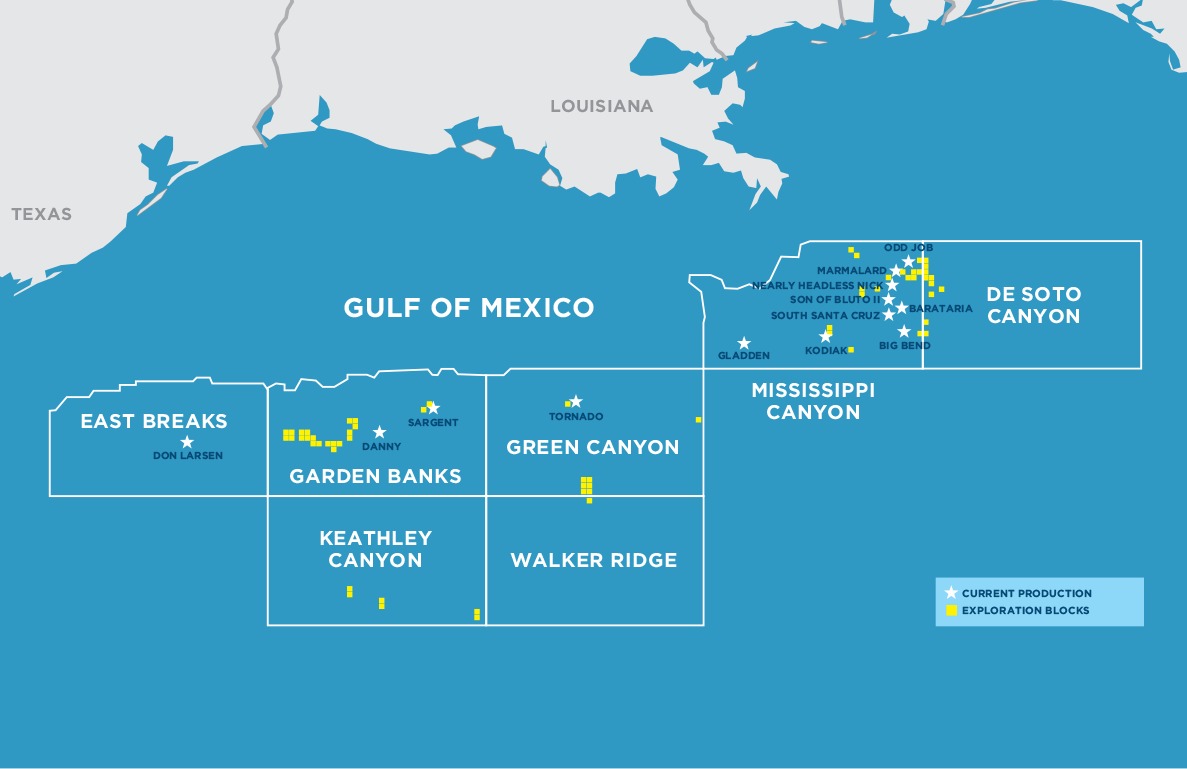
The Tiberius exploration well tested a four-way structural trap in the outboard Wilcox trend, located in Keathley Canyon Block 964. The well encountered approximately 250 feet (~75 meters) of net oil pay in the primary Wilcox target. Wireline logging has been completed and casing is currently being run to the target depth to enable the well to be used as a future oil producer. The Tiberius well is located in approximately 7,500 feet (2,300 meters) of water and was drilled to a total vertical depth of approximately 25,800 feet (7,800 meters).

BSEE data indicate that Kosmos has an excellent compliance record, having been cited for only 3 violations during 44 facility inspections (83 inspection types) since 1/1/2018.

Per the latest available BSEE summaries, Kosmos did not pay any civil penalties from 2019 through 2022.

One quibble: the Kosmos news release does not name the drilling unit or drilling contractor. The rig crew is the group most responsible for safely drilling the well.

Read Full Post »

Impressively, 4 GoM operators with significant production and well activity did not incur a single civil penalty payment during the most recent 4 year period. Each of these operators also had low incident of noncompliance (INC) to inspection ratios. The companies are as follows:

Operator2022 oil production (million bbls) 2022 oil production rank2022 gas production (bcf)No. of platformsNo. of well starts (2019-2022)
Hess21.6746.535
Kosmos8.5147.8subsea tiebacks 6
Beacon7.21512.2subsea tiebacks4
Cantium4.7196.18637
  • All of these companies deserve kudos.
  • Cantium’s record is especially impressive given that most of their platforms were installed more than 40 years ago and some date back to the 1950s. They have also been a very active development well driller.
  • Hess is the 7th biggest oil producer and 5th biggest gas producer in the GoM. Hess CEO John Hess made some encouraging comments (pasted below) about the deepwater GoM at a recent energy conference.
  • While Kosmos and Beacon have somewhat lower violation and penalty exposure because their production is via subsea wells tied back to surface facilities operated by other companies, they are demonstrating that entrepreneurial deepwater independents can also be safety leaders.

“The Pickerel-1 prospect was our first (exploration well on the Mississippi Canyon 727) and we are delighted that it was an oil discovery. Black Pearl will be the next and that will hopefully be a tieback (to Tubular Bells with first oil expected mid-2024).

“Then we have a wildcat opportunity (the Vancouver exploration prospect) later in the year in the Green Canyon. With the other 80 exploratory blocks that we have in the Gulf, we will be actively drilling for the next several years,” Hess said.

OilNow

Read Full Post »

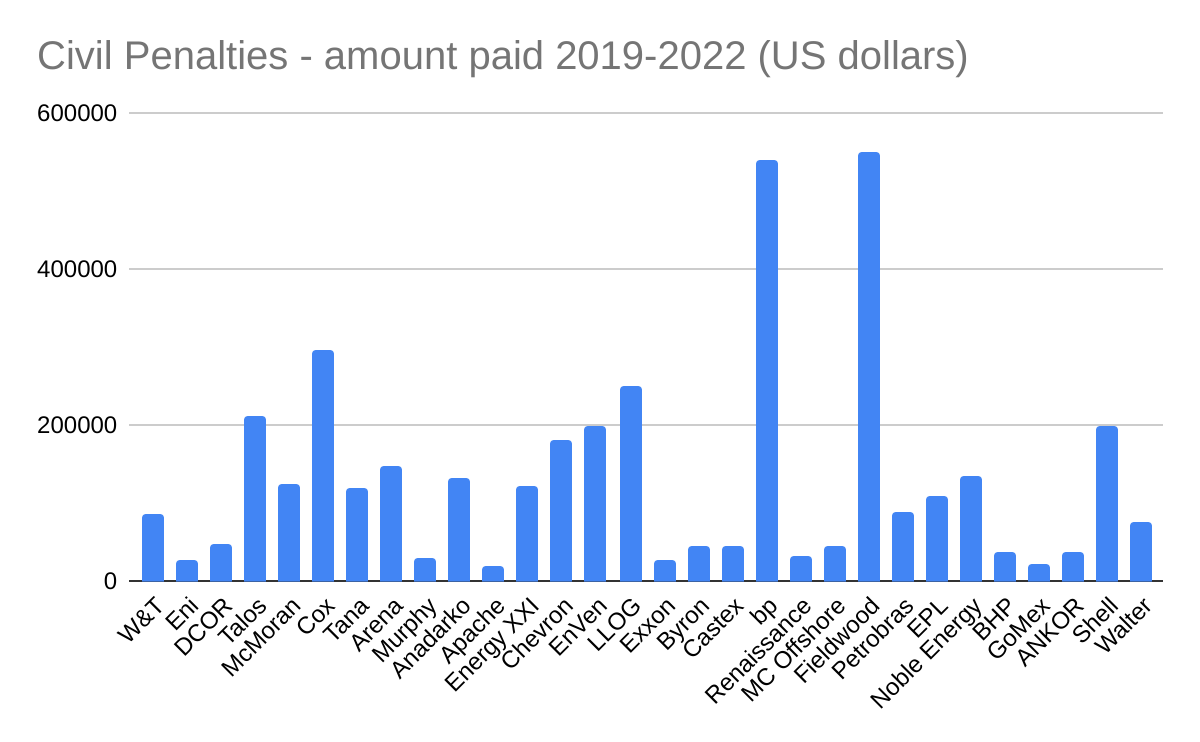
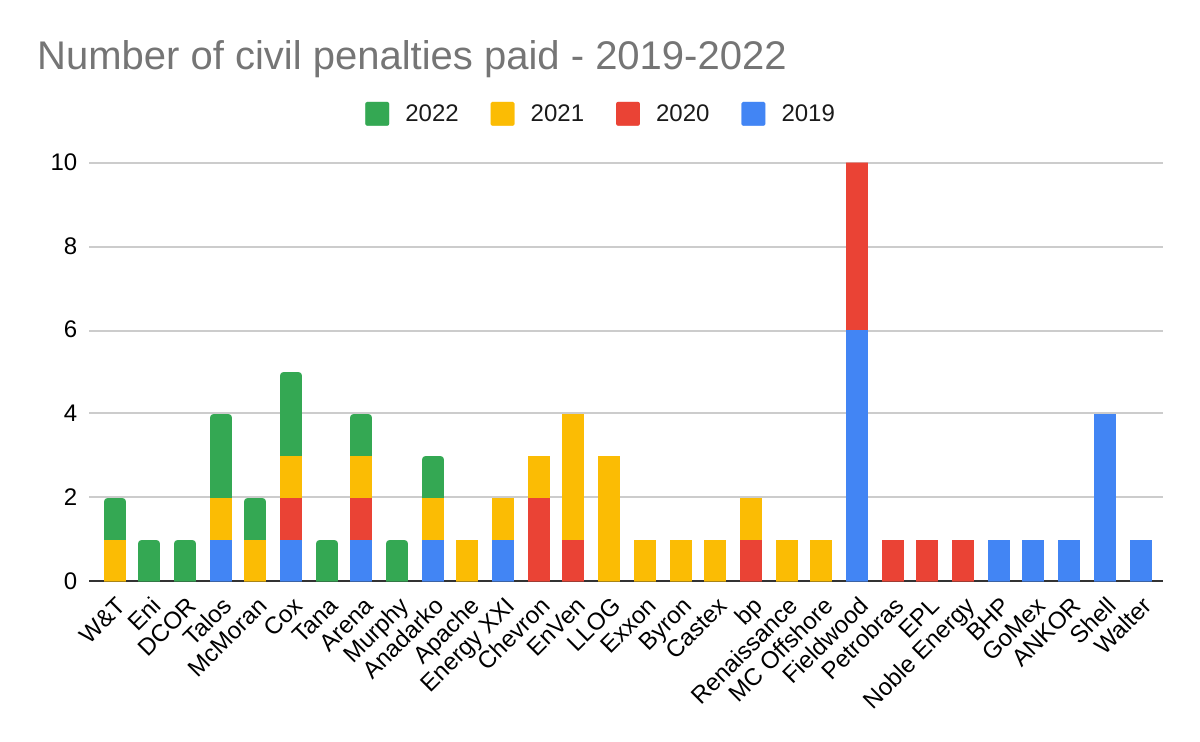
  • Per the previous civil penalties post
  • Data are on a fiscal year basis (i.e. 2022 started on 10/1/2021 and ended on 9/30/2022)
  • These data are only for civil penalties paid in that year. Data for civil penalties referrals are not publicly available.
  • Nothing terribly surprising in the data. Fieldwood’s issues have been discussed at length.
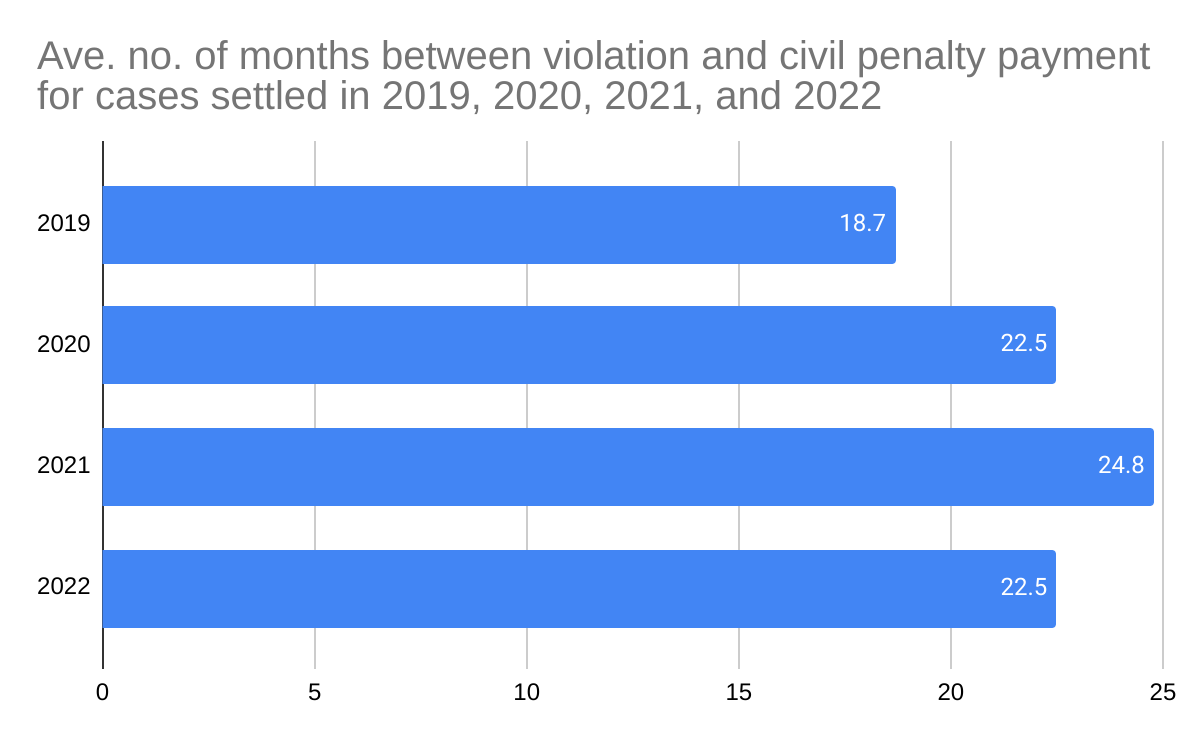
  • Note (last chart) the lag between the date violations were observed and the date penalties were paid. This lag is significant but understandable given due process considerations.
  • Fastest payment: 6 months by Shell for an open hole that was not properly barricaded ($26,750 penalty, 2018).
  • Slowest payment: 54 months by LLOG for failing to install and maintain equipment properly (three 2016 violations)
  • Largest civil penalty paid: $512,900 by bp for a high-pressure gas release caused by the use of improper seals (May 8, 2018 violation).
  • Smallest civil penalty paid: $16,300 by Arena for the release of 1000 psi gas on October 16, 2018
  • The current maximum penalty amount is $52,646 per day, per violation.
  • To learn more about the specific cases.

Read Full Post »

The civil penalties provision in the 1978 OCS Lands Act (OCSLA) Amendments was flawed in that it stipulated that operators must be given time to take corrective action before a civil penalty could be assessed. The “time to take corrective action” requirement was confirmed by a 1983 Federal Court decision in Louisiana:

The Court agrees with Chevron’s construction of Section 24(b) and holds that civil penalties may only be imposed under Section 24(b) for violations which continue after the violator has been notified of the breach and has failed to correct it within a reasonable period allowed. This conclusion is based primarily upon a careful review of the pertinent statute. The first sentence sets forth the conditions of liability:

If any person fails to comply with any [provision of the Act] after notice of such failure and expiration of any reasonable period allowed for corrective action, such person shall be liable for a civil penalty of not more than $10,000 for each day of the continuance of such failure.

The court decision gutted the Minerals Management Service (MMS) civil penalties program. Civil penalties could no longer be assessed until the operators had been given time to correct their violations, even those that endangered workers and the environment.

Ironically, Congressman George Miller (D-CA), an ardent opponent of the offshore oil and gas program, proved to be an important MMS ally by adding language to the Oil Pollution Act of 1990 that amended the OCSLA civil penalties provision. The first draft of that language expanded the civil penalties authority to include violations that may constitute a threat of serious, irreparable, or immediate harm or damage to life, property, or the environment.

We were able to revise that draft by adding the words “or constituted” after “constitute” to cover situations where the threat was no longer present. For example, if an inspector found that a well had been drilled without required elements of the well control system in place, the threat may no longer be present at the time the violation was detected but it certainly was when the well was drilled.

The revived MMS civil penalties program was fair and effective, and BSEE seems to be administering the program in a similar manner. Civil penalties data for the past 4 years will be posted next week.

Congressman George Miller (CA)

Read Full Post »